GROUP C5
SUPERVISOR: DR YAHIYA
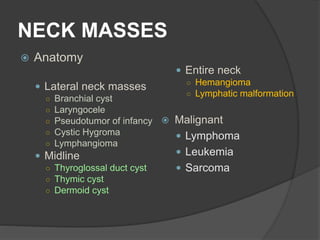
NECK MASSES
 Anatomy
 Lateral neck masses
○ Branchial cyst
○ Laryngocele
○ Pseudotumor of infancy
○ Cystic Hygroma
○ Lymphangioma
 Midline
○ Thyroglossal duct cyst
○ Thymic cyst
○ Dermoid cyst
 Entire neck
○ Hemangioma
○ Lymphatic malformation
 Malignant
 Lymphoma
 Leukemia
 Sarcoma
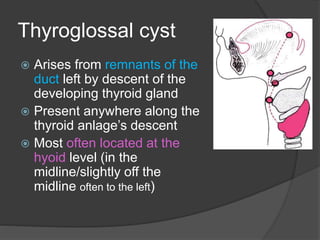
Thyroglossal cyst
 Arises from remnants of the
duct left by descent of the
developing thyroid gland
 Present anywhere along the
thyroid anlage’s descent
 Most often located at the
hyoid level (in the
midline/slightly off the
midline often to the left)
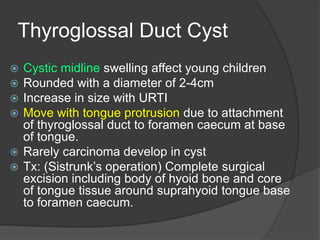
Thyroglossal Duct Cyst
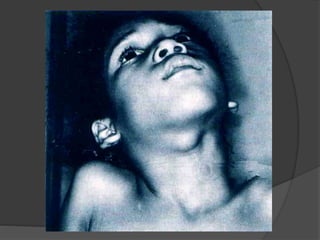
 Cystic midline swelling affect young children
 Rounded with a diameter of 2-4cm
 Increase in size with URTI
 Move with tongue protrusion due to attachment
of thyroglossal duct to foramen caecum at base
of tongue.
 Rarely carcinoma develop in cyst
 Tx: (Sistrunk’s operation) Complete surgical
excision including body of hyoid bone and core
of tongue tissue around suprahyoid tongue base
to foramen caecum.
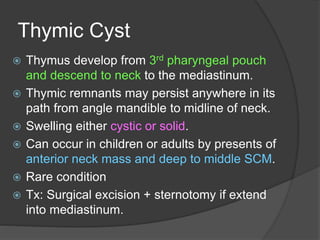
Thymic Cyst
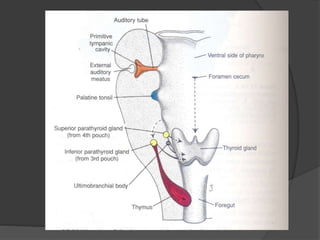
 Thymus develop from 3rd pharyngeal pouch
and descend to neck to the mediastinum.
 Thymic remnants may persist anywhere in its
path from angle mandible to midline of neck.
 Swelling either cystic or solid.
 Can occur in children or adults by presents of
anterior neck mass and deep to middle SCM.
 Rare condition
 Tx: Surgical excision + sternotomy if extend
into mediastinum.
Sublingual Dermoid Cyst
 Midline submental swelling but does
NOT move on protrusion of tongue.
 Can be arises from floor of mouth and
need to be diffrentiated with ranula.
 Tx: Surgical excision

Neck masses in paediatrics

  • 1.
  • 2.
    NECK MASSES  Anatomy Lateral neck masses ○ Branchial cyst ○ Laryngocele ○ Pseudotumor of infancy ○ Cystic Hygroma ○ Lymphangioma  Midline ○ Thyroglossal duct cyst ○ Thymic cyst ○ Dermoid cyst  Entire neck ○ Hemangioma ○ Lymphatic malformation  Malignant  Lymphoma  Leukemia  Sarcoma
  • 3.
    Thyroglossal cyst  Arisesfrom remnants of the duct left by descent of the developing thyroid gland  Present anywhere along the thyroid anlage’s descent  Most often located at the hyoid level (in the midline/slightly off the midline often to the left)
  • 4.
    Thyroglossal Duct Cyst Cystic midline swelling affect young children  Rounded with a diameter of 2-4cm  Increase in size with URTI  Move with tongue protrusion due to attachment of thyroglossal duct to foramen caecum at base of tongue.  Rarely carcinoma develop in cyst  Tx: (Sistrunk’s operation) Complete surgical excision including body of hyoid bone and core of tongue tissue around suprahyoid tongue base to foramen caecum.
  • 6.
    Thymic Cyst  Thymusdevelop from 3rd pharyngeal pouch and descend to neck to the mediastinum.  Thymic remnants may persist anywhere in its path from angle mandible to midline of neck.  Swelling either cystic or solid.  Can occur in children or adults by presents of anterior neck mass and deep to middle SCM.  Rare condition  Tx: Surgical excision + sternotomy if extend into mediastinum.
  • 8.
    Sublingual Dermoid Cyst Midline submental swelling but does NOT move on protrusion of tongue.  Can be arises from floor of mouth and need to be diffrentiated with ranula.  Tx: Surgical excision