Neonatal Cardiac Emergencies
Dr Neeraj Aggarwal
Consultant Pediatric Cardiology
Department of Pediatric Cardiac Sciences
Sir Ganga Ram Hospital
Neonatal Presentations
1. Cyanosis
2. Shock
3. CHF
4. Arrhythmias
• Septicemia, respiratory disorders, persistent
pulmonary hypertension of newborn
(PPHN),inborn errors of metabolism and so
on
Case 1
• Asymptomatic neonate was discharged on breast
feeds
• Suddenly presents at 3 days of life with bluish
discoloration
• Sats 70,mild tachypnoea and minimal distress
• soft ESM
• No response to oxygen
• Ventilation –mild increase in saturations (75%)
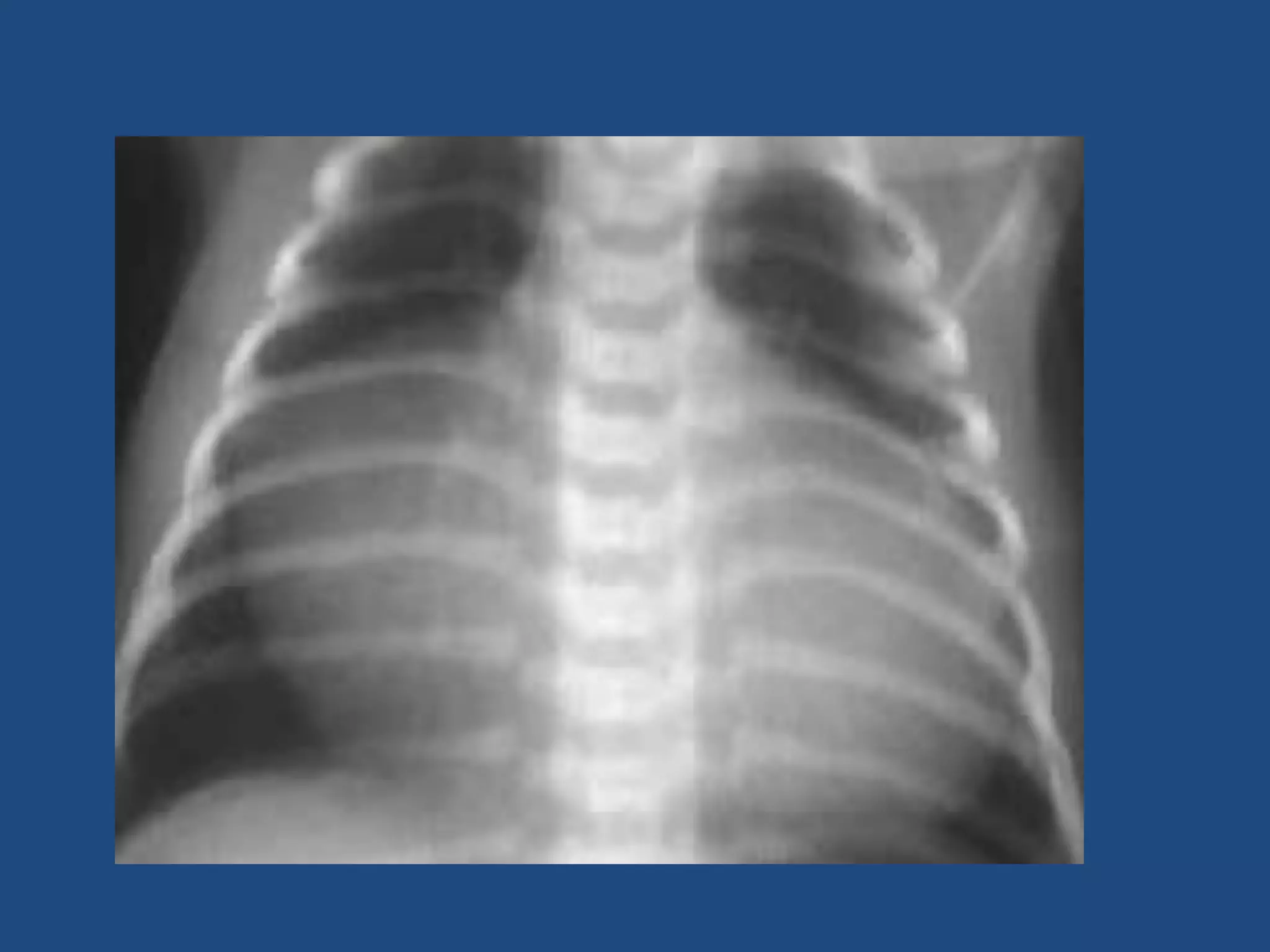
Oligemic lung fields and no
cardiomegaly
Plan
• Start Prostaglandin E1 and get Echo
• Could not find Prostin –referred
• Team went with prostin –shifted to SGRH
• Why prostin started
• Can we do it without echo
• What is the probable DD
• What is the prognosis
• Expenses
Diagnosis
• ECHO at SGRH –
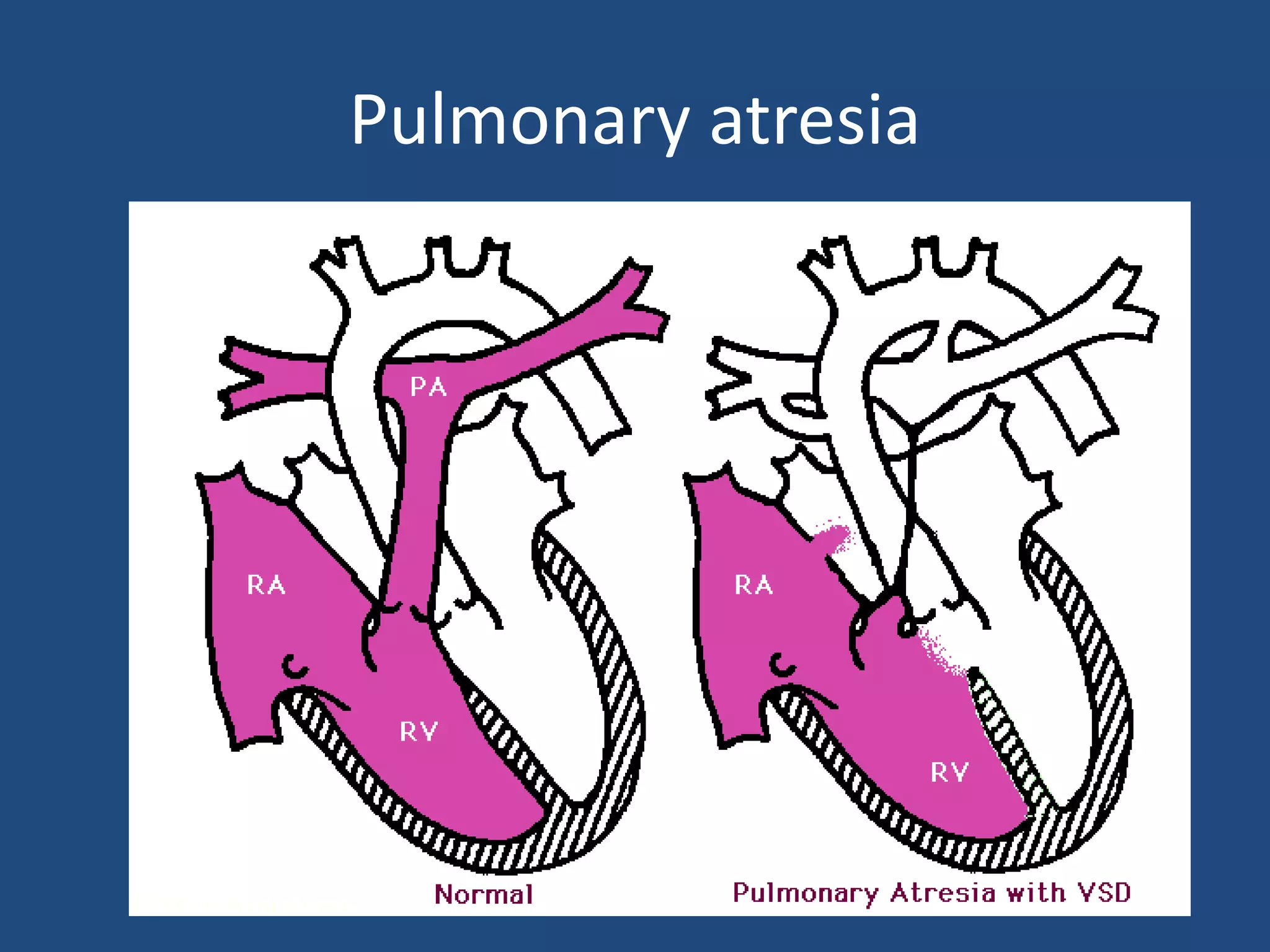
• Pulmonary atresia with VSD
• PDA
Neonatal cyanosis (cardiac causes)
PDA dependent pulmonary
circulation
• Pulmonary Atresia ,Intact Ventricular Septum
• Pulmonary Atresia, VSD and PDA
• Pulmonary Atresia with Single Ventricle
• Severe forms of Ebsteins anomaly
What is common to all these lesions
• Oligemia of lung fields on CXR
Pulmonary atresia
Neonatal cyanosis (cardiac causes)
Admixture lesions
• Transposition of Great Arteries, intact
Interventricular septum
• Total Anomalous Pulmonary venous connection
• Truncus Arteriosus
• Double Outlet Right Ventricle with VSD
• Single ventricle anomalies with or without
Pulmonary stenosis
TGA
Neonatal cyanosis (cardiac causes)
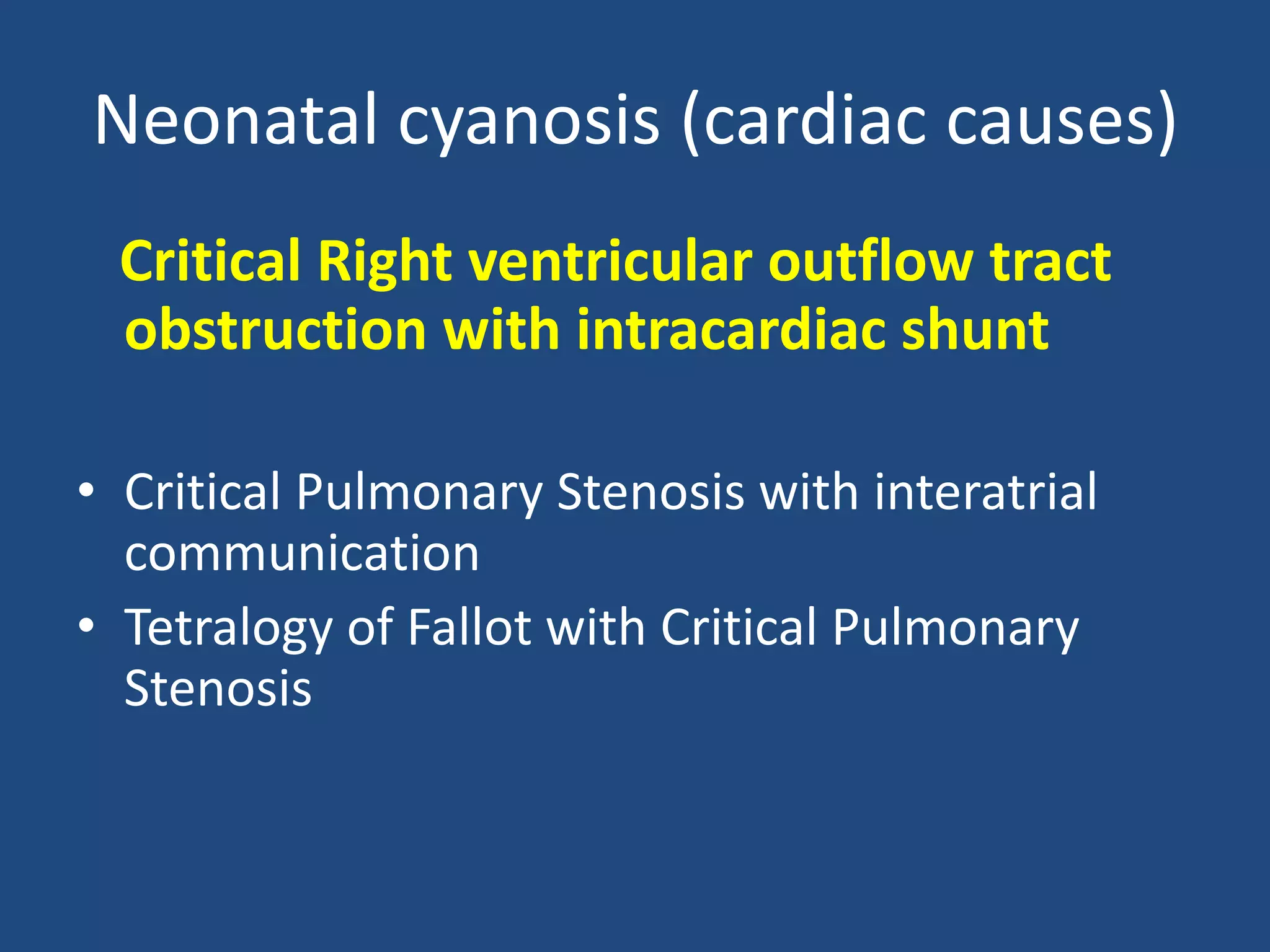
Critical Right ventricular outflow tract
obstruction with intracardiac shunt
• Critical Pulmonary Stenosis with interatrial
communication
• Tetralogy of Fallot with Critical Pulmonary
Stenosis
Non Cardiac causes of Cyanosis
Pulmonary
Primary lung disease
• Respiratory distress
syndrome
• meconium aspiration
• PPHN
• Pneumonia
• Tracheo- esophageal
fistula
• Airway obstruction
• Choanal atresia, laryngo-
tracheomalacia,laryngeal
web, vocal cord paralysis
• Extrinsic compression of
the lungs
• Pneumothorax
• Chylothorax, Hemothorax
• Diaphragmatic Hernia,
Space occupying lesions
Non Cardiac causes of Cyanosis
Neurologic
• Drug-induced depression of respiratory drive,
intracranial haemorrhage,post asphyxial
cerebral dysfunction, or central apnea
• Respiratory neuromuscular dysfunction --
spinal muscular atrophy, infant botulism, or
neonatal myasthenia gravis
Non Cardiac causes of Cyanosis
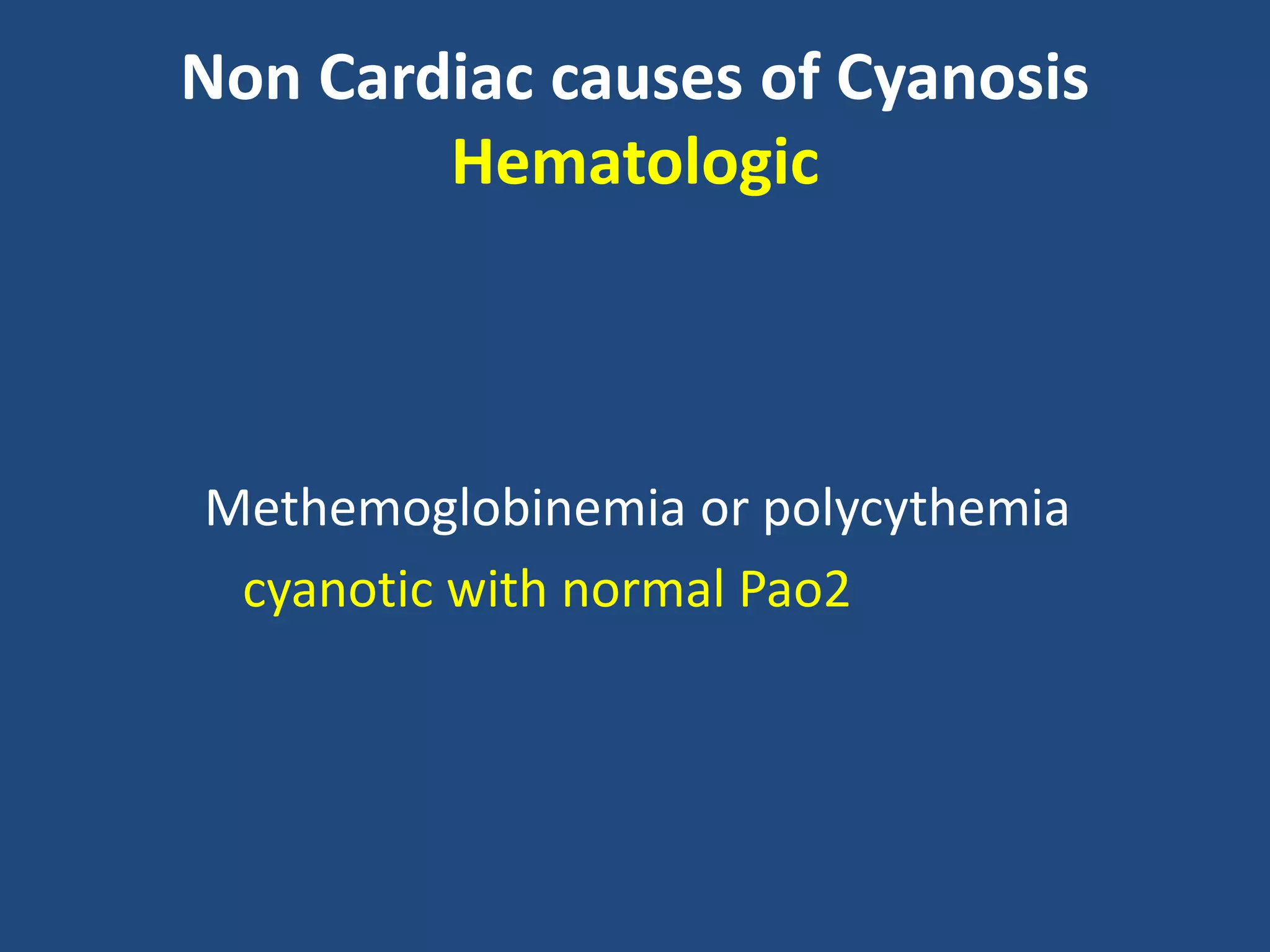
Hematologic
Methemoglobinemia or polycythemia
cyanotic with normal Pao2
Importance CXR
Situs Solitus, Dextrocardia
• How to identify cardiac vs resp causes of
cyanosis
DD of cyanosis
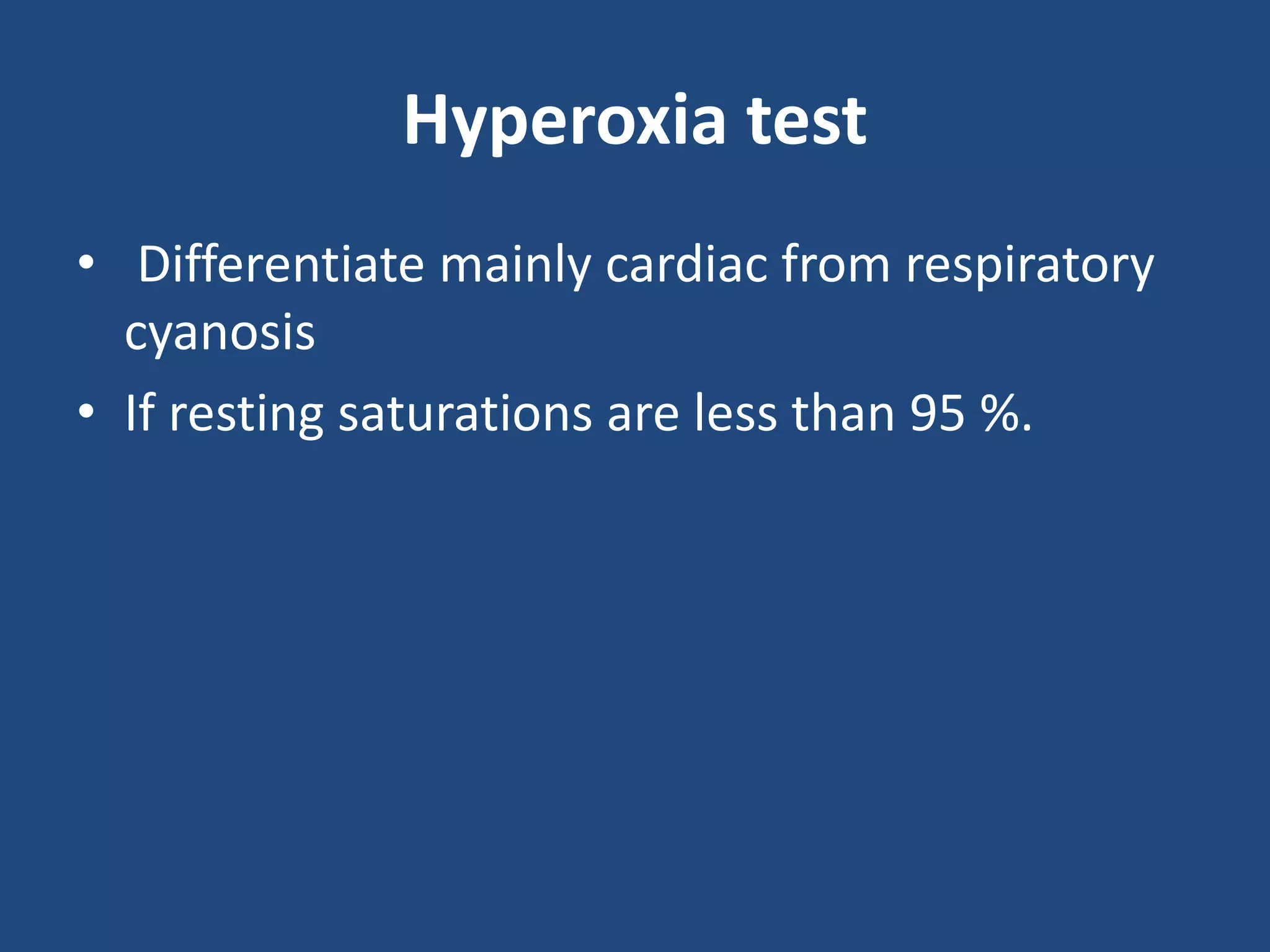
Hyperoxia test
• Differentiate mainly cardiac from respiratory
cyanosis
• If resting saturations are less than 95 %.
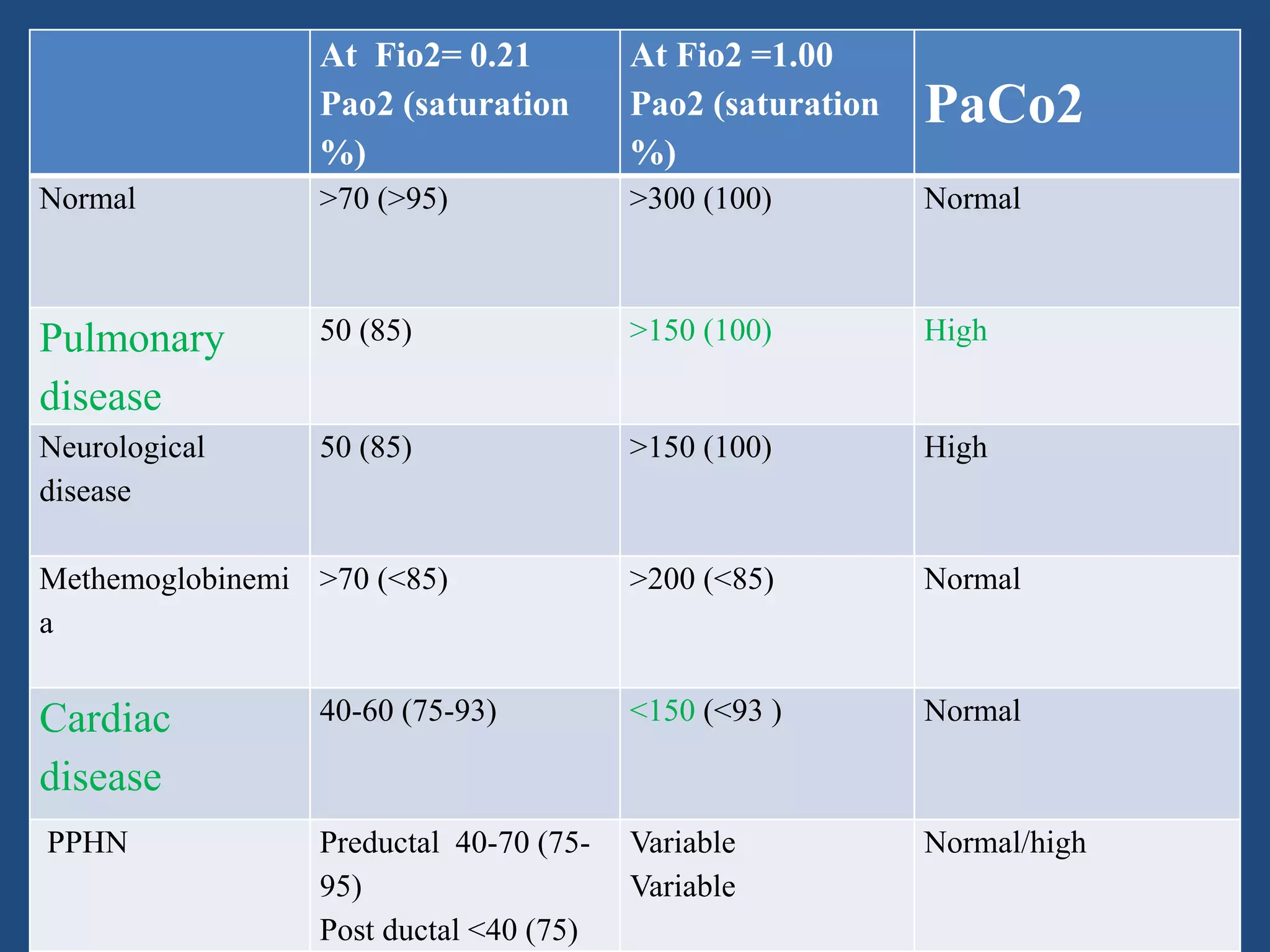
At Fio2= 0.21
Pao2 (saturation
%)
At Fio2 =1.00
Pao2 (saturation
%)
PaCo2
Normal >70 (>95) >300 (100) Normal
Pulmonary
disease
50 (85) >150 (100) High
Neurological
disease
50 (85) >150 (100) High
Methemoglobinemi
a
>70 (<85) >200 (<85) Normal
Cardiac
disease
40-60 (75-93) <150 (<93 ) Normal
PPHN Preductal 40-70 (75-
95)
Post ductal <40 (75)
Variable
Variable
Normal/high
Interpretation of hyperoxia test
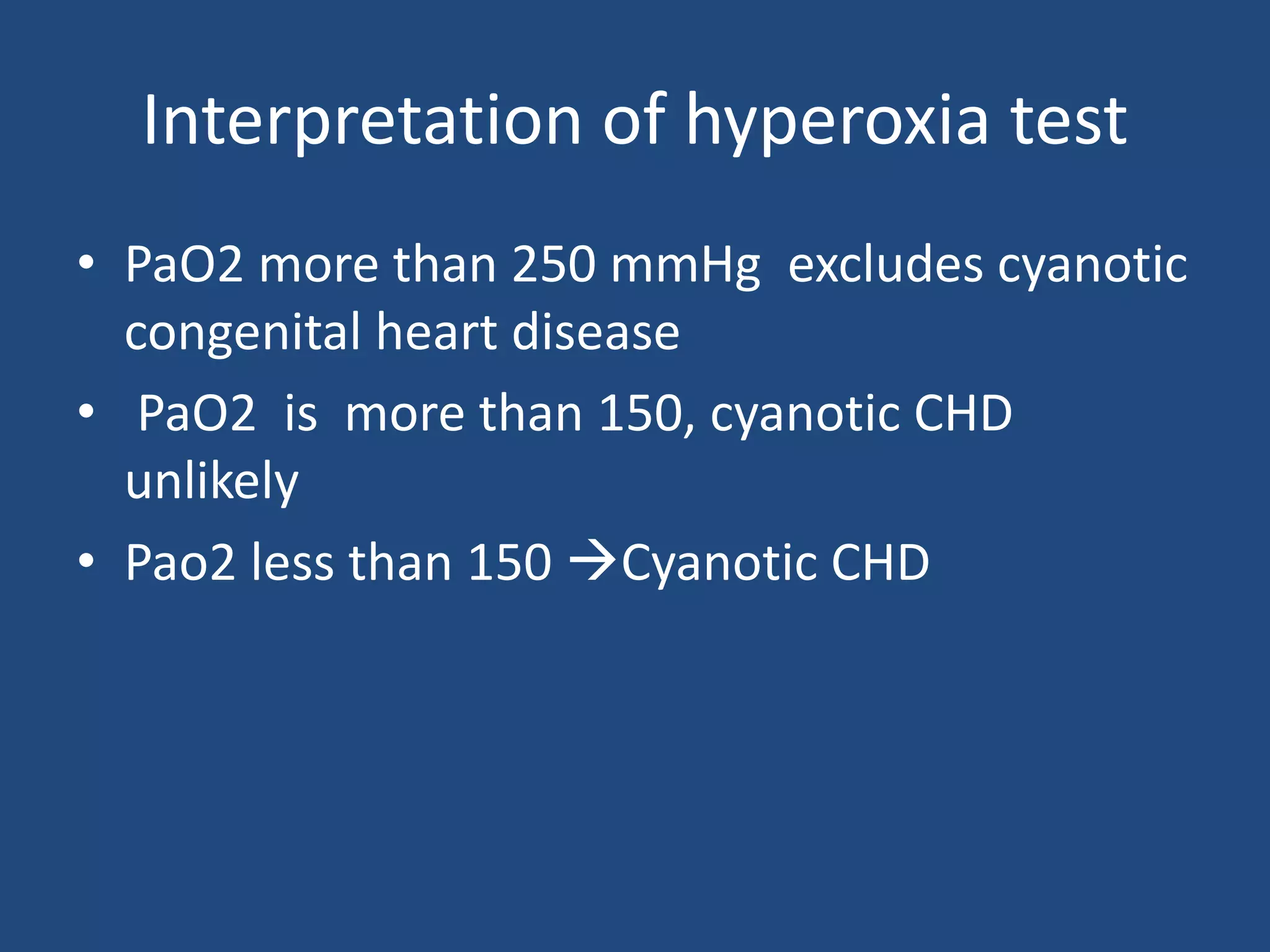
• PaO2 more than 250 mmHg excludes cyanotic
congenital heart disease
• PaO2 is more than 150, cyanotic CHD
unlikely
• Pao2 less than 150 Cyanotic CHD
Limitations of Hyperoxia Test
False positive
TAPVC and HLHS may respond to oxygenation
–False negative
– Pulmonary disease with a massive intrapulmonary shunt
may not respond to oxygenation.
– Failed hyperoxia test will not differentiate cardiac disease
from PPHN
Differential cyanosis
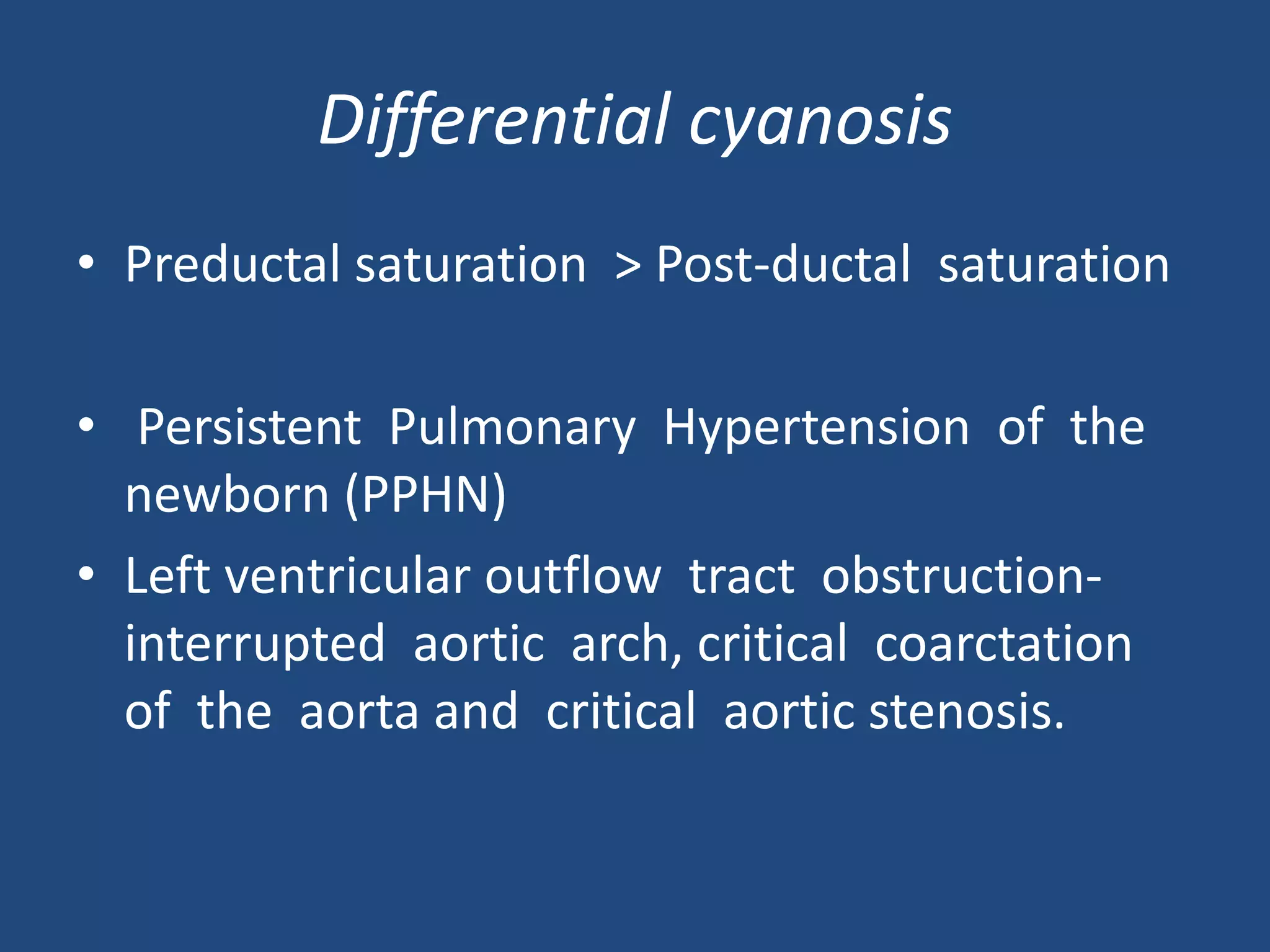
• Preductal saturation > Post-ductal saturation
• Persistent Pulmonary Hypertension of the
newborn (PPHN)
• Left ventricular outflow tract obstruction-
interrupted aortic arch, critical coarctation
of the aorta and critical aortic stenosis.
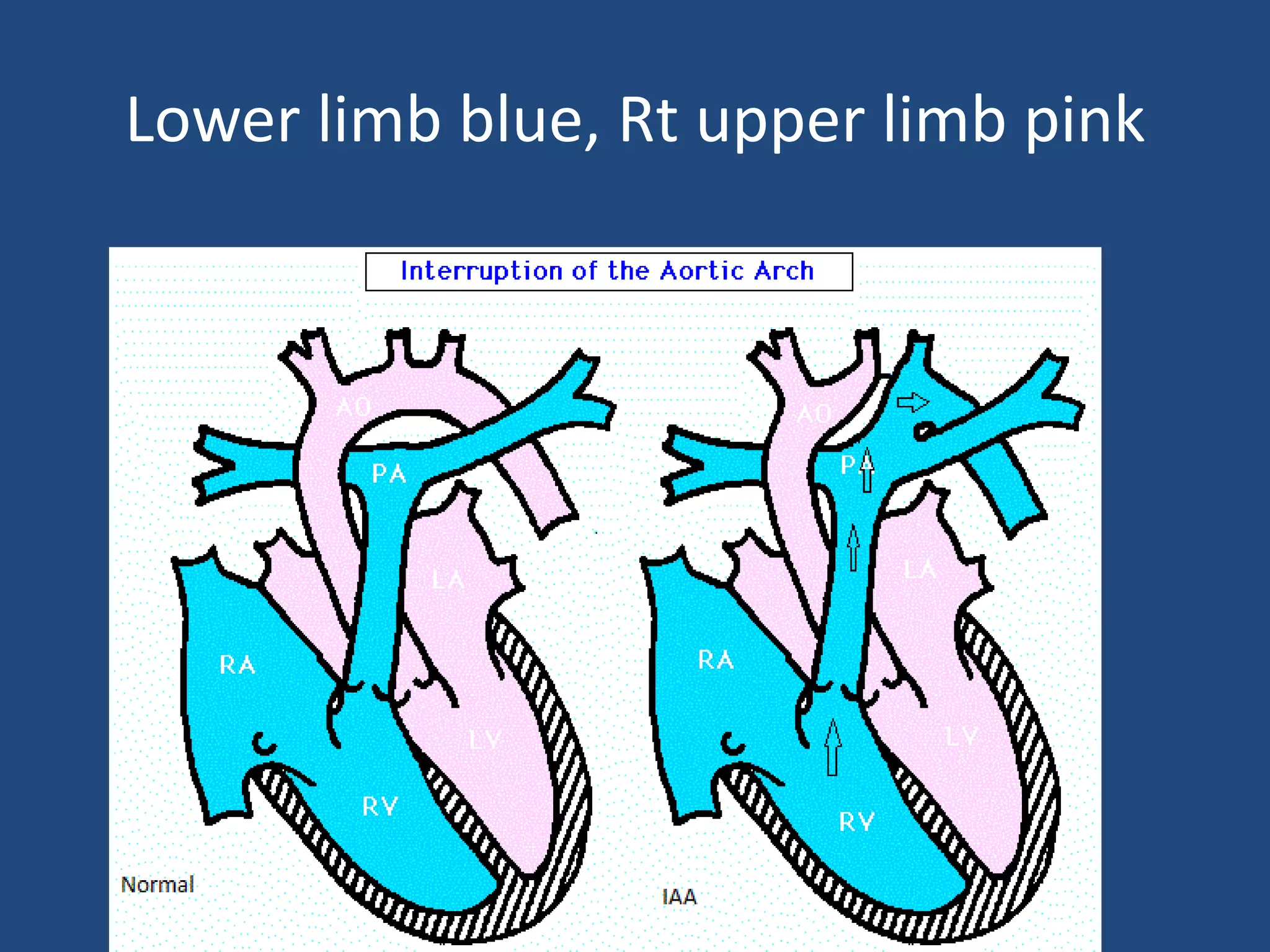
Lower limb blue, Rt upper limb pink
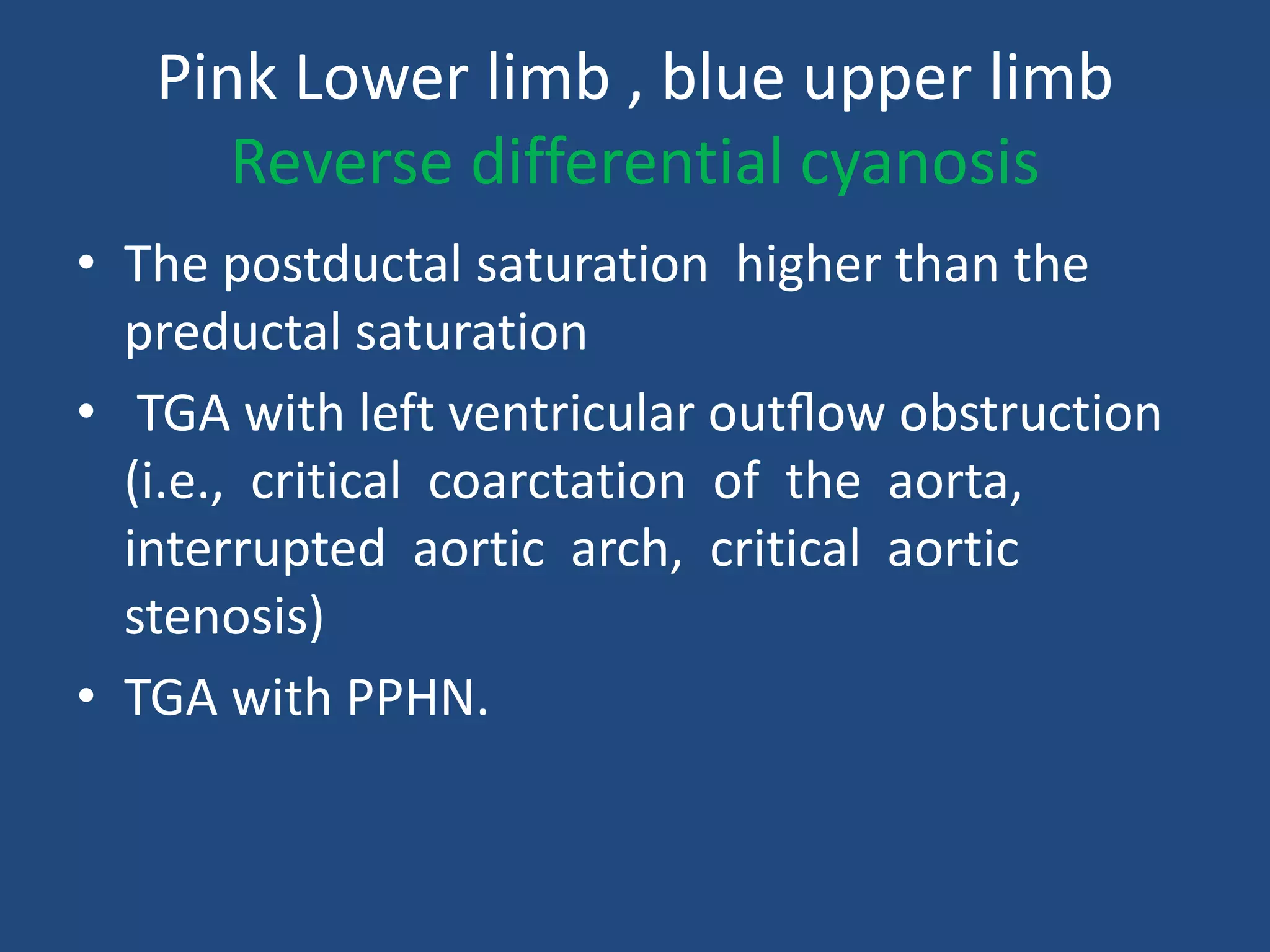
Pink Lower limb , blue upper limb
Reverse differential cyanosis
• The postductal saturation higher than the
preductal saturation
• TGA with left ventricular outflow obstruction
(i.e., critical coarctation of the aorta,
interrupted aortic arch, critical aortic
stenosis)
• TGA with PPHN.
Cardiac causes of cyanosis
• Healthy neonates who present with sudden
onset of cyanosis after being well for 2-3 days
when PDA starts constricting
• Soft faint murmur of PDA
• TGA -mild tachypnoea without respiratory
distress with saturation of around 90 %
• PULSE OXIMETRY
Cardiac causes of cyanosis
• There is obviously no response to oxygen in
such cases and hyperoxia test fails
Classification of Cyanotic CHD
• DECREASED PBF
–TOF
–TGA VSD PS
–DORV VSD PS
–TA VSD PS
–SV PS
–Pulmonary atresia
• INCREASED PBF
–TGA VSD
–TRUNCUS
–TAPVC
(ADMIXTURE)
–SV WITHOUT PS
–TA VSD NO PS
Chest X ray
• Rule out respiratory issues
• Assess pulmonary blood flow and presence of
Cardiomegaly
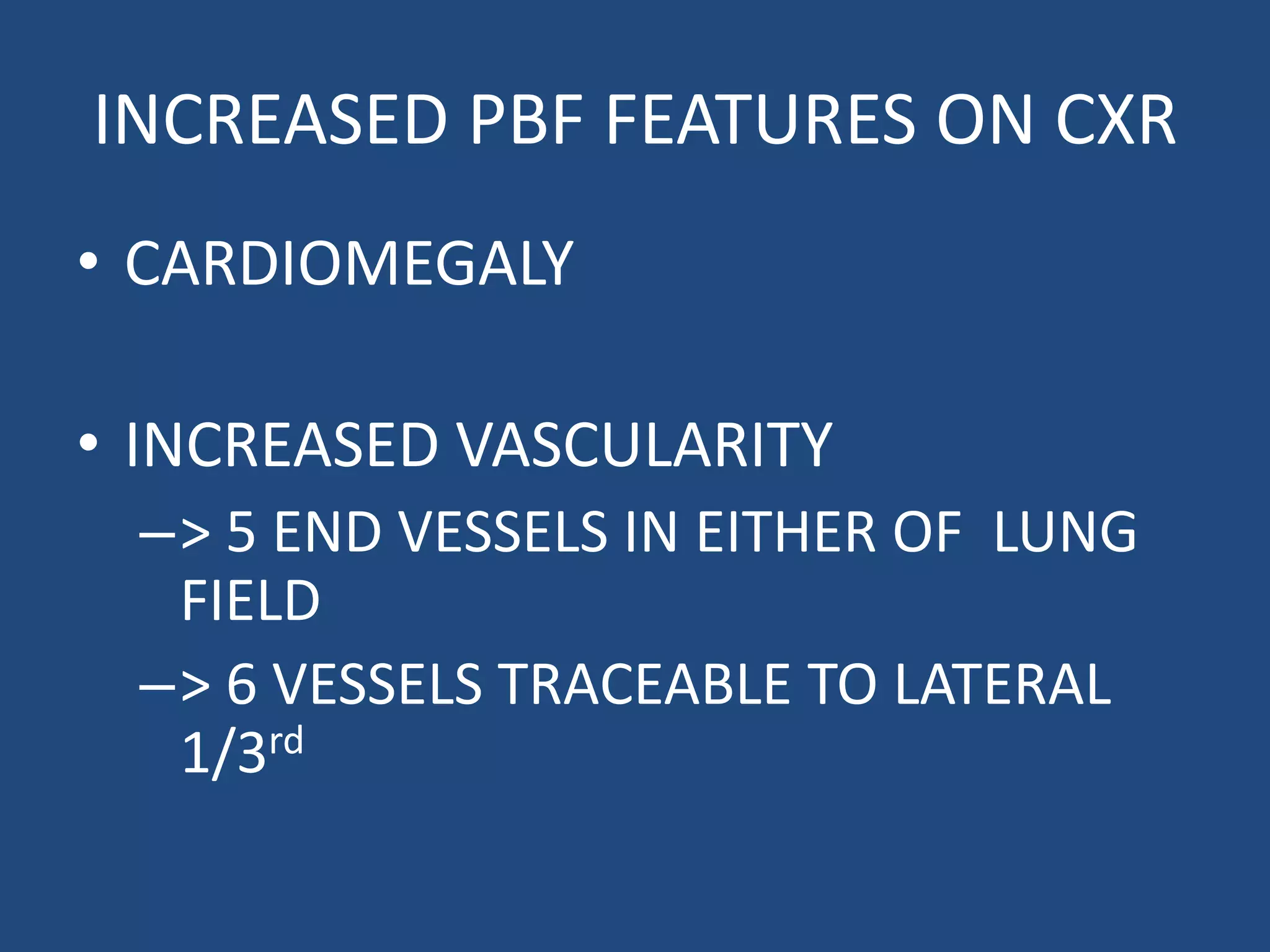
INCREASED PBF FEATURES ON CXR
• CARDIOMEGALY
• INCREASED VASCULARITY
–> 5 END VESSELS IN EITHER OF LUNG
FIELD
–> 6 VESSELS TRACEABLE TO LATERAL
1/3rd
INCREASED pulmonary blood Flow
Low pulm flow
INCREASED PBF
Truncus
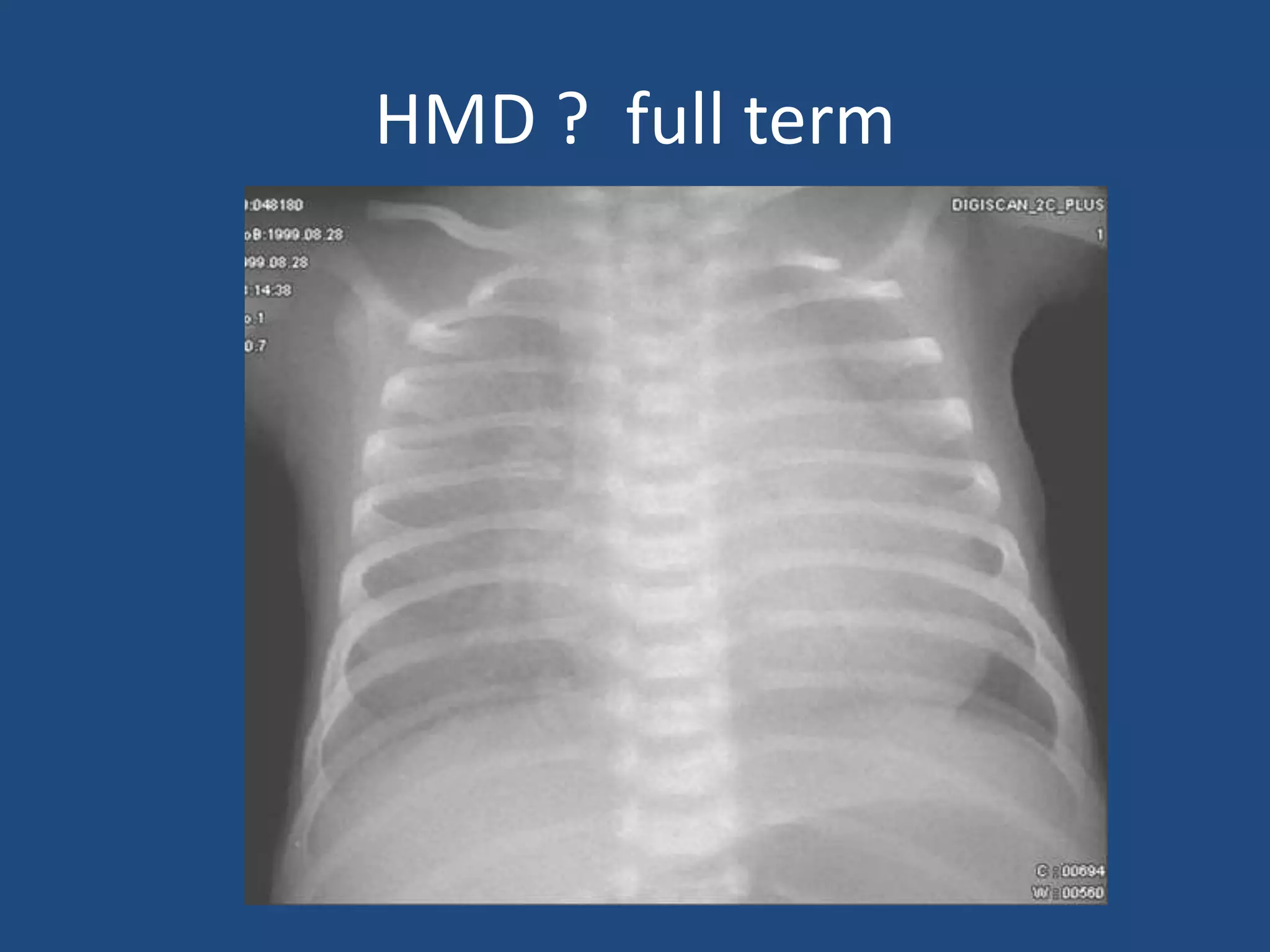
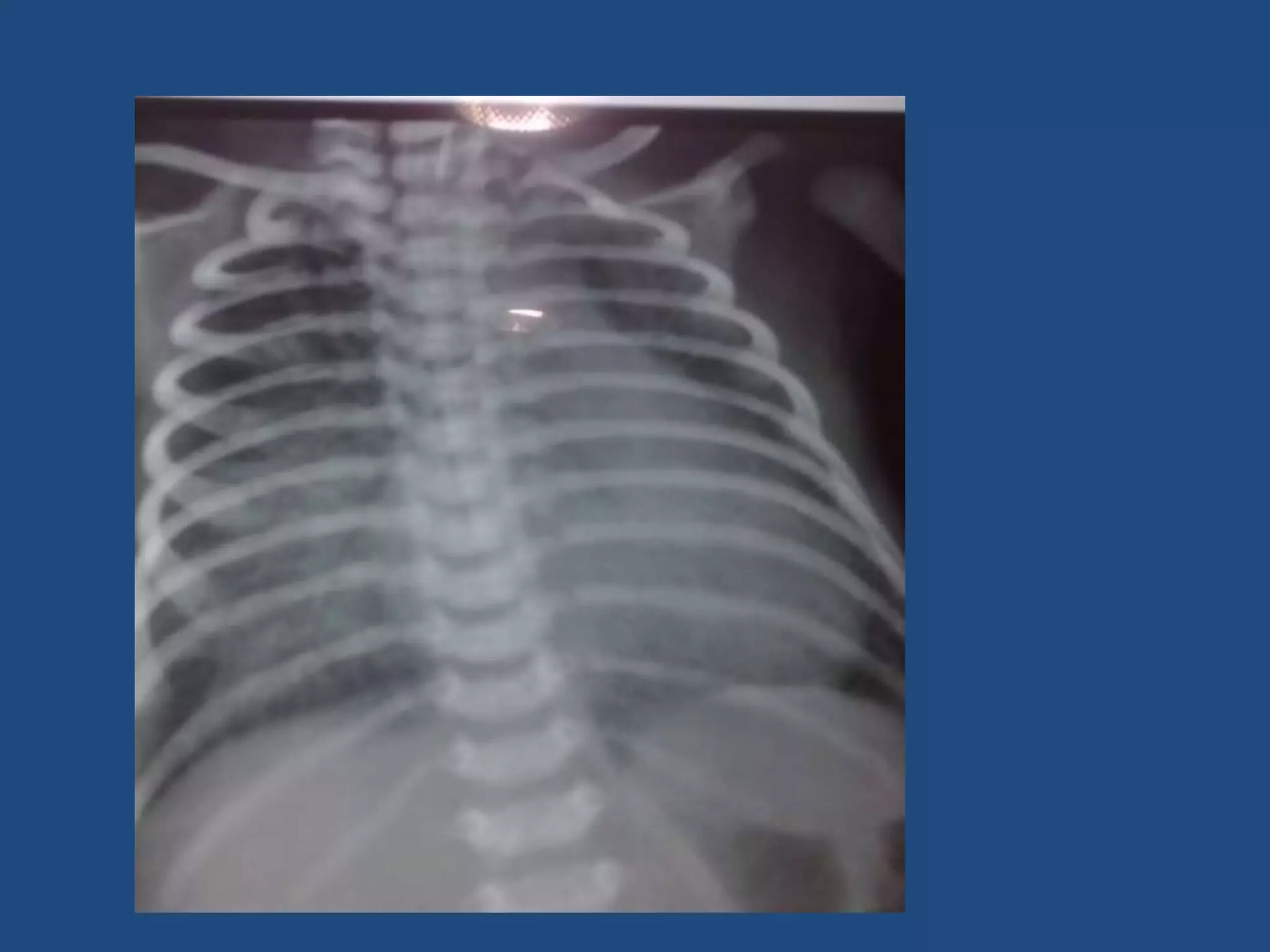
HMD ? full term
Reduced Pulmonary blood flow
No or minimal cardiomegaly
• Duct dependent pulmonary circulation
• Critical RVOT obstructions with intracardiac
mixing
Massive Cardiomegaly with reduced
pulmonary blood flow will suggest a diagnosis
of Ebstein anomaly
Pulmonary atresia, VSD
Pulm blood flow ?
Pulm blood flow ? Cardiac size ?
TRICUSPID ATRESIA,PS
Tricuspid Atresia
Ebstein
Case 2
• D3 old baby –suddenly sick
• Poor feeding , Not passing urine
• Colour not Looking good –pale
• Cold peripheries ,Tachypnoea , tachycardia
• poor pulses ,BP 32/20, metabolic acidosis
,raised lactates
Shock
Neonatal shock
• Ventilated
• Fluid challenge  oliguria unresponsive
• Inotropes high doses hypotension
persists
• Non cardiac- Sepsis ???
1.Shock
1. Duct dependent systemic circulation and Left
ventricular outflow Tract obstructions
• Critical Aortic stenosis and coarctation ,
Interrupted aortic arch
• Hypoplastic Left Heart Syndrome (HLHS)
2. Obstructive TAPVC
3. Rhythm disturbances
Tachyarrhythmias and Brady arrhythmias (e.g.
Complete heart block)
Clinical presentation
• A healthy newborn who presents after 48-72 hrs
of life with sudden onset of pallor, grey
appearance and breathing difficulty.
• Not passing urine and not taking feeds over last
4-6 hrs
• Metabolic acidosis
• Start prostaglandin E1 suspecting duct
dependent systemic circulation ??
• Other measures to stabilize including ventilation
and inotropes (unless echo rules out cardiac
lesion)
Clinical clues
• Harsh systolic murmur - obstructive lesion
(aortic stenosis or pulmonary stenosis).
• Differential cyanosis with lower limb showing
desaturation compared to upper limb should
prompt for the cause of PDA shunting right to
left (e.g. interrupted aortic arch ,severe
Coarctation of aorta or PPHN)
• Differential Pulse –good upper limb and feeble
lower limb-Coarctation /IAA
Lower limb blue, upper limb pink
Obstructed TAPVC
ECG
• Neonates presenting with shock to detect
arrhythmias
• Supraventricular and ventricular tachycardia,
or extreme bradycardia
• Pallor, diaphoresis, dizziness, and syncopal
or pallid spells, all related to the decreased
cardiac output
Case 3
• Apparently happy baby with mild cyanosis
• Hyper dynamic chest , Mild tachypnoea ,sats
80’s (pulse ox)
Transposition physiology
TGA
Parallel great vessels
Prostaglandin E1
• When to use
• How to give
• Doses and monitoring
How do we start Prostaglandin?
• Dose - 0.001-0.4 microgram/kg/min infusion
• Higher doses 0.1 mic/kg/min should be used
to reopen the closed PDA (or if there is
sudden onset of severe cyanosis or shock).
• Increments of 0.05 microgram /kg/min every
5-10 minutes
• Once the duct has opened, dose can be
reduced to a minimum
Preparation
• 500 microgram per vial, dilute it in 50 ml of 5 %
dextrose and start in infusion pump.
• According to formula (this formula can be used
for any inotropes)
• 3×wt×microgram/kg/min divided by
concentration (mg) in 50 ml =flow rate in ml/hr
• So for wt of 3 kg child and dose of 0.1mic/kg/min
• 3x3x0.1/0.5=ml/hr ( 0.9/0.5) = 1.8 ml per hr
infusion will give you 0.1 microgram/kg/min.
Preparation
• Lower doses in the range of 0.01
microgram/kg/min till definitive surgical
repair.
• With proper monitoring in ICU for saturations
and under echocardiographic guidance (for
PDA monitoring), dose can be reduced to
0.001 microgram/kg/min.
No Response to prostaglandin
Infusion
Diagnosis Management
1. Transposition of Great Arteries
with Intact Ventricular Septum
and a restrictive interatrial
communication
Needs emergency Balloon
Atrial Septostomy
1. Obstructed TAPVC Emergency surgery
1. Non Cardiac Diagnosis Treatment of etiology
Congestive heart failure
Cyanotic heart disease with high pulmonary flow
• Truncus Arteriosus
• Single ventricle physiology without Pulmonary
Stenosis
• Transposition of Great Arteries with VSD
• Double Outlet Right Ventricle with VSD
• Total Anomalous Pulmonary venous connection
Cyanotic heart disease with high
pulmonary flow
• Not significantly cyanotic due to torrential
pulmonary blood flow
• Saturation may vary in the range of 90’s.
• Naked eyes will not pick up the cyanosis
• Pulse oximetry -- early detection
Acyanotic Heart Disease with high
pulmonary flow
• Preterm with significant post tricuspid shunt
lesions (e.g. VSD ,PDA ,Aorto- Pulmonary
window)
• Severe valvular regurgitant lesions (e.g. Mitral
regurgitation associated with AV canal defects)
• Anomalous Left Coronary Artery from Pulmonary
Artery(ALCAPA)
• Cardiomyopathy
Other causes of CHF
Rhythm disturbances
• Tachyarrhythmias
• Brady arrhythmias ( e.g. complete heart block,
High degree second heart block)
Non Cardiac causes
• High output states like anemia ,thyrotoxicosis ,
systemic Arteriovenous malformations (g.e.Vein
of Galen )
Clinical features
• Difficulty in feeding ,sub costal indrawing,
sweating with feeds ,tachypnoea, tachycardia,
gallop rhythm and hepatomegaly .
Pulmonary blood flow –high
• Excessive sweating
• Feeding difficulty (suck rest suck)
• Chest infection
• Failure to thrive
• Hyperdynamic precordium
• Shunt murmur and diastolic flow murmur
• Cardiomegaly
Preterm PDA
• Steal phenomenon like cerebral steal
(manifesting as apnea) or steal from gut
(manifesting as necrotizing enterocolitis ).
• Bounding pulses along with wide pulse
pressure should give a suspicion
Preterm PDA
• After surfactant therapy, they show
improvement and ventilatory requirements go
down .
• As Hyaline membrane disease improves and
PVR falls, PDA shunt becomes significant and
ventilatory requirements become higher again
Preterm VS Full term –CHF
• Preterm --Other post tricuspid lesions can also
lead to CHF in preterm neonates (e.g. Large
VSD, AP window)
• Full term --Usually don’t present in full term
neonates as PVR falls after 4-6 weeks and then
shunt lesions start manifesting as CHF.
CHF
• Chest X ray in such cases will show
Cardiomegaly (cardiothoracic ratio >0.6).
• Thymic and extra cardiac shadows
ABSENT PULMONARY VALVE
TRUNCUS
Rhythm disturbances
• SVT
• Brady arrhythmias with Long QTc
Neonatal Interventions
• BAS-Ballon atrial Septostomy
• BPV-Ballon pulmonary valvuloplasty
• BAV-Ballon aortic valvuloplasty
• Ballon Coarct angioplasty
• PDA stenting
Summary
• Right sided obstructive lesions-
(cyanosis) - critical PS,pulmonary
atresia
• Left sided obstructive lesions
(Collapse) –
critical AS, IAA, COA, HLHS
Summary
• Mixing lesions (cyanosis with CCF) – TGA
• ASD dependent lesions (cyanosis with CCF)-
TAPVC, Tricuspid atresia
Probability of prostaglandin sensitive
lesion is increased
• In a cyanosed neonate with failed hyperoxia
test – murmur
• In a non -cyanosed neonate ,by abnormal
pulses
• Whenever in doubt,
Start PGE1 , though may not be effective in
certain lesions
Thank you
Dr Neeraj Aggarwal
Consultant Pediatric Cardiology
9818991620
drneeraj_12@yahoo.co.in

Neonatal cardiac emergency

  • 1.
    Neonatal Cardiac Emergencies DrNeeraj Aggarwal Consultant Pediatric Cardiology Department of Pediatric Cardiac Sciences Sir Ganga Ram Hospital
  • 2.
    Neonatal Presentations 1. Cyanosis 2.Shock 3. CHF 4. Arrhythmias • Septicemia, respiratory disorders, persistent pulmonary hypertension of newborn (PPHN),inborn errors of metabolism and so on
  • 3.
    Case 1 • Asymptomaticneonate was discharged on breast feeds • Suddenly presents at 3 days of life with bluish discoloration • Sats 70,mild tachypnoea and minimal distress • soft ESM • No response to oxygen • Ventilation –mild increase in saturations (75%)
  • 4.
    Oligemic lung fieldsand no cardiomegaly
  • 5.
    Plan • Start ProstaglandinE1 and get Echo • Could not find Prostin –referred • Team went with prostin –shifted to SGRH
  • 6.
    • Why prostinstarted • Can we do it without echo • What is the probable DD • What is the prognosis • Expenses
  • 7.
    Diagnosis • ECHO atSGRH – • Pulmonary atresia with VSD • PDA
  • 8.
    Neonatal cyanosis (cardiaccauses) PDA dependent pulmonary circulation • Pulmonary Atresia ,Intact Ventricular Septum • Pulmonary Atresia, VSD and PDA • Pulmonary Atresia with Single Ventricle • Severe forms of Ebsteins anomaly
  • 9.
    What is commonto all these lesions • Oligemia of lung fields on CXR
  • 11.
  • 12.
    Neonatal cyanosis (cardiaccauses) Admixture lesions • Transposition of Great Arteries, intact Interventricular septum • Total Anomalous Pulmonary venous connection • Truncus Arteriosus • Double Outlet Right Ventricle with VSD • Single ventricle anomalies with or without Pulmonary stenosis
  • 13.
  • 14.
    Neonatal cyanosis (cardiaccauses) Critical Right ventricular outflow tract obstruction with intracardiac shunt • Critical Pulmonary Stenosis with interatrial communication • Tetralogy of Fallot with Critical Pulmonary Stenosis
  • 15.
    Non Cardiac causesof Cyanosis Pulmonary Primary lung disease • Respiratory distress syndrome • meconium aspiration • PPHN • Pneumonia • Tracheo- esophageal fistula • Airway obstruction • Choanal atresia, laryngo- tracheomalacia,laryngeal web, vocal cord paralysis • Extrinsic compression of the lungs • Pneumothorax • Chylothorax, Hemothorax • Diaphragmatic Hernia, Space occupying lesions
  • 16.
    Non Cardiac causesof Cyanosis Neurologic • Drug-induced depression of respiratory drive, intracranial haemorrhage,post asphyxial cerebral dysfunction, or central apnea • Respiratory neuromuscular dysfunction -- spinal muscular atrophy, infant botulism, or neonatal myasthenia gravis
  • 17.
    Non Cardiac causesof Cyanosis Hematologic Methemoglobinemia or polycythemia cyanotic with normal Pao2
  • 19.
  • 21.
  • 22.
    • How toidentify cardiac vs resp causes of cyanosis
  • 23.
  • 24.
    Hyperoxia test • Differentiatemainly cardiac from respiratory cyanosis • If resting saturations are less than 95 %.
  • 25.
    At Fio2= 0.21 Pao2(saturation %) At Fio2 =1.00 Pao2 (saturation %) PaCo2 Normal >70 (>95) >300 (100) Normal Pulmonary disease 50 (85) >150 (100) High Neurological disease 50 (85) >150 (100) High Methemoglobinemi a >70 (<85) >200 (<85) Normal Cardiac disease 40-60 (75-93) <150 (<93 ) Normal PPHN Preductal 40-70 (75- 95) Post ductal <40 (75) Variable Variable Normal/high
  • 26.
    Interpretation of hyperoxiatest • PaO2 more than 250 mmHg excludes cyanotic congenital heart disease • PaO2 is more than 150, cyanotic CHD unlikely • Pao2 less than 150 Cyanotic CHD
  • 27.
    Limitations of HyperoxiaTest False positive TAPVC and HLHS may respond to oxygenation –False negative – Pulmonary disease with a massive intrapulmonary shunt may not respond to oxygenation. – Failed hyperoxia test will not differentiate cardiac disease from PPHN
  • 28.
    Differential cyanosis • Preductalsaturation > Post-ductal saturation • Persistent Pulmonary Hypertension of the newborn (PPHN) • Left ventricular outflow tract obstruction- interrupted aortic arch, critical coarctation of the aorta and critical aortic stenosis.
  • 29.
    Lower limb blue,Rt upper limb pink
  • 30.
    Pink Lower limb, blue upper limb Reverse differential cyanosis • The postductal saturation higher than the preductal saturation • TGA with left ventricular outflow obstruction (i.e., critical coarctation of the aorta, interrupted aortic arch, critical aortic stenosis) • TGA with PPHN.
  • 31.
    Cardiac causes ofcyanosis • Healthy neonates who present with sudden onset of cyanosis after being well for 2-3 days when PDA starts constricting • Soft faint murmur of PDA • TGA -mild tachypnoea without respiratory distress with saturation of around 90 % • PULSE OXIMETRY
  • 32.
    Cardiac causes ofcyanosis • There is obviously no response to oxygen in such cases and hyperoxia test fails
  • 33.
    Classification of CyanoticCHD • DECREASED PBF –TOF –TGA VSD PS –DORV VSD PS –TA VSD PS –SV PS –Pulmonary atresia • INCREASED PBF –TGA VSD –TRUNCUS –TAPVC (ADMIXTURE) –SV WITHOUT PS –TA VSD NO PS
  • 34.
    Chest X ray •Rule out respiratory issues • Assess pulmonary blood flow and presence of Cardiomegaly
  • 35.
    INCREASED PBF FEATURESON CXR • CARDIOMEGALY • INCREASED VASCULARITY –> 5 END VESSELS IN EITHER OF LUNG FIELD –> 6 VESSELS TRACEABLE TO LATERAL 1/3rd
  • 36.
  • 37.
  • 38.
  • 39.
  • 41.
  • 43.
    Reduced Pulmonary bloodflow No or minimal cardiomegaly • Duct dependent pulmonary circulation • Critical RVOT obstructions with intracardiac mixing Massive Cardiomegaly with reduced pulmonary blood flow will suggest a diagnosis of Ebstein anomaly
  • 44.
  • 45.
  • 46.
    Pulm blood flow? Cardiac size ?
  • 47.
  • 48.
  • 49.
  • 50.
    Case 2 • D3old baby –suddenly sick • Poor feeding , Not passing urine • Colour not Looking good –pale • Cold peripheries ,Tachypnoea , tachycardia • poor pulses ,BP 32/20, metabolic acidosis ,raised lactates Shock
  • 51.
    Neonatal shock • Ventilated •Fluid challenge  oliguria unresponsive • Inotropes high doses hypotension persists • Non cardiac- Sepsis ???
  • 52.
    1.Shock 1. Duct dependentsystemic circulation and Left ventricular outflow Tract obstructions • Critical Aortic stenosis and coarctation , Interrupted aortic arch • Hypoplastic Left Heart Syndrome (HLHS) 2. Obstructive TAPVC 3. Rhythm disturbances Tachyarrhythmias and Brady arrhythmias (e.g. Complete heart block)
  • 53.
    Clinical presentation • Ahealthy newborn who presents after 48-72 hrs of life with sudden onset of pallor, grey appearance and breathing difficulty. • Not passing urine and not taking feeds over last 4-6 hrs • Metabolic acidosis • Start prostaglandin E1 suspecting duct dependent systemic circulation ?? • Other measures to stabilize including ventilation and inotropes (unless echo rules out cardiac lesion)
  • 54.
    Clinical clues • Harshsystolic murmur - obstructive lesion (aortic stenosis or pulmonary stenosis). • Differential cyanosis with lower limb showing desaturation compared to upper limb should prompt for the cause of PDA shunting right to left (e.g. interrupted aortic arch ,severe Coarctation of aorta or PPHN) • Differential Pulse –good upper limb and feeble lower limb-Coarctation /IAA
  • 55.
    Lower limb blue,upper limb pink
  • 56.
  • 57.
    ECG • Neonates presentingwith shock to detect arrhythmias • Supraventricular and ventricular tachycardia, or extreme bradycardia • Pallor, diaphoresis, dizziness, and syncopal or pallid spells, all related to the decreased cardiac output
  • 61.
    Case 3 • Apparentlyhappy baby with mild cyanosis • Hyper dynamic chest , Mild tachypnoea ,sats 80’s (pulse ox) Transposition physiology
  • 62.
  • 64.
  • 65.
    Prostaglandin E1 • Whento use • How to give • Doses and monitoring
  • 66.
    How do westart Prostaglandin? • Dose - 0.001-0.4 microgram/kg/min infusion • Higher doses 0.1 mic/kg/min should be used to reopen the closed PDA (or if there is sudden onset of severe cyanosis or shock). • Increments of 0.05 microgram /kg/min every 5-10 minutes • Once the duct has opened, dose can be reduced to a minimum
  • 67.
    Preparation • 500 microgramper vial, dilute it in 50 ml of 5 % dextrose and start in infusion pump. • According to formula (this formula can be used for any inotropes) • 3×wt×microgram/kg/min divided by concentration (mg) in 50 ml =flow rate in ml/hr • So for wt of 3 kg child and dose of 0.1mic/kg/min • 3x3x0.1/0.5=ml/hr ( 0.9/0.5) = 1.8 ml per hr infusion will give you 0.1 microgram/kg/min.
  • 68.
    Preparation • Lower dosesin the range of 0.01 microgram/kg/min till definitive surgical repair. • With proper monitoring in ICU for saturations and under echocardiographic guidance (for PDA monitoring), dose can be reduced to 0.001 microgram/kg/min.
  • 69.
    No Response toprostaglandin Infusion Diagnosis Management 1. Transposition of Great Arteries with Intact Ventricular Septum and a restrictive interatrial communication Needs emergency Balloon Atrial Septostomy 1. Obstructed TAPVC Emergency surgery 1. Non Cardiac Diagnosis Treatment of etiology
  • 71.
    Congestive heart failure Cyanoticheart disease with high pulmonary flow • Truncus Arteriosus • Single ventricle physiology without Pulmonary Stenosis • Transposition of Great Arteries with VSD • Double Outlet Right Ventricle with VSD • Total Anomalous Pulmonary venous connection
  • 72.
    Cyanotic heart diseasewith high pulmonary flow • Not significantly cyanotic due to torrential pulmonary blood flow • Saturation may vary in the range of 90’s. • Naked eyes will not pick up the cyanosis • Pulse oximetry -- early detection
  • 73.
    Acyanotic Heart Diseasewith high pulmonary flow • Preterm with significant post tricuspid shunt lesions (e.g. VSD ,PDA ,Aorto- Pulmonary window) • Severe valvular regurgitant lesions (e.g. Mitral regurgitation associated with AV canal defects) • Anomalous Left Coronary Artery from Pulmonary Artery(ALCAPA) • Cardiomyopathy
  • 74.
    Other causes ofCHF Rhythm disturbances • Tachyarrhythmias • Brady arrhythmias ( e.g. complete heart block, High degree second heart block) Non Cardiac causes • High output states like anemia ,thyrotoxicosis , systemic Arteriovenous malformations (g.e.Vein of Galen )
  • 75.
    Clinical features • Difficultyin feeding ,sub costal indrawing, sweating with feeds ,tachypnoea, tachycardia, gallop rhythm and hepatomegaly .
  • 76.
    Pulmonary blood flow–high • Excessive sweating • Feeding difficulty (suck rest suck) • Chest infection • Failure to thrive • Hyperdynamic precordium • Shunt murmur and diastolic flow murmur • Cardiomegaly
  • 77.
    Preterm PDA • Stealphenomenon like cerebral steal (manifesting as apnea) or steal from gut (manifesting as necrotizing enterocolitis ). • Bounding pulses along with wide pulse pressure should give a suspicion
  • 78.
    Preterm PDA • Aftersurfactant therapy, they show improvement and ventilatory requirements go down . • As Hyaline membrane disease improves and PVR falls, PDA shunt becomes significant and ventilatory requirements become higher again
  • 79.
    Preterm VS Fullterm –CHF • Preterm --Other post tricuspid lesions can also lead to CHF in preterm neonates (e.g. Large VSD, AP window) • Full term --Usually don’t present in full term neonates as PVR falls after 4-6 weeks and then shunt lesions start manifesting as CHF.
  • 80.
    CHF • Chest Xray in such cases will show Cardiomegaly (cardiothoracic ratio >0.6). • Thymic and extra cardiac shadows
  • 82.
  • 83.
  • 84.
    Rhythm disturbances • SVT •Brady arrhythmias with Long QTc
  • 85.
    Neonatal Interventions • BAS-Ballonatrial Septostomy • BPV-Ballon pulmonary valvuloplasty • BAV-Ballon aortic valvuloplasty • Ballon Coarct angioplasty • PDA stenting
  • 89.
    Summary • Right sidedobstructive lesions- (cyanosis) - critical PS,pulmonary atresia • Left sided obstructive lesions (Collapse) – critical AS, IAA, COA, HLHS
  • 90.
    Summary • Mixing lesions(cyanosis with CCF) – TGA • ASD dependent lesions (cyanosis with CCF)- TAPVC, Tricuspid atresia
  • 91.
    Probability of prostaglandinsensitive lesion is increased • In a cyanosed neonate with failed hyperoxia test – murmur • In a non -cyanosed neonate ,by abnormal pulses • Whenever in doubt, Start PGE1 , though may not be effective in certain lesions
  • 92.
    Thank you Dr NeerajAggarwal Consultant Pediatric Cardiology 9818991620 drneeraj_12@yahoo.co.in