Approach to Child with
Lymphadenopathy
Nurzawani Binti Shamsudin
0918424
 Introduction
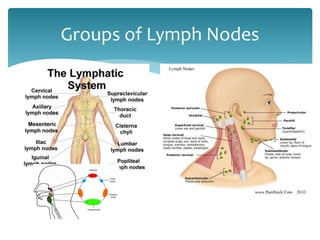
 Anatomy
 Pathophysiology
 Generalized lymphadenopathy
 Regional lymphadenopathy
 Investigation
 Management
Outline
Introduction
 Lymphatic system
 Network of organs, lymph nodes, lymph ducts and lymph vessel that make
and drain lymph from tissues to the bloodstream.
 This lymphoid tissue concerned with immune function in defending body
against antigen.
 Primary lymphoid organ (thymus & bone marrow)
 Secondary lymphoid organ (lymph nodes, tonsil & others)
 Lymphoid tissue enlarges until puberty & progressively atrophy throughout
life
 Functions
 Removal of interstitial fluid from tissues, collection of lymph plasma
 Absorption & transport of fatty acids and fats
 Formation of a defense mechanism for the body
Groups of Lymph Nodes
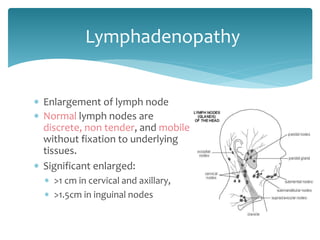
 Enlargement of lymph node
 Normal lymph nodes are
discrete, non tender, and mobile
without fixation to underlying
tissues.
 Significant enlarged:
 >1 cm in cervical and axillary,
 >1.5cm in inguinal nodes
Lymphadenopathy
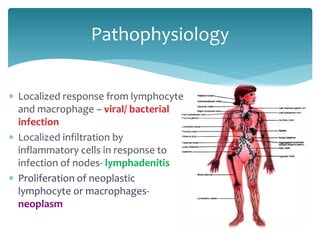
 Localized response from lymphocyte
and macrophage – viral/ bacterial
infection
 Localized infiltration by
inflammatory cells in response to
infection of nodes- lymphadenitis
 Proliferation of neoplastic
lymphocyte or macrophages-
neoplasm
Pathophysiology
 Generalized lymphadenopathy (enlargement of >2
noncontiguous node regions) is caused by systemic
disease
 Regional lymphadenopathy is most frequently the
result of infection in the involved node and/or its
drainage area
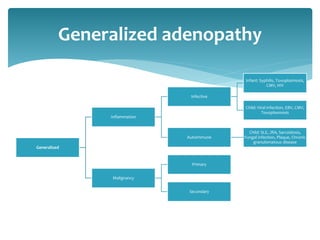
Lymphadenopathy
Generalized
Inflammation
Infective
Infant: Syphilis, Toxoplasmosis,
CMV, HIV
Child: Viral infection, EBV, CMV,
Toxoplasmosis
Autoimmune
Child: SLE, JRA, Sarcoidosis,
Fungal infection, Plaque, Chronic
granulomatous disease
Malignancy
Primary
Secondary
Generalized adenopathy
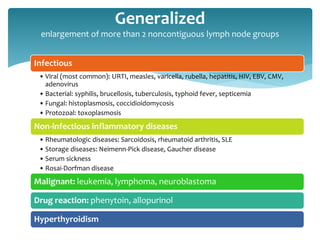
Generalized
enlargement of more than 2 noncontiguous lymph node groups
Infectious
• Viral (most common): URTI, measles, varicella, rubella, hepatitis, HIV, EBV, CMV,
adenovirus
• Bacterial: syphilis, brucellosis, tuberculosis, typhoid fever, septicemia
• Fungal: histoplasmosis, coccidioidomycosis
• Protozoal: toxoplasmosis
Non-infectious inflammatory diseases
• Rheumatologic diseases: Sarcoidosis, rheumatoid arthritis, SLE
• Storage diseases: Neimenn-Pick disease, Gaucher disease
• Serum sickness
• Rosai-Dorfman disease
Malignant: leukemia, lymphoma, neuroblastoma
Drug reaction: phenytoin, allopurinol
Hyperthyroidism
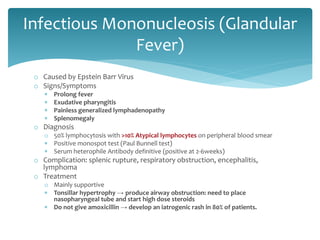
o Caused by Epstein Barr Virus
o Signs/Symptoms
 Prolong fever
 Exudative pharyngitis
 Painless generalized lymphadenopathy
 Splenomegaly
o Diagnosis
o 50% lymphocytosis with >10% Atypical lymphocytes on peripheral blood smear
 Positive monospot test (Paul Bunnell test)
 Serum heterophile Antibody definitive (positive at 2-6weeks)
o Complication: splenic rupture, respiratory obstruction, encephalitis,
lymphoma
o Treatment
o Mainly supportive
 Tonsillar hypertrophy → produce airway obstruction: need to place
nasopharyngeal tube and start high dose steroids
 Do not give amoxicillin → develop an iatrogenic rash in 80% of patients.
Infectious Mononucleosis (Glandular
Fever)
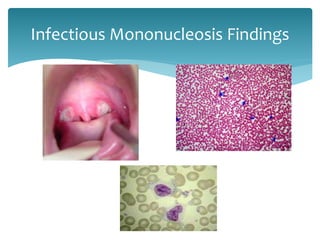
Infectious Mononucleosis Findings
 From Herpesviridae family
 Infectious mononucleosis like syndrome
 CF: fatigue, malaise, myalgia, headache, fever,
hepatosplenomegaly, elevated liver enzymes
 Ix: atypical lymphocytosis in peripheral blood smear,
CMV DNA PCR
 Tx: not indicated for immunocompetent persons
Cytomegalovirus
 Staphylococcus aureus and Group A Streptococcus
 Common history reveals recent
 URI
 Earache
 Sore Throat/Toothache
 Skin Lesions: erythema and tender of overlying skin
 Tx: Oral or IV antibiotics depending on severity of
infection
 If not resolving or getting worse Ultrasound or CT
scan to evaluate for phlegmon/abscess
 Surgical I&D vs Surgical Excision if abscess
Suppurative Bacterial Lymphadenitis
TB Lymphadenitis
o Most commonest form of extrapulmonary manifestation of TB in
children
o Tonsillar, anterior cervical, submandibular, and supraclavicular nodes
secondary to extension of the primary lesion of TB (lung/abdomen)
o Inguinal, epitrochlear, or axillary regions result from regional
lymphadenitis associated with tuberculosis of the skin or skeletal
system.
o Characteristic: firm, discrete and nontender – often feel fixed to
overlying tissue→ disease progress, multiple node infected (matted)
o Unilateral
o Reactive tuberculin test
o Dx: fine – needle aspiration of node (through histologic and bacterial
conformation)
o Response well to anti – TB therapy
 Treponema pallidum
 Vertical transmission, sexual contact with infectious lesion, blood
product
 4 stages: primary, secondary, latent and tertiary
 Primary:
 glands of penis, vulva or cervix
 Other: anus, fingers, oropharynx, tongue
 Regional lymphadenopathy
 2nd: localized or diffuse mucocutaneous rash, patch alopecia
condylomata with generalized non tender lymphadenopathy
 3rd: CNS involvement or CVS
 Ix: VDRL
 Tx: IM Benzathine Penincillin
Syphilis
 Bartonella Henselae
o Commonest cause of chronic lymphadenitis
 90% have had exposure to cat bite or scratch
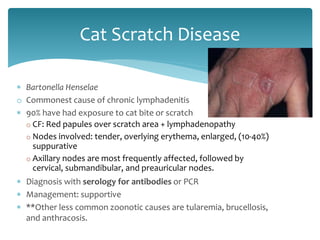
o CF: Red papules over scratch area + lymphadenopathy
o Nodes involved: tender, overlying erythema, enlarged, (10-40%)
suppurative
o Axillary nodes are most frequently affected, followed by
cervical, submandibular, and preauricular nodes.
 Diagnosis with serology for antibodies or PCR
 Management: supportive
 **Other less common zoonotic causes are tularemia, brucellosis,
and anthracosis.
Cat Scratch Disease
 Toxoplasma gondii
 Mechanism
 Consumption of undercooked meat
 Ingestion of oocytes from cat feces
 Symptoms
 Malaise, fever, sore throat, myalgias
 90% have cervical lymphadenitis
 Diagnosis by serologic testing
 Complications
 myocarditis
 pneumonitis
 Risk of TORCH infection to fetus
 Treatment with pyrimethamine or sulfonamides
Toxoplasmosis
Storage diseases
Gaucher disease
o multisystemic lipidosis characterized by hematologic problems,
hepatosplenomegaly, and skeletal involvement
o results from the deficient activity of the lysosomal hydrolase, acid β-glucosidase
o CFx:
 easily bruising owing to thrombocytopenia
 chronic fatigue secondary to anemia
 hepatomegaly with or without elevated liver function test results
 splenomegaly
 bone pain
Niemann-Pick disease
o 3 types:
 Type A & B deficient activity of acid sphingomyelinase
 Type C is defective cholesterol transport
o Characterized by a normal appearance at birth. Hepatosplenomegaly, moderate
lymphadenopathy, and psychomotor retardation are evident by 6 mo of age,
followed by neurodevelopmental regression.
o With advancing age, the loss of motor function and the deterioration of
intellectual capabilities are progressively debilitating; and in later stages,
spasticity and rigidity are evident.
o Affected infants lose contact with their environment - DEATH
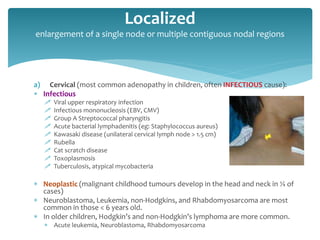
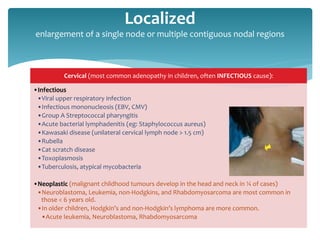
a) Cervical (most common adenopathy in children, often INFECTIOUS cause):
 Infectious
 Viral upper respiratory infection
 Infectious mononucleosis (EBV, CMV)
 Group A Streptococcal pharyngitis
 Acute bacterial lymphadenitis (eg: Staphylococcus aureus)
 Kawasaki disease (unilateral cervical lymph node > 1.5 cm)
 Rubella
 Cat scratch disease
 Toxoplasmosis
 Tuberculosis, atypical mycobacteria
 Neoplastic (malignant childhood tumours develop in the head and neck in ¼ of
cases)
 Neuroblastoma, Leukemia, non-Hodgkins, and Rhabdomyosarcoma are most
common in those < 6 years old.
 In older children, Hodgkin’s and non-Hodgkin’s lymphoma are more common.
 Acute leukemia, Neuroblastoma, Rhabdomyosarcoma
Localized
enlargement of a single node or multiple contiguous nodal regions
Cervical (most common adenopathy in children, often INFECTIOUS cause):
•Infectious
•Viral upper respiratory infection
•Infectious mononucleosis (EBV, CMV)
•Group A Streptococcal pharyngitis
•Acute bacterial lymphadenitis (eg: Staphylococcus aureus)
•Kawasaki disease (unilateral cervical lymph node > 1.5 cm)
•Rubella
•Cat scratch disease
•Toxoplasmosis
•Tuberculosis, atypical mycobacteria
•Neoplastic (malignant childhood tumours develop in the head and neck in ¼ of cases)
•Neuroblastoma, Leukemia, non-Hodgkins, and Rhabdomyosarcoma are most common in
those < 6 years old.
•In older children, Hodgkin’s and non-Hodgkin’s lymphoma are more common.
•Acute leukemia, Neuroblastoma, Rhabdomyosarcoma
Localized
enlargement of a single node or multiple contiguous nodal regions
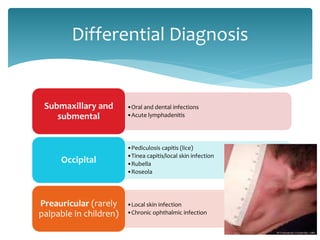
•Oral and dental infections
•Acute lymphadenitis
Submaxillary and
submental
•Pediculosis capitis (lice)
•Tinea capitis/local skin infection
•Rubella
•Roseola
Occipital
•Local skin infection
•Chronic ophthalmic infection
Preauricular (rarely
palpable in children)
Differential Diagnosis
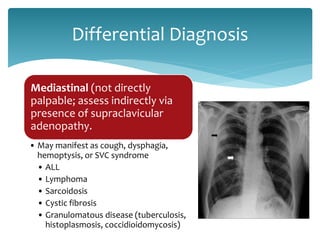
Mediastinal (not directly
palpable; assess indirectly via
presence of supraclavicular
adenopathy.
• May manifest as cough, dysphagia,
hemoptysis, or SVC syndrome
• ALL
• Lymphoma
• Sarcoidosis
• Cystic fibrosis
• Granulomatous disease (tuberculosis,
histoplasmosis, coccidioidomycosis)
Differential Diagnosis
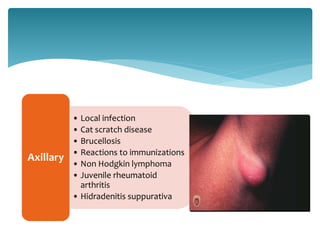
• Local infection
• Cat scratch disease
• Brucellosis
• Reactions to immunizations
• Non Hodgkin lymphoma
• Juvenile rheumatoid
arthritis
• Hidradenitis suppurativa
Axillary
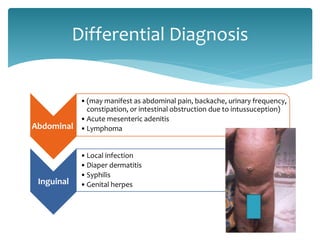
Abdominal
•(may manifest as abdominal pain, backache, urinary frequency,
constipation, or intestinal obstruction due to intussuception)
•Acute mesenteric adenitis
•Lymphoma
Inguinal
•Local infection
•Diaper dermatitis
•Syphilis
•Genital herpes
Differential Diagnosis
 Characteristic of LN: onset, size, duration, is it painful
or erythematous? Generalized or local? Associated
symptom?
 Recent infection? URT symptom? Rashes? Changes in
bowel movement or voiding patterns? Bone and joint
pain?
 Constitutional sx? Fever, night sweat, weight loss?
 Skin lesion or trauma? Cat scratch? Animal/ insect
bites? Open wounds? Dental abscess?
History
 Any ongoing medical condition? Surgery?
 Recent travel and exposures? Contact with infected person?
Viral respiratory exposures such as EBV/ CMV? TB exposure?
 Immunization status? MMR? DTaP?
 Medication? Isnoniazide, Allopurinol, Phenylbutazone,
Pyrimethamine? Carbemazepine or phenytoin?
 Allergies
 Adolescence: IVDU or sexual history
 Cats: Toxoplasmosis and Bartonella
 Foods: Unpasteurized milk (Brucellosis), Undercooked meats
(Toxoplasmosis, Tularemia)
History
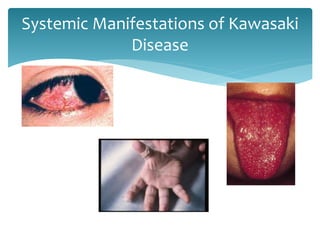
 Lymphomucocutaneous Disease
 Five Characteristics of Disease (4/5 for diagnosis)
 Fever >5 days
 Cervical lymphadenopathy (usually unilateral)
 Erythema and edema of palms and soles with desquamation of skin
 Nonpurulent Bilateral Conjunctivitis
 Strawberry Tongue
 Complications
 Coronary artery aneurysms
 Coronary artery thromboses
 Myocardial infarction
 Treatment
o IVIG and Aspirin
 **Be sure to get Echo and EKG is Kawasaki disease is suspected
Kawasaki Disease
Systemic Manifestations of Kawasaki
Disease
 Complete blood count, peripheral blood smear
 Erythrocyte sedimentation rate (non-specific)
 Rule out infectious causes: Monospot, CMV, EBV, &
toxoplasma, Bartonella titres, TB skin test, Anti-HIV test,
CRP, ESR
 Hepatic and renal function + urinalysis (systemic
disorders that can cause lymphadenopathy)
 Lactate dehydrogenase, uric acid, calcium, phosphate,
magnesium if malignancy suspected
 US guided lymph node biopsy
Investigations
 Chest X-ray. This study will help determine the presence of
mediastinal adenopathy and underlying pulmonary diseases
including tuberculosis, coccidioidomycosis, lymphomas, and
neuroblastoma.
 CT of the chest and/or abdomen. Supraclavicular adenopathy is
highly associated with serious disease in the chest and abdomen.
 Bone marrow, liver biopsies,
 Nuclear medicine scanning is helpful in the evaluation of
lymphomas.
Imaging Studies
Biopsy indications
1. + constitutional sx
2. Very large LN
3. Persistent growing > 2 wk
4. Constant for 6 wks
5. Fixed lymph nodes
6. Non responsive after 2 course of
antibiotic therapy
 Treatment with antibiotics. Bacterial infection results in large
nodes that are warm, erythematous, and tender. Start on
antibiotics that cover the bacterial pathogens frequently
implicated in lymphadenitis, including staphylococcus aureus
and streptococcus pyogenes. Reevaluate in 2-4 weeks. Biopsy if
unchanged or larger.
 If malignancy is a strong possibility excisional biopsy should be
considered immediately.
 If lymphadenitis is present, aspirate may be needed for culture.
Management
Management
 Treat the underlying cause.
 If no specific cause – Antibiotic (10day course), if still persist- give
another course of other antibiotic
 Antifungal, anti-TB
 Chemotherapy- for malignancy
 HAART- for HIV
 Incision & drainage – nodes with suppuration
 In summary, lymphadenopathy is a sign of a variety of
underlying disorders, most of which are benign in
children.
 Less commonly, there is a more serious cause of
lymphadenopathy and thus it is extremely important to
think of and rule out malignancy through a thorough
history and physical exam.
Conclusion
 Most common form of reactive lymphadenopathy
 Common virus’ involved:
1. Adenovirus
2. Rhinovirus
3. Coxsackie virus A and B
4. EBV
 Lymphadenopathy often bilateral, diffuse, non-tender
 Other Signs/Symptoms are consistent with URI
 Management is expectant but they are often biopsied due to slow
regression
 Nodal architecture and hilar vascularity are normal on pathologic
examination
Viral Lymphadenitis

Child with lymphadenopathy

  • 1.
    Approach to Childwith Lymphadenopathy Nurzawani Binti Shamsudin 0918424
  • 2.
     Introduction  Anatomy Pathophysiology  Generalized lymphadenopathy  Regional lymphadenopathy  Investigation  Management Outline
  • 3.
    Introduction  Lymphatic system Network of organs, lymph nodes, lymph ducts and lymph vessel that make and drain lymph from tissues to the bloodstream.  This lymphoid tissue concerned with immune function in defending body against antigen.  Primary lymphoid organ (thymus & bone marrow)  Secondary lymphoid organ (lymph nodes, tonsil & others)  Lymphoid tissue enlarges until puberty & progressively atrophy throughout life  Functions  Removal of interstitial fluid from tissues, collection of lymph plasma  Absorption & transport of fatty acids and fats  Formation of a defense mechanism for the body
  • 4.
  • 5.
     Enlargement oflymph node  Normal lymph nodes are discrete, non tender, and mobile without fixation to underlying tissues.  Significant enlarged:  >1 cm in cervical and axillary,  >1.5cm in inguinal nodes Lymphadenopathy
  • 6.
     Localized responsefrom lymphocyte and macrophage – viral/ bacterial infection  Localized infiltration by inflammatory cells in response to infection of nodes- lymphadenitis  Proliferation of neoplastic lymphocyte or macrophages- neoplasm Pathophysiology
  • 7.
     Generalized lymphadenopathy(enlargement of >2 noncontiguous node regions) is caused by systemic disease  Regional lymphadenopathy is most frequently the result of infection in the involved node and/or its drainage area Lymphadenopathy
  • 8.
    Generalized Inflammation Infective Infant: Syphilis, Toxoplasmosis, CMV,HIV Child: Viral infection, EBV, CMV, Toxoplasmosis Autoimmune Child: SLE, JRA, Sarcoidosis, Fungal infection, Plaque, Chronic granulomatous disease Malignancy Primary Secondary Generalized adenopathy
  • 9.
    Generalized enlargement of morethan 2 noncontiguous lymph node groups Infectious • Viral (most common): URTI, measles, varicella, rubella, hepatitis, HIV, EBV, CMV, adenovirus • Bacterial: syphilis, brucellosis, tuberculosis, typhoid fever, septicemia • Fungal: histoplasmosis, coccidioidomycosis • Protozoal: toxoplasmosis Non-infectious inflammatory diseases • Rheumatologic diseases: Sarcoidosis, rheumatoid arthritis, SLE • Storage diseases: Neimenn-Pick disease, Gaucher disease • Serum sickness • Rosai-Dorfman disease Malignant: leukemia, lymphoma, neuroblastoma Drug reaction: phenytoin, allopurinol Hyperthyroidism
  • 10.
    o Caused byEpstein Barr Virus o Signs/Symptoms  Prolong fever  Exudative pharyngitis  Painless generalized lymphadenopathy  Splenomegaly o Diagnosis o 50% lymphocytosis with >10% Atypical lymphocytes on peripheral blood smear  Positive monospot test (Paul Bunnell test)  Serum heterophile Antibody definitive (positive at 2-6weeks) o Complication: splenic rupture, respiratory obstruction, encephalitis, lymphoma o Treatment o Mainly supportive  Tonsillar hypertrophy → produce airway obstruction: need to place nasopharyngeal tube and start high dose steroids  Do not give amoxicillin → develop an iatrogenic rash in 80% of patients. Infectious Mononucleosis (Glandular Fever)
  • 11.
  • 12.
     From Herpesviridaefamily  Infectious mononucleosis like syndrome  CF: fatigue, malaise, myalgia, headache, fever, hepatosplenomegaly, elevated liver enzymes  Ix: atypical lymphocytosis in peripheral blood smear, CMV DNA PCR  Tx: not indicated for immunocompetent persons Cytomegalovirus
  • 13.
     Staphylococcus aureusand Group A Streptococcus  Common history reveals recent  URI  Earache  Sore Throat/Toothache  Skin Lesions: erythema and tender of overlying skin  Tx: Oral or IV antibiotics depending on severity of infection  If not resolving or getting worse Ultrasound or CT scan to evaluate for phlegmon/abscess  Surgical I&D vs Surgical Excision if abscess Suppurative Bacterial Lymphadenitis
  • 14.
    TB Lymphadenitis o Mostcommonest form of extrapulmonary manifestation of TB in children o Tonsillar, anterior cervical, submandibular, and supraclavicular nodes secondary to extension of the primary lesion of TB (lung/abdomen) o Inguinal, epitrochlear, or axillary regions result from regional lymphadenitis associated with tuberculosis of the skin or skeletal system. o Characteristic: firm, discrete and nontender – often feel fixed to overlying tissue→ disease progress, multiple node infected (matted) o Unilateral o Reactive tuberculin test o Dx: fine – needle aspiration of node (through histologic and bacterial conformation) o Response well to anti – TB therapy
  • 15.
     Treponema pallidum Vertical transmission, sexual contact with infectious lesion, blood product  4 stages: primary, secondary, latent and tertiary  Primary:  glands of penis, vulva or cervix  Other: anus, fingers, oropharynx, tongue  Regional lymphadenopathy  2nd: localized or diffuse mucocutaneous rash, patch alopecia condylomata with generalized non tender lymphadenopathy  3rd: CNS involvement or CVS  Ix: VDRL  Tx: IM Benzathine Penincillin Syphilis
  • 16.
     Bartonella Henselae oCommonest cause of chronic lymphadenitis  90% have had exposure to cat bite or scratch o CF: Red papules over scratch area + lymphadenopathy o Nodes involved: tender, overlying erythema, enlarged, (10-40%) suppurative o Axillary nodes are most frequently affected, followed by cervical, submandibular, and preauricular nodes.  Diagnosis with serology for antibodies or PCR  Management: supportive  **Other less common zoonotic causes are tularemia, brucellosis, and anthracosis. Cat Scratch Disease
  • 17.
     Toxoplasma gondii Mechanism  Consumption of undercooked meat  Ingestion of oocytes from cat feces  Symptoms  Malaise, fever, sore throat, myalgias  90% have cervical lymphadenitis  Diagnosis by serologic testing  Complications  myocarditis  pneumonitis  Risk of TORCH infection to fetus  Treatment with pyrimethamine or sulfonamides Toxoplasmosis
  • 18.
    Storage diseases Gaucher disease omultisystemic lipidosis characterized by hematologic problems, hepatosplenomegaly, and skeletal involvement o results from the deficient activity of the lysosomal hydrolase, acid β-glucosidase o CFx:  easily bruising owing to thrombocytopenia  chronic fatigue secondary to anemia  hepatomegaly with or without elevated liver function test results  splenomegaly  bone pain Niemann-Pick disease o 3 types:  Type A & B deficient activity of acid sphingomyelinase  Type C is defective cholesterol transport o Characterized by a normal appearance at birth. Hepatosplenomegaly, moderate lymphadenopathy, and psychomotor retardation are evident by 6 mo of age, followed by neurodevelopmental regression. o With advancing age, the loss of motor function and the deterioration of intellectual capabilities are progressively debilitating; and in later stages, spasticity and rigidity are evident. o Affected infants lose contact with their environment - DEATH
  • 19.
    a) Cervical (mostcommon adenopathy in children, often INFECTIOUS cause):  Infectious  Viral upper respiratory infection  Infectious mononucleosis (EBV, CMV)  Group A Streptococcal pharyngitis  Acute bacterial lymphadenitis (eg: Staphylococcus aureus)  Kawasaki disease (unilateral cervical lymph node > 1.5 cm)  Rubella  Cat scratch disease  Toxoplasmosis  Tuberculosis, atypical mycobacteria  Neoplastic (malignant childhood tumours develop in the head and neck in ¼ of cases)  Neuroblastoma, Leukemia, non-Hodgkins, and Rhabdomyosarcoma are most common in those < 6 years old.  In older children, Hodgkin’s and non-Hodgkin’s lymphoma are more common.  Acute leukemia, Neuroblastoma, Rhabdomyosarcoma Localized enlargement of a single node or multiple contiguous nodal regions
  • 20.
    Cervical (most commonadenopathy in children, often INFECTIOUS cause): •Infectious •Viral upper respiratory infection •Infectious mononucleosis (EBV, CMV) •Group A Streptococcal pharyngitis •Acute bacterial lymphadenitis (eg: Staphylococcus aureus) •Kawasaki disease (unilateral cervical lymph node > 1.5 cm) •Rubella •Cat scratch disease •Toxoplasmosis •Tuberculosis, atypical mycobacteria •Neoplastic (malignant childhood tumours develop in the head and neck in ¼ of cases) •Neuroblastoma, Leukemia, non-Hodgkins, and Rhabdomyosarcoma are most common in those < 6 years old. •In older children, Hodgkin’s and non-Hodgkin’s lymphoma are more common. •Acute leukemia, Neuroblastoma, Rhabdomyosarcoma Localized enlargement of a single node or multiple contiguous nodal regions
  • 21.
    •Oral and dentalinfections •Acute lymphadenitis Submaxillary and submental •Pediculosis capitis (lice) •Tinea capitis/local skin infection •Rubella •Roseola Occipital •Local skin infection •Chronic ophthalmic infection Preauricular (rarely palpable in children) Differential Diagnosis
  • 22.
    Mediastinal (not directly palpable;assess indirectly via presence of supraclavicular adenopathy. • May manifest as cough, dysphagia, hemoptysis, or SVC syndrome • ALL • Lymphoma • Sarcoidosis • Cystic fibrosis • Granulomatous disease (tuberculosis, histoplasmosis, coccidioidomycosis) Differential Diagnosis
  • 23.
    • Local infection •Cat scratch disease • Brucellosis • Reactions to immunizations • Non Hodgkin lymphoma • Juvenile rheumatoid arthritis • Hidradenitis suppurativa Axillary
  • 24.
    Abdominal •(may manifest asabdominal pain, backache, urinary frequency, constipation, or intestinal obstruction due to intussuception) •Acute mesenteric adenitis •Lymphoma Inguinal •Local infection •Diaper dermatitis •Syphilis •Genital herpes Differential Diagnosis
  • 25.
     Characteristic ofLN: onset, size, duration, is it painful or erythematous? Generalized or local? Associated symptom?  Recent infection? URT symptom? Rashes? Changes in bowel movement or voiding patterns? Bone and joint pain?  Constitutional sx? Fever, night sweat, weight loss?  Skin lesion or trauma? Cat scratch? Animal/ insect bites? Open wounds? Dental abscess? History
  • 26.
     Any ongoingmedical condition? Surgery?  Recent travel and exposures? Contact with infected person? Viral respiratory exposures such as EBV/ CMV? TB exposure?  Immunization status? MMR? DTaP?  Medication? Isnoniazide, Allopurinol, Phenylbutazone, Pyrimethamine? Carbemazepine or phenytoin?  Allergies  Adolescence: IVDU or sexual history  Cats: Toxoplasmosis and Bartonella  Foods: Unpasteurized milk (Brucellosis), Undercooked meats (Toxoplasmosis, Tularemia) History
  • 27.
     Lymphomucocutaneous Disease Five Characteristics of Disease (4/5 for diagnosis)  Fever >5 days  Cervical lymphadenopathy (usually unilateral)  Erythema and edema of palms and soles with desquamation of skin  Nonpurulent Bilateral Conjunctivitis  Strawberry Tongue  Complications  Coronary artery aneurysms  Coronary artery thromboses  Myocardial infarction  Treatment o IVIG and Aspirin  **Be sure to get Echo and EKG is Kawasaki disease is suspected Kawasaki Disease
  • 28.
  • 29.
     Complete bloodcount, peripheral blood smear  Erythrocyte sedimentation rate (non-specific)  Rule out infectious causes: Monospot, CMV, EBV, & toxoplasma, Bartonella titres, TB skin test, Anti-HIV test, CRP, ESR  Hepatic and renal function + urinalysis (systemic disorders that can cause lymphadenopathy)  Lactate dehydrogenase, uric acid, calcium, phosphate, magnesium if malignancy suspected  US guided lymph node biopsy Investigations
  • 30.
     Chest X-ray.This study will help determine the presence of mediastinal adenopathy and underlying pulmonary diseases including tuberculosis, coccidioidomycosis, lymphomas, and neuroblastoma.  CT of the chest and/or abdomen. Supraclavicular adenopathy is highly associated with serious disease in the chest and abdomen.  Bone marrow, liver biopsies,  Nuclear medicine scanning is helpful in the evaluation of lymphomas. Imaging Studies
  • 31.
    Biopsy indications 1. +constitutional sx 2. Very large LN 3. Persistent growing > 2 wk 4. Constant for 6 wks 5. Fixed lymph nodes 6. Non responsive after 2 course of antibiotic therapy
  • 32.
     Treatment withantibiotics. Bacterial infection results in large nodes that are warm, erythematous, and tender. Start on antibiotics that cover the bacterial pathogens frequently implicated in lymphadenitis, including staphylococcus aureus and streptococcus pyogenes. Reevaluate in 2-4 weeks. Biopsy if unchanged or larger.  If malignancy is a strong possibility excisional biopsy should be considered immediately.  If lymphadenitis is present, aspirate may be needed for culture. Management
  • 33.
    Management  Treat theunderlying cause.  If no specific cause – Antibiotic (10day course), if still persist- give another course of other antibiotic  Antifungal, anti-TB  Chemotherapy- for malignancy  HAART- for HIV  Incision & drainage – nodes with suppuration
  • 34.
     In summary,lymphadenopathy is a sign of a variety of underlying disorders, most of which are benign in children.  Less commonly, there is a more serious cause of lymphadenopathy and thus it is extremely important to think of and rule out malignancy through a thorough history and physical exam. Conclusion
  • 35.
     Most commonform of reactive lymphadenopathy  Common virus’ involved: 1. Adenovirus 2. Rhinovirus 3. Coxsackie virus A and B 4. EBV  Lymphadenopathy often bilateral, diffuse, non-tender  Other Signs/Symptoms are consistent with URI  Management is expectant but they are often biopsied due to slow regression  Nodal architecture and hilar vascularity are normal on pathologic examination Viral Lymphadenitis

Editor's Notes

  • #5 Cervical lymphadenopathy: Cervical lymphadenopathy is a common problem in children.[11] Cervical nodes drain the tongue, external ear, parotid gland, and deeper structures of the neck, including the larynx, thyroid, and trachea. Inflammation or direct infection of these areas causes subsequent engorgement and hyperplasia of their respective node groups. Adenopathy is most common in cervical nodes in children and is usually related to infectious etiologies. Lymphadenopathy posterior to the sternocleidomastoid is typically a more ominous finding, with a higher risk of serious underlying disease. Submaxillary and submental lymphadenopathy: These nodes drain the teeth, tongue, gums, and buccal mucosa. Their enlargement is usually the result of localized infection, such as pharyngitis, herpetic gingivostomatitis, and dental absces