www.ngsmips.nitte.edu.in
CODE OF FEDERAL REGULATIONS
(CFR)
DEPT OF PHARMACEUTICAL REGULATORY AFFAIRS
REGULATORY ASPECTS OF DRUGS AND COSMETICS
N.G.S.M. INSTITUTE OF PHARMACEUTICAL SCIENCES,
NITTE (DEEMED TO BE UNIVERSITY)
MANGALORE
- SWAPNIL D. FERNANDES
www.ngsmips.nitte.edu.in
CONTENTS
WHAT IS CFR ?
HISTORY OF CFR.
CFR TITLE 21
CFR IN MODERN TIMES
RESEARCH TOOLS IN CFR
CONCLUSION
www.ngsmips.nitte.edu.in
What is CFR ?
 The CFR is divided into 50 titles that represent broad areas
subject to federal regulation.
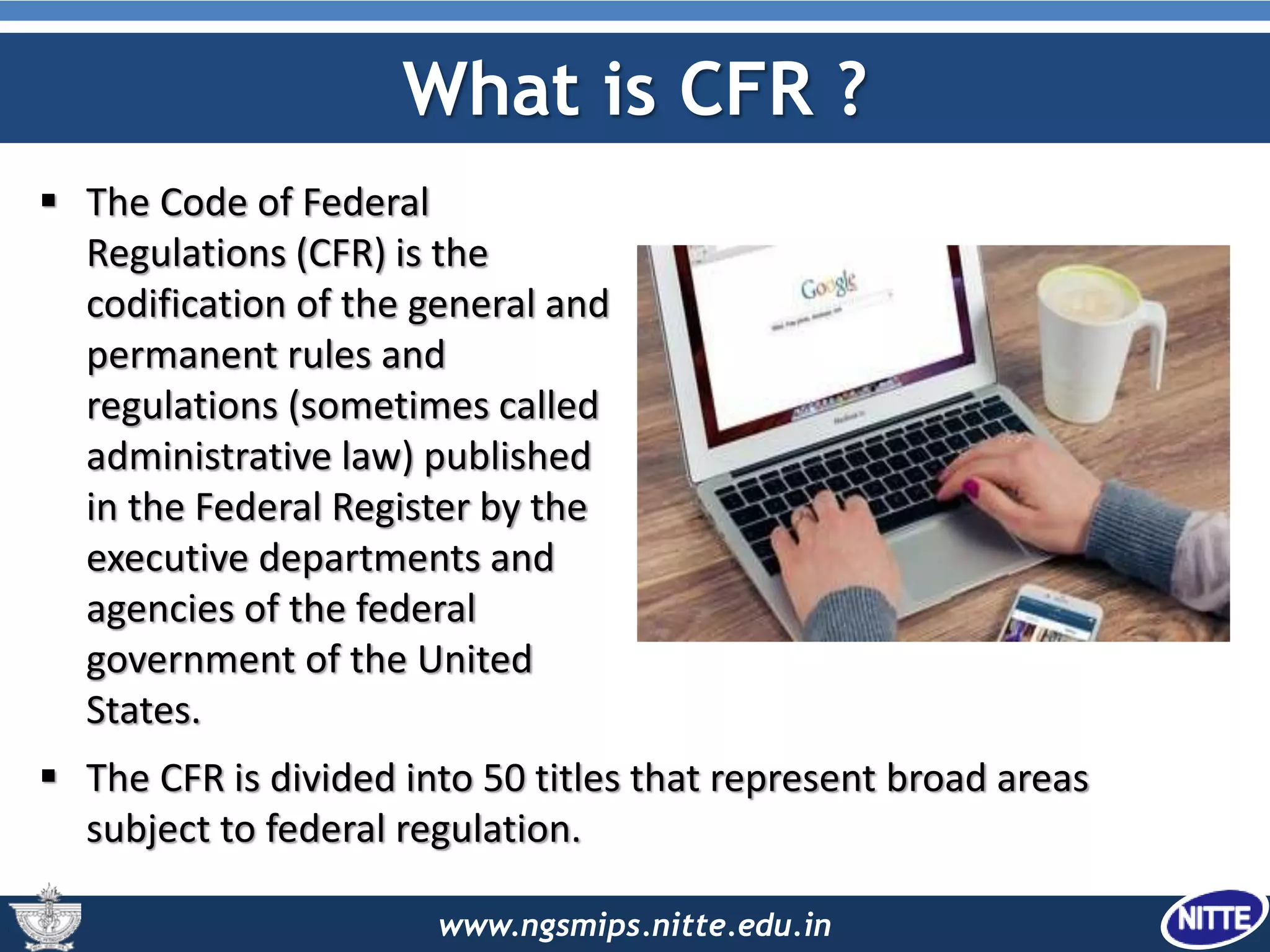
 The Code of Federal
Regulations (CFR) is the
codification of the general and
permanent rules and
regulations (sometimes called
administrative law) published
in the Federal Register by the
executive departments and
agencies of the federal
government of the United
States.
www.ngsmips.nitte.edu.in
 Each title is further divided into chapters, subchapters,
parts, and sections.
 A regulation is cited by title, part, and section, e.g. 14 CFR
121.313 (Title 14, Part 121, Section 313).
 The soft-cover volumes of the CFR are issued each year :
Titles 1 – 16 are updated as of January 1
Titles 17 – 27 are updated as of April 1
Titles 29 – 41 are updated as of July 1
Titles 42 – 50 are updated as of October 1
 The online CFR is a joint project authorized by the publisher,
the National Archives and Records Administration's (NARA)
Office of the Federal Register (OFR), and the Government
Publishing Office (GPO) to provide the public with enhanced
access to Government information.
www.ngsmips.nitte.edu.in
HISTORY OF CFR
www.ngsmips.nitte.edu.in
HISTORY OF CFR
 Franklin D. Roosevelt – 32nd President of the US.
 1935 - Instrumental in passing the Federal
Register Act – empowered the National Archives
of the US to form an Administrative Committee –
publish the Federal Register.
 The Federal Register Act - amended in 1937 to
provide a “codification” of all regulations every
five years – known as Code of Federal
Regulations.
www.ngsmips.nitte.edu.in
HISTORY OF CFR
 The first edition of the CFR was published in 1938 and
included all finalized regulations that were published in
the Federal Register from March 14, 1936 to June 1, 1938
 Beginning in 1963 for some titles and for all titles in 1967,
the Office of the Federal Register began publishing yearly
revisions.
 Beginning in 1972 - published revisions were conducted in
staggered quarters.
www.ngsmips.nitte.edu.in
CFR TITLE 21
www.ngsmips.nitte.edu.in
CFR TITLE 21
 Title 21 of the CFR is reserved for rules of the Food
and Drug Administration.
 Governs food and drugs within the United States for
the FDA, DEA, and the ONDCP.
 In all, 21 CFR consists of 1499 parts.
 It is divided into three chapters:
Chapter I — Food and Drug Administration
Chapter II — Drug Enforcement Administration
Chapter III — Office of National Drug Control
Policy
www.ngsmips.nitte.edu.in
CHAPTER I
 Most of the Chapter I regulations are based on the
Federal Food, Drug, and Cosmetic Act.
 Notable sections:
– 11 Electronic records and electronic signature related.
– 50 Protection of human subjects in clinical trials.
– 54 Financial Disclosure by Clinical Investigators.
– 56 Institutional Review Boards that oversee clinical
trials.
– 58 Good Laboratory Practices (GLP) for nonclinical
studies.
www.ngsmips.nitte.edu.in
 The 100 series are regulations pertaining to food.
 The 200 and 300 series are regulations pertaining
to pharmaceuticals
 The 500 series are regulations for animal feeds
and animal medications.
 The 600 series covers biological products.
 The 700 series includes the limited regulations
on cosmetics.
 The 800 series are for medical devices.
www.ngsmips.nitte.edu.in
 The 900 series covers mammography quality requirements
enforced by CDRH.
 The 1000 series covers radiation-emitting device
 The 1100 series includes updated rules with regards to
tobacco products.
 The 1200 series consists of rules primarily based in laws
other than the Food, Drug, and Cosmetic Act:
– Requirements for pasteurization of milk.
– Sanitation on interstate conveyances.
www.ngsmips.nitte.edu.in
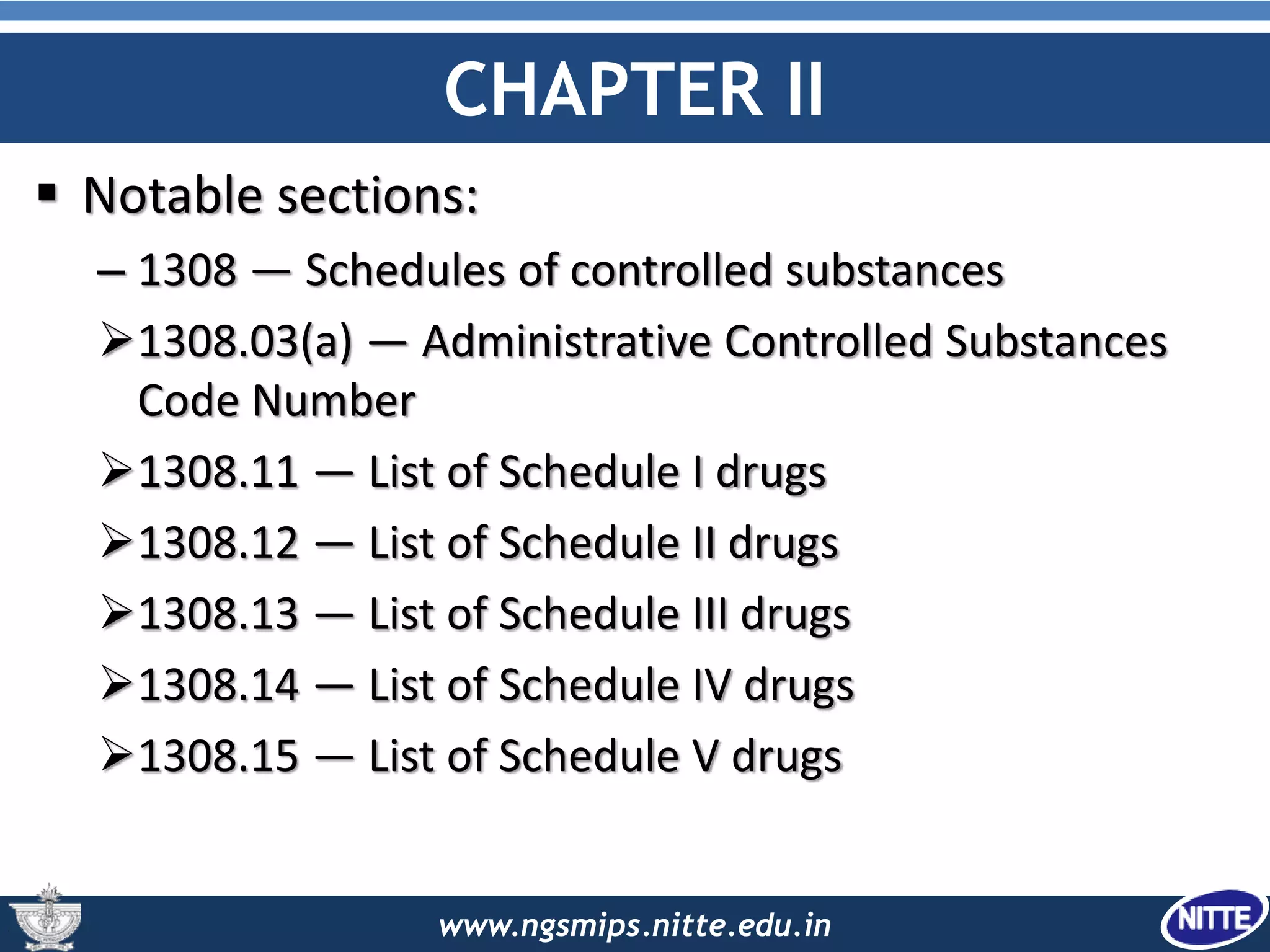
CHAPTER II
 Notable sections:
– 1308 — Schedules of controlled substances
1308.03(a) — Administrative Controlled Substances
Code Number
1308.11 — List of Schedule I drugs
1308.12 — List of Schedule II drugs
1308.13 — List of Schedule III drugs
1308.14 — List of Schedule IV drugs
1308.15 — List of Schedule V drugs
www.ngsmips.nitte.edu.in
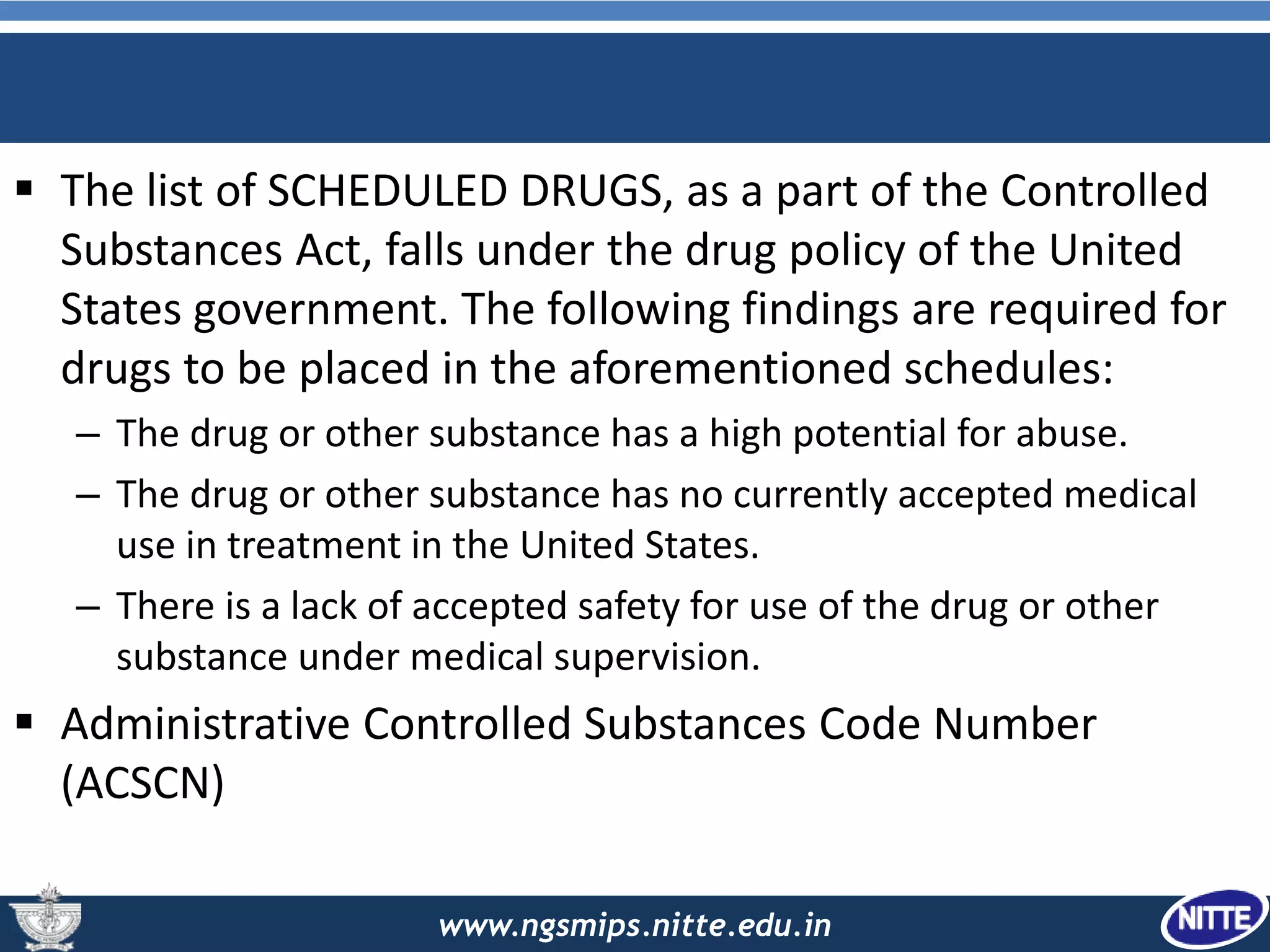
 The list of SCHEDULED DRUGS, as a part of the Controlled
Substances Act, falls under the drug policy of the United
States government. The following findings are required for
drugs to be placed in the aforementioned schedules:
– The drug or other substance has a high potential for abuse.
– The drug or other substance has no currently accepted medical
use in treatment in the United States.
– There is a lack of accepted safety for use of the drug or other
substance under medical supervision.
 Administrative Controlled Substances Code Number
(ACSCN)
www.ngsmips.nitte.edu.in
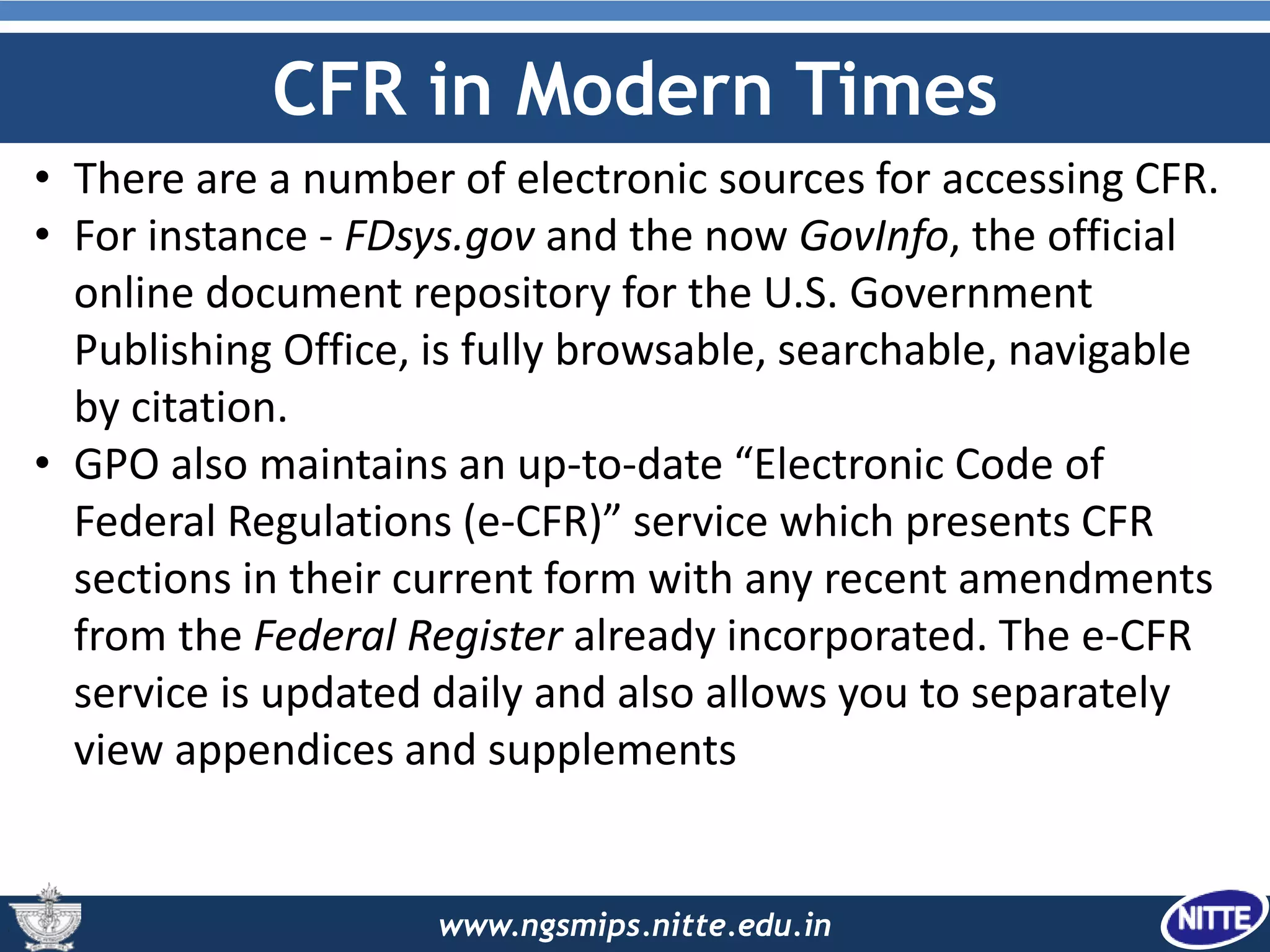
CFR in Modern Times
• There are a number of electronic sources for accessing CFR.
• For instance - FDsys.gov and the now GovInfo, the official
online document repository for the U.S. Government
Publishing Office, is fully browsable, searchable, navigable
by citation.
• GPO also maintains an up-to-date “Electronic Code of
Federal Regulations (e-CFR)” service which presents CFR
sections in their current form with any recent amendments
from the Federal Register already incorporated. The e-CFR
service is updated daily and also allows you to separately
view appendices and supplements
www.ngsmips.nitte.edu.in
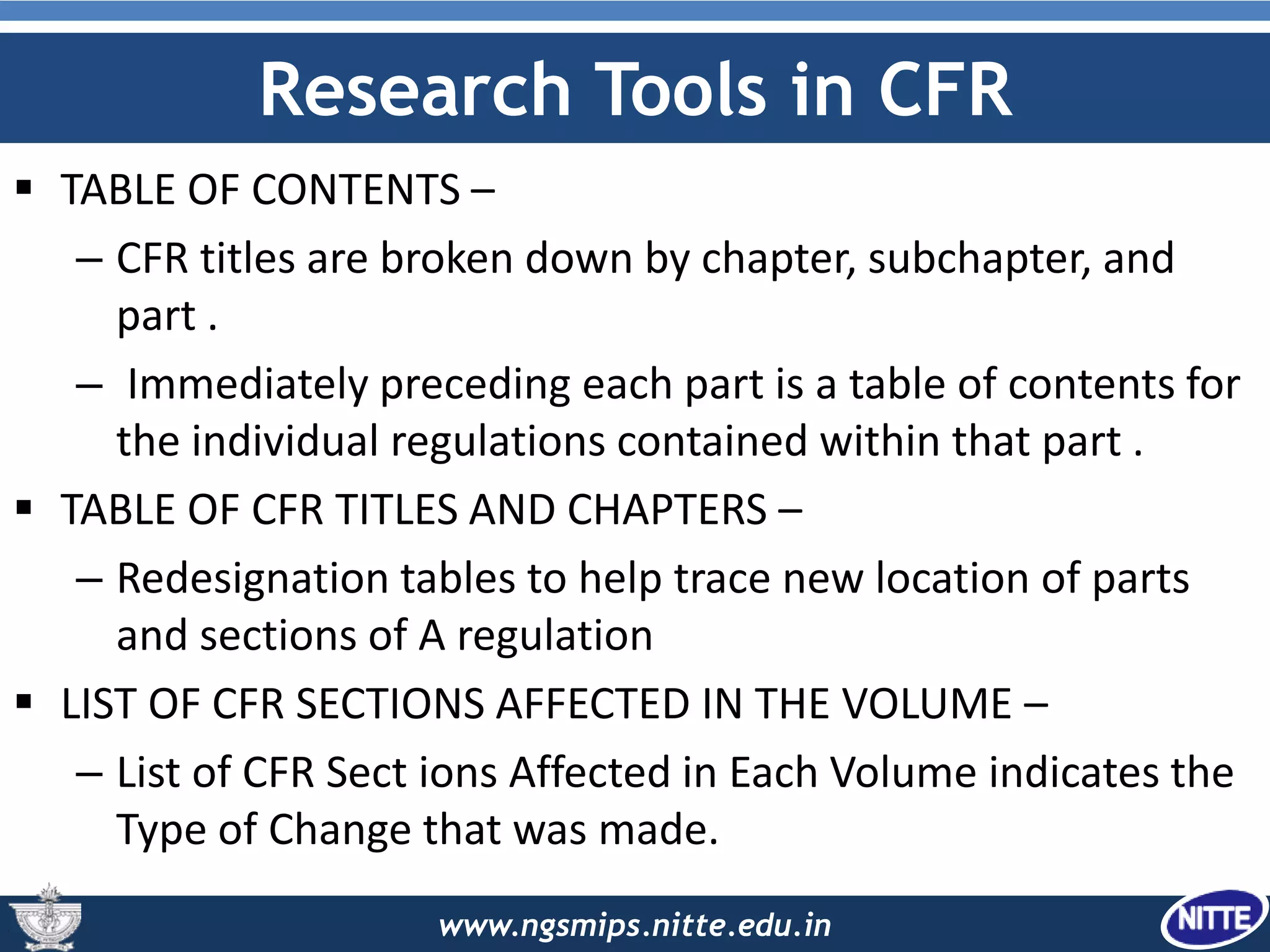
Research Tools in CFR
 TABLE OF CONTENTS –
– CFR titles are broken down by chapter, subchapter, and
part .
– Immediately preceding each part is a table of contents for
the individual regulations contained within that part .
 TABLE OF CFR TITLES AND CHAPTERS –
– Redesignation tables to help trace new location of parts
and sections of A regulation
 LIST OF CFR SECTIONS AFFECTED IN THE VOLUME –
– List of CFR Sect ions Affected in Each Volume indicates the
Type of Change that was made.
www.ngsmips.nitte.edu.in
CONCLUSION
 The Federal Register and the Code of Federal Regulations
replaced the existing system of dual set of regulations and
legislations that were in place.
 Although not perfect, the Federal Register and the CFR
appear to have met their original purpose of providing the
public with a comprehensive publication vehicle for all the
regulations issued by Federal agencies and the President.
 The CFR provided a codified form of the regulations, based
on title, chapters and subjects, that streamlined the
process of finding the required regulations and laws for the
pharmaceutical industry and the public in general, thereby
making these guidelines easily accessible.
www.ngsmips.nitte.edu.in
REFERENCES
 http://www.llsdc.org/fr-cfr-research-guide
(Accessed on 12th February 2018)
 Panama Refining Co. v. Ryan, 293 U.S. 388 (1935). Available from:
https://supreme.justia.com/cases/federal/us/293/388/case.html
 Griswold, E.N. Government in ignorance of the law; a plea for better
publication of executive legislation. 48 Harv. L. Rev. 198-215 (1934).
Available from: https://public.resource.org/48HarvLRev198.pdf
 CFR - Code of Federal Regulations Title 21. Available from :
https://www.accessdata.fda.gov/scripts/cdrh/cfdocs/cfcfr/cfrsearch.cf
m
(Accessed on 13th February 2018)
 https://en.wikipedia.org/wiki/Title_21_of_the_Code_of_Federal_Regul
ations
(Accessed on 13th February 2018)

Code of Federal Regulations

  • 1.
    www.ngsmips.nitte.edu.in CODE OF FEDERALREGULATIONS (CFR) DEPT OF PHARMACEUTICAL REGULATORY AFFAIRS REGULATORY ASPECTS OF DRUGS AND COSMETICS N.G.S.M. INSTITUTE OF PHARMACEUTICAL SCIENCES, NITTE (DEEMED TO BE UNIVERSITY) MANGALORE - SWAPNIL D. FERNANDES
  • 2.
    www.ngsmips.nitte.edu.in CONTENTS WHAT IS CFR? HISTORY OF CFR. CFR TITLE 21 CFR IN MODERN TIMES RESEARCH TOOLS IN CFR CONCLUSION
  • 3.
    www.ngsmips.nitte.edu.in What is CFR?  The CFR is divided into 50 titles that represent broad areas subject to federal regulation.  The Code of Federal Regulations (CFR) is the codification of the general and permanent rules and regulations (sometimes called administrative law) published in the Federal Register by the executive departments and agencies of the federal government of the United States.
  • 4.
    www.ngsmips.nitte.edu.in  Each titleis further divided into chapters, subchapters, parts, and sections.  A regulation is cited by title, part, and section, e.g. 14 CFR 121.313 (Title 14, Part 121, Section 313).  The soft-cover volumes of the CFR are issued each year : Titles 1 – 16 are updated as of January 1 Titles 17 – 27 are updated as of April 1 Titles 29 – 41 are updated as of July 1 Titles 42 – 50 are updated as of October 1  The online CFR is a joint project authorized by the publisher, the National Archives and Records Administration's (NARA) Office of the Federal Register (OFR), and the Government Publishing Office (GPO) to provide the public with enhanced access to Government information.
  • 5.
  • 6.
  • 7.
    www.ngsmips.nitte.edu.in HISTORY OF CFR Franklin D. Roosevelt – 32nd President of the US.  1935 - Instrumental in passing the Federal Register Act – empowered the National Archives of the US to form an Administrative Committee – publish the Federal Register.  The Federal Register Act - amended in 1937 to provide a “codification” of all regulations every five years – known as Code of Federal Regulations.
  • 8.
    www.ngsmips.nitte.edu.in HISTORY OF CFR The first edition of the CFR was published in 1938 and included all finalized regulations that were published in the Federal Register from March 14, 1936 to June 1, 1938  Beginning in 1963 for some titles and for all titles in 1967, the Office of the Federal Register began publishing yearly revisions.  Beginning in 1972 - published revisions were conducted in staggered quarters.
  • 9.
  • 10.
    www.ngsmips.nitte.edu.in CFR TITLE 21 Title 21 of the CFR is reserved for rules of the Food and Drug Administration.  Governs food and drugs within the United States for the FDA, DEA, and the ONDCP.  In all, 21 CFR consists of 1499 parts.  It is divided into three chapters: Chapter I — Food and Drug Administration Chapter II — Drug Enforcement Administration Chapter III — Office of National Drug Control Policy
  • 11.
    www.ngsmips.nitte.edu.in CHAPTER I  Mostof the Chapter I regulations are based on the Federal Food, Drug, and Cosmetic Act.  Notable sections: – 11 Electronic records and electronic signature related. – 50 Protection of human subjects in clinical trials. – 54 Financial Disclosure by Clinical Investigators. – 56 Institutional Review Boards that oversee clinical trials. – 58 Good Laboratory Practices (GLP) for nonclinical studies.
  • 12.
    www.ngsmips.nitte.edu.in  The 100series are regulations pertaining to food.  The 200 and 300 series are regulations pertaining to pharmaceuticals  The 500 series are regulations for animal feeds and animal medications.  The 600 series covers biological products.  The 700 series includes the limited regulations on cosmetics.  The 800 series are for medical devices.
  • 13.
    www.ngsmips.nitte.edu.in  The 900series covers mammography quality requirements enforced by CDRH.  The 1000 series covers radiation-emitting device  The 1100 series includes updated rules with regards to tobacco products.  The 1200 series consists of rules primarily based in laws other than the Food, Drug, and Cosmetic Act: – Requirements for pasteurization of milk. – Sanitation on interstate conveyances.
  • 14.
    www.ngsmips.nitte.edu.in CHAPTER II  Notablesections: – 1308 — Schedules of controlled substances 1308.03(a) — Administrative Controlled Substances Code Number 1308.11 — List of Schedule I drugs 1308.12 — List of Schedule II drugs 1308.13 — List of Schedule III drugs 1308.14 — List of Schedule IV drugs 1308.15 — List of Schedule V drugs
  • 15.
    www.ngsmips.nitte.edu.in  The listof SCHEDULED DRUGS, as a part of the Controlled Substances Act, falls under the drug policy of the United States government. The following findings are required for drugs to be placed in the aforementioned schedules: – The drug or other substance has a high potential for abuse. – The drug or other substance has no currently accepted medical use in treatment in the United States. – There is a lack of accepted safety for use of the drug or other substance under medical supervision.  Administrative Controlled Substances Code Number (ACSCN)
  • 16.
    www.ngsmips.nitte.edu.in CFR in ModernTimes • There are a number of electronic sources for accessing CFR. • For instance - FDsys.gov and the now GovInfo, the official online document repository for the U.S. Government Publishing Office, is fully browsable, searchable, navigable by citation. • GPO also maintains an up-to-date “Electronic Code of Federal Regulations (e-CFR)” service which presents CFR sections in their current form with any recent amendments from the Federal Register already incorporated. The e-CFR service is updated daily and also allows you to separately view appendices and supplements
  • 17.
    www.ngsmips.nitte.edu.in Research Tools inCFR  TABLE OF CONTENTS – – CFR titles are broken down by chapter, subchapter, and part . – Immediately preceding each part is a table of contents for the individual regulations contained within that part .  TABLE OF CFR TITLES AND CHAPTERS – – Redesignation tables to help trace new location of parts and sections of A regulation  LIST OF CFR SECTIONS AFFECTED IN THE VOLUME – – List of CFR Sect ions Affected in Each Volume indicates the Type of Change that was made.
  • 18.
    www.ngsmips.nitte.edu.in CONCLUSION  The FederalRegister and the Code of Federal Regulations replaced the existing system of dual set of regulations and legislations that were in place.  Although not perfect, the Federal Register and the CFR appear to have met their original purpose of providing the public with a comprehensive publication vehicle for all the regulations issued by Federal agencies and the President.  The CFR provided a codified form of the regulations, based on title, chapters and subjects, that streamlined the process of finding the required regulations and laws for the pharmaceutical industry and the public in general, thereby making these guidelines easily accessible.
  • 19.
    www.ngsmips.nitte.edu.in REFERENCES  http://www.llsdc.org/fr-cfr-research-guide (Accessed on12th February 2018)  Panama Refining Co. v. Ryan, 293 U.S. 388 (1935). Available from: https://supreme.justia.com/cases/federal/us/293/388/case.html  Griswold, E.N. Government in ignorance of the law; a plea for better publication of executive legislation. 48 Harv. L. Rev. 198-215 (1934). Available from: https://public.resource.org/48HarvLRev198.pdf  CFR - Code of Federal Regulations Title 21. Available from : https://www.accessdata.fda.gov/scripts/cdrh/cfdocs/cfcfr/cfrsearch.cf m (Accessed on 13th February 2018)  https://en.wikipedia.org/wiki/Title_21_of_the_Code_of_Federal_Regul ations (Accessed on 13th February 2018)

Editor's Notes

  • #4 The regulations are first published (chronologically) in the Federal Register on a daily basis - then codified in the Code of Federal Regulations. When codified, they are arranged by title, then by chapter and then by subject.
  • #5 Volumes are issued in sets on a staggered, quarterly basis
  • #8 President from 1933 - 1945
  • #11 A revised Title 21 is issued on approximately April 1st of each year. the Drug Enforcement Administration (DEA), and the Office of National Drug Control Policy (ONDCP). 1st being general enforcement and general administrative rulings, all the way to schedules for controlled substances and registration of manufacturers, importers, distributors.
  • #13 106-107 requirements for infant formula, 110 cGMPs for food products, 111 et seq. cGMPs for Dietary Supplements, 190 dietary supplements. 202-203 Drug advertising and marketing, 210 cGMPs for pharmaceuticals, 310 Requirements for new drugs, 328 Specific requirements for (OTC) drugs. 601 Licensing under section 351 of the Public Health Service Act, 606 cGMPs for human blood and blood products 803 Medical Device Reporting, 814 Premarket Approval of Medical Devices
  • #16 Acscn is a number assigned to drugs listed on the schedules created by the Controlled Substances Act. For example, heroin is assigned 9200.