S.GOKULAKRISHNAN
M.Pharm (Pharmaceutics) – I Year,
Department of Pharmaceutics,
College of Pharmacy,
Mother Theresa Post Graduate and Research Institute of Health Sciences,
Puducherry.
NON CLINICAL DRUG DEVELOPMENT
-NEW DRUG APPLICATION
GOKULAKRISHNAN NON CLINICAL DRUG DEVELOPMENT 1
OBJECTIVES
Provide enough information to permit FDA reviewers to establish the
following:
 Safety & effectiveness of drug.
 Benefits overweigh risks.
 Is the drug’s proposed labelling (package insert) appropriate, and what
should it contain?
 Are the methods used in manufacturing (Good Manufacturing Practice,
GMP) the drug and the controls used to maintain the drug’s quality
adequate to preserve the drug’s identity,,strength,quality and purity
GOKULAKRISHNAN NON CLINICAL DRUG DEVELOPMENT 2
NEW DRUG APPLICATION
For decades, the regulation and control of new drugs in the United
States has been based on the New Drug Application (NDA). Since
1938, every new drug has been the subject of an approved NDA
before U.S. commercialization.
The data gathered during the animal studies and human clinical
trials of an Investigational New Drug (IND) becomes part of the
NDA.
GOKULAKRISHNAN NON CLINICAL DRUG DEVELOPMENT 3
NDA CONTENTS
The NDA may have as many as 20 different sections in
addition to the Form FDA-356h itself
The specific contents of the NDA will depend on the Nature
of the drug product and the information available at the time
of submission the application
Form FDA-356h serves as Checklist as well as Certification
that, the sponsor agrees to comply with a range of legal and
regulatory requirements
GOKULAKRISHNAN NON CLINICAL DRUG DEVELOPMENT 4
NDA CONTENTS
 Introduction
 Brief description of the drug and the therapeutic class to which it belongs
 Chemical and pharmaceutical information
 Animal Pharmacolog
 Animal Toxicology
 Human/Clinical Pharmacology phase I
 Therapeutic exploratory trials (Phase II)
 Therapeutic confirmatory trials (Phase III)
 Special Studies
Geriatrics, pediatrics, pregnant or nursing women
 Regulatory status in other countries
 Prescribing information
 Samples and Testing Protocol/sGOKULAKRISHNAN NON CLINICAL DRUG DEVELOPMENT 5
WHEN TO GET APPROVAL FROM NDA
GOKULAKRISHNAN NON CLINICAL DRUG DEVELOPMENT 6
CLINICAL TRAIL PHASES
GOKULAKRISHNAN NON CLINICAL DRUG DEVELOPMENT 7
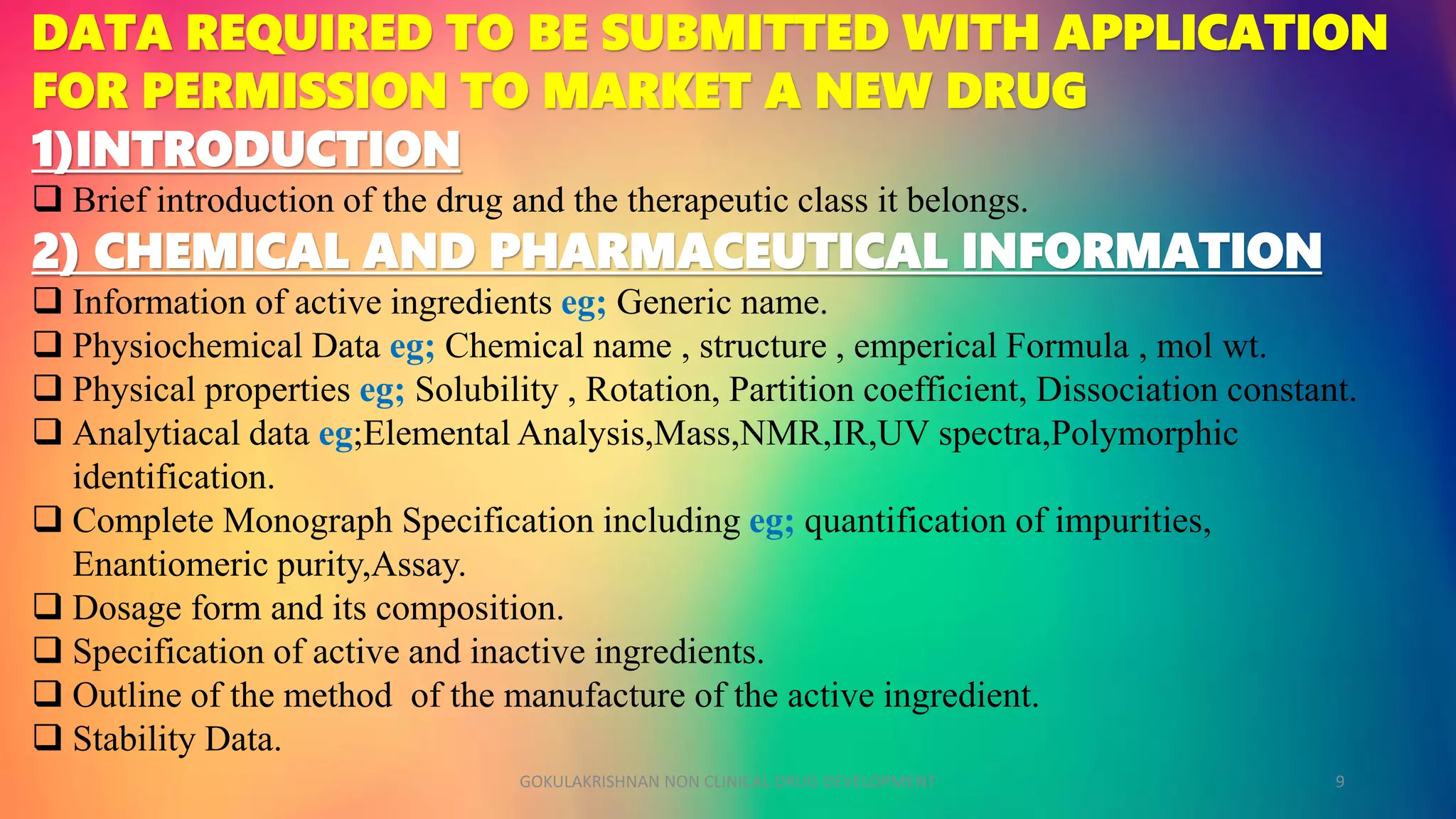
REVIEW OF NDA PROCESS
GOKULAKRISHNAN NON CLINICAL DRUG DEVELOPMENT 8
DATA REQUIRED TO BE SUBMITTED WITH APPLICATION
FOR PERMISSION TO MARKET A NEW DRUG
1)INTRODUCTION
 Brief introduction of the drug and the therapeutic class it belongs.
2) CHEMICAL AND PHARMACEUTICAL INFORMATION
 Information of active ingredients eg; Generic name.
 Physiochemical Data eg; Chemical name , structure , emperical Formula , mol wt.
 Physical properties eg; Solubility , Rotation, Partition coefficient, Dissociation constant.
 Analytiacal data eg;Elemental Analysis,Mass,NMR,IR,UV spectra,Polymorphic
identification.
 Complete Monograph Specification including eg; quantification of impurities,
Enantiomeric purity,Assay.
 Dosage form and its composition.
 Specification of active and inactive ingredients.
 Outline of the method of the manufacture of the active ingredient.
 Stability Data.
GOKULAKRISHNAN NON CLINICAL DRUG DEVELOPMENT 9
3.ANIMAL PHARMACOLOGY
 Summary
 Specific pharmacological actions.
 General pharmacological actions.
 Follow up and Supplemental safety pharmacological studies
 pharmaacokinetics: absorption,distribution,metabolism,excretion.
4.ANIMAL TOXICOLOGY
 Genral aspects
 Systemic toxicity studies
 Male fertility studies
 female Reproduction and developmental studies
 local toxicity
 Allergenicity/Hyper sensitivity
 Genotoxicity
 Carcinogenicity GOKULAKRISHNAN NON CLINICAL DRUG DEVELOPMENT 10
5.HUMAN/CLINICAL PHARMACOLOGY
(PHASE I)
 Summary
 Specific Pharmacological effects.
 General Phamacological effects
 Pharmacokinetics,absorption,distribution,metabolism,excretion
 Pharmacodynamics/early measurement of drug activity
6.THERAPEUTIC EXPLORATORY TRIALS
(PHASE II)
 Summary
 Study reports
GOKULAKRISHNAN NON CLINICAL DRUG DEVELOPMENT 11
7.THERAPEUTIC CONFIRMATORY TRIALS
(PHASE III)
 Summary
 Individual study reports with listing of sites and Investigators.
8.SPECIAL STUDIES
 Summary
 Bio-availability/Bio-equivalence
 Other Studies eg; geriatrics,paediatrics,pregnant or nursing woman
GOKULAKRISHNAN NON CLINICAL DRUG DEVELOPMENT 12
9.REGULATORY STATUS IN OTHER
COUNTRIES
 Countries where the drug is marketed Approved
 Approved as IND
 Withdrawn if any with reasons.
 Restrictions on use, if any, in countries where
marketed.
 Free sale certificate or certificate of analysis, as
appropriate.
GOKULAKRISHNAN NON CLINICAL DRUG DEVELOPMENT 13
NDA CONTENT AND FORMAT
REQUIREMENTS
 NDA must provide all relevant data and information
that a sponsor has collected during the product's
research and development.
 The FDA has numerous guidelines that relate to
NDA content and format issues. These guidelines
can be obtained from CDER's Drug Information
Branch (DIB).
GOKULAKRISHNAN NON CLINICAL DRUG DEVELOPMENT 14
NDA CONTENTS
SECTION 1: OVERALL NDA INDEX
 The NDA index is a comprehensive table of contents
that enables the reviewers to find specific
information in this massive document quickly.
SECTION 2: LABELING
 It must include all draft labeling that is intended for
use on the product container, cartons or packages,
including the proposed package insert.GOKULAKRISHNAN NON CLINICAL DRUG DEVELOPMENT 15
SECTION 3: APPLICATION SUMMARY
 Proposed annotated package insert
 Pharmacology class, scientific rational, intended use, and potential
clinical benefits
 Foreign marketing history
 Chemistry, Manufacturing and control summary
 Nonclinical pharmacology and toxicology summary
 Human pharmacokinetics and bioavailability summary
 Microbiology summary
 Clinical data summary and results of statistical analysis
 Discussion of benefit/risk relationship
GOKULAKRISHNAN NON CLINICAL DRUG DEVELOPMENT 16
SECTION 4: CHEMISTRY, MANUFACTURING AND
CONTROLS
 Chemistry, manufacturing and control information
 Samples
 Methods validation package
SECTION 5: NONCLINICAL PHARMACOLOGY AND
TOXICOLOGY
 Provide individual study reports, including pharmacology, toxicology,
ADME studies.
 Effects related to the therapeutic indication, such as the pharmacodynamic
ED50 in dose- ranging studies and the mechanism of act ion (if known)
 Interactions with other drugs (or cross-reference the location of the
information in any of the above subsectionGOKULAKRISHNAN NON CLINICAL DRUG DEVELOPMENT 17
SECTION 6: HUMAN PHARMACOKINETICS AND
BIOAVAILABILITY
o includes data from Phase I safety and tolerance studies in healthy volunteers.
Element in the section tabulated summary of studies showing all in vivo
biopharmaceutics studies performed.
 Summary of analytical method used in in vivo biopharmaceutic study
 Pilot or background studies
 Bioavailibility or bioequivalence studies
 Pharmacokinetic studies
 In vitro studies
GOKULAKRISHNAN NON CLINICAL DRUG DEVELOPMENT 18
SECTION 7: MICROBIOLOGY
o Includes for anti infective drug products.
Requires the following technical information and data:-
 A complete description of the biochemical basis of the drug action
on microbial physiology
 The drugs antimicrobial spectrum
 Describe any known mechanism of resistance to the drug and
provide information/data of any known epidemiologic studies
demonstrating prevalence to resistance factor
 Clinical microbiology laboratory methods
GOKULAKRISHNAN NON CLINICAL DRUG DEVELOPMENT 19
SECTION 8: CLINICAL DATA
Includes.
 List of investigators and list of INDs and NDAs
 Background or overview of clinical investigations
 Clinical pharmacology
 Controlled clinical trials
 Uncontrolled clinical trials
 Other studies and information
 Integrated summary of effectiveness data
 Integrated summary of safety information
 Drug abuse and overdose information
 Integrated summary of benefits and risks of drugGOKULAKRISHNAN NON CLINICAL DRUG DEVELOPMENT 20
SECTION 9: SAFETY DATA
 Statements in draft labeling
 Contraindications
 Warnings
 Precautions
 Adverse events
SECTION 10: STATISTICAL DATA
 All controlled clinical trial reports
 Integrated efficacy and safety summaries
 Integrated summary of risks and benefitsGOKULAKRISHNAN NON CLINICAL DRUG DEVELOPMENT 21
SECTION 11: CASE REPORT TABULATION
 include complete tabulation for each patient from every adequately
are well controlled phase II and Phase III efficacy, clinical
pharmacology study. It also tabulation of safety data from all
clinical studies.
SECTION 12: CASE REPORT FORMS
 include the complete CRF for each patient who died during a
clinical study or adverse event, regardless of whether the AE is
considered to be related to the study drug, even if the patient was
receiving a placebo or comparative drug.
GOKULAKRISHNAN NON CLINICAL DRUG DEVELOPMENT 22
oApplication itself consists of a cover letter and a completed form
FDA-356h along with several other supporting items as
appropriate
 Item 13: Patent information
 Item 14: Patent certification
 Item 15: Establishment description
 Item 16: Debarment certification
 Item 17: Field copy certification
 Item 18: User fee cover sheet (Form FDA-3397)
 Item 19: Financial disclosure (Form FDA 3454, form FDA-3455)
 Item 20: Other/pediatric use
GOKULAKRISHNAN NON CLINICAL DRUG DEVELOPMENT 23
GENERAL REQUIREMENTS
 The new (present) NDA regulations require that an
application be submitted in two copies :
1.ARCHIVAL COPY
 Serves as a permanent record of the submission.
2.REVIEW COPY
 The review copy is made up of a number of separate
technical volumes, each tailored to the needs of the
disciplines involved in the review.
GOKULAKRISHNAN NON CLINICAL DRUG DEVELOPMENT 24
 Both the archival and review copies are submitted in
hard copy, the regulations permit an application to
submit the archival copy as microfiche.
 The NDA application form (FORM NDA 356 h)
consist of Twelve items (including index) deals with
the safety and efficacy features of drug product, two
are concerned with patent information.
GOKULAKRISHNAN NON CLINICAL DRUG DEVELOPMENT 25
GUIDANCE DOCUMENTS FOR NDAs
 These documents are prepared for FDA review staff and
applicants/sponsors to provide guidelines to the
processing, content, and evaluation/approval of
applications.
 CDER gives guidance documents to help prepare NDAs
 CDER - Centre for Drug Evaluation and Research
 Drug Registration & Licensing System
 ICSR-Individual Case Safety system Reporting
GOKULAKRISHNAN NON CLINICAL DRUG DEVELOPMENT 26
 Bioavailability and bioequivalence studies for Orally
administered drug products- General considerations.
 Formatting, assembling and submitting new drug and
antibiotic application.
 Format and content of Chemistry, Manufacturing and
Control section of an application.
 Format and content of Microbiology section of an
application.
 Format and content of Clinical and Statistical section of an
application.
 Container closure system for packing human drugs and
biologics. GOKULAKRISHNAN NON CLINICAL DRUG DEVELOPMENT 27
 Submitting documentation for the Stability of human drugs
and biologics.
 Format and content of human pharmacokinetics and
bioavailability section of an application.
 Providing clinical evidence of effectiveness for human
drug and biological products.
 NDAs- Impurities in drug substances.
 Drug Master Files (DMF).
 Required specifications for FDA’s IND, NDA and ANDA
drug master file binders.
 Refusal to file.
GOKULAKRISHNAN NON CLINICAL DRUG DEVELOPMENT 28
ASSEMBLING APPLICATIONS FOR
SUBMISSION
GOKULAKRISHNAN NON CLINICAL DRUG DEVELOPMENT 29
ARCHIVAL COPY
 The cover letter
 Form FDA- 356h
 The Administrative sections
 Comprehensive NDA index
 Four copies of labeling section
 Three copies of CMC, Methods validation package
 Case report tabulations & Case report forms
GOKULAKRISHNAN NON CLINICAL DRUG DEVELOPMENT 30
REVIEW COPY
 Appropriate technical section
 The cover letter
 Form FDA- 356h
 The Administrative section
 Comprehensive NDA- index
 The labeling section
 The application summary
GOKULAKRISHNAN NON CLINICAL DRUG DEVELOPMENT 31
FIELD COPY
 Since 1993, use by FDA inspectors
 Cover letter
 Form FDA-356h
 The administrative sections
 The comprehensive NDA index
 An individual table of contents
 The Labeling section
 The Application Summary
 The CMC and Methods Validation PackageGOKULAKRISHNAN NON CLINICAL DRUG DEVELOPMENT 32
FDA APPROVAL PROCESS
GOKULAKRISHNAN NON CLINICAL DRUG DEVELOPMENT 33
FAST TRACK APPROVAL
Drugs For
 Serious diseases
 Fill an unmet medical need
 Must be requested by the drug company
 FDA- 60 Days-Review- Decision
GOKULAKRISHNAN NON CLINICAL DRUG DEVELOPMENT 34
ACCELERATED APPROVAL
 In 1992 FDA instituted the Accelerated Approval
regulation.
 Based on a Surrogate endpoint, not on clinical outcome.
 A surrogate endpoint is a marker- a laboratory
measurement, or physical sign - that is used in clinical
trials as an indirect or substitute measurement that
represents a clinically meaningful outcome, such as
survival or symptom improvement.
GOKULAKRISHNAN NON CLINICAL DRUG DEVELOPMENT 35
PRIORITY REVIEW
 A Priority Review designation is given to drugs that offer
major advances in treatment.
 The goal for completing a Priority Review is six months.
 It can given for Drugs use to Serious/ Nonserious diseases.
 Standard Review is applied to a drug that offers a
most, only minor improvement over existing
marketed therapies (Ten months for Approval).
GOKULAKRISHNAN NON CLINICAL DRUG DEVELOPMENT 36
REFERENCES
 www.fda.gov/cder/handbook/ndabox.htm
 www.fda.gov
 www.phrma.org
 www.fda.gov/cder/about/history/time1.html
GOKULAKRISHNAN NON CLINICAL DRUG DEVELOPMENT 37
38GOKULAKRISHNAN NON CLINICAL DRUG

NEW DRUG APPLICATION (NDA)

  • 1.
    S.GOKULAKRISHNAN M.Pharm (Pharmaceutics) –I Year, Department of Pharmaceutics, College of Pharmacy, Mother Theresa Post Graduate and Research Institute of Health Sciences, Puducherry. NON CLINICAL DRUG DEVELOPMENT -NEW DRUG APPLICATION GOKULAKRISHNAN NON CLINICAL DRUG DEVELOPMENT 1
  • 2.
    OBJECTIVES Provide enough informationto permit FDA reviewers to establish the following:  Safety & effectiveness of drug.  Benefits overweigh risks.  Is the drug’s proposed labelling (package insert) appropriate, and what should it contain?  Are the methods used in manufacturing (Good Manufacturing Practice, GMP) the drug and the controls used to maintain the drug’s quality adequate to preserve the drug’s identity,,strength,quality and purity GOKULAKRISHNAN NON CLINICAL DRUG DEVELOPMENT 2
  • 3.
    NEW DRUG APPLICATION Fordecades, the regulation and control of new drugs in the United States has been based on the New Drug Application (NDA). Since 1938, every new drug has been the subject of an approved NDA before U.S. commercialization. The data gathered during the animal studies and human clinical trials of an Investigational New Drug (IND) becomes part of the NDA. GOKULAKRISHNAN NON CLINICAL DRUG DEVELOPMENT 3
  • 4.
    NDA CONTENTS The NDAmay have as many as 20 different sections in addition to the Form FDA-356h itself The specific contents of the NDA will depend on the Nature of the drug product and the information available at the time of submission the application Form FDA-356h serves as Checklist as well as Certification that, the sponsor agrees to comply with a range of legal and regulatory requirements GOKULAKRISHNAN NON CLINICAL DRUG DEVELOPMENT 4
  • 5.
    NDA CONTENTS  Introduction Brief description of the drug and the therapeutic class to which it belongs  Chemical and pharmaceutical information  Animal Pharmacolog  Animal Toxicology  Human/Clinical Pharmacology phase I  Therapeutic exploratory trials (Phase II)  Therapeutic confirmatory trials (Phase III)  Special Studies Geriatrics, pediatrics, pregnant or nursing women  Regulatory status in other countries  Prescribing information  Samples and Testing Protocol/sGOKULAKRISHNAN NON CLINICAL DRUG DEVELOPMENT 5
  • 6.
    WHEN TO GETAPPROVAL FROM NDA GOKULAKRISHNAN NON CLINICAL DRUG DEVELOPMENT 6
  • 7.
    CLINICAL TRAIL PHASES GOKULAKRISHNANNON CLINICAL DRUG DEVELOPMENT 7
  • 8.
    REVIEW OF NDAPROCESS GOKULAKRISHNAN NON CLINICAL DRUG DEVELOPMENT 8
  • 9.
    DATA REQUIRED TOBE SUBMITTED WITH APPLICATION FOR PERMISSION TO MARKET A NEW DRUG 1)INTRODUCTION  Brief introduction of the drug and the therapeutic class it belongs. 2) CHEMICAL AND PHARMACEUTICAL INFORMATION  Information of active ingredients eg; Generic name.  Physiochemical Data eg; Chemical name , structure , emperical Formula , mol wt.  Physical properties eg; Solubility , Rotation, Partition coefficient, Dissociation constant.  Analytiacal data eg;Elemental Analysis,Mass,NMR,IR,UV spectra,Polymorphic identification.  Complete Monograph Specification including eg; quantification of impurities, Enantiomeric purity,Assay.  Dosage form and its composition.  Specification of active and inactive ingredients.  Outline of the method of the manufacture of the active ingredient.  Stability Data. GOKULAKRISHNAN NON CLINICAL DRUG DEVELOPMENT 9
  • 10.
    3.ANIMAL PHARMACOLOGY  Summary Specific pharmacological actions.  General pharmacological actions.  Follow up and Supplemental safety pharmacological studies  pharmaacokinetics: absorption,distribution,metabolism,excretion. 4.ANIMAL TOXICOLOGY  Genral aspects  Systemic toxicity studies  Male fertility studies  female Reproduction and developmental studies  local toxicity  Allergenicity/Hyper sensitivity  Genotoxicity  Carcinogenicity GOKULAKRISHNAN NON CLINICAL DRUG DEVELOPMENT 10
  • 11.
    5.HUMAN/CLINICAL PHARMACOLOGY (PHASE I) Summary  Specific Pharmacological effects.  General Phamacological effects  Pharmacokinetics,absorption,distribution,metabolism,excretion  Pharmacodynamics/early measurement of drug activity 6.THERAPEUTIC EXPLORATORY TRIALS (PHASE II)  Summary  Study reports GOKULAKRISHNAN NON CLINICAL DRUG DEVELOPMENT 11
  • 12.
    7.THERAPEUTIC CONFIRMATORY TRIALS (PHASEIII)  Summary  Individual study reports with listing of sites and Investigators. 8.SPECIAL STUDIES  Summary  Bio-availability/Bio-equivalence  Other Studies eg; geriatrics,paediatrics,pregnant or nursing woman GOKULAKRISHNAN NON CLINICAL DRUG DEVELOPMENT 12
  • 13.
    9.REGULATORY STATUS INOTHER COUNTRIES  Countries where the drug is marketed Approved  Approved as IND  Withdrawn if any with reasons.  Restrictions on use, if any, in countries where marketed.  Free sale certificate or certificate of analysis, as appropriate. GOKULAKRISHNAN NON CLINICAL DRUG DEVELOPMENT 13
  • 14.
    NDA CONTENT ANDFORMAT REQUIREMENTS  NDA must provide all relevant data and information that a sponsor has collected during the product's research and development.  The FDA has numerous guidelines that relate to NDA content and format issues. These guidelines can be obtained from CDER's Drug Information Branch (DIB). GOKULAKRISHNAN NON CLINICAL DRUG DEVELOPMENT 14
  • 15.
    NDA CONTENTS SECTION 1:OVERALL NDA INDEX  The NDA index is a comprehensive table of contents that enables the reviewers to find specific information in this massive document quickly. SECTION 2: LABELING  It must include all draft labeling that is intended for use on the product container, cartons or packages, including the proposed package insert.GOKULAKRISHNAN NON CLINICAL DRUG DEVELOPMENT 15
  • 16.
    SECTION 3: APPLICATIONSUMMARY  Proposed annotated package insert  Pharmacology class, scientific rational, intended use, and potential clinical benefits  Foreign marketing history  Chemistry, Manufacturing and control summary  Nonclinical pharmacology and toxicology summary  Human pharmacokinetics and bioavailability summary  Microbiology summary  Clinical data summary and results of statistical analysis  Discussion of benefit/risk relationship GOKULAKRISHNAN NON CLINICAL DRUG DEVELOPMENT 16
  • 17.
    SECTION 4: CHEMISTRY,MANUFACTURING AND CONTROLS  Chemistry, manufacturing and control information  Samples  Methods validation package SECTION 5: NONCLINICAL PHARMACOLOGY AND TOXICOLOGY  Provide individual study reports, including pharmacology, toxicology, ADME studies.  Effects related to the therapeutic indication, such as the pharmacodynamic ED50 in dose- ranging studies and the mechanism of act ion (if known)  Interactions with other drugs (or cross-reference the location of the information in any of the above subsectionGOKULAKRISHNAN NON CLINICAL DRUG DEVELOPMENT 17
  • 18.
    SECTION 6: HUMANPHARMACOKINETICS AND BIOAVAILABILITY o includes data from Phase I safety and tolerance studies in healthy volunteers. Element in the section tabulated summary of studies showing all in vivo biopharmaceutics studies performed.  Summary of analytical method used in in vivo biopharmaceutic study  Pilot or background studies  Bioavailibility or bioequivalence studies  Pharmacokinetic studies  In vitro studies GOKULAKRISHNAN NON CLINICAL DRUG DEVELOPMENT 18
  • 19.
    SECTION 7: MICROBIOLOGY oIncludes for anti infective drug products. Requires the following technical information and data:-  A complete description of the biochemical basis of the drug action on microbial physiology  The drugs antimicrobial spectrum  Describe any known mechanism of resistance to the drug and provide information/data of any known epidemiologic studies demonstrating prevalence to resistance factor  Clinical microbiology laboratory methods GOKULAKRISHNAN NON CLINICAL DRUG DEVELOPMENT 19
  • 20.
    SECTION 8: CLINICALDATA Includes.  List of investigators and list of INDs and NDAs  Background or overview of clinical investigations  Clinical pharmacology  Controlled clinical trials  Uncontrolled clinical trials  Other studies and information  Integrated summary of effectiveness data  Integrated summary of safety information  Drug abuse and overdose information  Integrated summary of benefits and risks of drugGOKULAKRISHNAN NON CLINICAL DRUG DEVELOPMENT 20
  • 21.
    SECTION 9: SAFETYDATA  Statements in draft labeling  Contraindications  Warnings  Precautions  Adverse events SECTION 10: STATISTICAL DATA  All controlled clinical trial reports  Integrated efficacy and safety summaries  Integrated summary of risks and benefitsGOKULAKRISHNAN NON CLINICAL DRUG DEVELOPMENT 21
  • 22.
    SECTION 11: CASEREPORT TABULATION  include complete tabulation for each patient from every adequately are well controlled phase II and Phase III efficacy, clinical pharmacology study. It also tabulation of safety data from all clinical studies. SECTION 12: CASE REPORT FORMS  include the complete CRF for each patient who died during a clinical study or adverse event, regardless of whether the AE is considered to be related to the study drug, even if the patient was receiving a placebo or comparative drug. GOKULAKRISHNAN NON CLINICAL DRUG DEVELOPMENT 22
  • 23.
    oApplication itself consistsof a cover letter and a completed form FDA-356h along with several other supporting items as appropriate  Item 13: Patent information  Item 14: Patent certification  Item 15: Establishment description  Item 16: Debarment certification  Item 17: Field copy certification  Item 18: User fee cover sheet (Form FDA-3397)  Item 19: Financial disclosure (Form FDA 3454, form FDA-3455)  Item 20: Other/pediatric use GOKULAKRISHNAN NON CLINICAL DRUG DEVELOPMENT 23
  • 24.
    GENERAL REQUIREMENTS  Thenew (present) NDA regulations require that an application be submitted in two copies : 1.ARCHIVAL COPY  Serves as a permanent record of the submission. 2.REVIEW COPY  The review copy is made up of a number of separate technical volumes, each tailored to the needs of the disciplines involved in the review. GOKULAKRISHNAN NON CLINICAL DRUG DEVELOPMENT 24
  • 25.
     Both thearchival and review copies are submitted in hard copy, the regulations permit an application to submit the archival copy as microfiche.  The NDA application form (FORM NDA 356 h) consist of Twelve items (including index) deals with the safety and efficacy features of drug product, two are concerned with patent information. GOKULAKRISHNAN NON CLINICAL DRUG DEVELOPMENT 25
  • 26.
    GUIDANCE DOCUMENTS FORNDAs  These documents are prepared for FDA review staff and applicants/sponsors to provide guidelines to the processing, content, and evaluation/approval of applications.  CDER gives guidance documents to help prepare NDAs  CDER - Centre for Drug Evaluation and Research  Drug Registration & Licensing System  ICSR-Individual Case Safety system Reporting GOKULAKRISHNAN NON CLINICAL DRUG DEVELOPMENT 26
  • 27.
     Bioavailability andbioequivalence studies for Orally administered drug products- General considerations.  Formatting, assembling and submitting new drug and antibiotic application.  Format and content of Chemistry, Manufacturing and Control section of an application.  Format and content of Microbiology section of an application.  Format and content of Clinical and Statistical section of an application.  Container closure system for packing human drugs and biologics. GOKULAKRISHNAN NON CLINICAL DRUG DEVELOPMENT 27
  • 28.
     Submitting documentationfor the Stability of human drugs and biologics.  Format and content of human pharmacokinetics and bioavailability section of an application.  Providing clinical evidence of effectiveness for human drug and biological products.  NDAs- Impurities in drug substances.  Drug Master Files (DMF).  Required specifications for FDA’s IND, NDA and ANDA drug master file binders.  Refusal to file. GOKULAKRISHNAN NON CLINICAL DRUG DEVELOPMENT 28
  • 29.
  • 30.
    ARCHIVAL COPY  Thecover letter  Form FDA- 356h  The Administrative sections  Comprehensive NDA index  Four copies of labeling section  Three copies of CMC, Methods validation package  Case report tabulations & Case report forms GOKULAKRISHNAN NON CLINICAL DRUG DEVELOPMENT 30
  • 31.
    REVIEW COPY  Appropriatetechnical section  The cover letter  Form FDA- 356h  The Administrative section  Comprehensive NDA- index  The labeling section  The application summary GOKULAKRISHNAN NON CLINICAL DRUG DEVELOPMENT 31
  • 32.
    FIELD COPY  Since1993, use by FDA inspectors  Cover letter  Form FDA-356h  The administrative sections  The comprehensive NDA index  An individual table of contents  The Labeling section  The Application Summary  The CMC and Methods Validation PackageGOKULAKRISHNAN NON CLINICAL DRUG DEVELOPMENT 32
  • 33.
    FDA APPROVAL PROCESS GOKULAKRISHNANNON CLINICAL DRUG DEVELOPMENT 33
  • 34.
    FAST TRACK APPROVAL DrugsFor  Serious diseases  Fill an unmet medical need  Must be requested by the drug company  FDA- 60 Days-Review- Decision GOKULAKRISHNAN NON CLINICAL DRUG DEVELOPMENT 34
  • 35.
    ACCELERATED APPROVAL  In1992 FDA instituted the Accelerated Approval regulation.  Based on a Surrogate endpoint, not on clinical outcome.  A surrogate endpoint is a marker- a laboratory measurement, or physical sign - that is used in clinical trials as an indirect or substitute measurement that represents a clinically meaningful outcome, such as survival or symptom improvement. GOKULAKRISHNAN NON CLINICAL DRUG DEVELOPMENT 35
  • 36.
    PRIORITY REVIEW  APriority Review designation is given to drugs that offer major advances in treatment.  The goal for completing a Priority Review is six months.  It can given for Drugs use to Serious/ Nonserious diseases.  Standard Review is applied to a drug that offers a most, only minor improvement over existing marketed therapies (Ten months for Approval). GOKULAKRISHNAN NON CLINICAL DRUG DEVELOPMENT 36
  • 37.
    REFERENCES  www.fda.gov/cder/handbook/ndabox.htm  www.fda.gov www.phrma.org  www.fda.gov/cder/about/history/time1.html GOKULAKRISHNAN NON CLINICAL DRUG DEVELOPMENT 37
  • 38.