NATUREVIEW FARM
HARVARD BUISNESS SCHOOL CASE
TABLE OF CONTENT
• BACKGROUND
• THE PROBLEM
• CHANNEL ANALYSES
• SITUATION ANALYSES
• FINANCIAL ANALYSES
• OPTIONS
• CONCLUSIONS
• DISCLAMIER
BACKGROUND
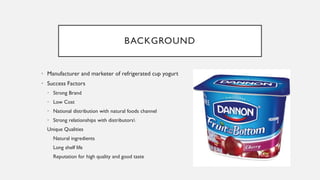
• Manufacturer and marketer of refrigerated cup yogurt
• Success Factors
• Strong Brand
• Low Cost
• National distribution with natural foods channel
• Strong relationships with distributors
Unique Qualities
Natural ingredients
Long shelf life
Reputation for high quality and good taste
BACKGROUND
(CONTD.)
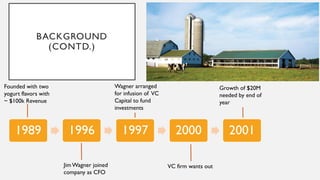
1989 1996 1997 2000 2001
Founded with two
yogurt flavors with
~ $100k Revenue
JimWagner joined
company as CFO
Wagner arranged
for infusion of VC
Capital to fund
investments
VC firm wants out
Growth of $20M
needed by end of
year
THE PROBLEM
• In a span of just 10 years, Natureview farms has increased their annual revenues from
$100,000 to $13,000,000.
• Snce Natureview is a small company, they had limited cash assets. So in 1997, Natureview
open their doors to venture capital firms to receive funds that were desperately needed.
• 3 years after the funding by venture capital, they found out that the venture capital firm had
to withdraw and cash out their investment.
• Natureviews main problem is that they have to make strategic marketing
decisions to grow revenues to $20,000,000 from their current $13,000,000 before
the end of the 2001fiscal year.That is about a 54% increase , in 12 months .
• To solve the problem,The main decision would be whether Natureview should expand their
product’s distribution through the supermarket channel across the U.S.A.
• To make the decision, Natureview must first vigorously analyze each channel and their
qualities.
WE SHALL ANALYZE THE CASE
IN THREE SEPARATE WAYS
CHANNEL ANALYSES
• Supermarket Channel :
• This channel of many supermarket chains scattered across all the regions of the United States.
• In this channel there are 4 steps in the distribution table.The manufacture sells the product to the distributor who sells the product to the retailer on its way to the end
consumer.
• In this channel an 8oz and a 32oz cup of yogurt go for $0.74 and $2.70, while a 4oz cup multipack can sell for $2.85.
• Compared to the nature store channel, this channel is much more technologically driven.
• These new manufactories must pay a $10,000 slotting fee for each stock keeping unit (SKU) per retailer chain in each of the four regions.
• This channel also requires each manufacture to contribute funds a minimum of every 3 months for cooperative weekly trade promotions that average $8,000 nationally / ad,
/retailer chain.
CHANNEL ANALYSES
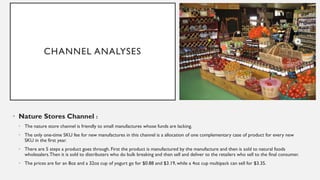
• Nature Stores Channel :
• The nature store channel is friendly to small manufactures whose funds are lacking.
• The only one-time SKU fee for new manufactures in this channel is a allocation of one complementary case of product for every new
SKU in the first year.
• There are 5 steps a product goes through. First the product is manufactured by the manufacture and then is sold to natural foods
wholesalers.Then it is sold to distributers who do bulk breaking and then sell and deliver to the retailers who sell to the final consumer.
• The prices are for an 8oz and a 32oz cup of yogurt go for $0.88 and $3.19, while a 4oz cup multipack can sell for $3.35.
SITUATION ANALYSES
Advantages over Competitors :
• Long product shelf life
• Reputation of high quality, taste and
natural ingredients.
• Strong relationship with nature store
retailers.
SITUATION ANALYSES
Opportunities :
• Organic food market expected to grow
to $13.3 billion in 2003.
• Nature store channel sales up 20%.
• 12.5% growth in 4oz multipack.
• Increase in consumer interest in organic
foods.
SITUATION ANALYSES
MISTAKES :
• Small manufacture, low funds and
revenue.
• Relies on brokers that may not be
adequate for supermarket channel.
• Current marketing strategy based only
on nature store channel.
FINANCIAL ANALYSES
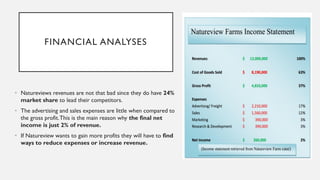
• Natureviews revenues are not that bad since they do have 24%
market share to lead their competitors.
• The advertising and sales expenses are little when compared to
the gross profit.This is the main reason why the final net
income is just 2% of revenue.
• If Natureview wants to gain more profits they will have to find
ways to reduce expenses or increase revenue.
OPTIONS
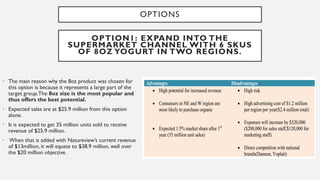
• The main reason why the 8oz product was chosen for
this option is because it represents a large part of the
target group.The 8oz size is the most popular and
thus offers the best potential.
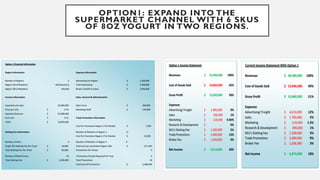
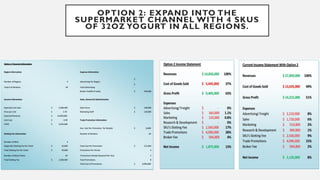
• Expected sales are at $25.9 million from this option
alone.
• It is expected to get 35 million units sold to receive
revenue of $25.9 million.
• When that is added with Natureview’s current revenue
of $13million, it will equate to $38.9 million, well over
the $20 million objective.
OPTION1: EXPAND INTO THE
SUPERMARKET CHANNEL WITH 6 SKUS
OF 8OZ YOGURT IN TWO REGIONS.
OPTION1: EXPAND INTO THE
SUPERMARKET CHANNEL WITH 6 SKUS
OF 8OZ YOGURT IN TWO REGIONS.
OPTION1: EXPAND INTO THE
SUPERMARKET CHANNEL WITH 6 SKUS
OF 8OZ YOGURT IN TWO REGIONS.
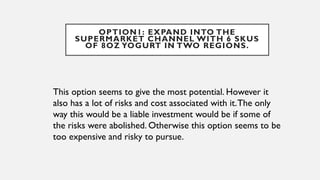
This option seems to give the most potential. However it
also has a lot of risks and cost associated with it.The only
way this would be a liable investment would be if some of
the risks were abolished. Otherwise this option seems to be
too expensive and risky to pursue.
OPTIONS
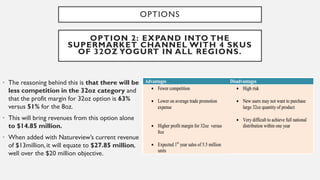
• The reasoning behind this is that there will be
less competition in the 32oz category and
that the profit margin for 32oz option is 63%
versus 51% for the 8oz.
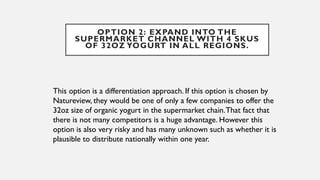
• This will bring revenues from this option alone
to $14.85 million.
• When added with Natureview’s current revenue
of $13million, it will equate to $27.85 million,
well over the $20 million objective.
OPTION 2: EXPAND INTO THE
SUPERMARKET CHANNEL WITH 4 SKUS
OF 32OZ YOGURT IN ALL REGIONS.
OPTION 2: EXPAND INTO THE
SUPERMARKET CHANNEL WITH 4 SKUS
OF 32OZ YOGURT IN ALL REGIONS.
OPTION 2: EXPAND INTO THE
SUPERMARKET CHANNEL WITH 4 SKUS
OF 32OZ YOGURT IN ALL REGIONS.
This option is a differentiation approach. If this option is chosen by
Natureview, they would be one of only a few companies to offer the
32oz size of organic yogurt in the supermarket chain.That fact that
there is not many competitors is a huge advantage. However this
option is also very risky and has many unknown such as whether it is
plausible to distribute nationally within one year.
OPTIONS
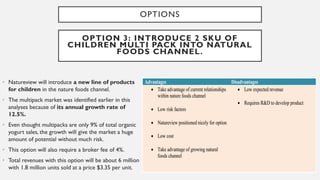
• Natureview will introduce a new line of products
for children in the nature foods channel.
• The multipack market was identified earlier in this
analyses because of its annual growth rate of
12.5%.
• Even thought multipacks are only 9% of total organic
yogurt sales, the growth will give the market a huge
amount of potential without much risk.
• This option will also require a broker fee of 4%.
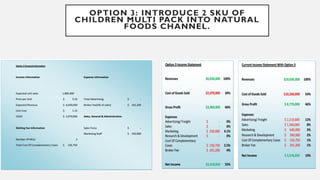
• Total revenues with this option will be about 6 million
with 1.8 million units sold at a price $3.35 per unit.
OPTION 3: INTRODUCE 2 SKU OF
CHILDREN MULTI PACK INTO NATURAL
FOODS CHANNEL.
OPTION 3: INTRODUCE 2 SKU OF
CHILDREN MULTI PACK INTO NATURAL
FOODS CHANNEL.
OPTION 3: INTRODUCE 2 SKU OF
CHILDREN MULTI PACK INTO NATURAL
FOODS CHANNEL.
This option is by far the most conservative of the three. It presents the least
amount of risk because the basis of this option is to stick with what is known.
There are very few unknown variables. However because there is so few risk
involved, reward is also few.The revenues from this options is the lowest of
the three options. Combined with the current $13 million revenue, it
equates to just over $19 million.This is under the objective of $20
million.This must be taken in consideration when choosing the
recommendation.
CONCLUSION
• After careful review and thorough analyses of the problem, situation and
available options, It is recommended that Natureview Farms chooses the third
option.
• It offers very few risk and had a vide variety of known variables.
• This option also did not require an entire marketing strategy change. It
used the same distributors, retailers and consumers.
• Natureview must ensure that they can increase the expected revenues by $1
million or more in order to meet or beat the objective of $20 million.
• If this option is followed with the suggested revisions, it has the potential to
increase Natureview’s success tremendously.
DISCLAIMER
Sameer Mathur
IIM Lucknow,
Marketing Professor 2013 -
McGill University
Marketing Professor 2009 – 2013
Carnegie Mellon
Ph.D and M.S (Marketing) 2003 - 2009
Vedanth Prakash
PES Institute of Technology,
Marketing Management Intern - 2016.

NATUREVIEW FARM

  • 1.
  • 2.
    TABLE OF CONTENT •BACKGROUND • THE PROBLEM • CHANNEL ANALYSES • SITUATION ANALYSES • FINANCIAL ANALYSES • OPTIONS • CONCLUSIONS • DISCLAMIER
  • 3.
    BACKGROUND • Manufacturer andmarketer of refrigerated cup yogurt • Success Factors • Strong Brand • Low Cost • National distribution with natural foods channel • Strong relationships with distributors Unique Qualities Natural ingredients Long shelf life Reputation for high quality and good taste
  • 4.
    BACKGROUND (CONTD.) 1989 1996 19972000 2001 Founded with two yogurt flavors with ~ $100k Revenue JimWagner joined company as CFO Wagner arranged for infusion of VC Capital to fund investments VC firm wants out Growth of $20M needed by end of year
  • 5.
    THE PROBLEM • Ina span of just 10 years, Natureview farms has increased their annual revenues from $100,000 to $13,000,000. • Snce Natureview is a small company, they had limited cash assets. So in 1997, Natureview open their doors to venture capital firms to receive funds that were desperately needed. • 3 years after the funding by venture capital, they found out that the venture capital firm had to withdraw and cash out their investment. • Natureviews main problem is that they have to make strategic marketing decisions to grow revenues to $20,000,000 from their current $13,000,000 before the end of the 2001fiscal year.That is about a 54% increase , in 12 months . • To solve the problem,The main decision would be whether Natureview should expand their product’s distribution through the supermarket channel across the U.S.A. • To make the decision, Natureview must first vigorously analyze each channel and their qualities.
  • 6.
    WE SHALL ANALYZETHE CASE IN THREE SEPARATE WAYS
  • 7.
    CHANNEL ANALYSES • SupermarketChannel : • This channel of many supermarket chains scattered across all the regions of the United States. • In this channel there are 4 steps in the distribution table.The manufacture sells the product to the distributor who sells the product to the retailer on its way to the end consumer. • In this channel an 8oz and a 32oz cup of yogurt go for $0.74 and $2.70, while a 4oz cup multipack can sell for $2.85. • Compared to the nature store channel, this channel is much more technologically driven. • These new manufactories must pay a $10,000 slotting fee for each stock keeping unit (SKU) per retailer chain in each of the four regions. • This channel also requires each manufacture to contribute funds a minimum of every 3 months for cooperative weekly trade promotions that average $8,000 nationally / ad, /retailer chain.
  • 8.
    CHANNEL ANALYSES • NatureStores Channel : • The nature store channel is friendly to small manufactures whose funds are lacking. • The only one-time SKU fee for new manufactures in this channel is a allocation of one complementary case of product for every new SKU in the first year. • There are 5 steps a product goes through. First the product is manufactured by the manufacture and then is sold to natural foods wholesalers.Then it is sold to distributers who do bulk breaking and then sell and deliver to the retailers who sell to the final consumer. • The prices are for an 8oz and a 32oz cup of yogurt go for $0.88 and $3.19, while a 4oz cup multipack can sell for $3.35.
  • 9.
    SITUATION ANALYSES Advantages overCompetitors : • Long product shelf life • Reputation of high quality, taste and natural ingredients. • Strong relationship with nature store retailers.
  • 10.
    SITUATION ANALYSES Opportunities : •Organic food market expected to grow to $13.3 billion in 2003. • Nature store channel sales up 20%. • 12.5% growth in 4oz multipack. • Increase in consumer interest in organic foods.
  • 11.
    SITUATION ANALYSES MISTAKES : •Small manufacture, low funds and revenue. • Relies on brokers that may not be adequate for supermarket channel. • Current marketing strategy based only on nature store channel.
  • 12.
    FINANCIAL ANALYSES • Natureviewsrevenues are not that bad since they do have 24% market share to lead their competitors. • The advertising and sales expenses are little when compared to the gross profit.This is the main reason why the final net income is just 2% of revenue. • If Natureview wants to gain more profits they will have to find ways to reduce expenses or increase revenue.
  • 13.
    OPTIONS • The mainreason why the 8oz product was chosen for this option is because it represents a large part of the target group.The 8oz size is the most popular and thus offers the best potential. • Expected sales are at $25.9 million from this option alone. • It is expected to get 35 million units sold to receive revenue of $25.9 million. • When that is added with Natureview’s current revenue of $13million, it will equate to $38.9 million, well over the $20 million objective. OPTION1: EXPAND INTO THE SUPERMARKET CHANNEL WITH 6 SKUS OF 8OZ YOGURT IN TWO REGIONS.
  • 14.
    OPTION1: EXPAND INTOTHE SUPERMARKET CHANNEL WITH 6 SKUS OF 8OZ YOGURT IN TWO REGIONS.
  • 15.
    OPTION1: EXPAND INTOTHE SUPERMARKET CHANNEL WITH 6 SKUS OF 8OZ YOGURT IN TWO REGIONS. This option seems to give the most potential. However it also has a lot of risks and cost associated with it.The only way this would be a liable investment would be if some of the risks were abolished. Otherwise this option seems to be too expensive and risky to pursue.
  • 16.
    OPTIONS • The reasoningbehind this is that there will be less competition in the 32oz category and that the profit margin for 32oz option is 63% versus 51% for the 8oz. • This will bring revenues from this option alone to $14.85 million. • When added with Natureview’s current revenue of $13million, it will equate to $27.85 million, well over the $20 million objective. OPTION 2: EXPAND INTO THE SUPERMARKET CHANNEL WITH 4 SKUS OF 32OZ YOGURT IN ALL REGIONS.
  • 17.
    OPTION 2: EXPANDINTO THE SUPERMARKET CHANNEL WITH 4 SKUS OF 32OZ YOGURT IN ALL REGIONS.
  • 18.
    OPTION 2: EXPANDINTO THE SUPERMARKET CHANNEL WITH 4 SKUS OF 32OZ YOGURT IN ALL REGIONS. This option is a differentiation approach. If this option is chosen by Natureview, they would be one of only a few companies to offer the 32oz size of organic yogurt in the supermarket chain.That fact that there is not many competitors is a huge advantage. However this option is also very risky and has many unknown such as whether it is plausible to distribute nationally within one year.
  • 19.
    OPTIONS • Natureview willintroduce a new line of products for children in the nature foods channel. • The multipack market was identified earlier in this analyses because of its annual growth rate of 12.5%. • Even thought multipacks are only 9% of total organic yogurt sales, the growth will give the market a huge amount of potential without much risk. • This option will also require a broker fee of 4%. • Total revenues with this option will be about 6 million with 1.8 million units sold at a price $3.35 per unit. OPTION 3: INTRODUCE 2 SKU OF CHILDREN MULTI PACK INTO NATURAL FOODS CHANNEL.
  • 20.
    OPTION 3: INTRODUCE2 SKU OF CHILDREN MULTI PACK INTO NATURAL FOODS CHANNEL.
  • 21.
    OPTION 3: INTRODUCE2 SKU OF CHILDREN MULTI PACK INTO NATURAL FOODS CHANNEL. This option is by far the most conservative of the three. It presents the least amount of risk because the basis of this option is to stick with what is known. There are very few unknown variables. However because there is so few risk involved, reward is also few.The revenues from this options is the lowest of the three options. Combined with the current $13 million revenue, it equates to just over $19 million.This is under the objective of $20 million.This must be taken in consideration when choosing the recommendation.
  • 22.
    CONCLUSION • After carefulreview and thorough analyses of the problem, situation and available options, It is recommended that Natureview Farms chooses the third option. • It offers very few risk and had a vide variety of known variables. • This option also did not require an entire marketing strategy change. It used the same distributors, retailers and consumers. • Natureview must ensure that they can increase the expected revenues by $1 million or more in order to meet or beat the objective of $20 million. • If this option is followed with the suggested revisions, it has the potential to increase Natureview’s success tremendously.
  • 23.
    DISCLAIMER Sameer Mathur IIM Lucknow, MarketingProfessor 2013 - McGill University Marketing Professor 2009 – 2013 Carnegie Mellon Ph.D and M.S (Marketing) 2003 - 2009 Vedanth Prakash PES Institute of Technology, Marketing Management Intern - 2016.