NATUREVIEW FARM
Harvard Business Case Analysis
• Founded in Cabot,Vermont
• First enter market 8-oz and 32-oz with plain and vanilla flavor
• Use natural ingredient with longer average shelf-life of 50 ays
• Revenue growth from $100,000 to $13 million
• Fruit on the bottom yogurt
• Expanded to 12 flavors
• Introduced multi pack yogurt for children
Background
Vice president
Chief Financial Officer
Chief executive officer
Vice president of sale
Vice president of operation
Assistant marketing director
Christine Walker
Jim Wagner
Barry Landers
Walter Bellini
Jack Gottlieb
Kelly Riley
Supermarkets
Small health
stores
Natural food
supermarket
Target Customers
Shoppers at Natural
Food Stores are older,
educated and have
higher incomes
Target Customers
ANALYSIS OF THE CASE
S W
O T
STRENGTHS WEAKNESSES
OPPORTUNITIES THREATS
• Strong Brand
• No artificial thickeners
used
• Usage of natural
ingredients
• Longer shelf life
• No alternative financing
available
• Lacks potential of taking
risks and costs
• Doubt on sales team’s
ability
• Strong relationship with
leading natural foods
retailers
• Accumulation of cash by
horizon from IPO
• Being dropped out of
traditional channel
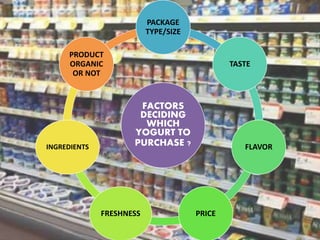
FACTORS
DECIDING
WHICH
YOGURT TO
PURCHASE ?
PACKAGE
TYPE/SIZE
TASTE
FLAVOR
PRICEFRESHNESS
INGREDIENTS
PRODUCT
ORGANIC
OR NOT
VC firm now
needs to cash
out of its
investment
The management
team needs to
find a way to
increase the
firm’s revenues
to $20 million by
the end of 2001
To come with a plan that takes the company to
$20 million in revenues by the end of 2001
To do so keeping in mind the words of the CEO “
We owe it to our customers, our suppliers, and our
distribution partners to make the right strategic
choices regarding the revenue growth objective
before us”

Senior Management proposed three options to
grow Natureview’s revenue
OPTION 1
• Expand 6 SKUs of the 8-oz. product line into
one or two selected supermarket channel
regions a
• Proposed by Walter Bellini VP Sales
1. Great Upside Potential
2. For supermarket adding these
products would attract higher-
income less price-sensitive
customers
3. Unit volume growth of organic
yogurt at supermarkets of 20%
per year from 2001 to
2006
4. This option also has the highest
incremental demand
1. Supporting 8-oz cup size would
require quarterly trade promotions
and a meaningful marketing budget
2. Advertising plan would cost $1.2
million per region per year in
addition to the promotional ads
expenses
3. SG&A expenses would increase by
$320,000 annually
4. This option creates direct
competition with national yogurt
brands
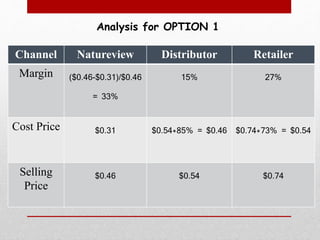
Channel Natureview Distributor Retailer
Margin ($0.46-$0.31)/$0.46
= 33%
15% 27%
Cost Price $0.31 $0.54*85% = $0.46 $0.74*73% = $0.54
Selling
Price
$0.46 $0.54 $0.74
Analysis for OPTION 1
Year 2000 Year 2001 Data from
Unit Sales 35,000,000 units 35,000,000*(1+20%)
= 42,000,000
Exhibit 6
Revenue 35,000,000*$0.46
= $16,100,000
42,000,000*$0.46
= $19,320,000
From previous slide
Cost 35,000,000*$0.31
= $10,850,000
42,000,000*$0.31
= $13,020,000
Exhibit 3
Gross Profit $5,250,000 $6,300,000 Revenue – Cost
Advertisement 1,200,000*2 Regions
= $2,400,000
$2,400,000
Page 7
SG & A $320,000 $640,000
Page 7
Slotting Fees 10,000*6*20 retails
= $1,200,000
--
Page 5
Broker’s Fee 16,100,000*4%
= $644,000
19,320,000*4%
= $772,800
Page 4
Net Profit $686,000 $2,487,200
OPTION 2
• Expand 4 SKUs of the 32-oz. size nationally
• Proposed by Jack Gottlieb, vice president of
operations
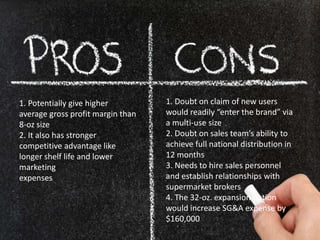
1. Potentially give higher
average gross profit margin than
8-oz size
2. It also has stronger
competitive advantage like
longer shelf life and lower
marketing
expenses
1. Doubt on claim of new users
would readily “enter the brand” via
a multi-use size
2. Doubt on sales team’s ability to
achieve full national distribution in
12 months
3. Needs to hire sales personnel
and establish relationships with
supermarket brokers
4. The 32-oz. expansion option
would increase SG&A expense by
$160,000
Channel Natureview Distributor Retailer
Margin ($1.67-$0.99)/$1.67
= 41%
15% 27%
Cost Price $0.99 $1.97*85% = $1.67 $2.70*73% = $1.97
Selling
Price
$1.67 $1.97 $2.70
Analysis for OPTION 2
Year 2000 Year 2001 Data from
Unit Sales 5,500,000 units 5,500,000
Exhibit 6
Revenue 5,500,000*$1.67
= $9,185,000
$9,185,000
From previous slide
Cost 5,500,000*$0.99
= $5,445,000
$5,445,000
Exhibit 3
Gross Profit $3,740,000 $3,740,000 Revenue – Cost
Marketing 120,000*4 Regions
= $480,000
$480,000
Page 8
SG & A $160,000 $320,000
Page 8
Slotting Fees 10,000*4*64 retails
= $2,560,000
--
Page 5
Broker’s Fee 9,185,000*4%
= $367,400
$367,400
Page 4
Net Profit $172,600 $2,572,600
OPTION 3
• Introduce 2 SKUs of a Children’s Multi-Pack
into the Natural Foods Channel
• Proposed by Kelly Riley, the assistant
marketing director
1. Established leader in this
channel
2. Perfect positioning for
new multi-pack product
3. Long term the financial
potential was very attractive
1. Established leader in
this channel
2. Perfect positioning for
new multi-pack product
3. Long term the financial
potential was very
attractive
Analysis for OPTION 3
Channel Natureview Natural Food
Wholesalers
Distributor Retailer
Margin ($1.84-$1.15)/$1.84
= 38%
7% 9% 35%
Cost
Price
$1.15 $1.98*93%
= $1.84
$2.18*91%
= $1.98
$3.35*73%
= $2.18
Selling
Price
$1.84 $1.98 $2.18 $3.35
Year 2000 Year 2001 Data from
Unit Sales 1,800,000 units 1,800,000*(1+15%)
= 2,070,000
Exhibit 6
Revenue 1,800,000*$1.84
= $3,312,000
2,070,000*$1.84
= $3,808,800
From previous slide
Cost 1,800,000*$1.15
= $2,070,000
2,070,000*$1.15
= $2,380,500
Exhibit 3
Gross Profit $1,242,000 $1,428,300 Revenue – Cost
Marketing $250,000 $250,000
Page 8
Comp. case $3,312,000*2% = $82,800 $3,808,800*2.5% = $95,220
Page 8
Net Profit $909,200 $1,083,080
POSSIBLE CONCLUSION
Go with OPTION 1
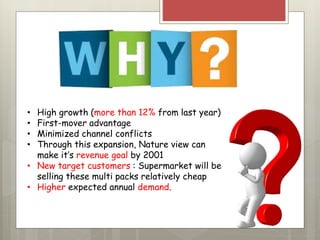
• High growth (more than 12% from last year)
• First-mover advantage
• Minimized channel conflicts
• Through this expansion, Nature view can
make it’s revenue goal by 2001
• New target customers : Supermarket will be
selling these multi packs relatively cheap
• Higher expected annual demand.
1. Background
2. Target Customers
3. SWOT analysis
4. Issue
5. Objective
6. Options
7. Evaluation of every option
8. Recommendation
Created by Aditi Garg, DTU, during a marketing
internship under Prof Sameer Mathur, IIM Lucknow

Natureview Farm

  • 1.
  • 2.
    • Founded inCabot,Vermont • First enter market 8-oz and 32-oz with plain and vanilla flavor • Use natural ingredient with longer average shelf-life of 50 ays • Revenue growth from $100,000 to $13 million • Fruit on the bottom yogurt • Expanded to 12 flavors • Introduced multi pack yogurt for children Background
  • 3.
    Vice president Chief FinancialOfficer Chief executive officer Vice president of sale Vice president of operation Assistant marketing director Christine Walker Jim Wagner Barry Landers Walter Bellini Jack Gottlieb Kelly Riley
  • 4.
  • 5.
    Shoppers at Natural FoodStores are older, educated and have higher incomes Target Customers
  • 6.
  • 7.
    S W O T STRENGTHSWEAKNESSES OPPORTUNITIES THREATS • Strong Brand • No artificial thickeners used • Usage of natural ingredients • Longer shelf life • No alternative financing available • Lacks potential of taking risks and costs • Doubt on sales team’s ability • Strong relationship with leading natural foods retailers • Accumulation of cash by horizon from IPO • Being dropped out of traditional channel
  • 8.
  • 9.
    VC firm now needsto cash out of its investment The management team needs to find a way to increase the firm’s revenues to $20 million by the end of 2001
  • 10.
    To come witha plan that takes the company to $20 million in revenues by the end of 2001 To do so keeping in mind the words of the CEO “ We owe it to our customers, our suppliers, and our distribution partners to make the right strategic choices regarding the revenue growth objective before us”
  • 11.
     Senior Management proposedthree options to grow Natureview’s revenue
  • 12.
    OPTION 1 • Expand6 SKUs of the 8-oz. product line into one or two selected supermarket channel regions a • Proposed by Walter Bellini VP Sales
  • 13.
    1. Great UpsidePotential 2. For supermarket adding these products would attract higher- income less price-sensitive customers 3. Unit volume growth of organic yogurt at supermarkets of 20% per year from 2001 to 2006 4. This option also has the highest incremental demand 1. Supporting 8-oz cup size would require quarterly trade promotions and a meaningful marketing budget 2. Advertising plan would cost $1.2 million per region per year in addition to the promotional ads expenses 3. SG&A expenses would increase by $320,000 annually 4. This option creates direct competition with national yogurt brands
  • 14.
    Channel Natureview DistributorRetailer Margin ($0.46-$0.31)/$0.46 = 33% 15% 27% Cost Price $0.31 $0.54*85% = $0.46 $0.74*73% = $0.54 Selling Price $0.46 $0.54 $0.74 Analysis for OPTION 1
  • 15.
    Year 2000 Year2001 Data from Unit Sales 35,000,000 units 35,000,000*(1+20%) = 42,000,000 Exhibit 6 Revenue 35,000,000*$0.46 = $16,100,000 42,000,000*$0.46 = $19,320,000 From previous slide Cost 35,000,000*$0.31 = $10,850,000 42,000,000*$0.31 = $13,020,000 Exhibit 3 Gross Profit $5,250,000 $6,300,000 Revenue – Cost Advertisement 1,200,000*2 Regions = $2,400,000 $2,400,000 Page 7 SG & A $320,000 $640,000 Page 7 Slotting Fees 10,000*6*20 retails = $1,200,000 -- Page 5 Broker’s Fee 16,100,000*4% = $644,000 19,320,000*4% = $772,800 Page 4 Net Profit $686,000 $2,487,200
  • 16.
    OPTION 2 • Expand4 SKUs of the 32-oz. size nationally • Proposed by Jack Gottlieb, vice president of operations
  • 17.
    1. Potentially givehigher average gross profit margin than 8-oz size 2. It also has stronger competitive advantage like longer shelf life and lower marketing expenses 1. Doubt on claim of new users would readily “enter the brand” via a multi-use size 2. Doubt on sales team’s ability to achieve full national distribution in 12 months 3. Needs to hire sales personnel and establish relationships with supermarket brokers 4. The 32-oz. expansion option would increase SG&A expense by $160,000
  • 18.
    Channel Natureview DistributorRetailer Margin ($1.67-$0.99)/$1.67 = 41% 15% 27% Cost Price $0.99 $1.97*85% = $1.67 $2.70*73% = $1.97 Selling Price $1.67 $1.97 $2.70 Analysis for OPTION 2
  • 19.
    Year 2000 Year2001 Data from Unit Sales 5,500,000 units 5,500,000 Exhibit 6 Revenue 5,500,000*$1.67 = $9,185,000 $9,185,000 From previous slide Cost 5,500,000*$0.99 = $5,445,000 $5,445,000 Exhibit 3 Gross Profit $3,740,000 $3,740,000 Revenue – Cost Marketing 120,000*4 Regions = $480,000 $480,000 Page 8 SG & A $160,000 $320,000 Page 8 Slotting Fees 10,000*4*64 retails = $2,560,000 -- Page 5 Broker’s Fee 9,185,000*4% = $367,400 $367,400 Page 4 Net Profit $172,600 $2,572,600
  • 20.
    OPTION 3 • Introduce2 SKUs of a Children’s Multi-Pack into the Natural Foods Channel • Proposed by Kelly Riley, the assistant marketing director
  • 21.
    1. Established leaderin this channel 2. Perfect positioning for new multi-pack product 3. Long term the financial potential was very attractive 1. Established leader in this channel 2. Perfect positioning for new multi-pack product 3. Long term the financial potential was very attractive
  • 22.
    Analysis for OPTION3 Channel Natureview Natural Food Wholesalers Distributor Retailer Margin ($1.84-$1.15)/$1.84 = 38% 7% 9% 35% Cost Price $1.15 $1.98*93% = $1.84 $2.18*91% = $1.98 $3.35*73% = $2.18 Selling Price $1.84 $1.98 $2.18 $3.35
  • 23.
    Year 2000 Year2001 Data from Unit Sales 1,800,000 units 1,800,000*(1+15%) = 2,070,000 Exhibit 6 Revenue 1,800,000*$1.84 = $3,312,000 2,070,000*$1.84 = $3,808,800 From previous slide Cost 1,800,000*$1.15 = $2,070,000 2,070,000*$1.15 = $2,380,500 Exhibit 3 Gross Profit $1,242,000 $1,428,300 Revenue – Cost Marketing $250,000 $250,000 Page 8 Comp. case $3,312,000*2% = $82,800 $3,808,800*2.5% = $95,220 Page 8 Net Profit $909,200 $1,083,080
  • 24.
  • 25.
    • High growth(more than 12% from last year) • First-mover advantage • Minimized channel conflicts • Through this expansion, Nature view can make it’s revenue goal by 2001 • New target customers : Supermarket will be selling these multi packs relatively cheap • Higher expected annual demand.
  • 26.
    1. Background 2. TargetCustomers 3. SWOT analysis 4. Issue 5. Objective 6. Options 7. Evaluation of every option 8. Recommendation
  • 27.
    Created by AditiGarg, DTU, during a marketing internship under Prof Sameer Mathur, IIM Lucknow