Natureview Farm : Case Analysis
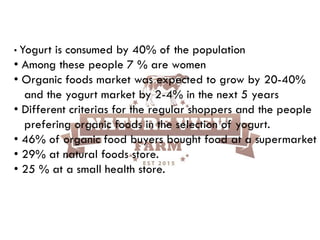
• Yogurt is consumed by 40% of the population
• Among these people 7 % are women
• Organic foods market was expected to grow by 20-40%
and the yogurt market by 2-4% in the next 5 years
• Different criterias for the regular shoppers and the people
prefering organic foods in the selection of yogurt.
• 46% of organic food buyers bought food at a supermarket
• 29% at natural foods store.
• 25 % at a small health store.
• Shoppers at natural food stores tend to be more educated, richer and
older than the regular supermarket shoppers.
• They tend to settle in the Northeast and the West.
• Natural stores channel was expected to grow 7 times faster than the
supermarket channel.
• 58% of US households told that they will buy more organic products if
prices were less.
• 44% demanded a larger variety of organic products
SITUATION
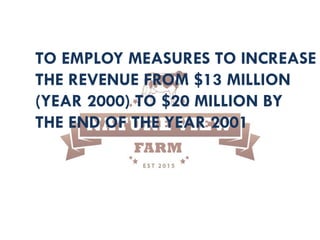
TO EMPLOY MEASURES TO INCREASE
THE REVENUE FROM $13 MILLION
(YEAR 2000) TO $20 MILLION BY
THE END OF THE YEAR 2001
DECISION
to be made!!
To expand into the supermarket chains
OR
To strengthen the existing distribution and
marketing strategy to earn greater revenues
MANUFACTURER
NATURAL FOODS WHOLESALER
CONSUMER
RETAILER
NATURAL FOODS DISTRIBUTOR
NATURAL FOODS CHANNEL
The typical natural foods wholesaler margin was 7%, the distributor margin
was 9%, and the retailer margin was 35%.
MANUFACTURER
DISTRIBUTOR
CUSTOMER
RETAILER
SUPERMARKET CHANNEL
The typical distributor margin in this channel was 15%, and the typical retailer margin
was 27% and thus prices tended to be lower here than the natural foods stores.
QUESTIONS
DECISION OPTIONS
•3 decision options
DECISION CRITERIAS
• REVENUE GENERATION
• EFFECT ON THE EXISTING RELATIONSHIPS
• ADDITIONAL COSTS
MOST IMPORTANT CRITERIA
•TO MEET THE OBJECTIVES OF REVENUE GENERATION
DECISION OPTIONS
OPTION 1
To expand 6 SKUs(Stock-keeping units) of 8 oz cups into
1 or 2 selected supermarkets.
BENEFITS
• Great upside potential
• 8 oz cups were the largest source of revenue generation
• Horizon Organic and other competitors were also planning to
enter the supermarkets and they would allow entry of only 1 such
brand
•A modest growth rate(3%).
RISKS
• Fierce competition in the 8 oz cup segment (74% of market share).
• Alienating relations with the existing distribution channel
• Fear of losing trust and in turn shelf place in the the natural food stores.
• Increased costs owing to increased advertising, trade promotions
incement in SG&A costs.
• Higher slotting costs
• Inefficient sales team.
OPTION 2
• To expand 4 SKUs of 32 oz cups nationally in supermarkets.
BENEFITS
• Potentially gives higher profit margins than the 8 oz cups
• Natureview had competitive advantage because of the longer
shelf life
• Lower marketing, advertising and SG&A cost increments.
• Trade Promotions only twice a year.
RISKS
• Doubt that they will enter a multi – brand use.
• Inefficiency of the sales team.
•Need to hire additional sales personnel.
• Increased costs for advertising , marketing and half- yearly trade
promotions(though less than option 1).
• The SG&A costs will increase by $160,000.
OPTION 3
• Introduce 2 SKUs of children’s multi-pack in the
natural foods channel.
BENEFITS
• Established leader in the market(45%).
• Perfect positioning for the launch of children multipacks.
• Attractive long term potential.
• Existing channel relationships would strengthen.
• Effective sales team.
• No additional SG&A costs.
• The natural foods channel was expected to grow 7 times
faster than the supermarket channel.
RISKS
• Lower revenue generation than either of the 3 options.
• Fears of natural food retailers putting forth the same demands
as a supermarket retailer.
• Fear of falling behind the competitors and losing an important
oppurtunity for expansion and increasing revenue.
HYPOTHESIS
and ANALYSIS
HYPOTHESIS
I hypothise that OPTION 2 shall generate enough revenue so as to
satisfy the objective and at the same time should be more suitable
among the 3 options to satisfy the remaining decision criterias.
OPTION 2
TARGET OF REVENUE GENERATION =$ 20 MILLION
CURRENT REVENUE GENERATION =$ 13 MILLION
DIFFERENCE TO BE ACHIEVED(in 1 year) =$ 7 MILLION
SELLING PRICE (at the supermarket) =$2.70/cup
DISTRIBUTOR+RETAILER MARGIN =15%+27%=42%
SELLING PRICE FOR NATUREVIEW =$ 1.566/CUP
ANTICIPATED INCREMENT IN SALES UNIT = 5,500,000
INCREASES REVENUE GENERATION = 5,500,000*1.566=$8,613,000
Hence, the revenue generation objective is fulfilled.
OPTION 2(COSTS AND DOWNSIDES)
MARKETING EXPENSES =$120,000/REGION
=$120,000*4
=$480,000
INCREASED SG&A EXPENSES =$160,000
SLOTTING EXPENSES =$X
HALF-YEARLY TRADE PROMOTIONS =$Y
TOTAL EXPENSES = $640,000+$X+$Y
The natural foods stores ,on the other hand, will have a reason less to feel detered and
violated as the 32 oz occupied a smaller portion of market share and hence only a small
source of revenue generation.
The costs , may seem somewhat higher but they are much less than option 1(evaluated next)
ALTERNATIVES
OPTION 1
TARGET OF REVENUE GENERATION =$ 20 MILLION
CURRENT REVENUE GENERATION =$ 13 MILLION
DIFFERENCE TO BE ACHIEVED(in 1 year) =$ 7 MILLION
SELLING PRICE (at the supermarket) =$.74/cup
DISTRIBUTOR+RETAILER MARGIN =15%+27%=42%
SELLING PRICE FOR NATUREVIEW =$ .4292/CUP
ANTICIPATED INCREMENT IN SALES UNIT = 35,000,000
INCREASES REVENUE GENERATION = 35,000,000*.4292=$15,022,000
Hence, the revenue generation objective is fulfilled.
OPTION 1(COSTS AND DOWNSIDES)
MARKETING EXPENSES =$1,200,000/REGION
=$1,200,000*4
=$4,800,000=$4.8 MILLION
INCREASED SG&A EXPENSES =$320,000
SLOTTING EXPENSES =$A($10,000/SKU)
QUARTERLY TRADE PROMOTIONS =$B
TOTAL EXPENSES = $5.12 MILLION+$A+$B
The natural foods stores ,on the other hand, will feel detered and
violated as the 8 oz occupied the largest chunk of market and hence was the largest
source of revenue generation.
The costs are way too high than option 2(evaluated earlier).
Also, this was the market segment which faces the most stiff competition and seeing the market
potential, even the supermarket chains were expected to release brands of their own.
OPTION 3
TARGET OF REVENUE GENERATION =$ 20 MILLION
CURRENT REVENUE GENERATION =$ 13 MILLION
DIFFERENCE TO BE ACHIEVED(in 1 year) =$ 7 MILLION
SELLING PRICE (at the natural foods store) =$3.35/pack
DISTRIBUTOR+WHOLESALER+RETAILER MARGIN =9%+7%+35%=51%
SELLING PRICE FOR NATUREVIEW =$ 1.6415/PACK
ANTICIPATED INCREMENT IN SALES UNIT = 1,800,000
INCREASES REVENUE GENERATION = 1,800,000*1.6415=$2,954,700
Hence, the revenue generation objective is NOT fulfilled.
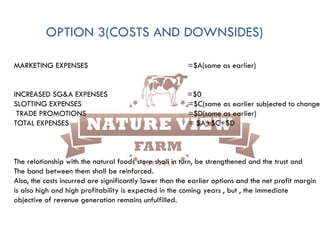
OPTION 3(COSTS AND DOWNSIDES)
MARKETING EXPENSES =$A(same as earlier)
INCREASED SG&A EXPENSES =$0
SLOTTING EXPENSES =$C(same as earlier subjected to change)
TRADE PROMOTIONS =$D(same as earlier)
TOTAL EXPENSES = $A+$C+$D
The relationship with the natural foods store shall in turn, be strengthened and the trust and
The bond between them shall be reinforced.
Also, the costs incurred are significantly lower than the earlier options and the net profit margin
is also high and high profitability is expected in the coming years , but , the immediate
objective of revenue generation remains unfulfilled.
PROOF
and ACTIONS
• Natureview could not risk itself losing the trust of the
natural food stores as they were expected to
grow 7 times faster than the supermarket stores.
“Farm had developed strong relationships with leading
natural foods retailers, including the chainsWhole
Foods ($1.57 billion revenues in 1999) and
Wild Oats ($721 million revenues). The organic
foods market, worth $6.5 billion in 1999, was
predicted to grow to $13.3 billion in 2003.”
• Also, Natureview had to enter the supermarket
chain as other competitors were also aiming for the
same and Natureview could not risk losing a
significant portion of market segment.
“Supermarket retailers would likely authorize
only one organic yogurt brand.
The first brand to enter the channel could
therefore have a significant first-mover advantage.”
Natureview should therefore go with option 2.
RECAP
• Title slide
• Background
• Facts
• Situation
• Decision to be made
• Questions
• Decision options
• Decision criterias
• Most important criteria
• Decision options
• Option 1
• Option 2
• Option 3
• Hypothesis and Analysis
• Hypothesis
• Analysis
• Option 2
• Alternatives
• Option 1
• Option 3
• Proof and Actions
• Proof
• Actions
DISCLAIMER
These slides were created by Shreyans Hinger , under the guidance of Prof.
Sameer Mathur , under a summer internship mentored by him.
Natureview Farm Harvard Case Analysis

Natureview Farm Harvard Case Analysis

  • 1.
    Natureview Farm :Case Analysis
  • 5.
    • Yogurt isconsumed by 40% of the population • Among these people 7 % are women • Organic foods market was expected to grow by 20-40% and the yogurt market by 2-4% in the next 5 years • Different criterias for the regular shoppers and the people prefering organic foods in the selection of yogurt. • 46% of organic food buyers bought food at a supermarket • 29% at natural foods store. • 25 % at a small health store.
  • 6.
    • Shoppers atnatural food stores tend to be more educated, richer and older than the regular supermarket shoppers. • They tend to settle in the Northeast and the West. • Natural stores channel was expected to grow 7 times faster than the supermarket channel. • 58% of US households told that they will buy more organic products if prices were less. • 44% demanded a larger variety of organic products
  • 7.
  • 8.
    TO EMPLOY MEASURESTO INCREASE THE REVENUE FROM $13 MILLION (YEAR 2000) TO $20 MILLION BY THE END OF THE YEAR 2001
  • 9.
  • 10.
    To expand intothe supermarket chains OR To strengthen the existing distribution and marketing strategy to earn greater revenues
  • 11.
    MANUFACTURER NATURAL FOODS WHOLESALER CONSUMER RETAILER NATURALFOODS DISTRIBUTOR NATURAL FOODS CHANNEL The typical natural foods wholesaler margin was 7%, the distributor margin was 9%, and the retailer margin was 35%.
  • 12.
    MANUFACTURER DISTRIBUTOR CUSTOMER RETAILER SUPERMARKET CHANNEL The typicaldistributor margin in this channel was 15%, and the typical retailer margin was 27% and thus prices tended to be lower here than the natural foods stores.
  • 13.
  • 14.
  • 15.
    DECISION CRITERIAS • REVENUEGENERATION • EFFECT ON THE EXISTING RELATIONSHIPS • ADDITIONAL COSTS
  • 16.
    MOST IMPORTANT CRITERIA •TOMEET THE OBJECTIVES OF REVENUE GENERATION
  • 17.
  • 18.
  • 19.
    To expand 6SKUs(Stock-keeping units) of 8 oz cups into 1 or 2 selected supermarkets.
  • 20.
    BENEFITS • Great upsidepotential • 8 oz cups were the largest source of revenue generation • Horizon Organic and other competitors were also planning to enter the supermarkets and they would allow entry of only 1 such brand •A modest growth rate(3%).
  • 21.
    RISKS • Fierce competitionin the 8 oz cup segment (74% of market share). • Alienating relations with the existing distribution channel • Fear of losing trust and in turn shelf place in the the natural food stores. • Increased costs owing to increased advertising, trade promotions incement in SG&A costs. • Higher slotting costs • Inefficient sales team.
  • 22.
  • 23.
    • To expand4 SKUs of 32 oz cups nationally in supermarkets.
  • 24.
    BENEFITS • Potentially giveshigher profit margins than the 8 oz cups • Natureview had competitive advantage because of the longer shelf life • Lower marketing, advertising and SG&A cost increments. • Trade Promotions only twice a year.
  • 25.
    RISKS • Doubt thatthey will enter a multi – brand use. • Inefficiency of the sales team. •Need to hire additional sales personnel. • Increased costs for advertising , marketing and half- yearly trade promotions(though less than option 1). • The SG&A costs will increase by $160,000.
  • 26.
  • 27.
    • Introduce 2SKUs of children’s multi-pack in the natural foods channel.
  • 28.
    BENEFITS • Established leaderin the market(45%). • Perfect positioning for the launch of children multipacks. • Attractive long term potential. • Existing channel relationships would strengthen. • Effective sales team. • No additional SG&A costs. • The natural foods channel was expected to grow 7 times faster than the supermarket channel.
  • 29.
    RISKS • Lower revenuegeneration than either of the 3 options. • Fears of natural food retailers putting forth the same demands as a supermarket retailer. • Fear of falling behind the competitors and losing an important oppurtunity for expansion and increasing revenue.
  • 30.
  • 31.
    HYPOTHESIS I hypothise thatOPTION 2 shall generate enough revenue so as to satisfy the objective and at the same time should be more suitable among the 3 options to satisfy the remaining decision criterias.
  • 33.
    OPTION 2 TARGET OFREVENUE GENERATION =$ 20 MILLION CURRENT REVENUE GENERATION =$ 13 MILLION DIFFERENCE TO BE ACHIEVED(in 1 year) =$ 7 MILLION SELLING PRICE (at the supermarket) =$2.70/cup DISTRIBUTOR+RETAILER MARGIN =15%+27%=42% SELLING PRICE FOR NATUREVIEW =$ 1.566/CUP ANTICIPATED INCREMENT IN SALES UNIT = 5,500,000 INCREASES REVENUE GENERATION = 5,500,000*1.566=$8,613,000 Hence, the revenue generation objective is fulfilled.
  • 34.
    OPTION 2(COSTS ANDDOWNSIDES) MARKETING EXPENSES =$120,000/REGION =$120,000*4 =$480,000 INCREASED SG&A EXPENSES =$160,000 SLOTTING EXPENSES =$X HALF-YEARLY TRADE PROMOTIONS =$Y TOTAL EXPENSES = $640,000+$X+$Y The natural foods stores ,on the other hand, will have a reason less to feel detered and violated as the 32 oz occupied a smaller portion of market share and hence only a small source of revenue generation. The costs , may seem somewhat higher but they are much less than option 1(evaluated next)
  • 35.
  • 36.
    OPTION 1 TARGET OFREVENUE GENERATION =$ 20 MILLION CURRENT REVENUE GENERATION =$ 13 MILLION DIFFERENCE TO BE ACHIEVED(in 1 year) =$ 7 MILLION SELLING PRICE (at the supermarket) =$.74/cup DISTRIBUTOR+RETAILER MARGIN =15%+27%=42% SELLING PRICE FOR NATUREVIEW =$ .4292/CUP ANTICIPATED INCREMENT IN SALES UNIT = 35,000,000 INCREASES REVENUE GENERATION = 35,000,000*.4292=$15,022,000 Hence, the revenue generation objective is fulfilled.
  • 37.
    OPTION 1(COSTS ANDDOWNSIDES) MARKETING EXPENSES =$1,200,000/REGION =$1,200,000*4 =$4,800,000=$4.8 MILLION INCREASED SG&A EXPENSES =$320,000 SLOTTING EXPENSES =$A($10,000/SKU) QUARTERLY TRADE PROMOTIONS =$B TOTAL EXPENSES = $5.12 MILLION+$A+$B The natural foods stores ,on the other hand, will feel detered and violated as the 8 oz occupied the largest chunk of market and hence was the largest source of revenue generation. The costs are way too high than option 2(evaluated earlier). Also, this was the market segment which faces the most stiff competition and seeing the market potential, even the supermarket chains were expected to release brands of their own.
  • 38.
    OPTION 3 TARGET OFREVENUE GENERATION =$ 20 MILLION CURRENT REVENUE GENERATION =$ 13 MILLION DIFFERENCE TO BE ACHIEVED(in 1 year) =$ 7 MILLION SELLING PRICE (at the natural foods store) =$3.35/pack DISTRIBUTOR+WHOLESALER+RETAILER MARGIN =9%+7%+35%=51% SELLING PRICE FOR NATUREVIEW =$ 1.6415/PACK ANTICIPATED INCREMENT IN SALES UNIT = 1,800,000 INCREASES REVENUE GENERATION = 1,800,000*1.6415=$2,954,700 Hence, the revenue generation objective is NOT fulfilled.
  • 39.
    OPTION 3(COSTS ANDDOWNSIDES) MARKETING EXPENSES =$A(same as earlier) INCREASED SG&A EXPENSES =$0 SLOTTING EXPENSES =$C(same as earlier subjected to change) TRADE PROMOTIONS =$D(same as earlier) TOTAL EXPENSES = $A+$C+$D The relationship with the natural foods store shall in turn, be strengthened and the trust and The bond between them shall be reinforced. Also, the costs incurred are significantly lower than the earlier options and the net profit margin is also high and high profitability is expected in the coming years , but , the immediate objective of revenue generation remains unfulfilled.
  • 40.
  • 42.
    • Natureview couldnot risk itself losing the trust of the natural food stores as they were expected to grow 7 times faster than the supermarket stores. “Farm had developed strong relationships with leading natural foods retailers, including the chainsWhole Foods ($1.57 billion revenues in 1999) and Wild Oats ($721 million revenues). The organic foods market, worth $6.5 billion in 1999, was predicted to grow to $13.3 billion in 2003.”
  • 43.
    • Also, Natureviewhad to enter the supermarket chain as other competitors were also aiming for the same and Natureview could not risk losing a significant portion of market segment. “Supermarket retailers would likely authorize only one organic yogurt brand. The first brand to enter the channel could therefore have a significant first-mover advantage.”
  • 45.
    Natureview should thereforego with option 2.
  • 46.
  • 47.
    • Title slide •Background • Facts • Situation • Decision to be made • Questions • Decision options • Decision criterias • Most important criteria • Decision options • Option 1 • Option 2 • Option 3 • Hypothesis and Analysis • Hypothesis • Analysis • Option 2 • Alternatives • Option 1 • Option 3 • Proof and Actions • Proof • Actions
  • 48.
    DISCLAIMER These slides werecreated by Shreyans Hinger , under the guidance of Prof. Sameer Mathur , under a summer internship mentored by him.