Natureview FarmHARVARD BUSINESS SCHOOL CASE
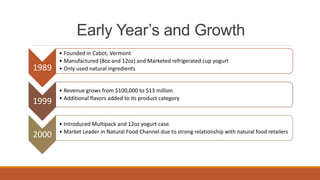
Early Year’s and Growth
1989
• Founded in Cabot, Vermont
• Manufactured (8oz and 12oz) and Marketed refrigerated cup yogurt
• Only used natural ingredients
1999
• Revenue grows from $100,000 to $13 million
• Additional flavors added to its product category
2000
• Introduced Multipack and 12oz yogurt case.
• Market Leader in Natural Food Channel due to strong relationship with natural food retailers
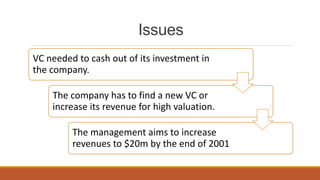
Issues
VC needed to cash out of its investment in
the company.
The company has to find a new VC or
increase its revenue for high valuation.
The management aims to increase
revenues to $20m by the end of 2001
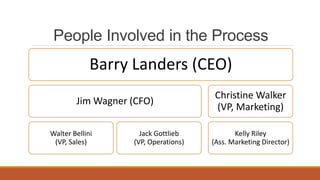
People Involved in the Process
Barry Landers (CEO)
Jim Wagner (CFO)
Walter Bellini
(VP, Sales)
Jack Gottlieb
(VP, Operations)
Christine Walker
(VP, Marketing)
Kelly Riley
(Ass. Marketing Director)
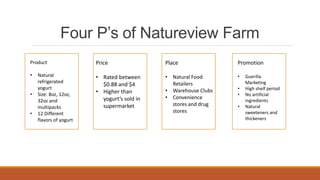
Four P’s of Natureview Farm
Product
• Natural
refrigerated
yogurt
• Size: 8oz, 12oz,
32oz and
multipacks
• 12 Different
flavors of yogurt
Price
• Rated between
$0.88 and $4
• Higher than
yogurt’s sold in
supermarket
Place
• Natural Food
Retailers
• Warehouse Clubs
• Convenience
stores and drug
stores
Promotion
• Guerilla
Marketing
• High shelf period
• No artificial
ingredients
• Natural
sweeteners and
thickeners
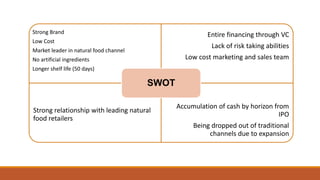
Strong Brand
Low Cost
Market leader in natural food channel
No artificial ingredients
Longer shelf life (50 days)
Entire financing through VC
Lack of risk taking abilities
Low cost marketing and sales team
Strong relationship with leading natural
food retailers
Accumulation of cash by horizon from
IPO
Being dropped out of traditional
channels due to expansion
SWOT
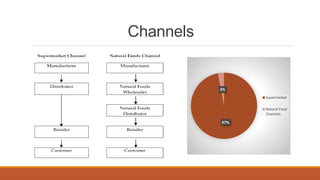
Channels
97%
3%
Supermarket
Natural Food
Channels
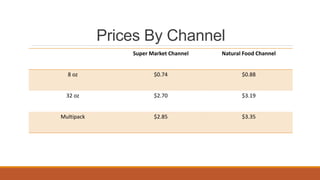
Prices By Channel
Super Market Channel Natural Food Channel
8 oz $0.74 $0.88
32 oz $2.70 $3.19
Multipack $2.85 $3.35
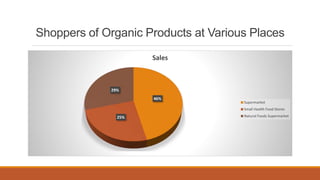
Shoppers of Organic Products at Various Places
46%
25%
29%
Sales
Supermarket
Small Health Food Stores
Natural Foods Supermarket
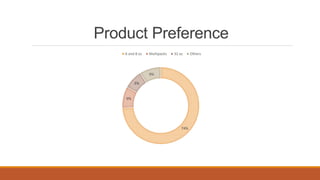
Product Preference
74%
9%
8%
9%
6 and 8 oz Multipacks 32 oz Others
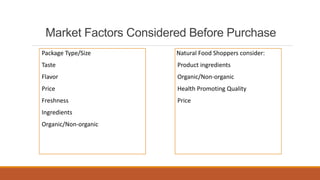
Market Factors Considered Before Purchase
Package Type/Size
Taste
Flavor
Price
Freshness
Ingredients
Organic/Non-organic
Natural Food Shoppers consider:
Product ingredients
Organic/Non-organic
Health Promoting Quality
Price
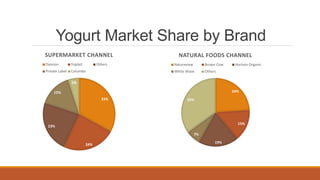
Yogurt Market Share by Brand
33%
24%
23%
15%
5%
SUPERMARKET CHANNEL
Dannon Yoplait Others
Private Label Columbo
24%
15%
19%
7%
35%
NATURAL FOODS CHANNEL
Natureview Brown Cow Horizon Organic
White Wave Others
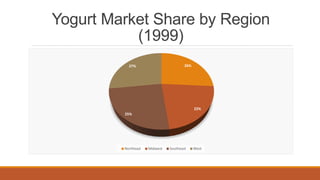
Yogurt Market Share by Region
(1999)
26%
22%
25%
27%
Northeast Midwest Southeast West
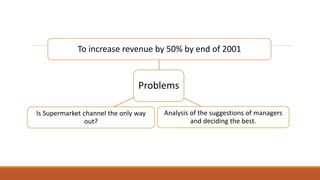
Problems
To increase revenue by 50% by end of 2001
Analysis of the suggestions of managers
and deciding the best.
Is Supermarket channel the only way
out?
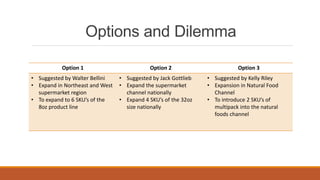
Options and Dilemma
Option 1 Option 2 Option 3
• Suggested by Walter Bellini
• Expand in Northeast and West
supermarket region
• To expand to 6 SKU’s of the
8oz product line
• Suggested by Jack Gottlieb
• Expand the supermarket
channel nationally
• Expand 4 SKU’s of the 32oz
size nationally
• Suggested by Kelly Riley
• Expansion in Natural Food
Channel
• To introduce 2 SKU’s of
multipack into the natural
foods channel
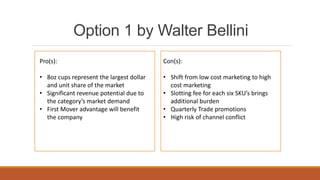
Option 1 by Walter Bellini
Pro(s):
• 8oz cups represent the largest dollar
and unit share of the market
• Significant revenue potential due to
the category’s market demand
• First Mover advantage will benefit
the company
Con(s):
• Shift from low cost marketing to high
cost marketing
• Slotting fee for each six SKU’s brings
additional burden
• Quarterly Trade promotions
• High risk of channel conflict
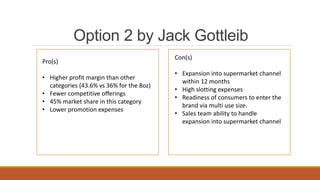
Option 2 by Jack Gottleib
Pro(s)
• Higher profit margin than other
categories (43.6% vs 36% for the 8oz)
• Fewer competitive offerings
• 45% market share in this category
• Lower promotion expenses
Con(s)
• Expansion into supermarket channel
within 12 months
• High slotting expenses
• Readiness of consumers to enter the
brand via multi use size.
• Sales team ability to handle
expansion into supermarket channel
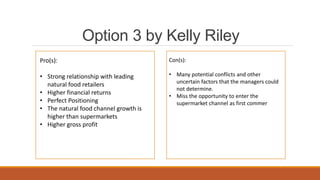
Option 3 by Kelly Riley
Pro(s):
• Strong relationship with leading
natural food retailers
• Higher financial returns
• Perfect Positioning
• The natural food channel growth is
higher than supermarkets
• Higher gross profit
Con(s):
• Many potential conflicts and other
uncertain factors that the managers could
not determine.
• Miss the opportunity to enter the
supermarket channel as first commer
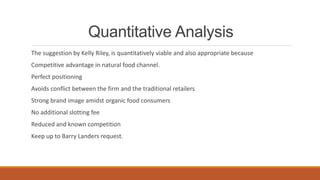
Quantitative Analysis
The suggestion by Kelly Riley, is quantitatively viable and also appropriate because
Competitive advantage in natural food channel.
Perfect positioning
Avoids conflict between the firm and the traditional retailers
Strong brand image amidst organic food consumers
No additional slotting fee
Reduced and known competition
Keep up to Barry Landers request.
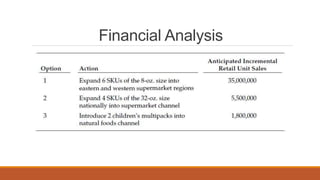
Financial Analysis
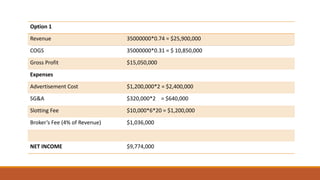
Option 1
Revenue 35000000*0.74 = $25,900,000
COGS 35000000*0.31 = $ 10,850,000
Gross Profit $15,050,000
Expenses
Advertisement Cost $1,200,000*2 = $2,400,000
SG&A $320,000*2 = $640,000
Slotting Fee $10,000*6*20 = $1,200,000
Broker’s Fee (4% of Revenue) $1,036,000
NET INCOME $9,774,000
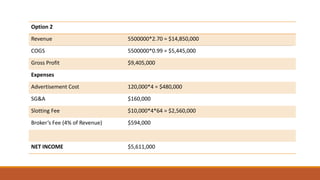
Option 2
Revenue 5500000*2.70 = $14,850,000
COGS 5500000*0.99 = $5,445,000
Gross Profit $9,405,000
Expenses
Advertisement Cost 120,000*4 = $480,000
SG&A $160,000
Slotting Fee $10,000*4*64 = $2,560,000
Broker’s Fee (4% of Revenue) $594,000
NET INCOME $5,611,000
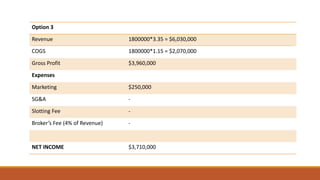
Option 3
Revenue 1800000*3.35 = $6,030,000
COGS 1800000*1.15 = $2,070,000
Gross Profit $3,960,000
Expenses
Marketing $250,000
SG&A -
Slotting Fee -
Broker’s Fee (4% of Revenue) -
NET INCOME $3,710,000
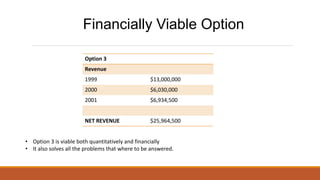
Option 3
Revenue
1999 $13,000,000
2000 $6,030,000
2001 $6,934,500
NET REVENUE $25,964,500
Financially Viable Option
• Option 3 is viable both quantitatively and financially
• It also solves all the problems that where to be answered.
Recap
Natureview Early Days and Background
People Involved
SWOT Analysis
Types of Channel
Channel and Market Analysis
Options and Dilemma
Quantitative Analysis
Financial Analysis
DISCLAIMER
Done By
Shachin Shibi,
Sri Sai Ram Institute of Technology
Chennai
Guided By,
Prof. Sameer Mathur,
IIM Lucknow
Carnegie Mellon University (PhD)
During the remote Marketing Management Internship,
Dec’17-Jan’18

Natureview Farm: Harvard Business Case

  • 1.
  • 2.
    Early Year’s andGrowth 1989 • Founded in Cabot, Vermont • Manufactured (8oz and 12oz) and Marketed refrigerated cup yogurt • Only used natural ingredients 1999 • Revenue grows from $100,000 to $13 million • Additional flavors added to its product category 2000 • Introduced Multipack and 12oz yogurt case. • Market Leader in Natural Food Channel due to strong relationship with natural food retailers
  • 3.
    Issues VC needed tocash out of its investment in the company. The company has to find a new VC or increase its revenue for high valuation. The management aims to increase revenues to $20m by the end of 2001
  • 4.
    People Involved inthe Process Barry Landers (CEO) Jim Wagner (CFO) Walter Bellini (VP, Sales) Jack Gottlieb (VP, Operations) Christine Walker (VP, Marketing) Kelly Riley (Ass. Marketing Director)
  • 5.
    Four P’s ofNatureview Farm Product • Natural refrigerated yogurt • Size: 8oz, 12oz, 32oz and multipacks • 12 Different flavors of yogurt Price • Rated between $0.88 and $4 • Higher than yogurt’s sold in supermarket Place • Natural Food Retailers • Warehouse Clubs • Convenience stores and drug stores Promotion • Guerilla Marketing • High shelf period • No artificial ingredients • Natural sweeteners and thickeners
  • 6.
    Strong Brand Low Cost Marketleader in natural food channel No artificial ingredients Longer shelf life (50 days) Entire financing through VC Lack of risk taking abilities Low cost marketing and sales team Strong relationship with leading natural food retailers Accumulation of cash by horizon from IPO Being dropped out of traditional channels due to expansion SWOT
  • 7.
  • 8.
    Prices By Channel SuperMarket Channel Natural Food Channel 8 oz $0.74 $0.88 32 oz $2.70 $3.19 Multipack $2.85 $3.35
  • 9.
    Shoppers of OrganicProducts at Various Places 46% 25% 29% Sales Supermarket Small Health Food Stores Natural Foods Supermarket
  • 10.
    Product Preference 74% 9% 8% 9% 6 and8 oz Multipacks 32 oz Others
  • 11.
    Market Factors ConsideredBefore Purchase Package Type/Size Taste Flavor Price Freshness Ingredients Organic/Non-organic Natural Food Shoppers consider: Product ingredients Organic/Non-organic Health Promoting Quality Price
  • 12.
    Yogurt Market Shareby Brand 33% 24% 23% 15% 5% SUPERMARKET CHANNEL Dannon Yoplait Others Private Label Columbo 24% 15% 19% 7% 35% NATURAL FOODS CHANNEL Natureview Brown Cow Horizon Organic White Wave Others
  • 13.
    Yogurt Market Shareby Region (1999) 26% 22% 25% 27% Northeast Midwest Southeast West
  • 14.
    Problems To increase revenueby 50% by end of 2001 Analysis of the suggestions of managers and deciding the best. Is Supermarket channel the only way out?
  • 15.
    Options and Dilemma Option1 Option 2 Option 3 • Suggested by Walter Bellini • Expand in Northeast and West supermarket region • To expand to 6 SKU’s of the 8oz product line • Suggested by Jack Gottlieb • Expand the supermarket channel nationally • Expand 4 SKU’s of the 32oz size nationally • Suggested by Kelly Riley • Expansion in Natural Food Channel • To introduce 2 SKU’s of multipack into the natural foods channel
  • 16.
    Option 1 byWalter Bellini Pro(s): • 8oz cups represent the largest dollar and unit share of the market • Significant revenue potential due to the category’s market demand • First Mover advantage will benefit the company Con(s): • Shift from low cost marketing to high cost marketing • Slotting fee for each six SKU’s brings additional burden • Quarterly Trade promotions • High risk of channel conflict
  • 17.
    Option 2 byJack Gottleib Pro(s) • Higher profit margin than other categories (43.6% vs 36% for the 8oz) • Fewer competitive offerings • 45% market share in this category • Lower promotion expenses Con(s) • Expansion into supermarket channel within 12 months • High slotting expenses • Readiness of consumers to enter the brand via multi use size. • Sales team ability to handle expansion into supermarket channel
  • 18.
    Option 3 byKelly Riley Pro(s): • Strong relationship with leading natural food retailers • Higher financial returns • Perfect Positioning • The natural food channel growth is higher than supermarkets • Higher gross profit Con(s): • Many potential conflicts and other uncertain factors that the managers could not determine. • Miss the opportunity to enter the supermarket channel as first commer
  • 19.
    Quantitative Analysis The suggestionby Kelly Riley, is quantitatively viable and also appropriate because Competitive advantage in natural food channel. Perfect positioning Avoids conflict between the firm and the traditional retailers Strong brand image amidst organic food consumers No additional slotting fee Reduced and known competition Keep up to Barry Landers request.
  • 20.
  • 21.
    Option 1 Revenue 35000000*0.74= $25,900,000 COGS 35000000*0.31 = $ 10,850,000 Gross Profit $15,050,000 Expenses Advertisement Cost $1,200,000*2 = $2,400,000 SG&A $320,000*2 = $640,000 Slotting Fee $10,000*6*20 = $1,200,000 Broker’s Fee (4% of Revenue) $1,036,000 NET INCOME $9,774,000
  • 22.
    Option 2 Revenue 5500000*2.70= $14,850,000 COGS 5500000*0.99 = $5,445,000 Gross Profit $9,405,000 Expenses Advertisement Cost 120,000*4 = $480,000 SG&A $160,000 Slotting Fee $10,000*4*64 = $2,560,000 Broker’s Fee (4% of Revenue) $594,000 NET INCOME $5,611,000
  • 23.
    Option 3 Revenue 1800000*3.35= $6,030,000 COGS 1800000*1.15 = $2,070,000 Gross Profit $3,960,000 Expenses Marketing $250,000 SG&A - Slotting Fee - Broker’s Fee (4% of Revenue) - NET INCOME $3,710,000
  • 24.
    Option 3 Revenue 1999 $13,000,000 2000$6,030,000 2001 $6,934,500 NET REVENUE $25,964,500 Financially Viable Option • Option 3 is viable both quantitatively and financially • It also solves all the problems that where to be answered.
  • 25.
    Recap Natureview Early Daysand Background People Involved SWOT Analysis Types of Channel Channel and Market Analysis Options and Dilemma Quantitative Analysis Financial Analysis
  • 27.
    DISCLAIMER Done By Shachin Shibi, SriSai Ram Institute of Technology Chennai Guided By, Prof. Sameer Mathur, IIM Lucknow Carnegie Mellon University (PhD) During the remote Marketing Management Internship, Dec’17-Jan’18