Natureview Farm Case Analysis
Contents
• Natureview Farm: Overview
• Goal
• Market Facts & Trends
• Challenges
• Option 1
• Option 2
• Option 3
• Recommendation
Natureview Farm
1989
• Founded and manufactured in Cabot, Vermont
• First entered market 8-oz and 32-oz with plain and vanilla flavor
• Used natural ingredient with longer average shelf-life of 50 days
1999
• Company revenue growth from $ 100,000 to $13 million
• Fruit on the bottom yogurt
2000
• Expanded to 12 yogurt flavors & multipack yogurt (for
children)
Goal
To increase its revenue by over 50% within 23 months to attain highest possible
valuation of the company
Market Facts & Trends
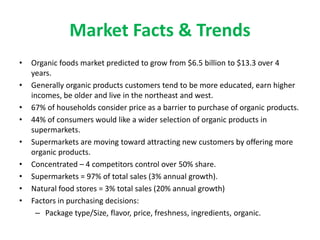
• Organic foods market predicted to grow from $6.5 billion to $13.3 over 4
years.
• Generally organic products customers tend to be more educated, earn higher
incomes, be older and live in the northeast and west.
• 67% of households consider price as a barrier to purchase of organic products.
• 44% of consumers would like a wider selection of organic products in
supermarkets.
• Supermarkets are moving toward attracting new customers by offering more
organic products.
• Concentrated – 4 competitors control over 50% share.
• Supermarkets = 97% of total sales (3% annual growth).
• Natural food stores = 3% total sales (20% annual growth)
• Factors in purchasing decisions:
– Package type/Size, flavor, price, freshness, ingredients, organic.
Three Options
Option 1
PROS CONS
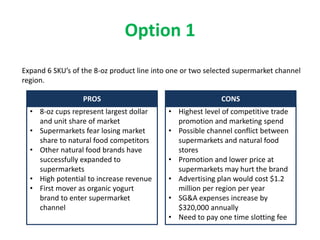
• 8-oz cups represent largest dollar
and unit share of market
• Supermarkets fear losing market
share to natural food competitors
• Other natural food brands have
successfully expanded to
supermarkets
• High potential to increase revenue
• First mover as organic yogurt
brand to enter supermarket
channel
• Highest level of competitive trade
promotion and marketing spend
• Possible channel conflict between
supermarkets and natural food
stores
• Promotion and lower price at
supermarkets may hurt the brand
• Advertising plan would cost $1.2
million per region per year
• SG&A expenses increase by
$320,000 annually
• Need to pay one time slotting fee
Expand 6 SKU’s of the 8-oz product line into one or two selected supermarket channel
region.
Financials
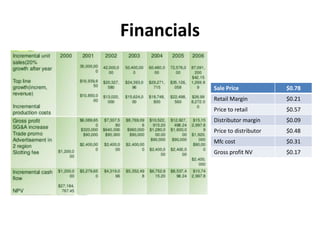
Sale Price $0.78
Retail Margin $0.21
Price to retail $0.57
Distributor margin $0.09
Price to distributor $0.48
Mfc cost $0.31
Gross profit NV $0.17
Option 2
PROS CONS
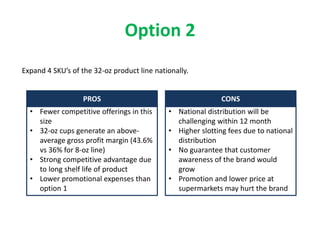
• Fewer competitive offerings in this
size
• 32-oz cups generate an above-
average gross profit margin (43.6%
vs 36% for 8-oz line)
• Strong competitive advantage due
to long shelf life of product
• Lower promotional expenses than
option 1
• National distribution will be
challenging within 12 month
• Higher slotting fees due to national
distribution
• No guarantee that customer
awareness of the brand would
grow
• Promotion and lower price at
supermarkets may hurt the brand
Expand 4 SKU’s of the 32-oz product line nationally.
Financials
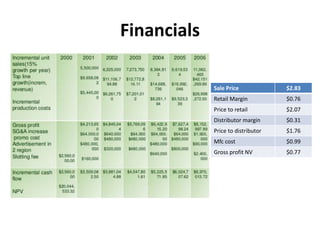
Sale Price $2.83
Retail Margin $0.76
Price to retail $2.07
Distributor margin $0.31
Price to distributor $1.76
Mfc cost $0.99
Gross profit NV $0.77
Option 3
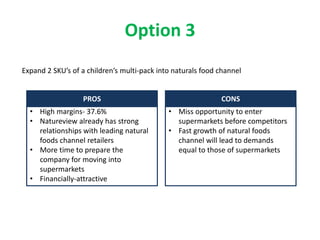
PROS CONS
• High margins- 37.6%
• Natureview already has strong
relationships with leading natural
foods channel retailers
• More time to prepare the
company for moving into
supermarkets
• Financially-attractive
• Miss opportunity to enter
supermarkets before competitors
• Fast growth of natural foods
channel will lead to demands
equal to those of supermarkets
Expand 2 SKU’s of a children’s multi-pack into naturals food channel
Financials
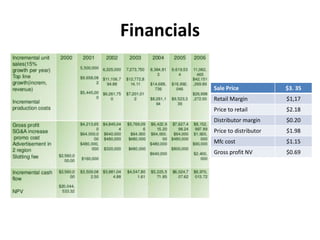
Sale Price $3. 35
Retail Margin $1,17
Price to retail $2.18
Distributor margin $0.20
Price to distributor $1.98
Mfc cost $1.15
Gross profit NV $0.69
Recommendations
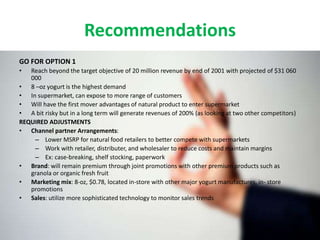
GO FOR OPTION 1
• Reach beyond the target objective of 20 million revenue by end of 2001 with projected of $31 060
000
• 8 –oz yogurt is the highest demand
• In supermarket, can expose to more range of customers
• Will have the first mover advantages of natural product to enter supermarket
• A bit risky but in a long term will generate revenues of 200% (as looking at two other competitors)
REQUIRED ADJUSTMENTS
• Channel partner Arrangements:
– Lower MSRP for natural food retailers to better compete with supermarkets
– Work with retailer, distributer, and wholesaler to reduce costs and maintain margins
– Ex: case-breaking, shelf stocking, paperwork
• Brand: will remain premium through joint promotions with other premium products such as
granola or organic fresh fruit
• Marketing mix: 8-oz, $0.78, located in-store with other major yogurt manufactures, in- store
promotions
• Sales: utilize more sophisticated technology to monitor sales trends
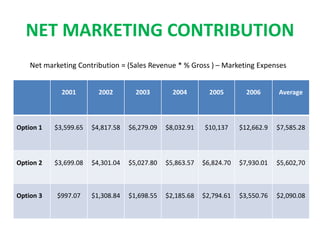
NET MARKETING CONTRIBUTION
2001 2002 2003 2004 2005 2006 Average
Option 1 $3,599.65 $4,817.58 $6,279.09 $8,032.91 $10,137 $12,662.9 $7,585.28
Option 2 $3,699.08 $4,301.04 $5,027.80 $5,863.57 $6,824.70 $7,930.01 $5,602,70
Option 3 $997.07 $1,308.84 $1,698.55 $2,185.68 $2,794.61 $3,550.76 $2,090.08
Net marketing Contribution = (Sales Revenue * % Gross ) – Marketing Expenses
Natureview farm

Natureview farm

  • 1.
  • 2.
    Contents • Natureview Farm:Overview • Goal • Market Facts & Trends • Challenges • Option 1 • Option 2 • Option 3 • Recommendation
  • 3.
    Natureview Farm 1989 • Foundedand manufactured in Cabot, Vermont • First entered market 8-oz and 32-oz with plain and vanilla flavor • Used natural ingredient with longer average shelf-life of 50 days 1999 • Company revenue growth from $ 100,000 to $13 million • Fruit on the bottom yogurt 2000 • Expanded to 12 yogurt flavors & multipack yogurt (for children)
  • 4.
    Goal To increase itsrevenue by over 50% within 23 months to attain highest possible valuation of the company
  • 5.
    Market Facts &Trends • Organic foods market predicted to grow from $6.5 billion to $13.3 over 4 years. • Generally organic products customers tend to be more educated, earn higher incomes, be older and live in the northeast and west. • 67% of households consider price as a barrier to purchase of organic products. • 44% of consumers would like a wider selection of organic products in supermarkets. • Supermarkets are moving toward attracting new customers by offering more organic products. • Concentrated – 4 competitors control over 50% share. • Supermarkets = 97% of total sales (3% annual growth). • Natural food stores = 3% total sales (20% annual growth) • Factors in purchasing decisions: – Package type/Size, flavor, price, freshness, ingredients, organic.
  • 6.
  • 7.
    Option 1 PROS CONS •8-oz cups represent largest dollar and unit share of market • Supermarkets fear losing market share to natural food competitors • Other natural food brands have successfully expanded to supermarkets • High potential to increase revenue • First mover as organic yogurt brand to enter supermarket channel • Highest level of competitive trade promotion and marketing spend • Possible channel conflict between supermarkets and natural food stores • Promotion and lower price at supermarkets may hurt the brand • Advertising plan would cost $1.2 million per region per year • SG&A expenses increase by $320,000 annually • Need to pay one time slotting fee Expand 6 SKU’s of the 8-oz product line into one or two selected supermarket channel region.
  • 8.
    Financials Sale Price $0.78 RetailMargin $0.21 Price to retail $0.57 Distributor margin $0.09 Price to distributor $0.48 Mfc cost $0.31 Gross profit NV $0.17
  • 9.
    Option 2 PROS CONS •Fewer competitive offerings in this size • 32-oz cups generate an above- average gross profit margin (43.6% vs 36% for 8-oz line) • Strong competitive advantage due to long shelf life of product • Lower promotional expenses than option 1 • National distribution will be challenging within 12 month • Higher slotting fees due to national distribution • No guarantee that customer awareness of the brand would grow • Promotion and lower price at supermarkets may hurt the brand Expand 4 SKU’s of the 32-oz product line nationally.
  • 10.
    Financials Sale Price $2.83 RetailMargin $0.76 Price to retail $2.07 Distributor margin $0.31 Price to distributor $1.76 Mfc cost $0.99 Gross profit NV $0.77
  • 11.
    Option 3 PROS CONS •High margins- 37.6% • Natureview already has strong relationships with leading natural foods channel retailers • More time to prepare the company for moving into supermarkets • Financially-attractive • Miss opportunity to enter supermarkets before competitors • Fast growth of natural foods channel will lead to demands equal to those of supermarkets Expand 2 SKU’s of a children’s multi-pack into naturals food channel
  • 12.
    Financials Sale Price $3.35 Retail Margin $1,17 Price to retail $2.18 Distributor margin $0.20 Price to distributor $1.98 Mfc cost $1.15 Gross profit NV $0.69
  • 13.
    Recommendations GO FOR OPTION1 • Reach beyond the target objective of 20 million revenue by end of 2001 with projected of $31 060 000 • 8 –oz yogurt is the highest demand • In supermarket, can expose to more range of customers • Will have the first mover advantages of natural product to enter supermarket • A bit risky but in a long term will generate revenues of 200% (as looking at two other competitors) REQUIRED ADJUSTMENTS • Channel partner Arrangements: – Lower MSRP for natural food retailers to better compete with supermarkets – Work with retailer, distributer, and wholesaler to reduce costs and maintain margins – Ex: case-breaking, shelf stocking, paperwork • Brand: will remain premium through joint promotions with other premium products such as granola or organic fresh fruit • Marketing mix: 8-oz, $0.78, located in-store with other major yogurt manufactures, in- store promotions • Sales: utilize more sophisticated technology to monitor sales trends
  • 14.
    NET MARKETING CONTRIBUTION 20012002 2003 2004 2005 2006 Average Option 1 $3,599.65 $4,817.58 $6,279.09 $8,032.91 $10,137 $12,662.9 $7,585.28 Option 2 $3,699.08 $4,301.04 $5,027.80 $5,863.57 $6,824.70 $7,930.01 $5,602,70 Option 3 $997.07 $1,308.84 $1,698.55 $2,185.68 $2,794.61 $3,550.76 $2,090.08 Net marketing Contribution = (Sales Revenue * % Gross ) – Marketing Expenses