Atlantic Computers:
A Bundle of Pricing Options
Presented by Team A6:
Daniel Josey
Delwyn Menezes
Janet Aiona
Jasmine Dennis
Tejaswini C
Overview
 Objective & Company Profile
 Competitors & Factors influencing Pricing
 Two-Step Savings & Pricing Alternatives
 Strategy 1: Status-Quo Pricing
 Strategy 2: Competition-based Pricing
 Strategy 3: Cost-plus Pricing
 Strategy 4: Value-in-use Pricing
 Review, Break-even Analysis & Recommendation
 Recommendation to Cadena’s Salesforce
 Zink management’s reaction to external threats 2 of 13
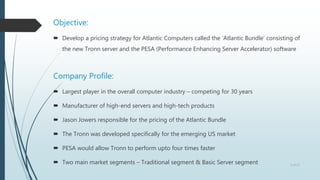
Objective:
 Develop a pricing strategy for Atlantic Computers called the ‘Atlantic Bundle’ consisting of
the new Tronn server and the PESA (Performance Enhancing Server Accelerator) software
Company Profile:
 Largest player in the overall computer industry – competing for 30 years
 Manufacturer of high-end servers and high-tech products
 Jason Jowers responsible for the pricing of the Atlantic Bundle
 The Tronn was developed specifically for the emerging US market
 PESA would allow Tronn to perform upto four times faster
 Two main market segments – Traditional segment & Basic Server segment 3 of 13
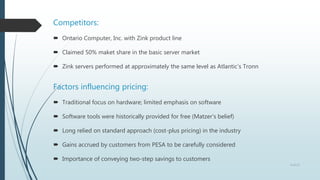
Competitors:
 Ontario Computer, Inc. with Zink product line
 Claimed 50% maket share in the basic server market
 Zink servers performed at approximately the same level as Atlantic’s Tronn
Factors influencing pricing:
 Traditional focus on hardware; limited emphasis on software
 Software tools were historically provided for free (Matzer’s belief)
 Long relied on standard approach (cost-plus pricing) in the industry
 Gains accrued by customers from PESA to be carefully considered
 Importance of conveying two-step savings to customers
4 of 13
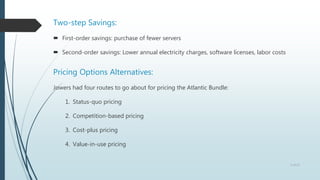
Two-step Savings:
 First-order savings: purchase of fewer servers
 Second-order savings: Lower annual electricity charges, software licenses, labor costs
Pricing Options Alternatives:
Jowers had four routes to go about for pricing the Atlantic Bundle:
1. Status-quo pricing
2. Competition-based pricing
3. Cost-plus pricing
4. Value-in-use pricing
5 of 13
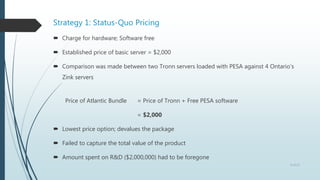
Strategy 1: Status-Quo Pricing
 Charge for hardware; Software free
 Established price of basic server = $2,000
 Comparison was made between two Tronn servers loaded with PESA against 4 Ontario’s
Zink servers
Price of Atlantic Bundle = Price of Tronn + Free PESA software
= $2,000
 Lowest price option; devalues the package
 Failed to capture the total value of the product
 Amount spent on R&D ($2,000,000) had to be foregone
6 of 13
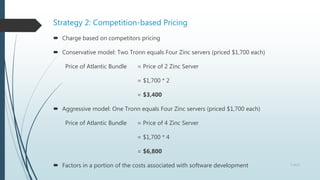
Strategy 2: Competition-based Pricing
 Charge based on competitors pricing
 Conservative model: Two Tronn equals Four Zinc servers (priced $1,700 each)
Price of Atlantic Bundle = Price of 2 Zinc Server
= $1,700 * 2
= $3,400
 Aggressive model: One Tronn equals Four Zinc servers (priced $1,700 each)
Price of Atlantic Bundle = Price of 4 Zinc Server
= $1,700 * 4
= $6,800
 Factors in a portion of the costs associated with software development 7 of 13
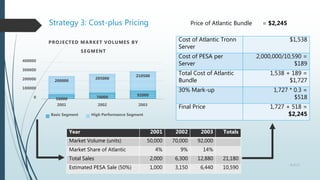
Strategy 3: Cost-plus Pricing
Year 2001 2002 2003 Totals
Market Volume (units) 50,000 70,000 92,000
Market Share of Atlantic 4% 9% 14%
Total Sales 2,000 6,300 12,880 21,180
Estimated PESA Sale (50%) 1,000 3,150 6,440 10,590
50000 70000
92000
200000
205000
210500
0
100000
200000
300000
400000
2001 2002 2003
PROJECTED MARKET VOLUMES BY
SEGMENT
Basic Segment High Performance Segment
Cost of Atlantic Tronn
Server
$1,538
Cost of PESA per
Server
2,000,000/10,590 =
$189
Total Cost of Atlantic
Bundle
1,538 + 189 =
$1,727
30% Mark-up 1,727 * 0.3 =
$518
Final Price 1,727 + 518 =
$2,245
Price of Atlantic Bundle = $2,245
8 of 13
Strategy 4: Value-in-use Pricing
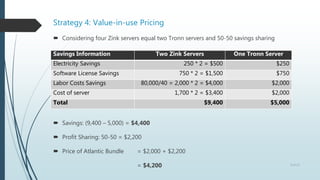
 Considering four Zink servers equal two Tronn servers and 50-50 savings sharing
 Savings: (9,400 – 5,000) = $4,400
 Profit Sharing: 50-50 = $2,200
 Price of Atlantic Bundle = $2,000 + $2,200
= $4,200
Savings Information Two Zink Servers One Tronn Server
Electricity Savings 250 * 2 = $500 $250
Software License Savings 750 * 2 = $1,500 $750
Labor Costs Savings 80,000/40 = 2,000 * 2 = $4,000 $2,000
Cost of server 1,700 * 2 = $3,400 $2,000
Total $9,400 $5,000
9 of 13
Review & Break-even Analysis:
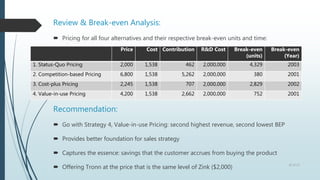
 Pricing for all four alternatives and their respective break-even units and time:
Price Cost Contribution R&D Cost Break-even
(units)
Break-even
(Year)
1. Status-Quo Pricing 2,000 1,538 462 2,000,000 4,329 2003
2. Competition-based Pricing 6,800 1,538 5,262 2,000,000 380 2001
3. Cost-plus Pricing 2,245 1,538 707 2,000,000 2,829 2002
4. Value-in-use Pricing 4,200 1,538 2,662 2,000,000 752 2001
Recommendation:
 Go with Strategy 4, Value-in-use Pricing: second highest revenue, second lowest BEP
 Provides better foundation for sales strategy
 Captures the essence: savings that the customer accrues from buying the product
 Offering Tronn at the price that is the same level of Zink ($2,000) 10 of 13
Recommendations for Cadena’s Sales Force
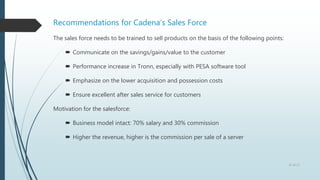
The sales force needs to be trained to sell products on the basis of the following points:
 Communicate on the savings/gains/value to the customer
 Performance increase in Tronn, especially with PESA software tool
 Emphasize on the lower acquisition and possession costs
 Ensure excellent after sales service for customers
Motivation for the salesforce:
 Business model intact: 70% salary and 30% commission
 Higher the revenue, higher is the commission per sale of a server
11 of 13
Reaction of Zink’s management to the threat posed to Atlantic Bundle
Short Term:
 Zink’s management might reduce the price of its server
 If so, Atlantic can charge the client according to the cost plus approach and show the
savings ($2,611) to them.
[Zink’s price can fall up to their costs of $1,214 countering Atlantic’s cost of $2,246. Since
four servers are needed, the total cost for Zink equals $1,214 * 4 = $4,856.
Therefore, savings = $(4,856 - 2,245) = $2,611]
Long Term:
 Zink’s management may come up with an identical software
 Atlantic can provide the PESA software free in that case
12 of 13
Atlantic Computers: A Bundle of Pricing Options

Atlantic Computers: A Bundle of Pricing Options

  • 1.
    Atlantic Computers: A Bundleof Pricing Options Presented by Team A6: Daniel Josey Delwyn Menezes Janet Aiona Jasmine Dennis Tejaswini C
  • 2.
    Overview  Objective &Company Profile  Competitors & Factors influencing Pricing  Two-Step Savings & Pricing Alternatives  Strategy 1: Status-Quo Pricing  Strategy 2: Competition-based Pricing  Strategy 3: Cost-plus Pricing  Strategy 4: Value-in-use Pricing  Review, Break-even Analysis & Recommendation  Recommendation to Cadena’s Salesforce  Zink management’s reaction to external threats 2 of 13
  • 3.
    Objective:  Develop apricing strategy for Atlantic Computers called the ‘Atlantic Bundle’ consisting of the new Tronn server and the PESA (Performance Enhancing Server Accelerator) software Company Profile:  Largest player in the overall computer industry – competing for 30 years  Manufacturer of high-end servers and high-tech products  Jason Jowers responsible for the pricing of the Atlantic Bundle  The Tronn was developed specifically for the emerging US market  PESA would allow Tronn to perform upto four times faster  Two main market segments – Traditional segment & Basic Server segment 3 of 13
  • 4.
    Competitors:  Ontario Computer,Inc. with Zink product line  Claimed 50% maket share in the basic server market  Zink servers performed at approximately the same level as Atlantic’s Tronn Factors influencing pricing:  Traditional focus on hardware; limited emphasis on software  Software tools were historically provided for free (Matzer’s belief)  Long relied on standard approach (cost-plus pricing) in the industry  Gains accrued by customers from PESA to be carefully considered  Importance of conveying two-step savings to customers 4 of 13
  • 5.
    Two-step Savings:  First-ordersavings: purchase of fewer servers  Second-order savings: Lower annual electricity charges, software licenses, labor costs Pricing Options Alternatives: Jowers had four routes to go about for pricing the Atlantic Bundle: 1. Status-quo pricing 2. Competition-based pricing 3. Cost-plus pricing 4. Value-in-use pricing 5 of 13
  • 6.
    Strategy 1: Status-QuoPricing  Charge for hardware; Software free  Established price of basic server = $2,000  Comparison was made between two Tronn servers loaded with PESA against 4 Ontario’s Zink servers Price of Atlantic Bundle = Price of Tronn + Free PESA software = $2,000  Lowest price option; devalues the package  Failed to capture the total value of the product  Amount spent on R&D ($2,000,000) had to be foregone 6 of 13
  • 7.
    Strategy 2: Competition-basedPricing  Charge based on competitors pricing  Conservative model: Two Tronn equals Four Zinc servers (priced $1,700 each) Price of Atlantic Bundle = Price of 2 Zinc Server = $1,700 * 2 = $3,400  Aggressive model: One Tronn equals Four Zinc servers (priced $1,700 each) Price of Atlantic Bundle = Price of 4 Zinc Server = $1,700 * 4 = $6,800  Factors in a portion of the costs associated with software development 7 of 13
  • 8.
    Strategy 3: Cost-plusPricing Year 2001 2002 2003 Totals Market Volume (units) 50,000 70,000 92,000 Market Share of Atlantic 4% 9% 14% Total Sales 2,000 6,300 12,880 21,180 Estimated PESA Sale (50%) 1,000 3,150 6,440 10,590 50000 70000 92000 200000 205000 210500 0 100000 200000 300000 400000 2001 2002 2003 PROJECTED MARKET VOLUMES BY SEGMENT Basic Segment High Performance Segment Cost of Atlantic Tronn Server $1,538 Cost of PESA per Server 2,000,000/10,590 = $189 Total Cost of Atlantic Bundle 1,538 + 189 = $1,727 30% Mark-up 1,727 * 0.3 = $518 Final Price 1,727 + 518 = $2,245 Price of Atlantic Bundle = $2,245 8 of 13
  • 9.
    Strategy 4: Value-in-usePricing  Considering four Zink servers equal two Tronn servers and 50-50 savings sharing  Savings: (9,400 – 5,000) = $4,400  Profit Sharing: 50-50 = $2,200  Price of Atlantic Bundle = $2,000 + $2,200 = $4,200 Savings Information Two Zink Servers One Tronn Server Electricity Savings 250 * 2 = $500 $250 Software License Savings 750 * 2 = $1,500 $750 Labor Costs Savings 80,000/40 = 2,000 * 2 = $4,000 $2,000 Cost of server 1,700 * 2 = $3,400 $2,000 Total $9,400 $5,000 9 of 13
  • 10.
    Review & Break-evenAnalysis:  Pricing for all four alternatives and their respective break-even units and time: Price Cost Contribution R&D Cost Break-even (units) Break-even (Year) 1. Status-Quo Pricing 2,000 1,538 462 2,000,000 4,329 2003 2. Competition-based Pricing 6,800 1,538 5,262 2,000,000 380 2001 3. Cost-plus Pricing 2,245 1,538 707 2,000,000 2,829 2002 4. Value-in-use Pricing 4,200 1,538 2,662 2,000,000 752 2001 Recommendation:  Go with Strategy 4, Value-in-use Pricing: second highest revenue, second lowest BEP  Provides better foundation for sales strategy  Captures the essence: savings that the customer accrues from buying the product  Offering Tronn at the price that is the same level of Zink ($2,000) 10 of 13
  • 11.
    Recommendations for Cadena’sSales Force The sales force needs to be trained to sell products on the basis of the following points:  Communicate on the savings/gains/value to the customer  Performance increase in Tronn, especially with PESA software tool  Emphasize on the lower acquisition and possession costs  Ensure excellent after sales service for customers Motivation for the salesforce:  Business model intact: 70% salary and 30% commission  Higher the revenue, higher is the commission per sale of a server 11 of 13
  • 12.
    Reaction of Zink’smanagement to the threat posed to Atlantic Bundle Short Term:  Zink’s management might reduce the price of its server  If so, Atlantic can charge the client according to the cost plus approach and show the savings ($2,611) to them. [Zink’s price can fall up to their costs of $1,214 countering Atlantic’s cost of $2,246. Since four servers are needed, the total cost for Zink equals $1,214 * 4 = $4,856. Therefore, savings = $(4,856 - 2,245) = $2,611] Long Term:  Zink’s management may come up with an identical software  Atlantic can provide the PESA software free in that case 12 of 13