HARVARD BUSINESS SCHOOL CASE
 Founded in 1989,Natureview Farm is a small
yogurt manufacturer in Vermont.
 It used natural ways to make yogurt which
increased the product’s shelf life to 50 days.
 CHRISTINE WALKER, vice president of
marketing
 JIM WAGNER,chief financial officer
 BARRY LANDERS,chief executive officer
 WALTER BELLINI,vice president of sales
 JACK GOTTLIEB ,vice president of operations
 KELLY RIELEY ,assistant marketing director
 To grow revenues by over 50% before the end
of 2001.
 Central focus: should company expand into
the supermarket channel.
 VC company now needed to cash out its
investment in Natureview.
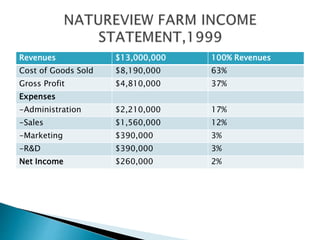
Revenues $13,000,000 100% Revenues
Cost of Goods Sold $8,190,000 63%
Gross Profit $4,810,000 37%
Expenses
-Administration $2,210,000 17%
-Sales $1,560,000 12%
-Marketing $390,000 3%
-R&D $390,000 3%
Net Income $260,000 2%
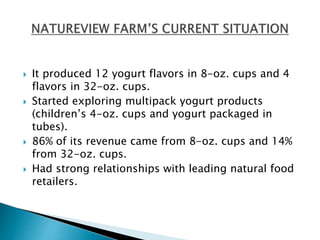
 It produced 12 yogurt flavors in 8-oz. cups and 4
flavors in 32-oz. cups.
 Started exploring multipack yogurt products
(children’s 4-oz. cups and yogurt packaged in
tubes).
 86% of its revenue came from 8-oz. cups and 14%
from 32-oz. cups.
 Had strong relationships with leading natural food
retailers.
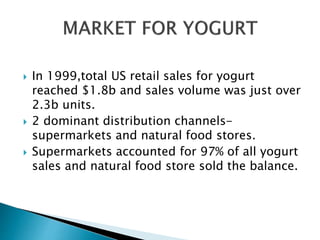
 In 1999,total US retail sales for yogurt
reached $1.8b and sales volume was just over
2.3b units.
 2 dominant distribution channels-
supermarkets and natural food stores.
 Supermarkets accounted for 97% of all yogurt
sales and natural food store sold the balance.
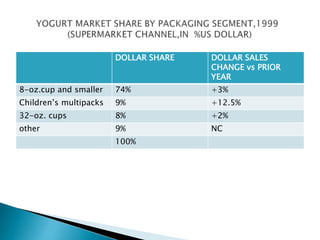
DOLLAR SHARE DOLLAR SALES
CHANGE vs PRIOR
YEAR
8-oz.cup and smaller 74% +3%
Children’s multipacks 9% +12.5%
32-oz. cups 8% +2%
other 9% NC
100%
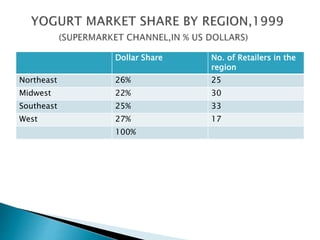
Dollar Share No. of Retailers in the
region
Northeast 26% 25
Midwest 22% 30
Southeast 25% 33
West 27% 17
100%
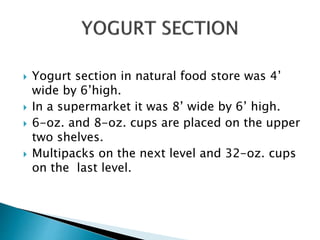
 Yogurt section in natural food store was 4’
wide by 6’high.
 In a supermarket it was 8’ wide by 6’ high.
 6-oz. and 8-oz. cups are placed on the upper
two shelves.
 Multipacks on the next level and 32-oz. cups
on the last level.
SUPERMARKET CHANNEL vs. NATURAL FOOD
STORES
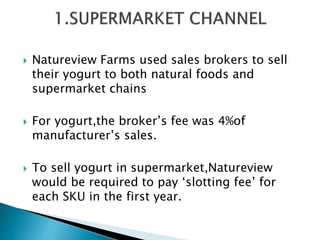
 Natureview Farms used sales brokers to sell
their yogurt to both natural foods and
supermarket chains
 For yogurt,the broker’s fee was 4%of
manufacturer’s sales.
 To sell yogurt in supermarket,Natureview
would be required to pay ‘slotting fee’ for
each SKU in the first year.
 For refrigerated yogurt, the slotting fee
averaged $10,000 per SKU per retail chain.
 Manufacturer has to participate in regular
trade promotions every 3 months.
 Advertising costs are $8000 on average.
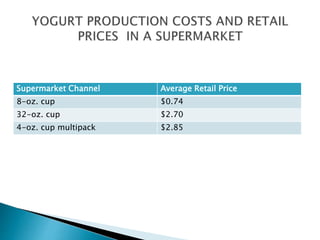
Supermarket Channel Average Retail Price
8-oz. cup $0.74
32-oz. cup $2.70
4-oz. cup multipack $2.85
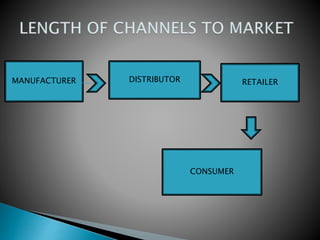
MANUFACTURER DISTRIBUTOR RETAILER
CONSUMER
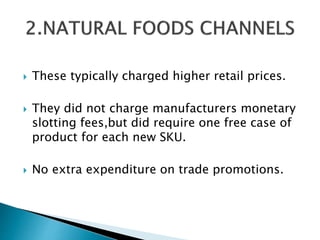
 These typically charged higher retail prices.
 They did not charge manufacturers monetary
slotting fees,but did require one free case of
product for each new SKU.
 No extra expenditure on trade promotions.
NATURAL FOOD CHANNEL AVERAGE RETAIL PRICE
8-oz.cup $0.88
32-oz. cup $3.19
4-oz.cup multipack $3.35
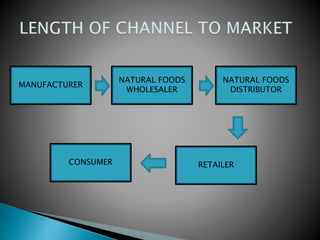
MANUFACTURER
NATURAL FOODS
WHOLESALER
NATURAL FOODS
DISTRIBUTOR
RETAILERCONSUMER
 Would the company be able to thrive in
supermarket world?
 Reaction of long term partners?
 Would price concessions follow?
 Would the stores in Natureview’s traditional
channel drop the brand and replace it with its
competitors?
 TO EXPAND 6 SKUs OF THE 8-
OZ. PRODUCT LINE INTO ONE
OR TWO SELECTED
SUPERMARKET CHANNEL
REGIONS.
 Eight oz.cups represented the largest dollar
and unit share of the refrigerated yogurt
market.
 Wanted to be the first organic brand to enter
supermarket channel.
 It required high level of trade promotion and
marketing.
 Comprehensive advertising plan would cost
the company $1.2 million.
 SG&A would increase by $320,000 annually.
 Natureview could achieve incremental annual
sales volume of just over 35M units.
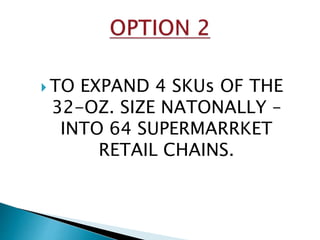
 TO EXPAND 4 SKUs OF THE
32-OZ. SIZE NATONALLY –
INTO 64 SUPERMARRKET
RETAIL CHAINS.
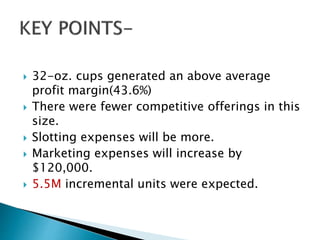
 32-oz. cups generated an above average
profit margin(43.6%)
 There were fewer competitive offerings in this
size.
 Slotting expenses will be more.
 Marketing expenses will increase by
$120,000.
 5.5M incremental units were expected.
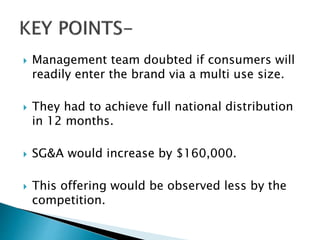
 Management team doubted if consumers will
readily enter the brand via a multi use size.
 They had to achieve full national distribution
in 12 months.
 SG&A would increase by $160,000.
 This offering would be observed less by the
competition.
2 SKUs OF A
CHILDREN’S
MULTIPACK INTO
NATURAL FOOD
CHANNELS.
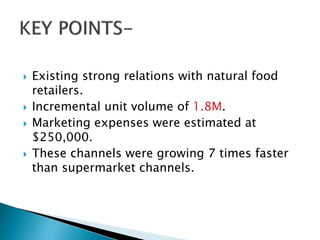
 Existing strong relations with natural food
retailers.
 Incremental unit volume of 1.8M.
 Marketing expenses were estimated at
$250,000.
 These channels were growing 7 times faster
than supermarket channels.
 No additional SG&A costs.
 It was within the capabilities of current
functional resources.
 No SKU costs.
 Of all the 3 solutions last one is most
economically viable as it involves least
investment and would be able to generate
$20M revenue.
 Also, Natureview’s team is ready to execute
this plan.
 Its current consumers will be happy with this
new investment.
 Company will also be able to stick to its
unconventional route.
Natureview farm

Natureview farm

  • 1.
  • 2.
     Founded in1989,Natureview Farm is a small yogurt manufacturer in Vermont.  It used natural ways to make yogurt which increased the product’s shelf life to 50 days.
  • 3.
     CHRISTINE WALKER,vice president of marketing  JIM WAGNER,chief financial officer  BARRY LANDERS,chief executive officer  WALTER BELLINI,vice president of sales  JACK GOTTLIEB ,vice president of operations  KELLY RIELEY ,assistant marketing director
  • 4.
     To growrevenues by over 50% before the end of 2001.  Central focus: should company expand into the supermarket channel.  VC company now needed to cash out its investment in Natureview.
  • 5.
    Revenues $13,000,000 100%Revenues Cost of Goods Sold $8,190,000 63% Gross Profit $4,810,000 37% Expenses -Administration $2,210,000 17% -Sales $1,560,000 12% -Marketing $390,000 3% -R&D $390,000 3% Net Income $260,000 2%
  • 6.
     It produced12 yogurt flavors in 8-oz. cups and 4 flavors in 32-oz. cups.  Started exploring multipack yogurt products (children’s 4-oz. cups and yogurt packaged in tubes).  86% of its revenue came from 8-oz. cups and 14% from 32-oz. cups.  Had strong relationships with leading natural food retailers.
  • 7.
     In 1999,totalUS retail sales for yogurt reached $1.8b and sales volume was just over 2.3b units.  2 dominant distribution channels- supermarkets and natural food stores.  Supermarkets accounted for 97% of all yogurt sales and natural food store sold the balance.
  • 8.
    DOLLAR SHARE DOLLARSALES CHANGE vs PRIOR YEAR 8-oz.cup and smaller 74% +3% Children’s multipacks 9% +12.5% 32-oz. cups 8% +2% other 9% NC 100%
  • 9.
    Dollar Share No.of Retailers in the region Northeast 26% 25 Midwest 22% 30 Southeast 25% 33 West 27% 17 100%
  • 10.
     Yogurt sectionin natural food store was 4’ wide by 6’high.  In a supermarket it was 8’ wide by 6’ high.  6-oz. and 8-oz. cups are placed on the upper two shelves.  Multipacks on the next level and 32-oz. cups on the last level.
  • 11.
    SUPERMARKET CHANNEL vs.NATURAL FOOD STORES
  • 12.
     Natureview Farmsused sales brokers to sell their yogurt to both natural foods and supermarket chains  For yogurt,the broker’s fee was 4%of manufacturer’s sales.  To sell yogurt in supermarket,Natureview would be required to pay ‘slotting fee’ for each SKU in the first year.
  • 13.
     For refrigeratedyogurt, the slotting fee averaged $10,000 per SKU per retail chain.  Manufacturer has to participate in regular trade promotions every 3 months.  Advertising costs are $8000 on average.
  • 14.
    Supermarket Channel AverageRetail Price 8-oz. cup $0.74 32-oz. cup $2.70 4-oz. cup multipack $2.85
  • 15.
  • 16.
     These typicallycharged higher retail prices.  They did not charge manufacturers monetary slotting fees,but did require one free case of product for each new SKU.  No extra expenditure on trade promotions.
  • 17.
    NATURAL FOOD CHANNELAVERAGE RETAIL PRICE 8-oz.cup $0.88 32-oz. cup $3.19 4-oz.cup multipack $3.35
  • 18.
  • 19.
     Would thecompany be able to thrive in supermarket world?  Reaction of long term partners?  Would price concessions follow?  Would the stores in Natureview’s traditional channel drop the brand and replace it with its competitors?
  • 21.
     TO EXPAND6 SKUs OF THE 8- OZ. PRODUCT LINE INTO ONE OR TWO SELECTED SUPERMARKET CHANNEL REGIONS.
  • 22.
     Eight oz.cupsrepresented the largest dollar and unit share of the refrigerated yogurt market.  Wanted to be the first organic brand to enter supermarket channel.  It required high level of trade promotion and marketing.  Comprehensive advertising plan would cost the company $1.2 million.
  • 23.
     SG&A wouldincrease by $320,000 annually.  Natureview could achieve incremental annual sales volume of just over 35M units.
  • 24.
     TO EXPAND4 SKUs OF THE 32-OZ. SIZE NATONALLY – INTO 64 SUPERMARRKET RETAIL CHAINS.
  • 25.
     32-oz. cupsgenerated an above average profit margin(43.6%)  There were fewer competitive offerings in this size.  Slotting expenses will be more.  Marketing expenses will increase by $120,000.  5.5M incremental units were expected.
  • 26.
     Management teamdoubted if consumers will readily enter the brand via a multi use size.  They had to achieve full national distribution in 12 months.  SG&A would increase by $160,000.  This offering would be observed less by the competition.
  • 27.
    2 SKUs OFA CHILDREN’S MULTIPACK INTO NATURAL FOOD CHANNELS.
  • 28.
     Existing strongrelations with natural food retailers.  Incremental unit volume of 1.8M.  Marketing expenses were estimated at $250,000.  These channels were growing 7 times faster than supermarket channels.
  • 29.
     No additionalSG&A costs.  It was within the capabilities of current functional resources.  No SKU costs.
  • 31.
     Of allthe 3 solutions last one is most economically viable as it involves least investment and would be able to generate $20M revenue.  Also, Natureview’s team is ready to execute this plan.  Its current consumers will be happy with this new investment.  Company will also be able to stick to its unconventional route.