Curled Metal Inc. Case Study
WHAT SHOULD A CUSTOMER BE WILLING TO PAY FOR
ONE OF CURLED METAL INCORPORATED’S (CMI) NEW
CUSHION PADS? WHAT FACTORS ARE RELEVANT IN
CALCULATING WILLINGNESS TO PAY IN THIS
SITUATION?
Question 1
Factors to be considered
WHAT PRICE SHOULD CMI SET FOR ONE OF ITS NEW CUSHION
PADS? WHY?
Question 2
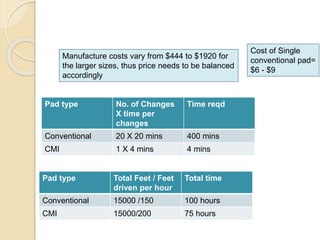
Pad type No. of Changes
X time per
changes
Time reqd
Conventional 20 X 20 mins 400 mins
CMI 1 X 4 mins 4 mins
Cost of Single
conventional pad=
$6 - $9
Pad type Total Feet / Feet
driven per hour
Total time
Conventional 15000 /150 100 hours
CMI 15000/200 75 hours
Manufacture costs vary from $444 to $1920 for
the larger sizes, thus price needs to be balanced
accordingly
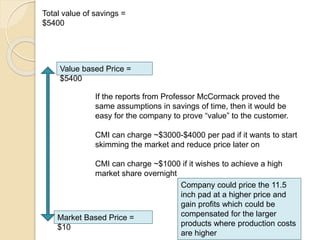
Total value of savings =
$5400
Value based Price =
$5400
Market Based Price =
$10
If the reports from Professor McCormack proved the
same assumptions in savings of time, then it would be
easy for the company to prove “value” to the customer.
CMI can charge ~$3000-$4000 per pad if it wants to start
skimming the market and reduce price later on
CMI can charge ~$1000 if it wishes to achieve a high
market share overnight
Company could price the 11.5
inch pad at a higher price and
gain profits which could be
compensated for the larger
products where production costs
are higher
HOW BIG IS THE POTENTIAL
MARKET FOR THIS PRODUCT, AND
WHAT SHOULD BE CMI’S
STRATEGIC AND MARKETING
OBJECTIVES IN INTRODUCING
THIS PRODUCT?
Question 3
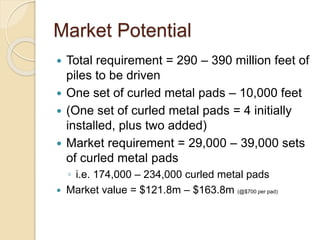
Market Potential
 Total requirement = 290 – 390 million feet of
piles to be driven
 One set of curled metal pads – 10,000 feet
 (One set of curled metal pads = 4 initially
installed, plus two added)
 Market requirement = 29,000 – 39,000 sets
of curled metal pads
◦ i.e. 174,000 – 234,000 curled metal pads
 Market value = $121.8m – $163.8m (@$700 per pad)
Strategic and Marketing
objectives
Strategic Objectives
• Price the product right to achieve high profit margins while establishing a
dominant market share in the market
• Distribution, production and capital investment strategy
• Advertising, promotion and positioning of the product with respect to the
existing cushion pads available in the market
• Protect IPR for this pad by filing patents if possible
Marketing Objectives
• To convince the important influencers to endorse CMI cushion pads
• Architectural/ consulting engineers and soil consultants have a key
influence in the buying decision (expert power)
• Engineering/ construction contractors (large value contracts)
• Independent pile-driving contractors (large volumes)
• Promote in industry magazines like Oklahoma Contractor and try and get a
feature in the same
• Get Professor Stephen McCormack of Pennsylvania A&M University to
officially endorse the product
4. ON PAGE 1 OF THE CASE, CMI VICE PRESIDENT JOSEPH FERNANDEZ SAYS, “THE WAY WE PRICE THIS
COULD HAVE A SIGNIFICANT IMPACT ON EVERYTHING ELSE WE DO.” AN INTEGRATED STRATEGIC OPTION
SPECIFIES THE BASIC TYPE OF ADVANTAGE A COMPANY WILL PURSUE (E.G., DIFFERENTIATION? LOW
COST? OTHER?), RELEVANT DECISIONS ABOUT CUSTOMER AND PRODUCT SCOPE, AND KEY CHOICES
THROUGHOUT THE COMPANY’S VALUE CHAIN. DEVELOP AN INTEGRATED STRATEGIC OPTION FOR CMI—
AN OPTION THAT SPECIFIES YOUR PRICE BUT ALSO SPECIFIES THE MANY OTHER CHOICES FACING CMI IN
FORMULATING A STRATEGY FOR ITS NEW CUSHION PADS (E.G., IN MARKETING, SALES, DISTRIBUTION,
PRODUCTION, FINANCE, AND OTHER FUNCTIONS).
Question 4.
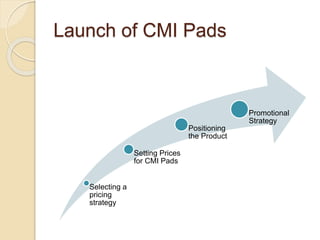
Launch of CMI Pads
Selecting a
pricing
strategy
Setting Prices
for CMI Pads
Positioning
the Product
Promotional
Strategy
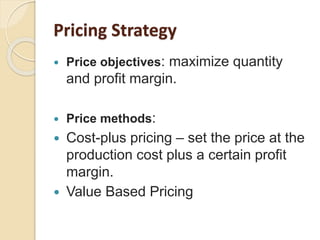
 Price objectives: maximize quantity
and profit margin.
 Price methods:
 Cost-plus pricing – set the price at the
production cost plus a certain profit
margin.
 Value Based Pricing
Pricing Strategy
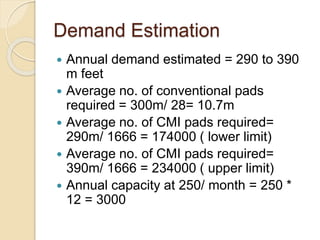
Demand Estimation
 Annual demand estimated = 290 to 390
m feet
 Average no. of conventional pads
required = 300m/ 28= 10.7m
 Average no. of CMI pads required=
290m/ 1666 = 174000 ( lower limit)
 Average no. of CMI pads required=
390m/ 1666 = 234000 ( upper limit)
 Annual capacity at 250/ month = 250 *
12 = 3000
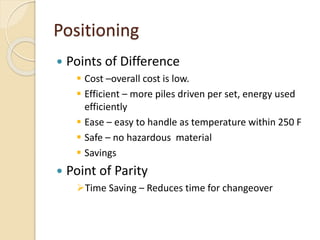
Positioning
 Points of Difference
 Cost –overall cost is low.
 Efficient – more piles driven per set, energy used
efficiently
 Ease – easy to handle as temperature within 250 F
 Safe – no hazardous material
 Savings
 Point of Parity
Time Saving – Reduces time for changeover
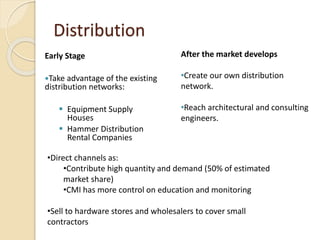
Early Stage
Take advantage of the existing
distribution networks:
 Equipment Supply
Houses
 Hammer Distribution
Rental Companies
Distribution
After the market develops
•Create our own distribution
network.
•Reach architectural and consulting
engineers.
•Direct channels as:
•Contribute high quantity and demand (50% of estimated
market share)
•CMI has more control on education and monitoring
•Sell to hardware stores and wholesalers to cover small
contractors
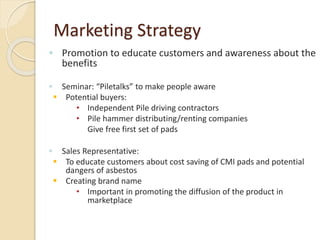
Marketing Strategy
◦ Promotion to educate customers and awareness about the
benefits
◦ Seminar: “Piletalks” to make people aware
 Potential buyers:
• Independent Pile driving contractors
• Pile hammer distributing/renting companies
Give free first set of pads
◦ Sales Representative:
 To educate customers about cost saving of CMI pads and potential
dangers of asbestos
 Creating brand name
• Important in promoting the diffusion of the product in
marketplace
Marketing Strategy
 Word of mouth: Key influencers to endorse the product
 Pile hammer manufacturers
• To influence recommendations
 Professor Stephen McCormack would have a significant impact
• Department to study pile driving and was a respected
authority
 Advertisement [Magazine/Newspaper/TV ads]
 Effective advertisement in business magazines to target
undecided market
 Publish test results in magazine & Newspaper
THANK YOU

curled-metal-case study01

  • 1.
  • 2.
    WHAT SHOULD ACUSTOMER BE WILLING TO PAY FOR ONE OF CURLED METAL INCORPORATED’S (CMI) NEW CUSHION PADS? WHAT FACTORS ARE RELEVANT IN CALCULATING WILLINGNESS TO PAY IN THIS SITUATION? Question 1
  • 3.
    Factors to beconsidered
  • 4.
    WHAT PRICE SHOULDCMI SET FOR ONE OF ITS NEW CUSHION PADS? WHY? Question 2
  • 5.
    Pad type No.of Changes X time per changes Time reqd Conventional 20 X 20 mins 400 mins CMI 1 X 4 mins 4 mins Cost of Single conventional pad= $6 - $9 Pad type Total Feet / Feet driven per hour Total time Conventional 15000 /150 100 hours CMI 15000/200 75 hours Manufacture costs vary from $444 to $1920 for the larger sizes, thus price needs to be balanced accordingly
  • 6.
    Total value ofsavings = $5400 Value based Price = $5400 Market Based Price = $10 If the reports from Professor McCormack proved the same assumptions in savings of time, then it would be easy for the company to prove “value” to the customer. CMI can charge ~$3000-$4000 per pad if it wants to start skimming the market and reduce price later on CMI can charge ~$1000 if it wishes to achieve a high market share overnight Company could price the 11.5 inch pad at a higher price and gain profits which could be compensated for the larger products where production costs are higher
  • 7.
    HOW BIG ISTHE POTENTIAL MARKET FOR THIS PRODUCT, AND WHAT SHOULD BE CMI’S STRATEGIC AND MARKETING OBJECTIVES IN INTRODUCING THIS PRODUCT? Question 3
  • 8.
    Market Potential  Totalrequirement = 290 – 390 million feet of piles to be driven  One set of curled metal pads – 10,000 feet  (One set of curled metal pads = 4 initially installed, plus two added)  Market requirement = 29,000 – 39,000 sets of curled metal pads ◦ i.e. 174,000 – 234,000 curled metal pads  Market value = $121.8m – $163.8m (@$700 per pad)
  • 9.
    Strategic and Marketing objectives StrategicObjectives • Price the product right to achieve high profit margins while establishing a dominant market share in the market • Distribution, production and capital investment strategy • Advertising, promotion and positioning of the product with respect to the existing cushion pads available in the market • Protect IPR for this pad by filing patents if possible Marketing Objectives • To convince the important influencers to endorse CMI cushion pads • Architectural/ consulting engineers and soil consultants have a key influence in the buying decision (expert power) • Engineering/ construction contractors (large value contracts) • Independent pile-driving contractors (large volumes) • Promote in industry magazines like Oklahoma Contractor and try and get a feature in the same • Get Professor Stephen McCormack of Pennsylvania A&M University to officially endorse the product
  • 10.
    4. ON PAGE1 OF THE CASE, CMI VICE PRESIDENT JOSEPH FERNANDEZ SAYS, “THE WAY WE PRICE THIS COULD HAVE A SIGNIFICANT IMPACT ON EVERYTHING ELSE WE DO.” AN INTEGRATED STRATEGIC OPTION SPECIFIES THE BASIC TYPE OF ADVANTAGE A COMPANY WILL PURSUE (E.G., DIFFERENTIATION? LOW COST? OTHER?), RELEVANT DECISIONS ABOUT CUSTOMER AND PRODUCT SCOPE, AND KEY CHOICES THROUGHOUT THE COMPANY’S VALUE CHAIN. DEVELOP AN INTEGRATED STRATEGIC OPTION FOR CMI— AN OPTION THAT SPECIFIES YOUR PRICE BUT ALSO SPECIFIES THE MANY OTHER CHOICES FACING CMI IN FORMULATING A STRATEGY FOR ITS NEW CUSHION PADS (E.G., IN MARKETING, SALES, DISTRIBUTION, PRODUCTION, FINANCE, AND OTHER FUNCTIONS). Question 4.
  • 11.
    Launch of CMIPads Selecting a pricing strategy Setting Prices for CMI Pads Positioning the Product Promotional Strategy
  • 12.
     Price objectives:maximize quantity and profit margin.  Price methods:  Cost-plus pricing – set the price at the production cost plus a certain profit margin.  Value Based Pricing Pricing Strategy
  • 13.
    Demand Estimation  Annualdemand estimated = 290 to 390 m feet  Average no. of conventional pads required = 300m/ 28= 10.7m  Average no. of CMI pads required= 290m/ 1666 = 174000 ( lower limit)  Average no. of CMI pads required= 390m/ 1666 = 234000 ( upper limit)  Annual capacity at 250/ month = 250 * 12 = 3000
  • 14.
    Positioning  Points ofDifference  Cost –overall cost is low.  Efficient – more piles driven per set, energy used efficiently  Ease – easy to handle as temperature within 250 F  Safe – no hazardous material  Savings  Point of Parity Time Saving – Reduces time for changeover
  • 15.
    Early Stage Take advantageof the existing distribution networks:  Equipment Supply Houses  Hammer Distribution Rental Companies Distribution After the market develops •Create our own distribution network. •Reach architectural and consulting engineers. •Direct channels as: •Contribute high quantity and demand (50% of estimated market share) •CMI has more control on education and monitoring •Sell to hardware stores and wholesalers to cover small contractors
  • 16.
    Marketing Strategy ◦ Promotionto educate customers and awareness about the benefits ◦ Seminar: “Piletalks” to make people aware  Potential buyers: • Independent Pile driving contractors • Pile hammer distributing/renting companies Give free first set of pads ◦ Sales Representative:  To educate customers about cost saving of CMI pads and potential dangers of asbestos  Creating brand name • Important in promoting the diffusion of the product in marketplace
  • 17.
    Marketing Strategy  Wordof mouth: Key influencers to endorse the product  Pile hammer manufacturers • To influence recommendations  Professor Stephen McCormack would have a significant impact • Department to study pile driving and was a respected authority  Advertisement [Magazine/Newspaper/TV ads]  Effective advertisement in business magazines to target undecided market  Publish test results in magazine & Newspaper
  • 18.

Editor's Notes

  • #14 Demand Estimation: Annual estimated demand = 290 to 390 million units (data as assumed by Sanwal) In Kendrick Foundation’s case, feet driven = 15000 ft. No. of conventional pads used = 480 Avg depth the piles driven/ pad = 15000/ 480 = 31 ft In Corey Construction’s case, feet driven = 16000 ft. No. of conventional pads used = 600 Avg depth the piles driven/ pad = 16000/ 600 = 26.67 ft Taking the average number of feet the conventional pad lasts as 28 feet, (average of above 2 values) Avg number of conventional pads required = 300m/ 28 = 10.7 million annually (approx) Data as assumed by Sanwal in the case, a set of 6 pads lasts for 10000 feet. Therefore, the average depth the CMI lasts for = 10000/6 = 1666 feet Avg number of CMI pads required at 290m= 290m/ 1666 = 174000 annually (lower limit) At 390m = 390/1666 = 234000 annually (upper limit) Annual capacity of the plant = 250 * 12 = 3000 Market penetration achieved at 3000 units = 3000/ 174000= 1.7% At 234000= 1.28% (The value 174000 and 234000 was arrived at assuming all the demand comes for CMI pads)
  • #15 Efficient – CMI pads are highly efficient as piles driven per set of pads is 6 for conventional pads whereas it is 300 for CMI pads. Also, lesser energy dissipation through heat adds to the efficiency. Ease – Easy to handle as temperature never went above 250F so pads could be handled immediately with protective gloves. Also saves on downtime, compared with conventional pads, while waiting for the pads to cool down. Safe – No hazardous material used. Time Saving - As CMI Pads lasted the entire job, it eliminated downtime required for change. Time required to change sets in Kendrick Foundation’s case Conventional pads= 20 * 20 min = 400 minutes CMI pads = 1 * 4 min = 4 minutes Time required to change sets in Corey Construction’s case Conventional pads= 50 * 20 min = 1000 minutes CMI pads = 1 * 4 min = 4 minutes