Nature of Intelligence
Maria Medina
AET/500 Foundations of Adult Learning
Prof. Mary Joseph
Due: May 31, 2016
The most accurate and
reliable Theories of
Intelligence are developed
by:
Howard Gardner
Sternberg
Daniel Goleman
Multiple Intelligence -
Gardner-
Practical Intelligence - Sternberg-
ANALITICAL
• Abstract
thinking &
logical
reasoning
• Verbal &
mathematical
skills
PRACTICAL
• Ability to apply
knowledge to
the real world
• Ability to shape
one’s
environment
CREATIVE
• Divergent
thinking
(generating new
ideas)
• Ability to deal
with novel
situations
Emotional Intelligence - Daniel Goleman
Goleman identified the five
'domains' of EQ as:
Knowing your emotions.
Managing your emotions.
Motivating yourself.
Recognizing and understanding
other people's emotions.
Managing relationships.
How culture influence this theories
• According to Cocodia E, (2014) “Notions of
intelligence may vary based on experiences
within our social and cultural environment”
(p.183)
• Cocodia E, (2014) also states that
“Decision-making, verbal accuracy,
problem solving skills, perceptual skills and
inference are all important characteristics
of intelligence within cultures.” ( p.189)
•Cultures have different values of
importance to the various types
of intelligence.
•Gardner says: "It is the culture
that defines the stages and fixes
the limits of individual
achievement.”
Conclusion
•There are different ways to learn and to
define Intelligence, their characteristics
and the way people learn.
•Adulthood is cumulative of experiences
that allows us to develop our sense of
intelligence and to know how do we learn
and what learning skills we already have.
Those experiences make us appreciate
and defined our educational goals.
References
Cocodia, E. A. (2014). Cultural perceptions of human intelligence. Journal of
Intelligence, 2(4), 180-196.
Ramsey, J. R., & Lorenz, M. P. (2014). Exploring the Impact of Cross-Cultural
Intelligence, Student Satisfaction and Commitment. Academy of
Management Learning & Education, 15(1), 79-99.
Tamilselvi, B., & Geetha, D. (2015, September). Efficacy in Teaching Through
“Multiple Intelligence” Instructional Strategies. Journal on School of
Educational Technology, 11(2), 1-11.
Yurt, E., & Polat, S. (2015). The Effectiveness of Multiple Intelligence
Applications on Academic Achievement: A Meta-Analysis. Journal of Social
Studies Education Research, 6(1), 84-122

Nature of intelligence

  • 1.
    Nature of Intelligence MariaMedina AET/500 Foundations of Adult Learning Prof. Mary Joseph Due: May 31, 2016
  • 2.
    The most accurateand reliable Theories of Intelligence are developed by: Howard Gardner Sternberg Daniel Goleman
  • 3.
  • 6.
    Practical Intelligence -Sternberg- ANALITICAL • Abstract thinking & logical reasoning • Verbal & mathematical skills PRACTICAL • Ability to apply knowledge to the real world • Ability to shape one’s environment CREATIVE • Divergent thinking (generating new ideas) • Ability to deal with novel situations
  • 7.
  • 8.
    Goleman identified thefive 'domains' of EQ as: Knowing your emotions. Managing your emotions. Motivating yourself. Recognizing and understanding other people's emotions. Managing relationships.
  • 9.
    How culture influencethis theories • According to Cocodia E, (2014) “Notions of intelligence may vary based on experiences within our social and cultural environment” (p.183) • Cocodia E, (2014) also states that “Decision-making, verbal accuracy, problem solving skills, perceptual skills and inference are all important characteristics of intelligence within cultures.” ( p.189)
  • 10.
    •Cultures have differentvalues of importance to the various types of intelligence. •Gardner says: "It is the culture that defines the stages and fixes the limits of individual achievement.”
  • 11.
    Conclusion •There are differentways to learn and to define Intelligence, their characteristics and the way people learn. •Adulthood is cumulative of experiences that allows us to develop our sense of intelligence and to know how do we learn and what learning skills we already have. Those experiences make us appreciate and defined our educational goals.
  • 12.
    References Cocodia, E. A.(2014). Cultural perceptions of human intelligence. Journal of Intelligence, 2(4), 180-196. Ramsey, J. R., & Lorenz, M. P. (2014). Exploring the Impact of Cross-Cultural Intelligence, Student Satisfaction and Commitment. Academy of Management Learning & Education, 15(1), 79-99. Tamilselvi, B., & Geetha, D. (2015, September). Efficacy in Teaching Through “Multiple Intelligence” Instructional Strategies. Journal on School of Educational Technology, 11(2), 1-11. Yurt, E., & Polat, S. (2015). The Effectiveness of Multiple Intelligence Applications on Academic Achievement: A Meta-Analysis. Journal of Social Studies Education Research, 6(1), 84-122

Editor's Notes

  • #3 Human beings are complex and are hard to understand the nature of our process and intelligence. This is the primary reason for many types of research and theories that try to define how do we learn and what are the best practices to develop those cognitive processes. Some of those researchers are Howard Gardner, Sternberg, and Daniel Goleman. They have developed the most accurate and reliable Theories of Intelligence.
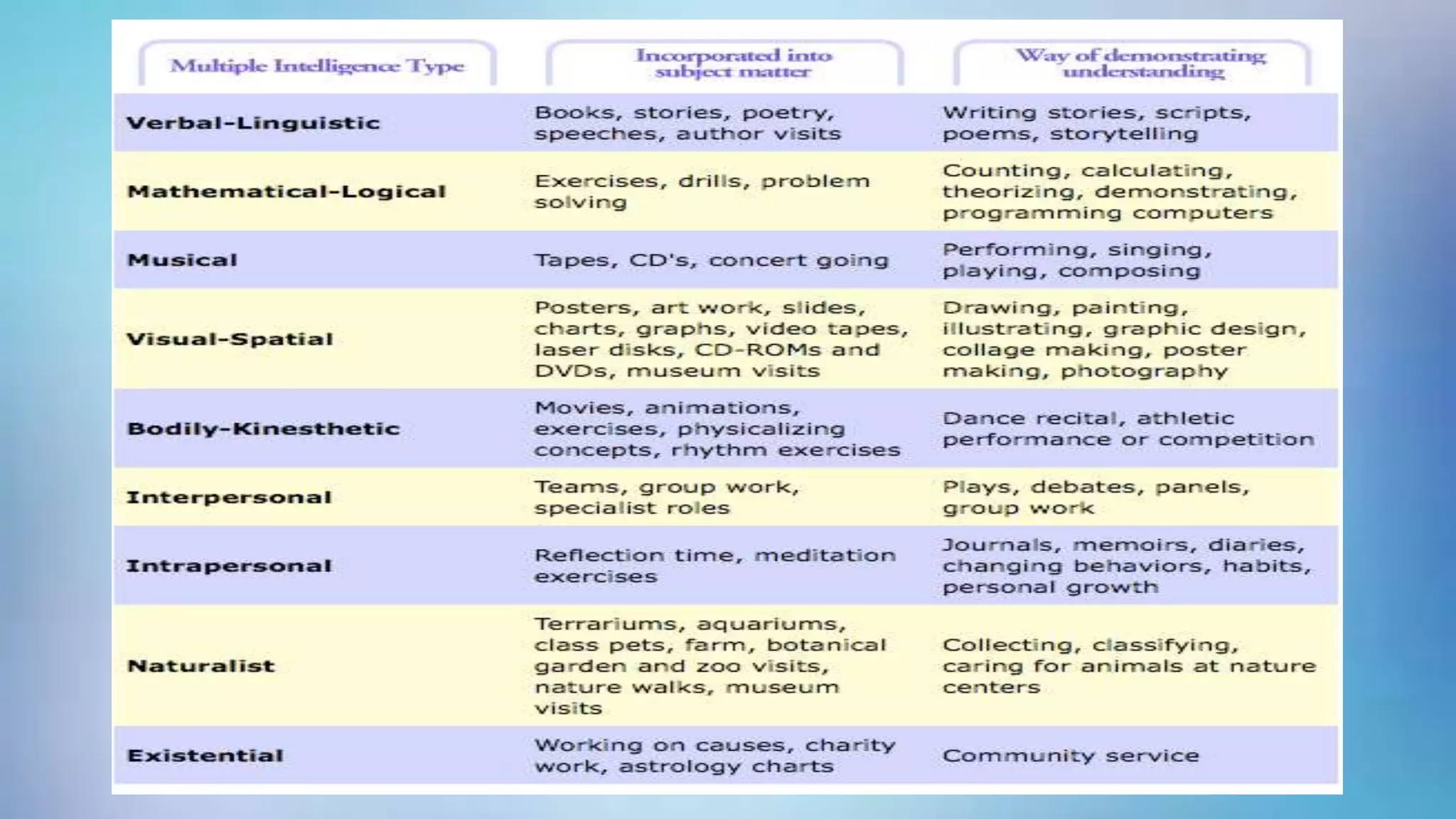
  • #4 Howard Gardner in 1983 proposed this theory. He stated that people learn in different ways and have different strengths and intelligence. The instruction needs to be designed to help students develop their strengths and also trigger their confidence to grow in areas in which they are not as strong.
  • #5 Gardner defined abilities that are found in different amounts in each as intelligence areas or “modalities.” Gardner’s multiple intelligence theory can be use for curriculum development, planning instruction, selection, of course, activities, and related assessment strategies. This table represents the ways we as educators can incorporate them in our classes and how the students will demonstrate their understanding without a formative assessment. In an adult learning environment, this theory would make the adult choose their new educational endeavor based on the way he/she learns, the previous experiences would influence that the adult brings to the learning activities, the adult will choose from what has been proving something that works.
  • #6 Sternberg calls Successful Intelligence to "the integrated set of abilities needed to attain success in life; however, an individuals define it, within his or her sociocultural context.“ Fundamental to Sternberg's theory of intelligence is the idea that intelligence is developing abilities rather than fixed characteristics of an individual (Sternberg, 1998).  This approach is also called Triarchic Theory of Intelligence, and it’s capacity to develop characteristic and strength with everyday situations.
  • #7 Practical Intelligence is how you react to your environment and your ability to change it. It could be compared with the use of common sense when making decisions in real life. It is also the capacity to deal with everyday and ordinary life tasks. It can be applied to andragogy and adult learning theories because the adult needs to have a purpose and a reason to learn and everything that the adult choose to learn needs to be pertinent or practical to them.
  • #8 This term can be defined as the capacity of individuals to recognize their own, and other people's emotions, to discriminate between different feelings and label them appropriately, and to use emotional information to guide thinking and behavior. This theory was developed recently in 1995 and developed two aspects of intelligence: understanding yourself, your goals, intentions, responses and behavior and understanding others, and their feelings. We can apply this on how adults learn; they use their previous knowledge and experiences with them to the classroom, and they are mature enough to know their emotions and feelings and to understand other people's behavior and thoughts.
  • #10 Culture influence these theories and everything. Our culture defines us as individuals, and when people of different cultural backgrounds get together, the differences could be noticeable. Intelligence could be defined in various ways by culture; their culture influences the people's ability to make decisions in everyday life, to solve their problems and to learn.
  • #11 Each culture has their parameters of what is considered being smart or intelligent. Each person growth with those parameters in mind and develop their definition of what it is intelligent.