Human Resource University
Chapter
4:
Individua
l
MA. in TESOL
Course: Educational Psychology
 Lecturer: Mr. VATH Vary
 Email: varyvath@gmail.com
 Tel: 017471117
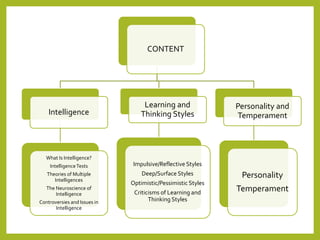
CONTENT
Intelligence
What Is Intelligence?
IntelligenceTests
Theories of Multiple
Intelligences
The Neuroscience of
Intelligence
Controversies and Issues in
Intelligence
Learning and
Thinking Styles
Impulsive/Reflective Styles
Deep/Surface Styles
Optimistic/Pessimistic Styles
Criticisms of Learning and
Thinking Styles
Personality and
Temperament
Personality
Temperament
PREVIEW
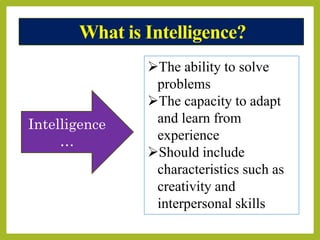
What is Intelligence?
The ability to solve
problems
The capacity to adapt
and learn from
experience
Should include
characteristics such as
creativity and
interpersonal skills
Intelligence
…
What is Intelligence?
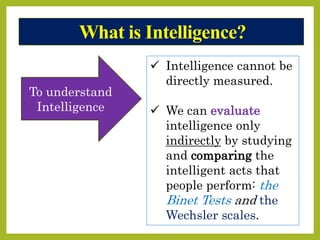
 Intelligence cannot be
directly measured.
 We can evaluate
intelligence only
indirectly by studying
and comparing the
intelligent acts that
people perform: the
Binet Tests and the
Wechsler scales.
To understand
Intelligence
The Binet Test
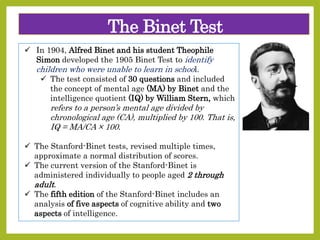
 In 1904, Alfred Binet and his student Theophile
Simon developed the 1905 Binet Test to identify
children who were unable to learn in school.
 The test consisted of 30 questions and included
the concept of mental age (MA) by Binet and the
intelligence quotient (IQ) by William Stern, which
refers to a person’s mental age divided by
chronological age (CA), multiplied by 100. That is,
IQ = MA/CA × 100.
 The Stanford-Binet tests, revised multiple times,
approximate a normal distribution of scores.
 The current version of the Stanford-Binet is
administered individually to people aged 2 through
adult.
 The fifth edition of the Stanford-Binet includes an
analysis of five aspects of cognitive ability and two
aspects of intelligence.
The Binet Test
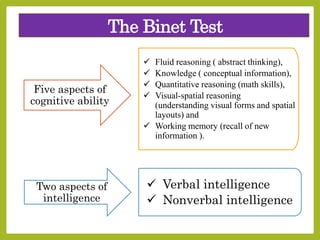
Five aspects of
cognitive ability
 Fluid reasoning ( abstract thinking),
 Knowledge ( conceptual information),
 Quantitative reasoning (math skills),
 Visual-spatial reasoning
(understanding visual forms and spatial
layouts) and
 Working memory (recall of new
information ).
Two aspects of
intelligence
 Verbal intelligence
 Nonverbal intelligence
The Wechsler Scales
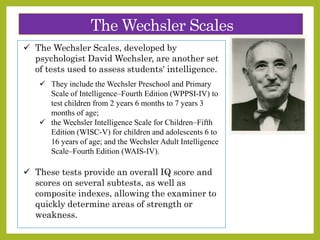
 The Wechsler Scales, developed by
psychologist David Wechsler, are another set
of tests used to assess students' intelligence.
 They include the Wechsler Preschool and Primary
Scale of Intelligence–Fourth Edition (WPPSI-IV) to
test children from 2 years 6 months to 7 years 3
months of age;
 the Wechsler Intelligence Scale for Children–Fifth
Edition (WISC-V) for children and adolescents 6 to
16 years of age; and the Wechsler Adult Intelligence
Scale–Fourth Edition (WAIS-IV).
 These tests provide an overall IQ score and
scores on several subtests, as well as
composite indexes, allowing the examiner to
quickly determine areas of strength or
weakness.
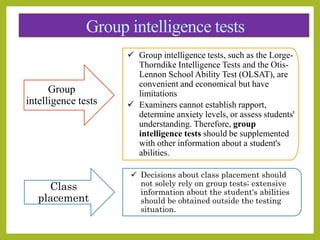
Group intelligence tests
Group
intelligence tests
 Group intelligence tests, such as the Lorge-
Thorndike Intelligence Tests and the Otis-
Lennon School Ability Test (OLSAT), are
convenient and economical but have
limitations
 Examiners cannot establish rapport,
determine anxiety levels, or assess students'
understanding. Therefore, group
intelligence tests should be supplemented
with other information about a student's
abilities.
Class
placement
 Decisions about class placement should
not solely rely on group tests; extensive
information about the student's abilities
should be obtained outside the testing
situation.
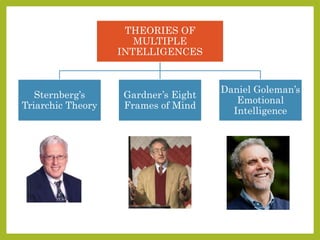
THEORIES OF
MULTIPLE
INTELLIGENCES
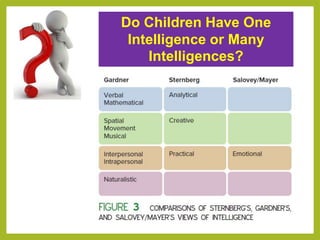
Sternberg’s
Triarchic Theory
Gardner’s Eight
Frames of Mind
Daniel Goleman’s
Emotional
Intelligence
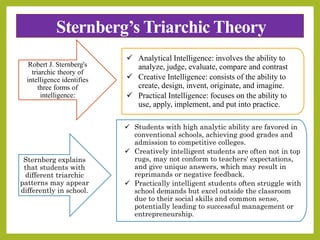
Sternberg’s Triarchic Theory
Robert J. Sternberg's
triarchic theory of
intelligence identifies
three forms of
intelligence:
 Analytical Intelligence: involves the ability to
analyze, judge, evaluate, compare and contrast
 Creative Intelligence: consists of the ability to
create, design, invent, originate, and imagine.
 Practical Intelligence: focuses on the ability to
use, apply, implement, and put into practice.
Sternberg explains
that students with
different triarchic
patterns may appear
differently in school.
 Students with high analytic ability are favored in
conventional schools, achieving good grades and
admission to competitive colleges.
 Creatively intelligent students are often not in top
rugs, may not conform to teachers' expectations,
and give unique answers, which may result in
reprimands or negative feedback.
 Practically intelligent students often struggle with
school demands but excel outside the classroom
due to their social skills and common sense,
potentially leading to successful management or
entrepreneurship.
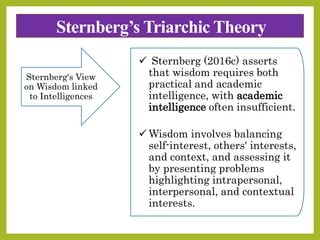
Sternberg’s Triarchic Theory
Sternberg's View
on Wisdom linked
to Intelligences
 Sternberg (2016c) asserts
that wisdom requires both
practical and academic
intelligence, with academic
intelligence often insufficient.
 Wisdom involves balancing
self-interest, others' interests,
and context, and assessing it
by presenting problems
highlighting intrapersonal,
interpersonal, and contextual
interests.
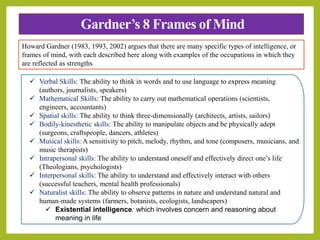
Gardner’s 8 Frames of Mind
 Verbal Skills: The ability to think in words and to use language to express meaning
(authors, journalists, speakers)
 Mathematical Skills: The ability to carry out mathematical operations (scientists,
engineers, accountants)
 Spatial skills: The ability to think three-dimensionally (architects, artists, sailors)
 Bodily-kinesthetic skills: The ability to manipulate objects and be physically adept
(surgeons, craftspeople, dancers, athletes)
 Musical skills: A sensitivity to pitch, melody, rhythm, and tone (composers, musicians, and
music therapists)
 Intrapersonal skills: The ability to understand oneself and effectively direct one’s life
(Theologians, psychologists)
 Interpersonal skills: The ability to understand and effectively interact with others
(successful teachers, mental health professionals)
 Naturalist skills: The ability to observe patterns in nature and understand natural and
human-made systems (farmers, botanists, ecologists, landscapers)
 Existential intelligence: which involves concern and reasoning about
meaning in life
Howard Gardner (1983, 1993, 2002) argues that there are many specific types of intelligence, or
frames of mind, with each described here along with examples of the occupations in which they
are reflected as strengths
Gardner’s 8 Frames of Mind
 Gardner's model of education has been endorsed but has
been criticized for its misuse.
 He suggests that teaching every subject in eight ways to
correspond to the eight intelligences is not effective;
 Applying a specific type of intelligence is not enough.
 Gardner also warns against using one type of intelligence
as a background activity while children are working on
another, as this is a misapplication of his theory.
 Example: Music playing while students solve math
problems is a misapplication of Gardner's theory.
Gardner’s 8 Frames of Mind - Discussion
How do practicing
teachers apply
Gardner’s theory of
multiple
intelligences in
their classrooms?
What is Emotional Intelligence?
• According to Salovey and Mayer (1990)
Emotional Intelligence is the ability to:
 Perceive and express emotion
accurately and adaptively (such as taking
the perspective of others),
 Understand emotion and emotional
knowledge (such as understanding the roles
that emotions play in friendship and other
relationships),
 Use feelings to facilitate thought (such
as being in a positive mood, which is linked to
creative thinking)
 Manage emotions in oneself and
others (such as being able to control one’s
anger).
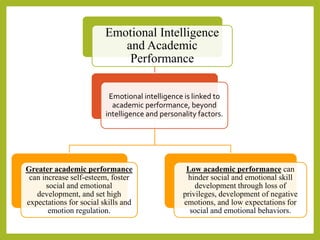
Emotional Intelligence
and Academic
Performance
Emotional intelligence is linked to
academic performance, beyond
intelligence and personality factors.
Greater academic performance
can increase self-esteem, foster
social and emotional
development, and set high
expectations for social skills and
emotion regulation.
Low academic performance can
hinder social and emotional skill
development through loss of
privileges, development of negative
emotions, and low expectations for
social and emotional behaviors.
Do Children Have One
Intelligence or Many
Intelligences?
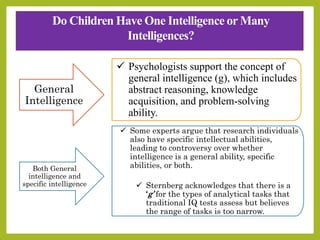
Do Children Have One Intelligence or Many
Intelligences?
General
Intelligence
 Psychologists support the concept of
general intelligence (g), which includes
abstract reasoning, knowledge
acquisition, and problem-solving
ability.
Both General
intelligence and
specific intelligence
 Some experts argue that research individuals
also have specific intellectual abilities,
leading to controversy over whether
intelligence is a general ability, specific
abilities, or both.
 Sternberg acknowledges that there is a
‘g’ for the types of analytical tasks that
traditional IQ tests assess but believes
the range of tasks is too narrow.
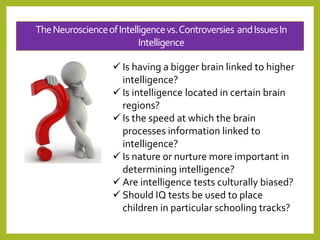
TheNeuroscienceofIntelligencevs.Controversies andIssuesIn
Intelligence
 Is having a bigger brain linked to higher
intelligence?
 Is intelligence located in certain brain
regions?
 Is the speed at which the brain
processes information linked to
intelligence?
 Is nature or nurture more important in
determining intelligence?
 Are intelligence tests culturally biased?
 Should IQ tests be used to place
children in particular schooling tracks?
THENEUROSCIENCEOFINTELLIGENCE
Researchers recently
have found that
intelligence is
distributed more
widely across brain
region.
Brain imagine studies
reveals that a
distributed neural
network involving the
frontal and parietal
lobes (an area active
in processing math
and spatial
information) is related
to higher intelligence.
For example, Albert
Einstein’s total
brain size was
average but a
region of his brain’s
parietal lobe was
15% larger than
average.
Nature-Nurture
issue
involves the debate about
whether development is
primarily influenced by
nature (a person’s biological
inheritance) or by nurture
(environmental
experiences).
However, experts agree
that the environment
also plays a crucial role
in intelligence
development.
Research shows that
improving children's
environments can raise their
intelligence, improve school
achievement, and promote
the acquisition of skills
needed for employment.
Controversies andIssuesIn Intelligence
Recent research has examined combined influences of environment and genetics,
finding that schooling, socioeconomic status, and genetic markers have significant
effects on intelligence differences.
Ethnicity andCulture
 Are there ethnic
differences in intelligence?
 Are conventional tests of
intelligence biased, and if
so, can we develop culture-
fair tests?
Ethnicity andCulture
Ethnic
Comparisons
• Children from African American and Latino families generally score lower on
standardized intelligence tests compared to White children, though this gap has
narrowed with increased social, economic, and educational opportunities.
• Studies indicate that African American children adopted into higher socioeconomic
families score closer to national averages, and matched preschool children show no
significant differences.
Cultural Bias and
Culture-Fair Tests
 Cultural bias in early intelligence tests favored certain groups, and stereotype
threat may impact performance. Interventions like role models and self-affirmation
exercises can mitigate these effects.
 Culture-fair tests, such as Raven’s Progressive Matrices, aim to avoid cultural bias,
by including questions familiar to people from all socioeconomic and ethnic
backgrounds or containing no verbal questions.
 However, creating culture-fair tests is difficult due to the tendency of tests to reflect
what the dominant culture thinks is important.
 Time limits, languages, and even pictures can produce bias, as different groups
within the same culture may have different attitudes, values, and motivations,
which could affect their performance on intelligence tests.
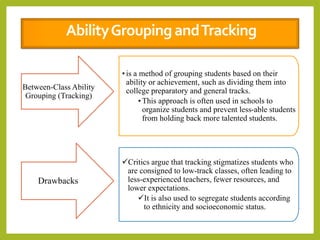
Between-Class Ability
Grouping (Tracking)
•is a method of grouping students based on their
ability or achievement, such as dividing them into
college preparatory and general tracks.
•This approach is often used in schools to
organize students and prevent less-able students
from holding back more talented students.
Drawbacks
Critics argue that tracking stigmatizes students who
are consigned to low-track classes, often leading to
less-experienced teachers, fewer resources, and
lower expectations.
It is also used to segregate students according
to ethnicity and socioeconomic status.
AbilityGroupingandTracking
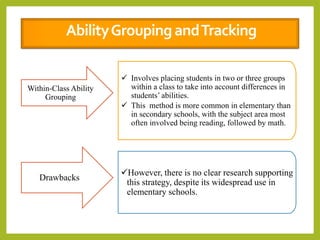
Within-Class Ability
Grouping
 Involves placing students in two or three groups
within a class to take into account differences in
students’ abilities.
 This method is more common in elementary than
in secondary schools, with the subject area most
often involved being reading, followed by math.
Drawbacks
However, there is no clear research supporting
this strategy, despite its widespread use in
elementary schools.
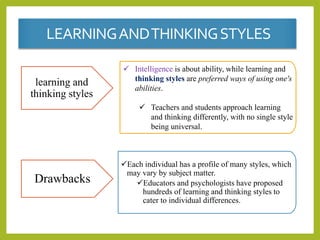
learning and
thinking styles
 Intelligence is about ability, while learning and
thinking styles are preferred ways of using one's
abilities.
 Teachers and students approach learning
and thinking differently, with no single style
being universal.
Drawbacks
Each individual has a profile of many styles, which
may vary by subject matter.
Educators and psychologists have proposed
hundreds of learning and thinking styles to
cater to individual differences.
LEARNINGANDTHINKINGSTYLES
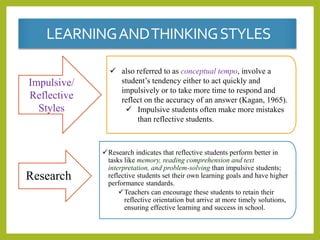
Impulsive/
Reflective
Styles
 also referred to as conceptual tempo, involve a
student’s tendency either to act quickly and
impulsively or to take more time to respond and
reflect on the accuracy of an answer (Kagan, 1965).
 Impulsive students often make more mistakes
than reflective students.
Research
Research indicates that reflective students perform better in
tasks like memory, reading comprehension and text
interpretation, and problem-solving than impulsive students;
reflective students set their own learning goals and have higher
performance standards.
Teachers can encourage these students to retain their
reflective orientation but arrive at more timely solutions,
ensuring effective learning and success in school.
LEARNINGANDTHINKINGSTYLES
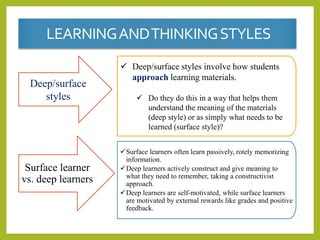
Deep/surface
styles
 Deep/surface styles involve how students
approach learning materials.
 Do they do this in a way that helps them
understand the meaning of the materials
(deep style) or as simply what needs to be
learned (surface style)?
Surface learner
vs. deep learners
Surface learners often learn passively, rotely memorizing
information.
Deep learners actively construct and give meaning to
what they need to remember, taking a constructivist
approach.
Deep learners are self-motivated, while surface learners
are motivated by external rewards like grades and positive
feedback.
LEARNINGANDTHINKINGSTYLES
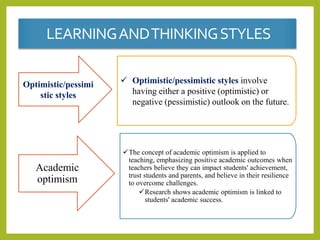
Optimistic/pessimi
stic styles
 Optimistic/pessimistic styles involve
having either a positive (optimistic) or
negative (pessimistic) outlook on the future.
Academic
optimism
The concept of academic optimism is applied to
teaching, emphasizing positive academic outcomes when
teachers believe they can impact students' achievement,
trust students and parents, and believe in their resilience
to overcome challenges.
Research shows academic optimism is linked to
students' academic success.
LEARNINGANDTHINKINGSTYLES
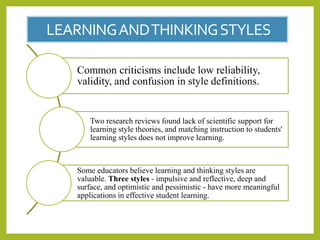
Common criticisms include low reliability,
validity, and confusion in style definitions.
Two research reviews found lack of scientific support for
learning style theories, and matching instruction to students'
learning styles does not improve learning.
Some educators believe learning and thinking styles are
valuable. Three styles - impulsive and reflective, deep and
surface, and optimistic and pessimistic - have more meaningful
applications in effective student learning.
PERSONALITYANDTEMPERAMENT
 What is your
personality like?
 Are you
outgoing or shy?
 Considerate or
caring?
 Friendly or
hostile?
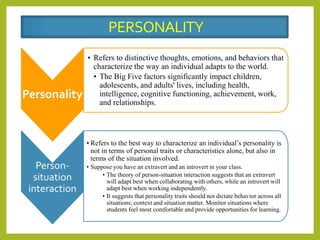
PERSONALITY
Personality
• Refers to distinctive thoughts, emotions, and behaviors that
characterize the way an individual adapts to the world.
• The Big Five factors significantly impact children,
adolescents, and adults' lives, including health,
intelligence, cognitive functioning, achievement, work,
and relationships.
Person-
situation
interaction
• Refers to the best way to characterize an individual’s personality is
not in terms of personal traits or characteristics alone, but also in
terms of the situation involved.
• Suppose you have an extravert and an introvert in your class.
• The theory of person-situation interaction suggests that an extravert
will adapt best when collaborating with others, while an introvert will
adapt best when working independently.
• It suggests that personality traits should not dictate behavior across all
situations; context and situation matter. Monitor situations where
students feel most comfortable and provide opportunities for learning.
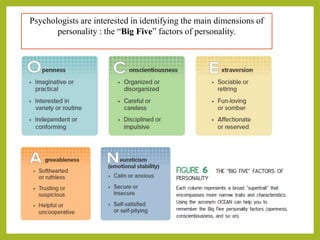
Psychologists are interested in identifying the main dimensions of
personality : the “Big Five” factors of personality.
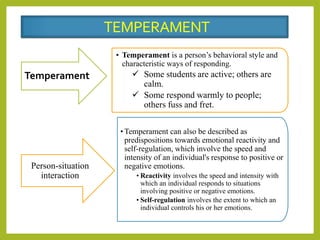
TEMPERAMENT
Temperament
• Temperament is a person’s behavioral style and
characteristic ways of responding.
 Some students are active; others are
calm.
 Some respond warmly to people;
others fuss and fret.
Person-situation
interaction
•Temperament can also be described as
predispositions towards emotional reactivity and
self-regulation, which involve the speed and
intensity of an individual's response to positive or
negative emotions.
• Reactivity involves the speed and intensity with
which an individual responds to situations
involving positive or negative emotions.
• Self-regulation involves the extent to which an
individual controls his or her emotions.
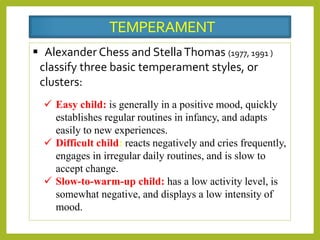
 Alexander Chess and StellaThomas (1977, 1991 )
classify three basic temperament styles, or
clusters:
 Easy child: is generally in a positive mood, quickly
establishes regular routines in infancy, and adapts
easily to new experiences.
 Difficult child: reacts negatively and cries frequently,
engages in irregular daily routines, and is slow to
accept change.
 Slow-to-warm-up child: has a low activity level, is
somewhat negative, and displays a low intensity of
mood.
TEMPERAMENT
 Jerome Kagan (2002, 2010, 2013) regards shyness
with strangers (peers or adults) as one feature of a
broad temperament category called inhibition to the
unfamiliar.
 Mary Rothbart and John Bates (2006) identified three
temperament dimensions:
 Extraversion/surgency includes approach, pleasure, activity,
smiling, and laughter.
 Negative affectivity includes fear, frustration, sadness, and
discomfort.
 Effortful control involves self-regulation, allowing infants to
control their arousal.
 Low effortful control can lead to agitation and intense
emotional outbursts.
TEMPERAMENT
 Goodness of fit refers to the balance
between an individual's
temperament and environmental
demands.
 The temperament characteristics of effortful
control, manageability, and agreeableness
reduce the effects of adverse environments,
whereas negative emotionality increases
their effects.
TEMPERAMENT
Chapter 4 Individual Variations, by John Santrock.ppt

Chapter 4 Individual Variations, by John Santrock.ppt

  • 1.
    Human Resource University Chapter 4: Individua l MA.in TESOL Course: Educational Psychology  Lecturer: Mr. VATH Vary  Email: varyvath@gmail.com  Tel: 017471117
  • 2.
    CONTENT Intelligence What Is Intelligence? IntelligenceTests Theoriesof Multiple Intelligences The Neuroscience of Intelligence Controversies and Issues in Intelligence Learning and Thinking Styles Impulsive/Reflective Styles Deep/Surface Styles Optimistic/Pessimistic Styles Criticisms of Learning and Thinking Styles Personality and Temperament Personality Temperament
  • 3.
  • 4.
    What is Intelligence? Theability to solve problems The capacity to adapt and learn from experience Should include characteristics such as creativity and interpersonal skills Intelligence …
  • 5.
    What is Intelligence? Intelligence cannot be directly measured.  We can evaluate intelligence only indirectly by studying and comparing the intelligent acts that people perform: the Binet Tests and the Wechsler scales. To understand Intelligence
  • 6.
    The Binet Test In 1904, Alfred Binet and his student Theophile Simon developed the 1905 Binet Test to identify children who were unable to learn in school.  The test consisted of 30 questions and included the concept of mental age (MA) by Binet and the intelligence quotient (IQ) by William Stern, which refers to a person’s mental age divided by chronological age (CA), multiplied by 100. That is, IQ = MA/CA × 100.  The Stanford-Binet tests, revised multiple times, approximate a normal distribution of scores.  The current version of the Stanford-Binet is administered individually to people aged 2 through adult.  The fifth edition of the Stanford-Binet includes an analysis of five aspects of cognitive ability and two aspects of intelligence.
  • 7.
    The Binet Test Fiveaspects of cognitive ability  Fluid reasoning ( abstract thinking),  Knowledge ( conceptual information),  Quantitative reasoning (math skills),  Visual-spatial reasoning (understanding visual forms and spatial layouts) and  Working memory (recall of new information ). Two aspects of intelligence  Verbal intelligence  Nonverbal intelligence
  • 8.
    The Wechsler Scales The Wechsler Scales, developed by psychologist David Wechsler, are another set of tests used to assess students' intelligence.  They include the Wechsler Preschool and Primary Scale of Intelligence–Fourth Edition (WPPSI-IV) to test children from 2 years 6 months to 7 years 3 months of age;  the Wechsler Intelligence Scale for Children–Fifth Edition (WISC-V) for children and adolescents 6 to 16 years of age; and the Wechsler Adult Intelligence Scale–Fourth Edition (WAIS-IV).  These tests provide an overall IQ score and scores on several subtests, as well as composite indexes, allowing the examiner to quickly determine areas of strength or weakness.
  • 9.
    Group intelligence tests Group intelligencetests  Group intelligence tests, such as the Lorge- Thorndike Intelligence Tests and the Otis- Lennon School Ability Test (OLSAT), are convenient and economical but have limitations  Examiners cannot establish rapport, determine anxiety levels, or assess students' understanding. Therefore, group intelligence tests should be supplemented with other information about a student's abilities. Class placement  Decisions about class placement should not solely rely on group tests; extensive information about the student's abilities should be obtained outside the testing situation.
  • 10.
    THEORIES OF MULTIPLE INTELLIGENCES Sternberg’s Triarchic Theory Gardner’sEight Frames of Mind Daniel Goleman’s Emotional Intelligence
  • 11.
    Sternberg’s Triarchic Theory RobertJ. Sternberg's triarchic theory of intelligence identifies three forms of intelligence:  Analytical Intelligence: involves the ability to analyze, judge, evaluate, compare and contrast  Creative Intelligence: consists of the ability to create, design, invent, originate, and imagine.  Practical Intelligence: focuses on the ability to use, apply, implement, and put into practice. Sternberg explains that students with different triarchic patterns may appear differently in school.  Students with high analytic ability are favored in conventional schools, achieving good grades and admission to competitive colleges.  Creatively intelligent students are often not in top rugs, may not conform to teachers' expectations, and give unique answers, which may result in reprimands or negative feedback.  Practically intelligent students often struggle with school demands but excel outside the classroom due to their social skills and common sense, potentially leading to successful management or entrepreneurship.
  • 12.
    Sternberg’s Triarchic Theory Sternberg'sView on Wisdom linked to Intelligences  Sternberg (2016c) asserts that wisdom requires both practical and academic intelligence, with academic intelligence often insufficient.  Wisdom involves balancing self-interest, others' interests, and context, and assessing it by presenting problems highlighting intrapersonal, interpersonal, and contextual interests.
  • 13.
    Gardner’s 8 Framesof Mind  Verbal Skills: The ability to think in words and to use language to express meaning (authors, journalists, speakers)  Mathematical Skills: The ability to carry out mathematical operations (scientists, engineers, accountants)  Spatial skills: The ability to think three-dimensionally (architects, artists, sailors)  Bodily-kinesthetic skills: The ability to manipulate objects and be physically adept (surgeons, craftspeople, dancers, athletes)  Musical skills: A sensitivity to pitch, melody, rhythm, and tone (composers, musicians, and music therapists)  Intrapersonal skills: The ability to understand oneself and effectively direct one’s life (Theologians, psychologists)  Interpersonal skills: The ability to understand and effectively interact with others (successful teachers, mental health professionals)  Naturalist skills: The ability to observe patterns in nature and understand natural and human-made systems (farmers, botanists, ecologists, landscapers)  Existential intelligence: which involves concern and reasoning about meaning in life Howard Gardner (1983, 1993, 2002) argues that there are many specific types of intelligence, or frames of mind, with each described here along with examples of the occupations in which they are reflected as strengths
  • 14.
    Gardner’s 8 Framesof Mind  Gardner's model of education has been endorsed but has been criticized for its misuse.  He suggests that teaching every subject in eight ways to correspond to the eight intelligences is not effective;  Applying a specific type of intelligence is not enough.  Gardner also warns against using one type of intelligence as a background activity while children are working on another, as this is a misapplication of his theory.  Example: Music playing while students solve math problems is a misapplication of Gardner's theory.
  • 15.
    Gardner’s 8 Framesof Mind - Discussion How do practicing teachers apply Gardner’s theory of multiple intelligences in their classrooms?
  • 16.
    What is EmotionalIntelligence? • According to Salovey and Mayer (1990) Emotional Intelligence is the ability to:  Perceive and express emotion accurately and adaptively (such as taking the perspective of others),  Understand emotion and emotional knowledge (such as understanding the roles that emotions play in friendship and other relationships),  Use feelings to facilitate thought (such as being in a positive mood, which is linked to creative thinking)  Manage emotions in oneself and others (such as being able to control one’s anger).
  • 17.
    Emotional Intelligence and Academic Performance Emotionalintelligence is linked to academic performance, beyond intelligence and personality factors. Greater academic performance can increase self-esteem, foster social and emotional development, and set high expectations for social skills and emotion regulation. Low academic performance can hinder social and emotional skill development through loss of privileges, development of negative emotions, and low expectations for social and emotional behaviors.
  • 18.
    Do Children HaveOne Intelligence or Many Intelligences?
  • 19.
    Do Children HaveOne Intelligence or Many Intelligences? General Intelligence  Psychologists support the concept of general intelligence (g), which includes abstract reasoning, knowledge acquisition, and problem-solving ability. Both General intelligence and specific intelligence  Some experts argue that research individuals also have specific intellectual abilities, leading to controversy over whether intelligence is a general ability, specific abilities, or both.  Sternberg acknowledges that there is a ‘g’ for the types of analytical tasks that traditional IQ tests assess but believes the range of tasks is too narrow.
  • 20.
    TheNeuroscienceofIntelligencevs.Controversies andIssuesIn Intelligence  Ishaving a bigger brain linked to higher intelligence?  Is intelligence located in certain brain regions?  Is the speed at which the brain processes information linked to intelligence?  Is nature or nurture more important in determining intelligence?  Are intelligence tests culturally biased?  Should IQ tests be used to place children in particular schooling tracks?
  • 21.
    THENEUROSCIENCEOFINTELLIGENCE Researchers recently have foundthat intelligence is distributed more widely across brain region. Brain imagine studies reveals that a distributed neural network involving the frontal and parietal lobes (an area active in processing math and spatial information) is related to higher intelligence. For example, Albert Einstein’s total brain size was average but a region of his brain’s parietal lobe was 15% larger than average.
  • 22.
    Nature-Nurture issue involves the debateabout whether development is primarily influenced by nature (a person’s biological inheritance) or by nurture (environmental experiences). However, experts agree that the environment also plays a crucial role in intelligence development. Research shows that improving children's environments can raise their intelligence, improve school achievement, and promote the acquisition of skills needed for employment. Controversies andIssuesIn Intelligence Recent research has examined combined influences of environment and genetics, finding that schooling, socioeconomic status, and genetic markers have significant effects on intelligence differences.
  • 23.
    Ethnicity andCulture  Arethere ethnic differences in intelligence?  Are conventional tests of intelligence biased, and if so, can we develop culture- fair tests?
  • 24.
    Ethnicity andCulture Ethnic Comparisons • Childrenfrom African American and Latino families generally score lower on standardized intelligence tests compared to White children, though this gap has narrowed with increased social, economic, and educational opportunities. • Studies indicate that African American children adopted into higher socioeconomic families score closer to national averages, and matched preschool children show no significant differences. Cultural Bias and Culture-Fair Tests  Cultural bias in early intelligence tests favored certain groups, and stereotype threat may impact performance. Interventions like role models and self-affirmation exercises can mitigate these effects.  Culture-fair tests, such as Raven’s Progressive Matrices, aim to avoid cultural bias, by including questions familiar to people from all socioeconomic and ethnic backgrounds or containing no verbal questions.  However, creating culture-fair tests is difficult due to the tendency of tests to reflect what the dominant culture thinks is important.  Time limits, languages, and even pictures can produce bias, as different groups within the same culture may have different attitudes, values, and motivations, which could affect their performance on intelligence tests.
  • 25.
    Between-Class Ability Grouping (Tracking) •isa method of grouping students based on their ability or achievement, such as dividing them into college preparatory and general tracks. •This approach is often used in schools to organize students and prevent less-able students from holding back more talented students. Drawbacks Critics argue that tracking stigmatizes students who are consigned to low-track classes, often leading to less-experienced teachers, fewer resources, and lower expectations. It is also used to segregate students according to ethnicity and socioeconomic status. AbilityGroupingandTracking
  • 26.
    AbilityGroupingandTracking Within-Class Ability Grouping  Involvesplacing students in two or three groups within a class to take into account differences in students’ abilities.  This method is more common in elementary than in secondary schools, with the subject area most often involved being reading, followed by math. Drawbacks However, there is no clear research supporting this strategy, despite its widespread use in elementary schools.
  • 27.
    learning and thinking styles Intelligence is about ability, while learning and thinking styles are preferred ways of using one's abilities.  Teachers and students approach learning and thinking differently, with no single style being universal. Drawbacks Each individual has a profile of many styles, which may vary by subject matter. Educators and psychologists have proposed hundreds of learning and thinking styles to cater to individual differences. LEARNINGANDTHINKINGSTYLES
  • 28.
    Impulsive/ Reflective Styles  also referredto as conceptual tempo, involve a student’s tendency either to act quickly and impulsively or to take more time to respond and reflect on the accuracy of an answer (Kagan, 1965).  Impulsive students often make more mistakes than reflective students. Research Research indicates that reflective students perform better in tasks like memory, reading comprehension and text interpretation, and problem-solving than impulsive students; reflective students set their own learning goals and have higher performance standards. Teachers can encourage these students to retain their reflective orientation but arrive at more timely solutions, ensuring effective learning and success in school. LEARNINGANDTHINKINGSTYLES
  • 29.
    LEARNINGANDTHINKINGSTYLES Deep/surface styles  Deep/surface stylesinvolve how students approach learning materials.  Do they do this in a way that helps them understand the meaning of the materials (deep style) or as simply what needs to be learned (surface style)? Surface learner vs. deep learners Surface learners often learn passively, rotely memorizing information. Deep learners actively construct and give meaning to what they need to remember, taking a constructivist approach. Deep learners are self-motivated, while surface learners are motivated by external rewards like grades and positive feedback.
  • 30.
    LEARNINGANDTHINKINGSTYLES Optimistic/pessimi stic styles  Optimistic/pessimisticstyles involve having either a positive (optimistic) or negative (pessimistic) outlook on the future. Academic optimism The concept of academic optimism is applied to teaching, emphasizing positive academic outcomes when teachers believe they can impact students' achievement, trust students and parents, and believe in their resilience to overcome challenges. Research shows academic optimism is linked to students' academic success.
  • 31.
    LEARNINGANDTHINKINGSTYLES Common criticisms includelow reliability, validity, and confusion in style definitions. Two research reviews found lack of scientific support for learning style theories, and matching instruction to students' learning styles does not improve learning. Some educators believe learning and thinking styles are valuable. Three styles - impulsive and reflective, deep and surface, and optimistic and pessimistic - have more meaningful applications in effective student learning.
  • 32.
    PERSONALITYANDTEMPERAMENT  What isyour personality like?  Are you outgoing or shy?  Considerate or caring?  Friendly or hostile?
  • 33.
    PERSONALITY Personality • Refers todistinctive thoughts, emotions, and behaviors that characterize the way an individual adapts to the world. • The Big Five factors significantly impact children, adolescents, and adults' lives, including health, intelligence, cognitive functioning, achievement, work, and relationships. Person- situation interaction • Refers to the best way to characterize an individual’s personality is not in terms of personal traits or characteristics alone, but also in terms of the situation involved. • Suppose you have an extravert and an introvert in your class. • The theory of person-situation interaction suggests that an extravert will adapt best when collaborating with others, while an introvert will adapt best when working independently. • It suggests that personality traits should not dictate behavior across all situations; context and situation matter. Monitor situations where students feel most comfortable and provide opportunities for learning.
  • 34.
    Psychologists are interestedin identifying the main dimensions of personality : the “Big Five” factors of personality.
  • 35.
    TEMPERAMENT Temperament • Temperament isa person’s behavioral style and characteristic ways of responding.  Some students are active; others are calm.  Some respond warmly to people; others fuss and fret. Person-situation interaction •Temperament can also be described as predispositions towards emotional reactivity and self-regulation, which involve the speed and intensity of an individual's response to positive or negative emotions. • Reactivity involves the speed and intensity with which an individual responds to situations involving positive or negative emotions. • Self-regulation involves the extent to which an individual controls his or her emotions.
  • 36.
     Alexander Chessand StellaThomas (1977, 1991 ) classify three basic temperament styles, or clusters:  Easy child: is generally in a positive mood, quickly establishes regular routines in infancy, and adapts easily to new experiences.  Difficult child: reacts negatively and cries frequently, engages in irregular daily routines, and is slow to accept change.  Slow-to-warm-up child: has a low activity level, is somewhat negative, and displays a low intensity of mood. TEMPERAMENT
  • 37.
     Jerome Kagan(2002, 2010, 2013) regards shyness with strangers (peers or adults) as one feature of a broad temperament category called inhibition to the unfamiliar.  Mary Rothbart and John Bates (2006) identified three temperament dimensions:  Extraversion/surgency includes approach, pleasure, activity, smiling, and laughter.  Negative affectivity includes fear, frustration, sadness, and discomfort.  Effortful control involves self-regulation, allowing infants to control their arousal.  Low effortful control can lead to agitation and intense emotional outbursts. TEMPERAMENT
  • 38.
     Goodness offit refers to the balance between an individual's temperament and environmental demands.  The temperament characteristics of effortful control, manageability, and agreeableness reduce the effects of adverse environments, whereas negative emotionality increases their effects. TEMPERAMENT