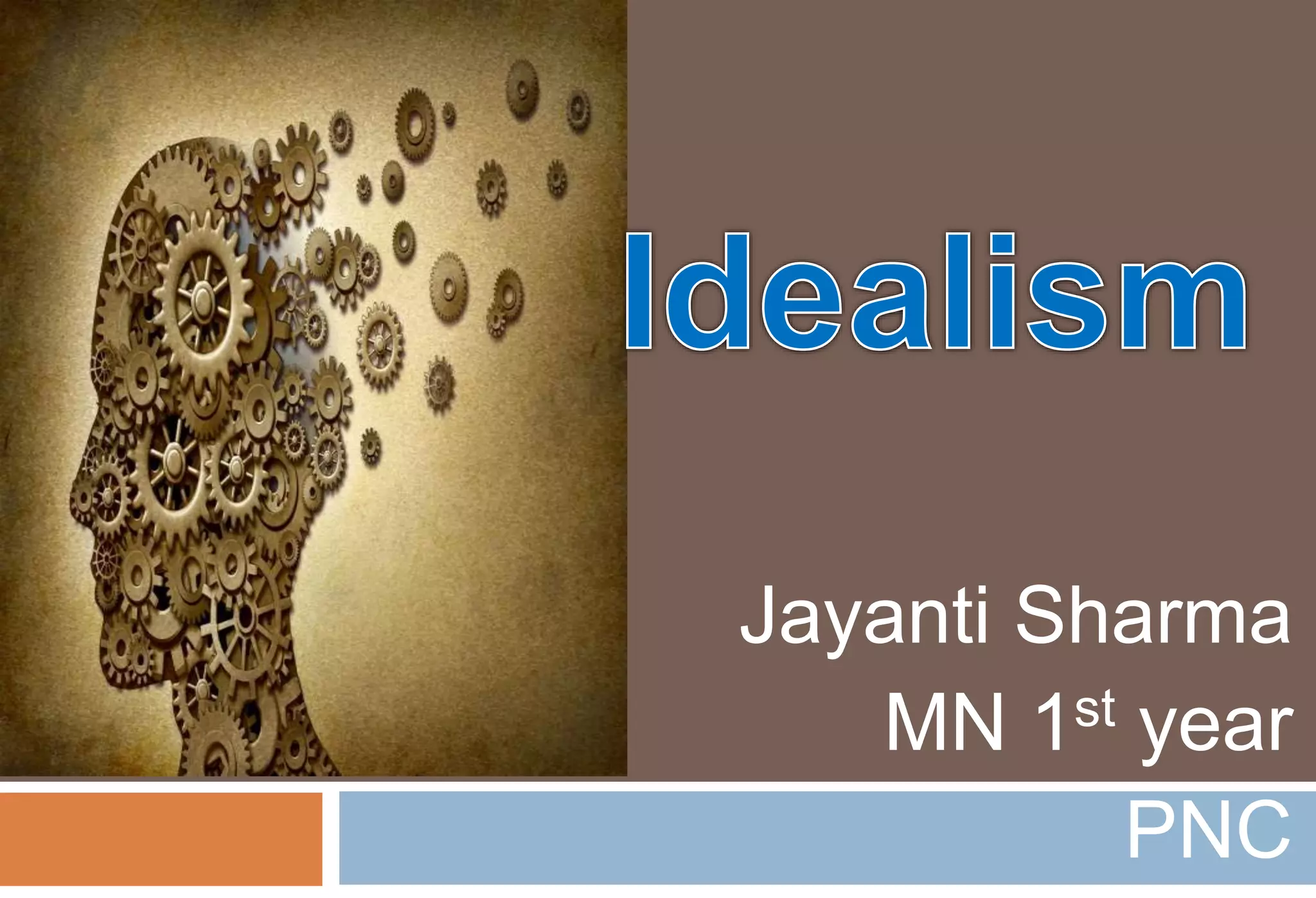
Jayanti Sharma
MN 1st year
PNC
Objectives
2
At the end of this session participants will be able to:
 explain idealism
 state fundamental principle
 state principle of education
 identify aim of education
 list different method of teaching
 describe role of teacher, student, school, discipline
 critique the philosophy.
6/9/2021
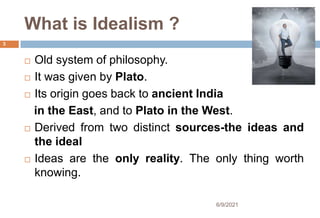
What is Idealism ?
 Old system of philosophy.
 It was given by Plato.
 Its origin goes back to ancient India
in the East, and to Plato in the West.
 Derived from two distinct sources-the ideas and
the ideal
 Ideas are the only reality. The only thing worth
knowing.
3
6/9/2021
Continue…
 Material world do not really exist. For the idealist,
there is no external reality and the word is consist
of ideas.
 Gives most importance to mind and self then the
matter and body.
 Give importance to spiritual values-truth, goodness
and beauty ‘’Satyam, Shivam and Sundaram’’
 Attainment of perfection of human being, search for
truth (spirit).
4
6/9/2021
Exponents of Idealism
Indian
 Vedic Rishis
 Rabindranath Tagore
 M.K. Gandhi
 Swami Vivekananda
 Swami Dayananda
Saraswati
 Aurobindo Ghosh
 Radhakrishnan
Western
 Socrates
 Plato
 Augustine
 René Descartes
 George Berkeley Froebel
 David Hume
 Immanuel Kant
 Georg Wilhelm Friedrich
Hegel
 Josiah Royce
 Descartes
5
6/9/2021
Exponents
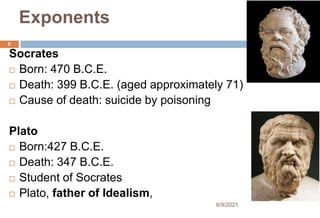
Socrates
 Born: 470 B.C.E.
 Death: 399 B.C.E. (aged approximately 71)
 Cause of death: suicide by poisoning
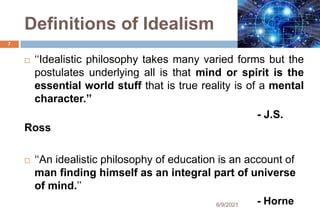
Plato
 Born:427 B.C.E.
 Death: 347 B.C.E.
 Student of Socrates
 Plato, father of Idealism,
6
6/9/2021
Definitions of Idealism
7
 ‘‘Idealistic philosophy takes many varied forms but the
postulates underlying all is that mind or spirit is the
essential world stuff that is true reality is of a mental
character.’’
- J.S.
Ross
 ‘‘An idealistic philosophy of education is an account of
man finding himself as an integral part of universe
of mind.’’
- Horne
6/9/2021
Fundamental Principles of
Idealism
 This universe is created by God.
 Spiritual world is superior to material world.
 Man is the best creation of the world.
 Ultimate aim of human life is self-realization.
 Truth, goodness and beauty is essential for self
realization.
8
6/9/2021
Idealism as a Philosophy of
Education
 Plato made education the core of his best state in
his famous book, The Republic.
 Augustine gave extensive attention to the need for
Christians to become aware of the importance of
education.
 Kant and Hegel wrote about education or referred
to it a great deal in their writings.
 More recent idealists have tried systematically to
apply idealist principles to the theory and practice of
education.
9
6/9/2021
Principles of Education
 Education is based on spiritualism
 It emphasizes mental capacities
 Teachers and curriculum are the center of
education
 Emphasizes book learning
 Both individual and society are valued
 It is a definite and specific ideology
10
6/9/2021
Aims of Education
In idealism, the ultimate aim of education is to
discover and develop each individual's abilities.
 Develop natural self with physical and mental
development Individual growth through processes,
experience and problem solving
 Develop social self with culture, moral and
character development and apply practical
knowledge and skills for life in a progressive
democratic society.
11
6/9/2021
Aim continue…
 Intellectual self development with reasoning
power
 Spiritual development
 Self realization or exaltation of personality
 Realization of truth, goodness and beauty
 Conservation promotion and transmission of
cultural heritage.
12
6/9/2021
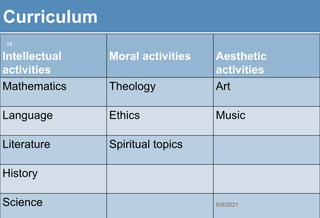
Curriculum
Intellectual
activities
Moral activities Aesthetic
activities
Mathematics Theology Art
Language Ethics Music
Literature Spiritual topics
History
Science
13
6/9/2021
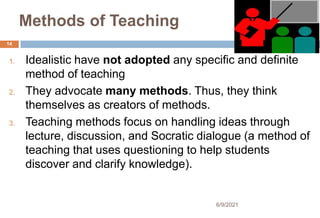
Methods of Teaching
1. Idealistic have not adopted any specific and definite
method of teaching
2. They advocate many methods. Thus, they think
themselves as creators of methods.
3. Teaching methods focus on handling ideas through
lecture, discussion, and Socratic dialogue (a method of
teaching that uses questioning to help students
discover and clarify knowledge).
14
6/9/2021
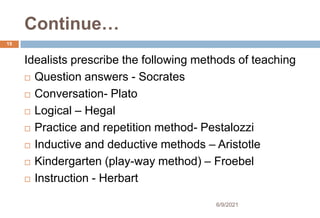
Continue…
Idealists prescribe the following methods of teaching
 Question answers - Socrates
 Conversation- Plato
 Logical – Hegal
 Practice and repetition method- Pestalozzi
 Inductive and deductive methods – Aristotle
 Kindergarten (play-way method) – Froebel
 Instruction - Herbart
15
6/9/2021
Continue…
 Lecture method is considered the most important
one in which a delivers lecture.
 Students listen to the teacher (teacher-centered
approach).
 The Socratic Method in which the teacher involves
the students in learning activities (student-centered
approach)
16
6/9/2021
Role of Teacher
 Supreme and important place of teacher
 Spiritual guide, role model
 Teacher helps in moral and spiritual development
 Teacher is center of education process
 In Hindu idealism, teacher has been considered
equal to 3 Gods, Tri-Dev.
17
6/9/2021
‘‘The teacher is just like a
gardener who works in a
garden in order to bring about
the growth of plants’’
- Froebel
18
6/9/2021
Role of Student
 Passive
 Receiving and memorizing the lecture of the
teacher
19
6/9/2021
Discipline
 Idealism advocates discipline at all costs
 Idealism believes in inner discipline.
 Freedom of child should be restricted.
 Human behavior should have internal control
rather than external one like praise and punishment
 Emphasizes impressionistic (self discipline)
discipline
20
6/9/2021
“FREEDOM IS CRY OF
NATRURLISTS, WHILE
DISCIPLINE IS THAT OF
IDEALIST”
-Thomas & Lang
21
6/9/2021
School
 According to idealism, students come into contact
with ideal teachers in school and get the education of
high ideals.
 School is a miniature society
 Gives the child balance and genuine experience in
preparation for life democratic living
 Place where ideas are tested, implemented and
restructured
 School is the only place for regular and effective
education
22
6/9/2021
limitations of Idealism in
Education.
 The spiritualist theory of spiritual universe is not
considered to be in consonance with the scientific
research today.
 Idealistic concepts like ‘spirit’, ‘mind’, ‘soul’, the
‘cosmos’ have little relevance in classroom
teaching.
 The idealistic education stresses on imitation of
models but younger generation prefers invention
and originally rather than imitation.
23
6/9/2021
Continue…
 Too much emphasis on good manners and modesty
may be mistaken for diffidence.
 Emphasis in gaining knowledge is likely to turn
educational institutions. School curricula becomes
overloaded with obsolete knowledge sometimes.
 Idealistic scheme of education pays less attention
to physical, industrial, social and electronic
environment of today.
24
6/9/2021
Summary
1. Moral education
2. Integrated curriculum
3. Believe in enteral values
4. Emphasis on self discipline
5. Proper place given to teacher
25
6/9/2021
6/9/2021
26
27
6/9/2021
References
 Singh,I.(2011),essential of education,ISBN 99946-
993-1-8
 https://oregonstate.edu/instruct/ed416/PP2.html#:~:te
xt=In
 https://www.researchgate.net/publication/338829212_
IDEALISM_AND_ITS_IMPLICATION_TO_EDUCATI
ON
 https://optimistminds.com/idealism-in-education/
 https://www.academia.edu/34558188/Idealism_Realis
m_and_Pragmatism_in_Education?email_work_card
=view-paper
28
6/9/2021

Idealism ppt

  • 1.
  • 2.
    Objectives 2 At the endof this session participants will be able to:  explain idealism  state fundamental principle  state principle of education  identify aim of education  list different method of teaching  describe role of teacher, student, school, discipline  critique the philosophy. 6/9/2021
  • 3.
    What is Idealism?  Old system of philosophy.  It was given by Plato.  Its origin goes back to ancient India in the East, and to Plato in the West.  Derived from two distinct sources-the ideas and the ideal  Ideas are the only reality. The only thing worth knowing. 3 6/9/2021
  • 4.
    Continue…  Material worlddo not really exist. For the idealist, there is no external reality and the word is consist of ideas.  Gives most importance to mind and self then the matter and body.  Give importance to spiritual values-truth, goodness and beauty ‘’Satyam, Shivam and Sundaram’’  Attainment of perfection of human being, search for truth (spirit). 4 6/9/2021
  • 5.
    Exponents of Idealism Indian Vedic Rishis  Rabindranath Tagore  M.K. Gandhi  Swami Vivekananda  Swami Dayananda Saraswati  Aurobindo Ghosh  Radhakrishnan Western  Socrates  Plato  Augustine  René Descartes  George Berkeley Froebel  David Hume  Immanuel Kant  Georg Wilhelm Friedrich Hegel  Josiah Royce  Descartes 5 6/9/2021
  • 6.
    Exponents Socrates  Born: 470B.C.E.  Death: 399 B.C.E. (aged approximately 71)  Cause of death: suicide by poisoning Plato  Born:427 B.C.E.  Death: 347 B.C.E.  Student of Socrates  Plato, father of Idealism, 6 6/9/2021
  • 7.
    Definitions of Idealism 7 ‘‘Idealistic philosophy takes many varied forms but the postulates underlying all is that mind or spirit is the essential world stuff that is true reality is of a mental character.’’ - J.S. Ross  ‘‘An idealistic philosophy of education is an account of man finding himself as an integral part of universe of mind.’’ - Horne 6/9/2021
  • 8.
    Fundamental Principles of Idealism This universe is created by God.  Spiritual world is superior to material world.  Man is the best creation of the world.  Ultimate aim of human life is self-realization.  Truth, goodness and beauty is essential for self realization. 8 6/9/2021
  • 9.
    Idealism as aPhilosophy of Education  Plato made education the core of his best state in his famous book, The Republic.  Augustine gave extensive attention to the need for Christians to become aware of the importance of education.  Kant and Hegel wrote about education or referred to it a great deal in their writings.  More recent idealists have tried systematically to apply idealist principles to the theory and practice of education. 9 6/9/2021
  • 10.
    Principles of Education Education is based on spiritualism  It emphasizes mental capacities  Teachers and curriculum are the center of education  Emphasizes book learning  Both individual and society are valued  It is a definite and specific ideology 10 6/9/2021
  • 11.
    Aims of Education Inidealism, the ultimate aim of education is to discover and develop each individual's abilities.  Develop natural self with physical and mental development Individual growth through processes, experience and problem solving  Develop social self with culture, moral and character development and apply practical knowledge and skills for life in a progressive democratic society. 11 6/9/2021
  • 12.
    Aim continue…  Intellectualself development with reasoning power  Spiritual development  Self realization or exaltation of personality  Realization of truth, goodness and beauty  Conservation promotion and transmission of cultural heritage. 12 6/9/2021
  • 13.
    Curriculum Intellectual activities Moral activities Aesthetic activities MathematicsTheology Art Language Ethics Music Literature Spiritual topics History Science 13 6/9/2021
  • 14.
    Methods of Teaching 1.Idealistic have not adopted any specific and definite method of teaching 2. They advocate many methods. Thus, they think themselves as creators of methods. 3. Teaching methods focus on handling ideas through lecture, discussion, and Socratic dialogue (a method of teaching that uses questioning to help students discover and clarify knowledge). 14 6/9/2021
  • 15.
    Continue… Idealists prescribe thefollowing methods of teaching  Question answers - Socrates  Conversation- Plato  Logical – Hegal  Practice and repetition method- Pestalozzi  Inductive and deductive methods – Aristotle  Kindergarten (play-way method) – Froebel  Instruction - Herbart 15 6/9/2021
  • 16.
    Continue…  Lecture methodis considered the most important one in which a delivers lecture.  Students listen to the teacher (teacher-centered approach).  The Socratic Method in which the teacher involves the students in learning activities (student-centered approach) 16 6/9/2021
  • 17.
    Role of Teacher Supreme and important place of teacher  Spiritual guide, role model  Teacher helps in moral and spiritual development  Teacher is center of education process  In Hindu idealism, teacher has been considered equal to 3 Gods, Tri-Dev. 17 6/9/2021
  • 18.
    ‘‘The teacher isjust like a gardener who works in a garden in order to bring about the growth of plants’’ - Froebel 18 6/9/2021
  • 19.
    Role of Student Passive  Receiving and memorizing the lecture of the teacher 19 6/9/2021
  • 20.
    Discipline  Idealism advocatesdiscipline at all costs  Idealism believes in inner discipline.  Freedom of child should be restricted.  Human behavior should have internal control rather than external one like praise and punishment  Emphasizes impressionistic (self discipline) discipline 20 6/9/2021
  • 21.
    “FREEDOM IS CRYOF NATRURLISTS, WHILE DISCIPLINE IS THAT OF IDEALIST” -Thomas & Lang 21 6/9/2021
  • 22.
    School  According toidealism, students come into contact with ideal teachers in school and get the education of high ideals.  School is a miniature society  Gives the child balance and genuine experience in preparation for life democratic living  Place where ideas are tested, implemented and restructured  School is the only place for regular and effective education 22 6/9/2021
  • 23.
    limitations of Idealismin Education.  The spiritualist theory of spiritual universe is not considered to be in consonance with the scientific research today.  Idealistic concepts like ‘spirit’, ‘mind’, ‘soul’, the ‘cosmos’ have little relevance in classroom teaching.  The idealistic education stresses on imitation of models but younger generation prefers invention and originally rather than imitation. 23 6/9/2021
  • 24.
    Continue…  Too muchemphasis on good manners and modesty may be mistaken for diffidence.  Emphasis in gaining knowledge is likely to turn educational institutions. School curricula becomes overloaded with obsolete knowledge sometimes.  Idealistic scheme of education pays less attention to physical, industrial, social and electronic environment of today. 24 6/9/2021
  • 25.
    Summary 1. Moral education 2.Integrated curriculum 3. Believe in enteral values 4. Emphasis on self discipline 5. Proper place given to teacher 25 6/9/2021
  • 26.
  • 27.
  • 28.
    References  Singh,I.(2011),essential ofeducation,ISBN 99946- 993-1-8  https://oregonstate.edu/instruct/ed416/PP2.html#:~:te xt=In  https://www.researchgate.net/publication/338829212_ IDEALISM_AND_ITS_IMPLICATION_TO_EDUCATI ON  https://optimistminds.com/idealism-in-education/  https://www.academia.edu/34558188/Idealism_Realis m_and_Pragmatism_in_Education?email_work_card =view-paper 28 6/9/2021