Presented by
Adil Abbas
Muhammad Junaid
“ There are two ways to express an action
of a subject in relation to its object.”
 Active Voice.
 Passive Voice.
 In active voice sentences, the subject
performs the action stated by the verb.
Example:
Active voice: He sings a song.
 Voices refers to the arrangement of the
subject and object in a sentence along with
the change in the tense in the clause.
Example:
 The student finished the exercise.
 In passive voice sentences the subject is
acted upon by the verb
Example:
 Sami helps Asad. (A.V)
 Asad is helped by Sami. (P.V)
 The active voice is mostly used in writing
because it gives a direct and more concise
meaning.
 When intentionally hiding the subject of
sentence.
Example: Women were not treated as equals.
 When passive voice better explain thought of
sentence.
Example: Cloth is sold in yards.
 When subject is not exactly known.
Example: His watch was stolen.
1. The places of subject and object are
interchanged.
Example:
Active voice: I write a letter.
Passive voice: Letter is written by me.
2. The word “by” is used before subject in sentences
in passive voice.
Example:
Active voice: He sings a song.
Passive voice: A song is sung by him.
3.The word “by” is not always used before
subject in passive voice. Sometimes words
“with, to, etc” may also be used before
subject in passive voice.
Examples:
Active voice: He knows me.
Passive voice: I am known to him.
Active Voice Passive Voice
Subject + Verb (Ist form) + s/es +
Object
Object + Is/Are/Am + Verb (3rd
form) + By+ Subject
Active Voice:
She drives my car.
Passive Voice:
My car is driven by her.
Example:
Active Voice Passive Voice
Subject + Is/Am/Are + Verb (Ist
form) + Ing+ Object
Object +Is/Are/Am + Being + Verb
(3rd form)+ By + Subject
Active Voice:
I am writing a letter.
Passive Voice:
A letter is being written by me.
Example:
Active Voice Passive Voice
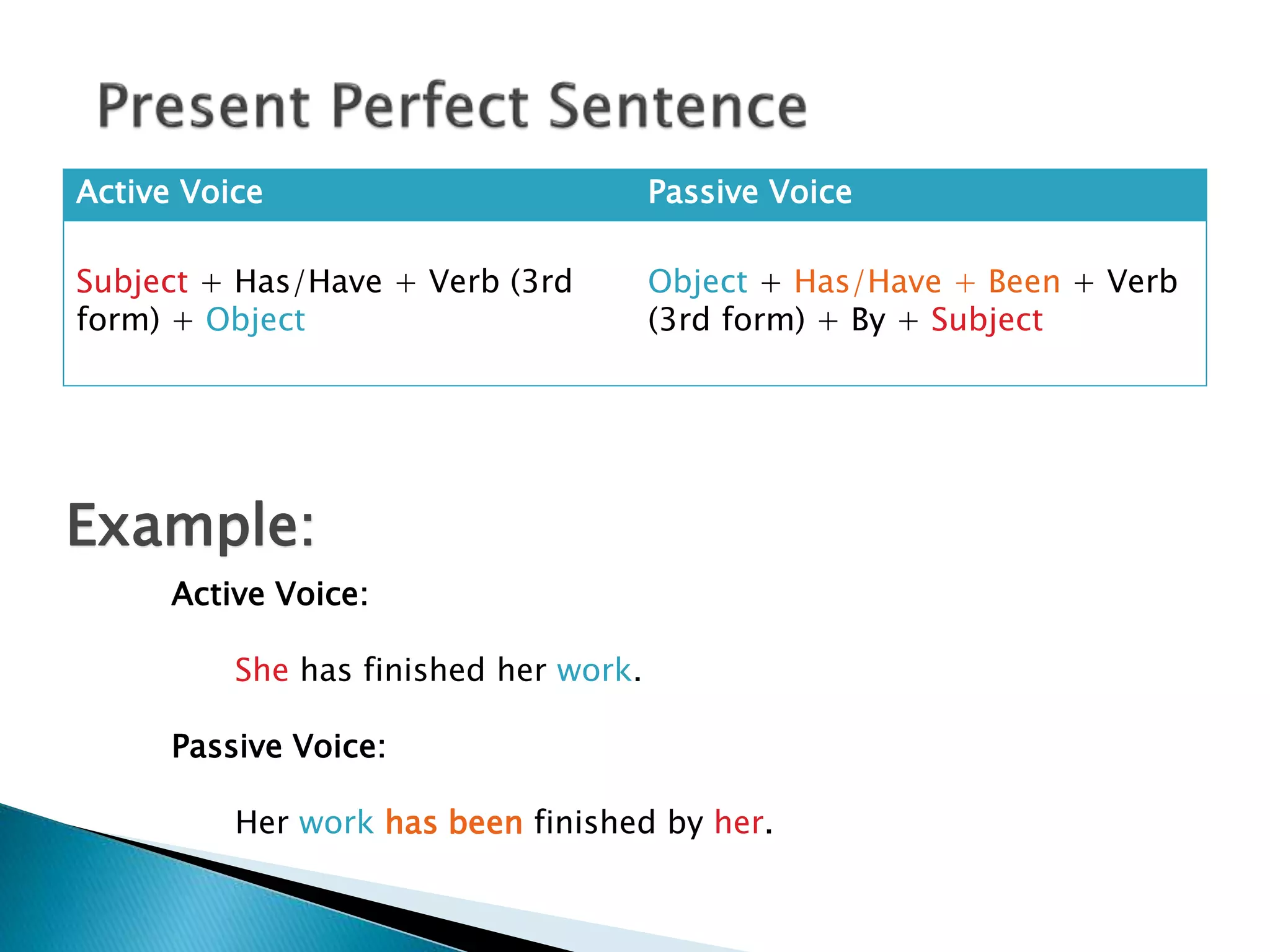
Subject + Has/Have + Verb (3rd
form) + Object
Object + Has/Have + Been + Verb
(3rd form) + By + Subject
Active Voice:
She has finished her work.
Passive Voice:
Her work has been finished by her.
Example:
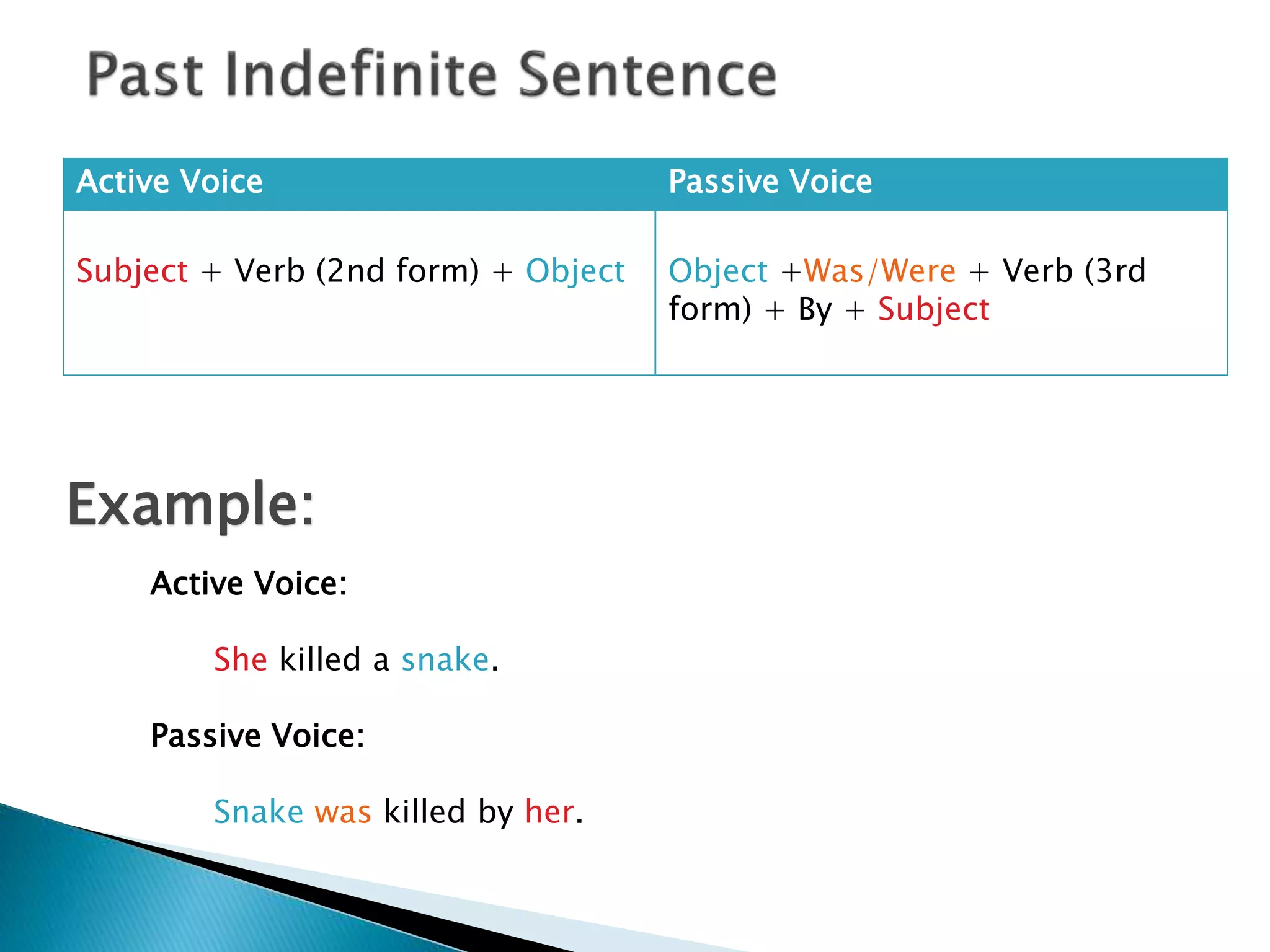
Active Voice Passive Voice
Subject + Verb (2nd form) + Object Object +Was/Were + Verb (3rd
form) + By + Subject
Active Voice:
She killed a snake.
Passive Voice:
Snake was killed by her.
Example:
Active Voice Passive Voice
Subject + Was/Were + Verb (Ist
form) + Ing + Object
Object +Was/Were + Being + Verb
(3rd form)+ By + Subject
Active Voice:
He was driving a car.
Passive Voice:
A car was being driven by him.
Example:
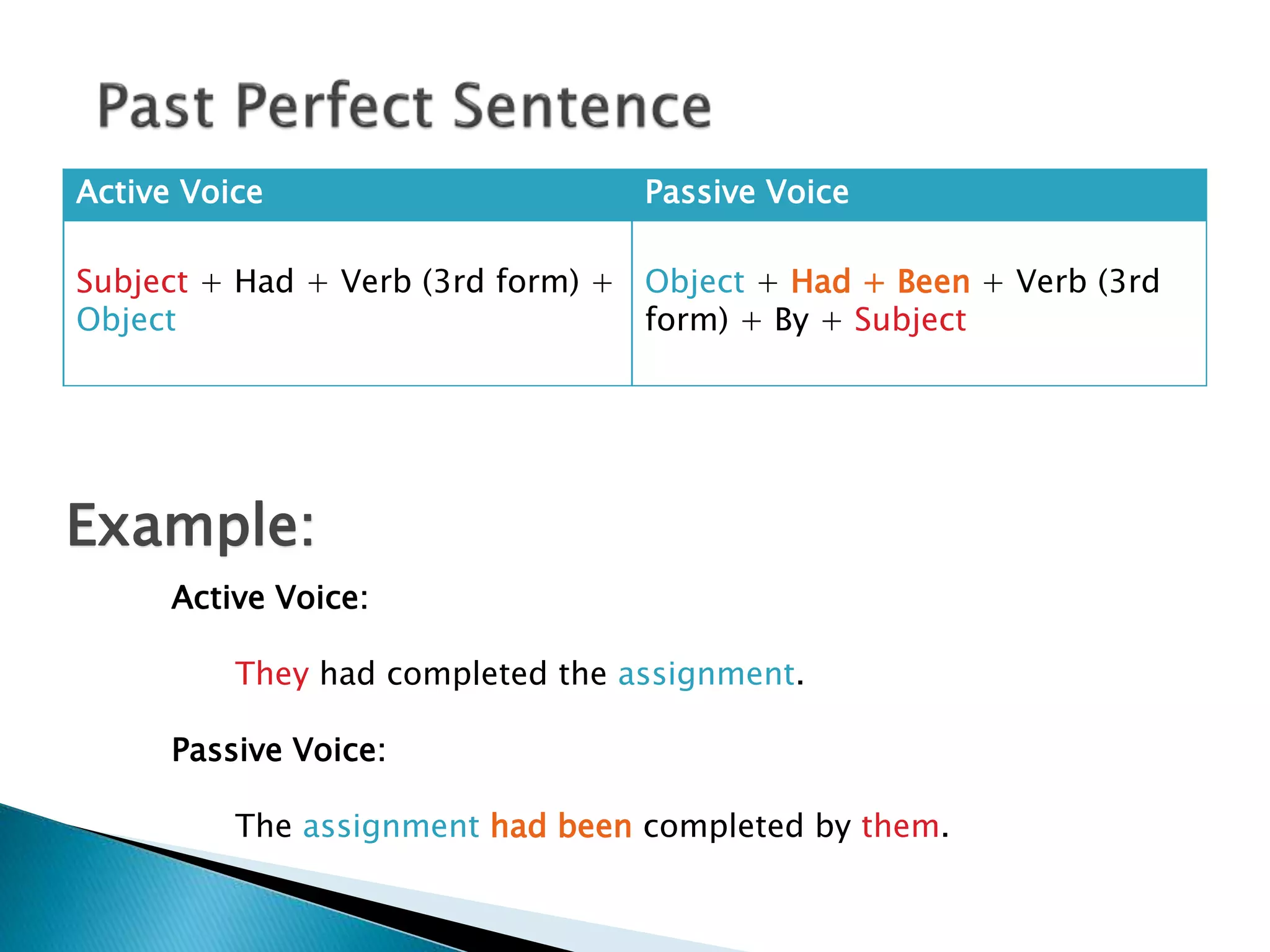
Active Voice Passive Voice
Subject + Had + Verb (3rd form) +
Object
Object + Had + Been + Verb (3rd
form) + By + Subject
Active Voice:
They had completed the assignment.
Passive Voice:
The assignment had been completed by them.
Example:
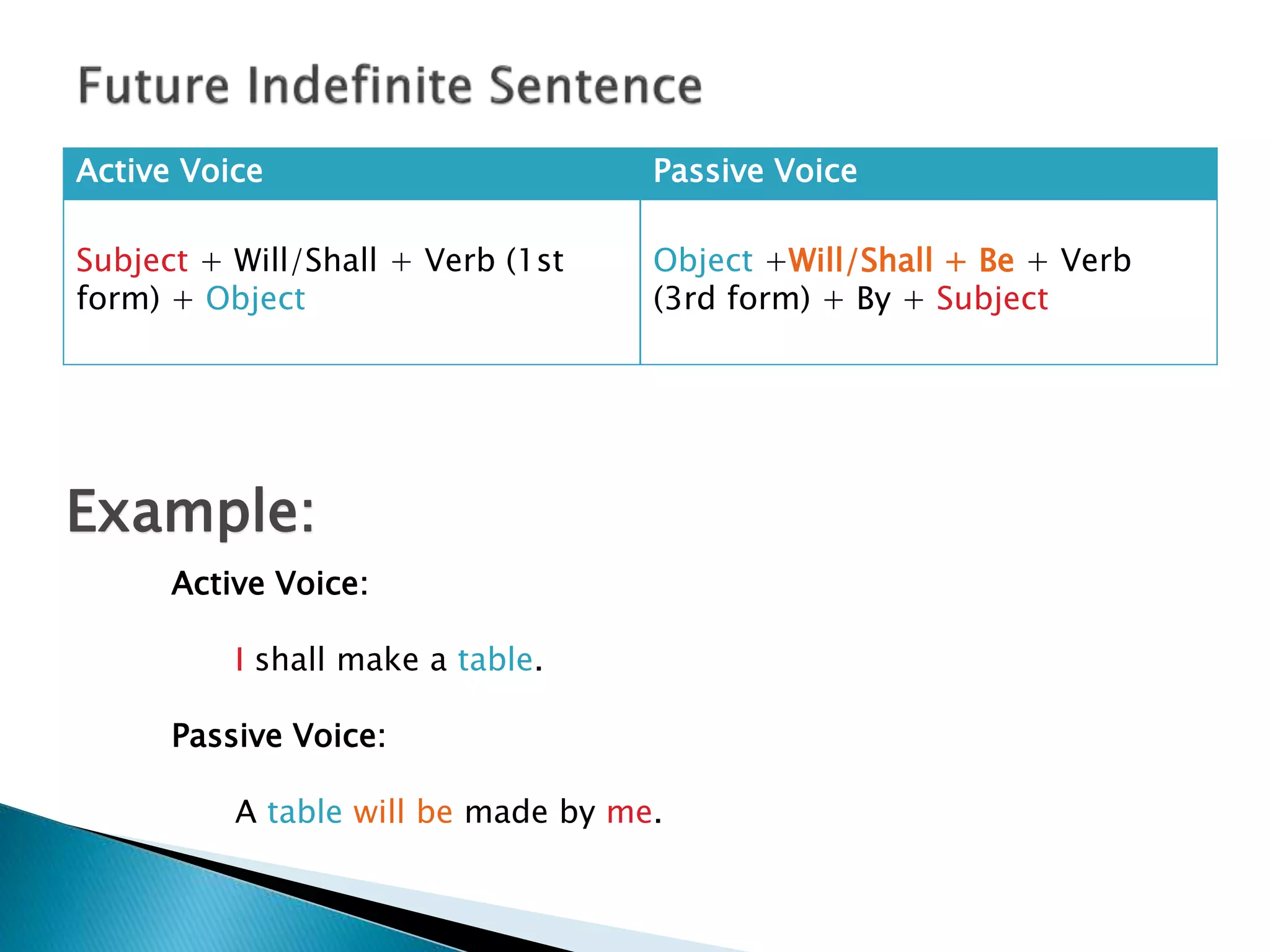
Active Voice Passive Voice
Subject + Will/Shall + Verb (1st
form) + Object
Object +Will/Shall + Be + Verb
(3rd form) + By + Subject
Active Voice:
I shall make a table.
Passive Voice:
A table will be made by me.
Example:
Active Voice Passive Voice
Subject + Will/Shall + Have + Verb
(Ist form) + Object
Object +Will/Shall + Have + Been
+ By + Subject
Active Voice:
You will have started the job.
Passive Voice:
The job will have been started by you.
Example:
Change the voice

Change the voice

  • 1.
  • 3.
    “ There aretwo ways to express an action of a subject in relation to its object.”  Active Voice.  Passive Voice.
  • 4.
     In activevoice sentences, the subject performs the action stated by the verb. Example: Active voice: He sings a song.
  • 5.
     Voices refersto the arrangement of the subject and object in a sentence along with the change in the tense in the clause. Example:  The student finished the exercise.
  • 6.
     In passivevoice sentences the subject is acted upon by the verb Example:  Sami helps Asad. (A.V)  Asad is helped by Sami. (P.V)
  • 7.
     The activevoice is mostly used in writing because it gives a direct and more concise meaning.
  • 8.
     When intentionallyhiding the subject of sentence. Example: Women were not treated as equals.  When passive voice better explain thought of sentence. Example: Cloth is sold in yards.  When subject is not exactly known. Example: His watch was stolen.
  • 9.
    1. The placesof subject and object are interchanged. Example: Active voice: I write a letter. Passive voice: Letter is written by me.
  • 10.
    2. The word“by” is used before subject in sentences in passive voice. Example: Active voice: He sings a song. Passive voice: A song is sung by him.
  • 11.
    3.The word “by”is not always used before subject in passive voice. Sometimes words “with, to, etc” may also be used before subject in passive voice. Examples: Active voice: He knows me. Passive voice: I am known to him.
  • 13.
    Active Voice PassiveVoice Subject + Verb (Ist form) + s/es + Object Object + Is/Are/Am + Verb (3rd form) + By+ Subject Active Voice: She drives my car. Passive Voice: My car is driven by her. Example:
  • 14.
    Active Voice PassiveVoice Subject + Is/Am/Are + Verb (Ist form) + Ing+ Object Object +Is/Are/Am + Being + Verb (3rd form)+ By + Subject Active Voice: I am writing a letter. Passive Voice: A letter is being written by me. Example:
  • 15.
    Active Voice PassiveVoice Subject + Has/Have + Verb (3rd form) + Object Object + Has/Have + Been + Verb (3rd form) + By + Subject Active Voice: She has finished her work. Passive Voice: Her work has been finished by her. Example:
  • 16.
    Active Voice PassiveVoice Subject + Verb (2nd form) + Object Object +Was/Were + Verb (3rd form) + By + Subject Active Voice: She killed a snake. Passive Voice: Snake was killed by her. Example:
  • 17.
    Active Voice PassiveVoice Subject + Was/Were + Verb (Ist form) + Ing + Object Object +Was/Were + Being + Verb (3rd form)+ By + Subject Active Voice: He was driving a car. Passive Voice: A car was being driven by him. Example:
  • 18.
    Active Voice PassiveVoice Subject + Had + Verb (3rd form) + Object Object + Had + Been + Verb (3rd form) + By + Subject Active Voice: They had completed the assignment. Passive Voice: The assignment had been completed by them. Example:
  • 19.
    Active Voice PassiveVoice Subject + Will/Shall + Verb (1st form) + Object Object +Will/Shall + Be + Verb (3rd form) + By + Subject Active Voice: I shall make a table. Passive Voice: A table will be made by me. Example:
  • 20.
    Active Voice PassiveVoice Subject + Will/Shall + Have + Verb (Ist form) + Object Object +Will/Shall + Have + Been + By + Subject Active Voice: You will have started the job. Passive Voice: The job will have been started by you. Example:

Editor's Notes

  • #2 So let start the presentation hope you will like it.
  • #5 The active voice is the normal voice.This is the voice that we used most of the time.You are already familiar with the active Voice. In “active voice” subject acts upon object It can also be said, in “active voice” subject does a work on object, while in “passive voice” object is worked on by subject
  • #6 Modern English is in SVO order language i.e; Subject+verb+object This arrangemet of the subject and object is the active voice order .
  • #9 1.Women were not treated as equals 2.  For example, to say, cloth is sold in yards, is more meaningful than to say, Shop keepers sell cloth in yards. 3. His watch was stolen.
  • #10  .  i.e. the object shifts to the place of subject and subject shifts to the place of object in passive voice