 An action expressed in the verb can take
 place in three different times-
 past, present, future-and ‘in each time’ it
 (the action) can be of three different types-
 simple, continuous, perfect. Three times
 with their types are called tenses.
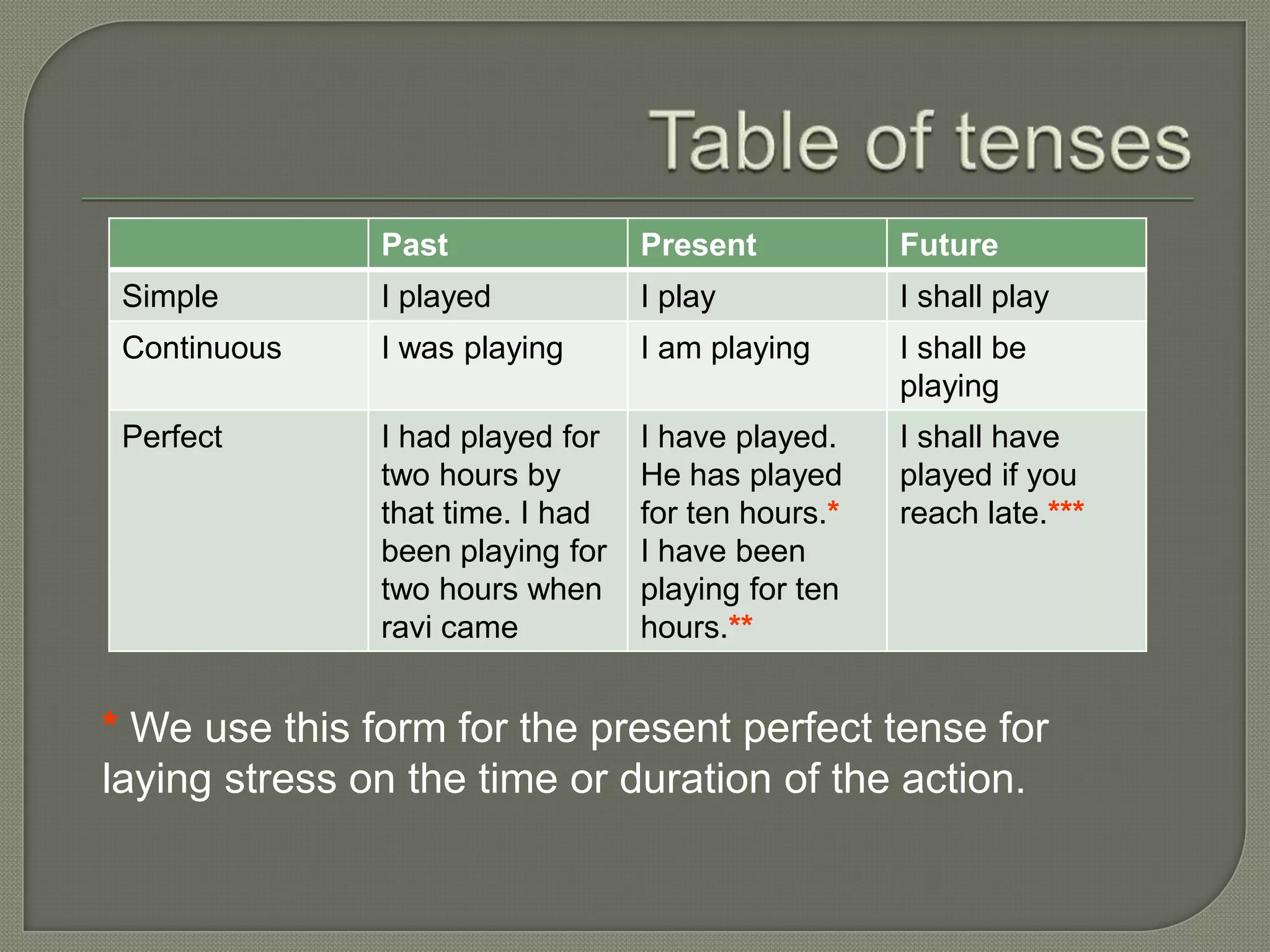
Past               Present           Future
 Simple        I played           I play            I shall play
 Continuous    I was playing      I am playing      I shall be
                                                    playing
 Perfect       I had played for   I have played.    I shall have
               two hours by       He has played     played if you
               that time. I had   for ten hours.*   reach late.***
               been playing for   I have been
               two hours when     playing for ten
               ravi came          hours.**


* We use this form for the present perfect tense for
laying stress on the time or duration of the action.
 ** We use this form for the present perfect
  tense for laying stress on the continuity of
  the action. This tense is called the present
  perfect continuous tense also.
 *** ‘If you reach late’. We do not use the
  future perfect tense for the dependent
  clauses of time or condition.
 ‘TIME’ AND   ‘TYPE’ OF AN ACTION=TENSE
 Simple:    simple type is expressed directly.
                    Example of simple type
              •I passed my B.A. examination
                in 1995.
              •Raja will play hockey.


 Continuous: Continuous type is that which
 is incomplete.     Examples of Continuous type
                             •Radha was cooking food.
                             •Ravi is reading.


 Perfect:
        Perfect type isExampleswhich is
                         that of Perfect type
 rounded off or complete.has been writing for two
                     •Ravi
                                hours.
                                •Ravi has written for two
                                hours.
 ‘Do’ is brought from     I play hockey
  outside for making        Do you play hockey?
  questions & negative      Ravi does not play
  sentences of positive      hockey.
  assertive sentences in
  the simple present
  and the simplest past
  tenses                   I  do see.
 The auxiliary ‘do’        I did see.
  makes special
  emphatic tenses in
  the simple present
  and the past
 There  is one more tense. It is called ‘the
  Future in the past tense’. This tense marks
  an action as future from a past point of
  view. It is used.
1. In simple sentences and in the main
                           When summer came, they
   clauses of complex sentences. to make
                             ‘would begin’
                                         preparations to mobilize the
                                         army from Delhi to Shimla.


2.   In subordinate clauses.
                 I knew that you
                     ‘would come’.
                       I ‘should
                  like’(should have
                   liked) to tell you.
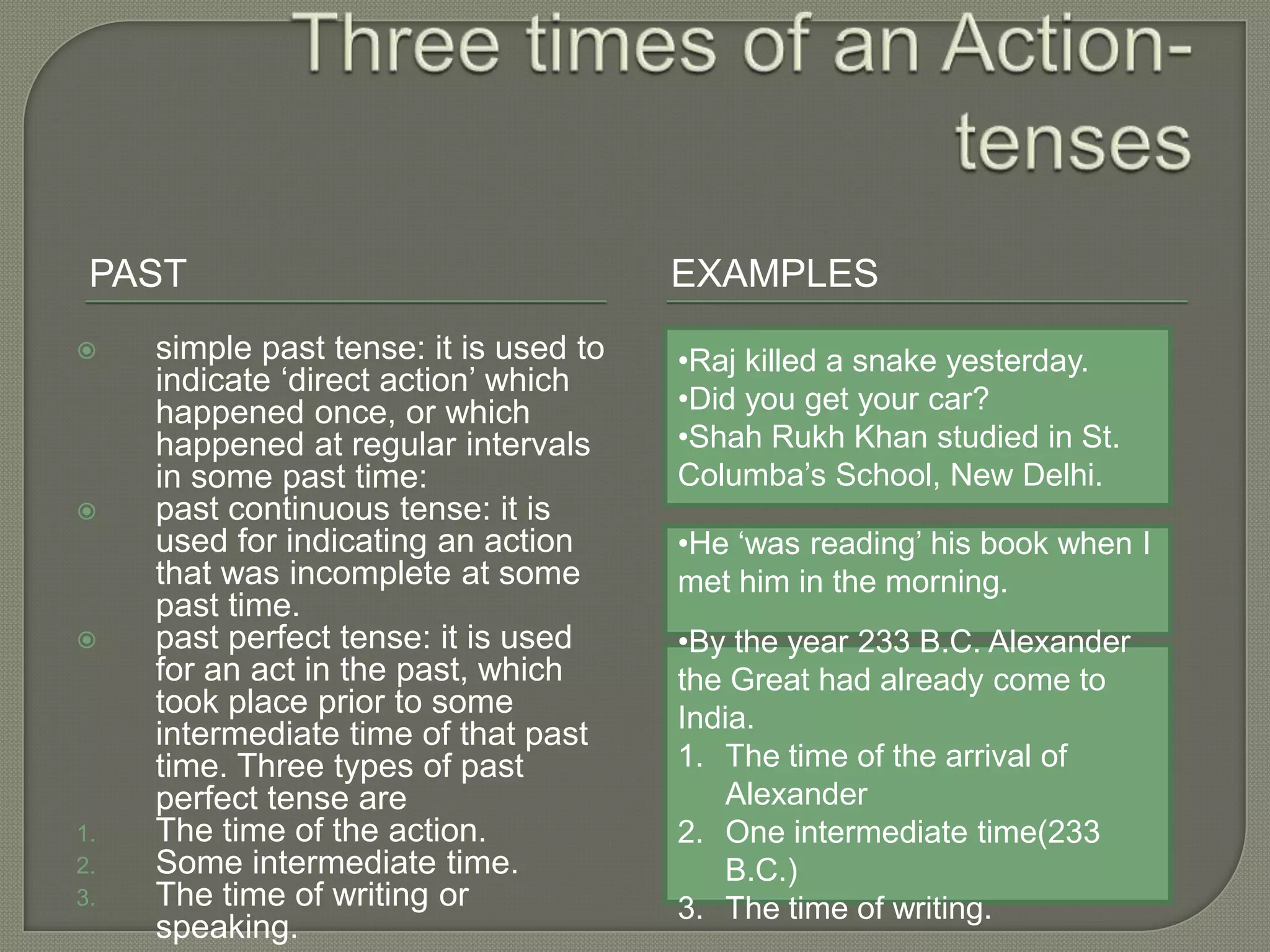
PAST                                   EXAMPLES
    simple past tense: it is used to   •Raj killed a snake yesterday.
     indicate ‘direct action’ which
     happened once, or which            •Did you get your car?
     happened at regular intervals      •Shah Rukh Khan studied in St.
     in some past time:                 Columba’s School, New Delhi.
    past continuous tense: it is
     used for indicating an action      •He ‘was reading’ his book when I
     that was incomplete at some        met him in the morning.
     past time.
    past perfect tense: it is used     •By the year 233 B.C. Alexander
     for an act in the past, which      the Great had already come to
     took place prior to some           India.
     intermediate time of that past
     time. Three types of past          1. The time of the arrival of
     perfect tense are                      Alexander
1.   The time of the action.            2. One intermediate time(233
2.   Some intermediate time.                B.C.)
3.   The time of writing or             3. The time of writing.
     speaking.
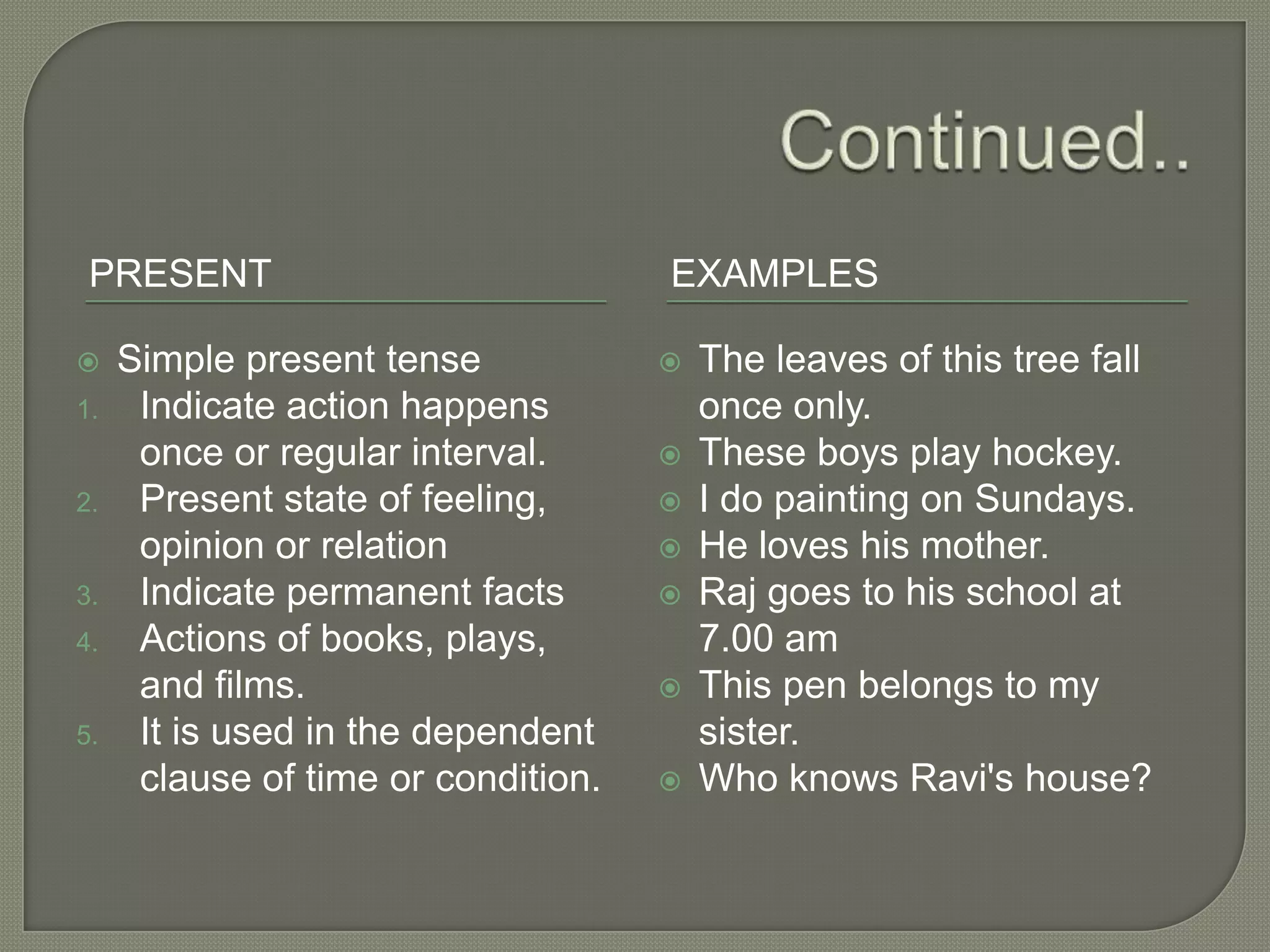
PRESENT                             EXAMPLES

    Simple present tense               The leaves of this tree fall
1.    Indicate action happens            once only.
      once or regular interval.         These boys play hockey.
2.    Present state of feeling,         I do painting on Sundays.
      opinion or relation               He loves his mother.
3.    Indicate permanent facts          Raj goes to his school at
4.    Actions of books, plays,           7.00 am
      and films.                        This pen belongs to my
5.    It is used in the dependent        sister.
      clause of time or condition.      Who knows Ravi's house?
PRESENT                             EXAMPLES

    Present continuous tense:          Boys are playing outside.
1.    Indicating an action              I am visiting Mumbai today
      incomplete in present time.        evening.
2.    Indicate an action take           Ravi is coming to Mumbai
      place in immediate future.         next week.
3.    Used for talking about            They are always giving
      something or decided to            parties.
      do.                               Our teacher is always giving
4.    When a ‘serious of actions’        us tests.
      is there for a limited time.      They love their mother.
PRESENT                               EXAMPLES

   Present perfect tense: this          Ravi has come.
    tense indicates an action,           I have not received my
    completed or rounded off in           salary this month.
    the present time, whose
    effect remains till the time of
    speaking or writing. It tells
    us about the present status
    of the act.
FUTURE                              EXAMPLES

   Simple future tense: it is         Ravi will play cricked today.
    used for ‘direct action’ of        We shall visit Mumbai next
    future.                             month.
   Future continuous tense: it        I am leaving for my office
    is used to indicate an action       just now.
    that will be continuing some       I shall be playing with my
    future time.                        brother when you come to
   Future perfect tense: it is         my house tomorrow.
    used to indicate the               I ‘shall have paid’ it to Ravi if
    completion or rounding off of       you come after 10.00 am.
    an action in some future
    time.
English ppt on tenses

English ppt on tenses

  • 2.
     An actionexpressed in the verb can take place in three different times- past, present, future-and ‘in each time’ it (the action) can be of three different types- simple, continuous, perfect. Three times with their types are called tenses.
  • 3.
    Past Present Future Simple I played I play I shall play Continuous I was playing I am playing I shall be playing Perfect I had played for I have played. I shall have two hours by He has played played if you that time. I had for ten hours.* reach late.*** been playing for I have been two hours when playing for ten ravi came hours.** * We use this form for the present perfect tense for laying stress on the time or duration of the action.
  • 4.
     ** Weuse this form for the present perfect tense for laying stress on the continuity of the action. This tense is called the present perfect continuous tense also.  *** ‘If you reach late’. We do not use the future perfect tense for the dependent clauses of time or condition.  ‘TIME’ AND ‘TYPE’ OF AN ACTION=TENSE
  • 5.
     Simple: simple type is expressed directly. Example of simple type •I passed my B.A. examination in 1995. •Raja will play hockey.  Continuous: Continuous type is that which is incomplete. Examples of Continuous type •Radha was cooking food. •Ravi is reading.  Perfect: Perfect type isExampleswhich is that of Perfect type rounded off or complete.has been writing for two •Ravi hours. •Ravi has written for two hours.
  • 6.
     ‘Do’ isbrought from I play hockey outside for making  Do you play hockey? questions & negative  Ravi does not play sentences of positive hockey. assertive sentences in the simple present and the simplest past tenses I do see.  The auxiliary ‘do’  I did see. makes special emphatic tenses in the simple present and the past
  • 7.
     There is one more tense. It is called ‘the Future in the past tense’. This tense marks an action as future from a past point of view. It is used. 1. In simple sentences and in the main When summer came, they clauses of complex sentences. to make ‘would begin’ preparations to mobilize the army from Delhi to Shimla. 2. In subordinate clauses. I knew that you ‘would come’. I ‘should like’(should have liked) to tell you.
  • 8.
    PAST EXAMPLES  simple past tense: it is used to •Raj killed a snake yesterday. indicate ‘direct action’ which happened once, or which •Did you get your car? happened at regular intervals •Shah Rukh Khan studied in St. in some past time: Columba’s School, New Delhi.  past continuous tense: it is used for indicating an action •He ‘was reading’ his book when I that was incomplete at some met him in the morning. past time.  past perfect tense: it is used •By the year 233 B.C. Alexander for an act in the past, which the Great had already come to took place prior to some India. intermediate time of that past time. Three types of past 1. The time of the arrival of perfect tense are Alexander 1. The time of the action. 2. One intermediate time(233 2. Some intermediate time. B.C.) 3. The time of writing or 3. The time of writing. speaking.
  • 9.
    PRESENT EXAMPLES  Simple present tense  The leaves of this tree fall 1. Indicate action happens once only. once or regular interval.  These boys play hockey. 2. Present state of feeling,  I do painting on Sundays. opinion or relation  He loves his mother. 3. Indicate permanent facts  Raj goes to his school at 4. Actions of books, plays, 7.00 am and films.  This pen belongs to my 5. It is used in the dependent sister. clause of time or condition.  Who knows Ravi's house?
  • 10.
    PRESENT EXAMPLES  Present continuous tense:  Boys are playing outside. 1. Indicating an action  I am visiting Mumbai today incomplete in present time. evening. 2. Indicate an action take  Ravi is coming to Mumbai place in immediate future. next week. 3. Used for talking about  They are always giving something or decided to parties. do.  Our teacher is always giving 4. When a ‘serious of actions’ us tests. is there for a limited time.  They love their mother.
  • 11.
    PRESENT EXAMPLES  Present perfect tense: this  Ravi has come. tense indicates an action,  I have not received my completed or rounded off in salary this month. the present time, whose effect remains till the time of speaking or writing. It tells us about the present status of the act.
  • 12.
    FUTURE EXAMPLES  Simple future tense: it is  Ravi will play cricked today. used for ‘direct action’ of  We shall visit Mumbai next future. month.  Future continuous tense: it  I am leaving for my office is used to indicate an action just now. that will be continuing some  I shall be playing with my future time. brother when you come to  Future perfect tense: it is my house tomorrow. used to indicate the  I ‘shall have paid’ it to Ravi if completion or rounding off of you come after 10.00 am. an action in some future time.