Presented by
C. Karthiksaran
II- M.Sc., Botany
Periyar University,
Salem- 636 011.
1
 The process of creating living, physiological, three
dimensional tissues and organs utilizing specific
combinations of cells, cell scaffold and cell signals, both
chemical and mechanical.
(OR)
 Tissue engineering covers the wide range of applications
that repairs or replace the portion of damaged tissues like
bone, cartilage, blood vessels, skin and bladder.
 Producing better organ used for transplantation.
2
 Biomaterials serve as an integral component of tissue
engineering.
 They are designed to provide architectural
framework reminiscent of native extracellular
matrix in order to encourage cell growth and
eventual tissue regeneration.
3
 To induce cellular migration or tissue regeneration
 To encapsulate cells and act as an immuno- isolation
barrier
 To provide a matrix to support cell growth and cell
organization.
4
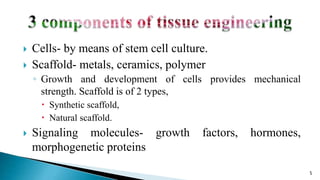
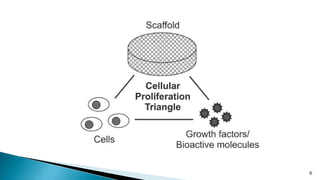
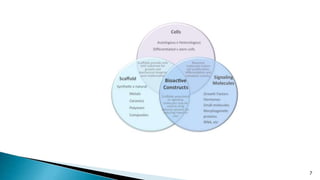
 Cells- by means of stem cell culture.
 Scaffold- metals, ceramics, polymer
◦ Growth and development of cells provides mechanical
strength. Scaffold is of 2 types,
 Synthetic scaffold,
 Natural scaffold.
 Signaling molecules- growth factors, hormones,
morphogenetic proteins
5
6
7
8

Biomaterials in tissue engineering

  • 1.
    Presented by C. Karthiksaran II-M.Sc., Botany Periyar University, Salem- 636 011. 1
  • 2.
     The processof creating living, physiological, three dimensional tissues and organs utilizing specific combinations of cells, cell scaffold and cell signals, both chemical and mechanical. (OR)  Tissue engineering covers the wide range of applications that repairs or replace the portion of damaged tissues like bone, cartilage, blood vessels, skin and bladder.  Producing better organ used for transplantation. 2
  • 3.
     Biomaterials serveas an integral component of tissue engineering.  They are designed to provide architectural framework reminiscent of native extracellular matrix in order to encourage cell growth and eventual tissue regeneration. 3
  • 4.
     To inducecellular migration or tissue regeneration  To encapsulate cells and act as an immuno- isolation barrier  To provide a matrix to support cell growth and cell organization. 4
  • 5.
     Cells- bymeans of stem cell culture.  Scaffold- metals, ceramics, polymer ◦ Growth and development of cells provides mechanical strength. Scaffold is of 2 types,  Synthetic scaffold,  Natural scaffold.  Signaling molecules- growth factors, hormones, morphogenetic proteins 5
  • 6.
  • 7.
  • 8.