GREEN NPs PRODUCTION
SUBMITTED BY:AMINA BIBI
ROLL NO:5810
SUBMITTED TO: MAM SEHRISH
BS CHEMISTRY 8TH
SEMESTER
SU
b
GREEN NANOPARTICAL PRODUCTION
 Contents:
 Refrences
Ag NPs
Intro to
Green NPS
production
ZnO NPsAu NPs
CdS NPs
Application
of Green
green nano
synthesis
Green nano partical production
Introduction:
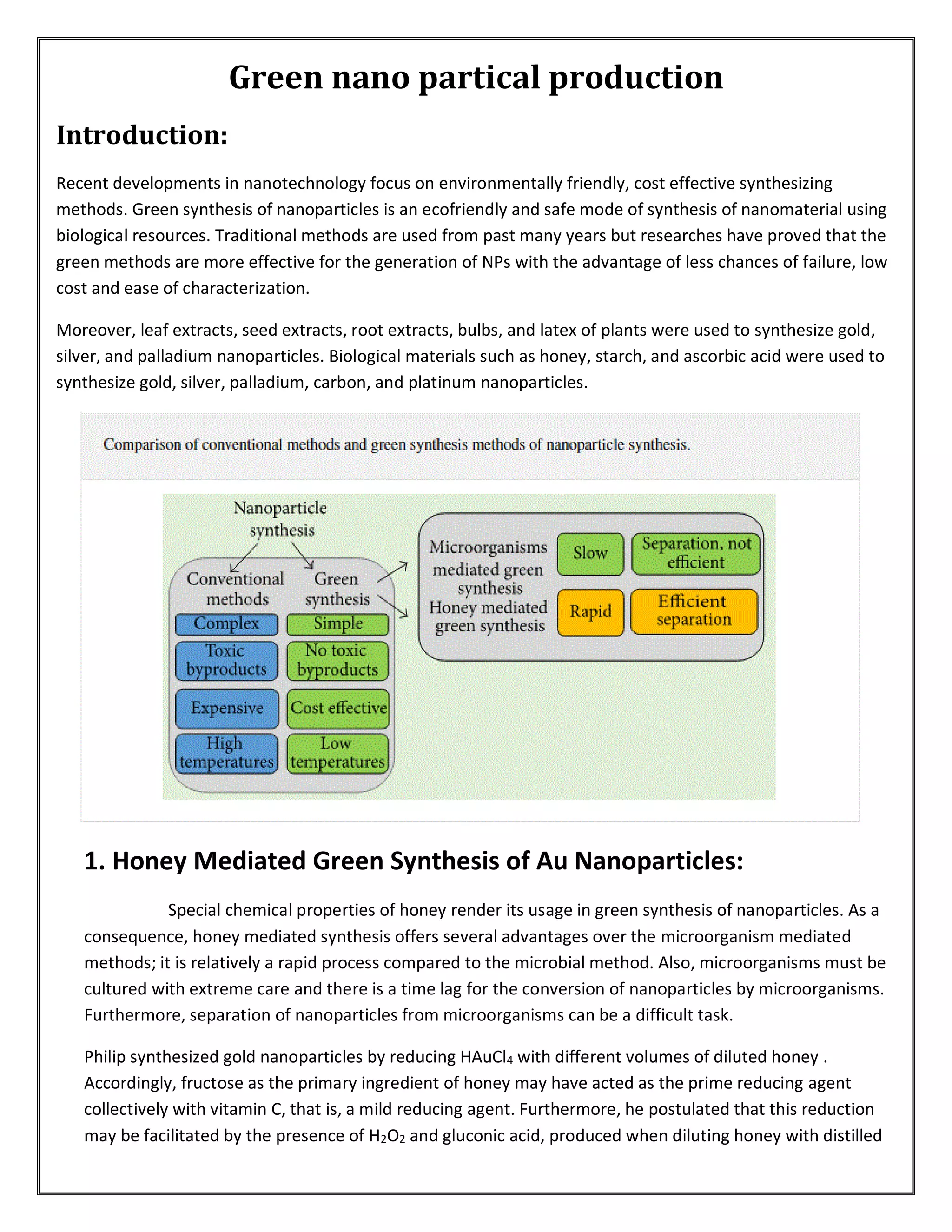
Recent developments in nanotechnology focus on environmentally friendly, cost effective synthesizing
methods. Green synthesis of nanoparticles is an ecofriendly and safe mode of synthesis of nanomaterial using
biological resources. Traditional methods are used from past many years but researches have proved that the
green methods are more effective for the generation of NPs with the advantage of less chances of failure, low
cost and ease of characterization.
Moreover, leaf extracts, seed extracts, root extracts, bulbs, and latex of plants were used to synthesize gold,
silver, and palladium nanoparticles. Biological materials such as honey, starch, and ascorbic acid were used to
synthesize gold, silver, palladium, carbon, and platinum nanoparticles.
1. Honey Mediated Green Synthesis of Au Nanoparticles:
Special chemical properties of honey render its usage in green synthesis of nanoparticles. As a
consequence, honey mediated synthesis offers several advantages over the microorganism mediated
methods; it is relatively a rapid process compared to the microbial method. Also, microorganisms must be
cultured with extreme care and there is a time lag for the conversion of nanoparticles by microorganisms.
Furthermore, separation of nanoparticles from microorganisms can be a difficult task.
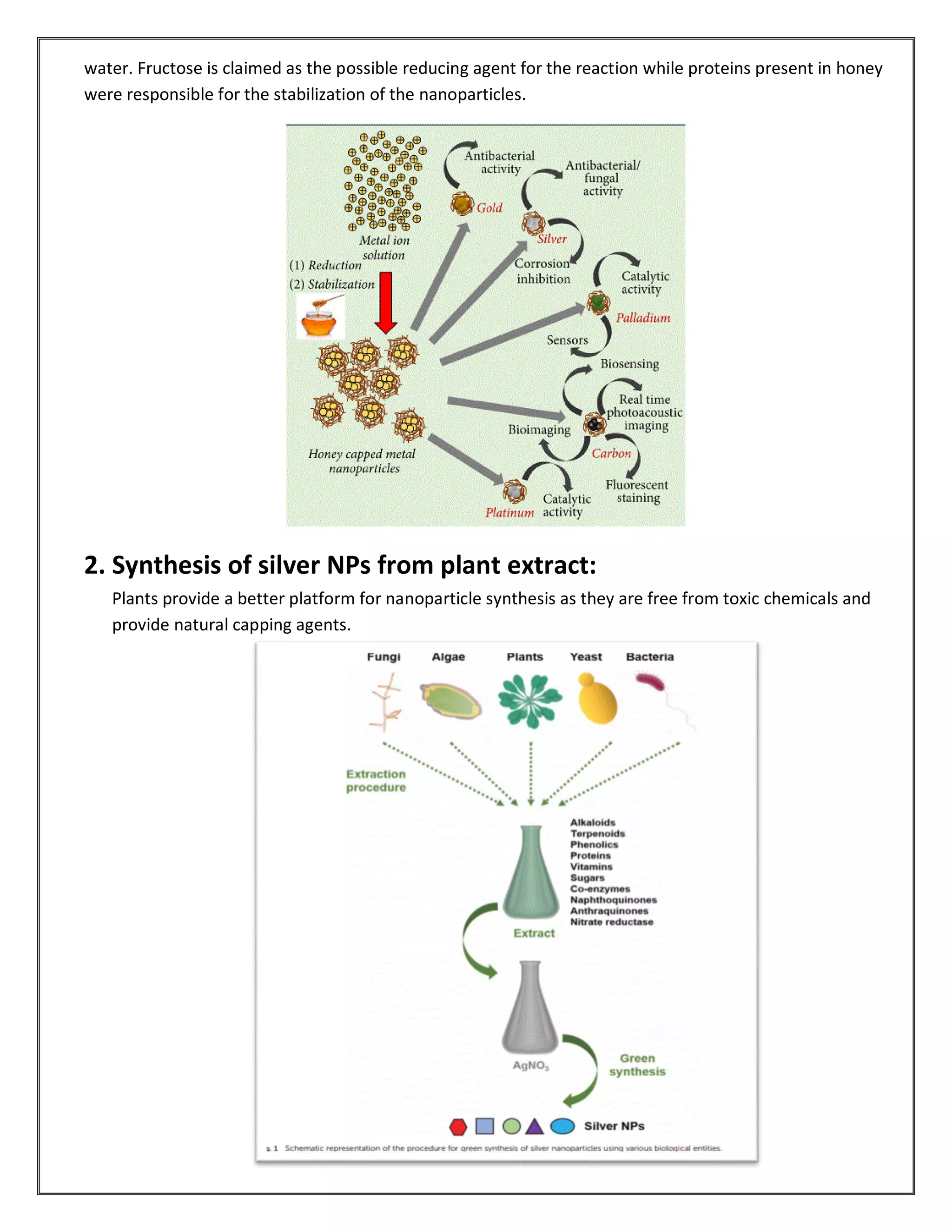
Philip synthesized gold nanoparticles by reducing HAuCl4 with different volumes of diluted honey .
Accordingly, fructose as the primary ingredient of honey may have acted as the prime reducing agent
collectively with vitamin C, that is, a mild reducing agent. Furthermore, he postulated that this reduction
may be facilitated by the presence of H2O2 and gluconic acid, produced when diluting honey with distilled
water. Fructose is claimed as the possible reducing agent for the reaction while proteins present in honey
were responsible for the stabilization of the nanoparticles.
2. Synthesis of silver NPs from plant extract:
Plants provide a better platform for nanoparticle synthesis as they are free from toxic chemicals and
provide natural capping agents.
Moreover, use of plant extracts also reduces the cost of microorganisms isolation and culture media enhancing
the cost competitive feasibility over nanoparticles synthesis by microorganisms.
Slow rate of nanoparticle synthesis using microbes makes plant extracts as preferred choice due to its
simplicity, efficiency and viability. The ability of plants to accumulate and detoxify heavy metals is well proved.
Generally it is used as bio reductant in the process of synthesizing silver nanoparticles. A plant extract contains
a number of metabolites and reductive biomolecules responsible for the reduction of metal ions. This includes
terpenoids,ketones, aldehydes, amides, carboxylic acids, carbohydrates, proteins, and vitamins. Among many
possible natural products, polysaccharides represent an excellent scaffold for this purpose.The use of
polysaccharides like starch and chitosan for the synthesis of AgNPs has been reported in recent years.
3. Synthesis of zinc oxide NPs:
There are many conventional zinc oxide (ZnO) nanostructure synthesis routes employing the chemical
and physical methods, which require particular set-up, high cost, high temperature-pressure conditions,
and nonecological chemicals. However, high-energy consumption of these routes and released toxic
chemicals after the process can be hazardous to the environment and human health. In recent years, the
green synthesis approach has been gaining attention, which eliminates the use of toxic chemicals and
applies environmentally friendly routes.
 Natural extract-based ZnO nanostructures:
Natural extracts obtained from plants, leaves, fruit peels, flowers, and seeds have been utilized for
the green synthesis of metal oxide nanoparticles for years. After the plants are collected from different
sources, they are washed with water and basic extraction procedures are applied to obtain plant
extracts in which leaves are ground and immersed in water by stirring at room temperature for a while.
Then, the solutions are filtered and the eluted extract solution is separated for further use in ZnO
synthesis (Figure 2). The eluent solution could be used directly for ZnO synthesis or could be dried for
the concentration of solid extracts. Afterward, zinc precursors and plant extracts are reacted under
various pH and temperature conditions ]. If the extract is used as an aqueous solution, the zinc
precursors are added into the solution after the react ion Zinc NPs are filtered.
4. Synthesis of CdS NPs:
Nanoparticle production using microbial forms has a significant prospective to support nanoparticles
synthesis that does not require any of the toxic and hazardous, chemicals that are routinely used.
Cadmium sulphide nanoparticles (CdS) was chosen as a compound of interest due to its high stability,
excellent physical, chemical and structural properties, ease of preparation and handling. CdS nanoparticles
are being used widely used for the cancer diagnosis and antimicrobial treatment.
Bacillus licheniformis strain is used in this method. The bacterial strain was inoculated on nutrient broth.
The isolate was maintained in nutrient agar for further study.
The initiated culture was centrifuged at 8000 rpm for 15 minutes. The pellet was washed repeatedly to
remove remnant media. The biomass was carefully weighed and deionized water was added. This set up
(in an Erlenmeyer flask) was maintained in a shaker for 30 minutes at 200 rpm. 0.1 mM of cadmium
chloride and 0.01 mM of sodium sulphide was added to the mixture. Post incubation, the contaminants
were excluded using acetone and water to obtain pure nanoparticles.
Applications of green nanotechnology:
From recent years, dramatic changes in the interest of researchers developed for the green
nanotechnology and number of science publications are expanding ceaselessly. Green NPs have differing
impact on the utilization of metallic NPs. They assume an imperative part to expanding the utility of NPs in
pharmaceutical field particularly.
 Dentistry :
Ag-NPs have been utilized in dental instruments and swathes. Joining of Ag-NPs into orthodontic glue can
increase or keep up the shear bond nature of orthodontic cement while expanding its confirmation from
microorganisms.
 Purification of drinking water:
Biogenic silver NPs produced using Lactobacillus Fermentum is used for removal of viruses from
drinking water.
 Environmental remediation
NPs are useful in environmental remediation.They have wide scope in the treatment of surface water,
ground water and waste water contaminated by toxic metal ions, organic and inorganic chemicals.
Refrences:
1) https://www.intechopen.com/books/zinc-oxide-based-nano-materials-and-devices/green-
synthesis-of-zinc-oxide- nanostructures
2) https://sci-hub.tw/https://doi.org/10.1039/C8RA08982E
3) https://www.researchgate.net/publication/288835216_Green_synthesis_of_nanoparticles
_and_its_potential_application

Green nanopartical synthesis

  • 1.
    GREEN NPs PRODUCTION SUBMITTEDBY:AMINA BIBI ROLL NO:5810 SUBMITTED TO: MAM SEHRISH BS CHEMISTRY 8TH SEMESTER SU b
  • 2.
    GREEN NANOPARTICAL PRODUCTION Contents:  Refrences Ag NPs Intro to Green NPS production ZnO NPsAu NPs CdS NPs Application of Green green nano synthesis
  • 3.
    Green nano particalproduction Introduction: Recent developments in nanotechnology focus on environmentally friendly, cost effective synthesizing methods. Green synthesis of nanoparticles is an ecofriendly and safe mode of synthesis of nanomaterial using biological resources. Traditional methods are used from past many years but researches have proved that the green methods are more effective for the generation of NPs with the advantage of less chances of failure, low cost and ease of characterization. Moreover, leaf extracts, seed extracts, root extracts, bulbs, and latex of plants were used to synthesize gold, silver, and palladium nanoparticles. Biological materials such as honey, starch, and ascorbic acid were used to synthesize gold, silver, palladium, carbon, and platinum nanoparticles. 1. Honey Mediated Green Synthesis of Au Nanoparticles: Special chemical properties of honey render its usage in green synthesis of nanoparticles. As a consequence, honey mediated synthesis offers several advantages over the microorganism mediated methods; it is relatively a rapid process compared to the microbial method. Also, microorganisms must be cultured with extreme care and there is a time lag for the conversion of nanoparticles by microorganisms. Furthermore, separation of nanoparticles from microorganisms can be a difficult task. Philip synthesized gold nanoparticles by reducing HAuCl4 with different volumes of diluted honey . Accordingly, fructose as the primary ingredient of honey may have acted as the prime reducing agent collectively with vitamin C, that is, a mild reducing agent. Furthermore, he postulated that this reduction may be facilitated by the presence of H2O2 and gluconic acid, produced when diluting honey with distilled
  • 4.
    water. Fructose isclaimed as the possible reducing agent for the reaction while proteins present in honey were responsible for the stabilization of the nanoparticles. 2. Synthesis of silver NPs from plant extract: Plants provide a better platform for nanoparticle synthesis as they are free from toxic chemicals and provide natural capping agents.
  • 5.
    Moreover, use ofplant extracts also reduces the cost of microorganisms isolation and culture media enhancing the cost competitive feasibility over nanoparticles synthesis by microorganisms. Slow rate of nanoparticle synthesis using microbes makes plant extracts as preferred choice due to its simplicity, efficiency and viability. The ability of plants to accumulate and detoxify heavy metals is well proved. Generally it is used as bio reductant in the process of synthesizing silver nanoparticles. A plant extract contains a number of metabolites and reductive biomolecules responsible for the reduction of metal ions. This includes terpenoids,ketones, aldehydes, amides, carboxylic acids, carbohydrates, proteins, and vitamins. Among many possible natural products, polysaccharides represent an excellent scaffold for this purpose.The use of polysaccharides like starch and chitosan for the synthesis of AgNPs has been reported in recent years. 3. Synthesis of zinc oxide NPs: There are many conventional zinc oxide (ZnO) nanostructure synthesis routes employing the chemical and physical methods, which require particular set-up, high cost, high temperature-pressure conditions, and nonecological chemicals. However, high-energy consumption of these routes and released toxic chemicals after the process can be hazardous to the environment and human health. In recent years, the green synthesis approach has been gaining attention, which eliminates the use of toxic chemicals and applies environmentally friendly routes.  Natural extract-based ZnO nanostructures: Natural extracts obtained from plants, leaves, fruit peels, flowers, and seeds have been utilized for the green synthesis of metal oxide nanoparticles for years. After the plants are collected from different sources, they are washed with water and basic extraction procedures are applied to obtain plant extracts in which leaves are ground and immersed in water by stirring at room temperature for a while. Then, the solutions are filtered and the eluted extract solution is separated for further use in ZnO synthesis (Figure 2). The eluent solution could be used directly for ZnO synthesis or could be dried for
  • 6.
    the concentration ofsolid extracts. Afterward, zinc precursors and plant extracts are reacted under various pH and temperature conditions ]. If the extract is used as an aqueous solution, the zinc precursors are added into the solution after the react ion Zinc NPs are filtered. 4. Synthesis of CdS NPs: Nanoparticle production using microbial forms has a significant prospective to support nanoparticles synthesis that does not require any of the toxic and hazardous, chemicals that are routinely used. Cadmium sulphide nanoparticles (CdS) was chosen as a compound of interest due to its high stability, excellent physical, chemical and structural properties, ease of preparation and handling. CdS nanoparticles are being used widely used for the cancer diagnosis and antimicrobial treatment. Bacillus licheniformis strain is used in this method. The bacterial strain was inoculated on nutrient broth. The isolate was maintained in nutrient agar for further study. The initiated culture was centrifuged at 8000 rpm for 15 minutes. The pellet was washed repeatedly to remove remnant media. The biomass was carefully weighed and deionized water was added. This set up (in an Erlenmeyer flask) was maintained in a shaker for 30 minutes at 200 rpm. 0.1 mM of cadmium chloride and 0.01 mM of sodium sulphide was added to the mixture. Post incubation, the contaminants were excluded using acetone and water to obtain pure nanoparticles. Applications of green nanotechnology: From recent years, dramatic changes in the interest of researchers developed for the green nanotechnology and number of science publications are expanding ceaselessly. Green NPs have differing impact on the utilization of metallic NPs. They assume an imperative part to expanding the utility of NPs in pharmaceutical field particularly.  Dentistry : Ag-NPs have been utilized in dental instruments and swathes. Joining of Ag-NPs into orthodontic glue can increase or keep up the shear bond nature of orthodontic cement while expanding its confirmation from microorganisms.  Purification of drinking water:
  • 7.
    Biogenic silver NPsproduced using Lactobacillus Fermentum is used for removal of viruses from drinking water.  Environmental remediation NPs are useful in environmental remediation.They have wide scope in the treatment of surface water, ground water and waste water contaminated by toxic metal ions, organic and inorganic chemicals. Refrences: 1) https://www.intechopen.com/books/zinc-oxide-based-nano-materials-and-devices/green- synthesis-of-zinc-oxide- nanostructures 2) https://sci-hub.tw/https://doi.org/10.1039/C8RA08982E 3) https://www.researchgate.net/publication/288835216_Green_synthesis_of_nanoparticles _and_its_potential_application