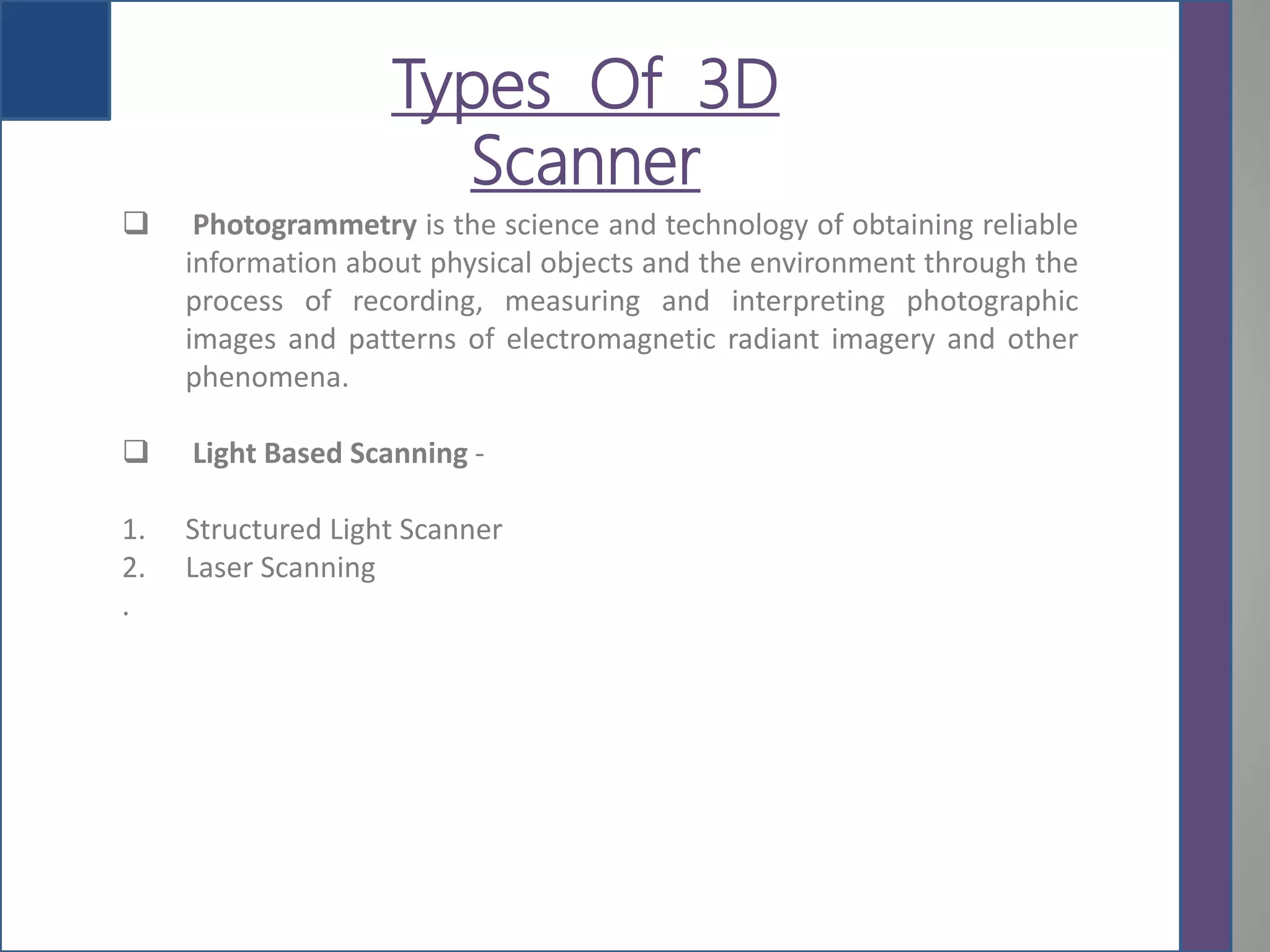
Team Members
Name Roll No
1. Ashitos Raj 05
2. Bidhan Rakshit 23
3. Priya Yadav 29
4. Zeenat Parween 16
5. Mahima Kumari 36
Content
1. Abstract
2. Introduction To 3D Printing
3. History
4. Types of 3D Scanner
5. Components Of 3D Printer
6. Material used for 3D Printing
7. Working
8. Software Required For 3D Printing
9. Advantages Of 3D Printing
10. Limitations Of 3D Printing
11. Applications
12. Future Scope
13. Conclusion
14. References
Abstract
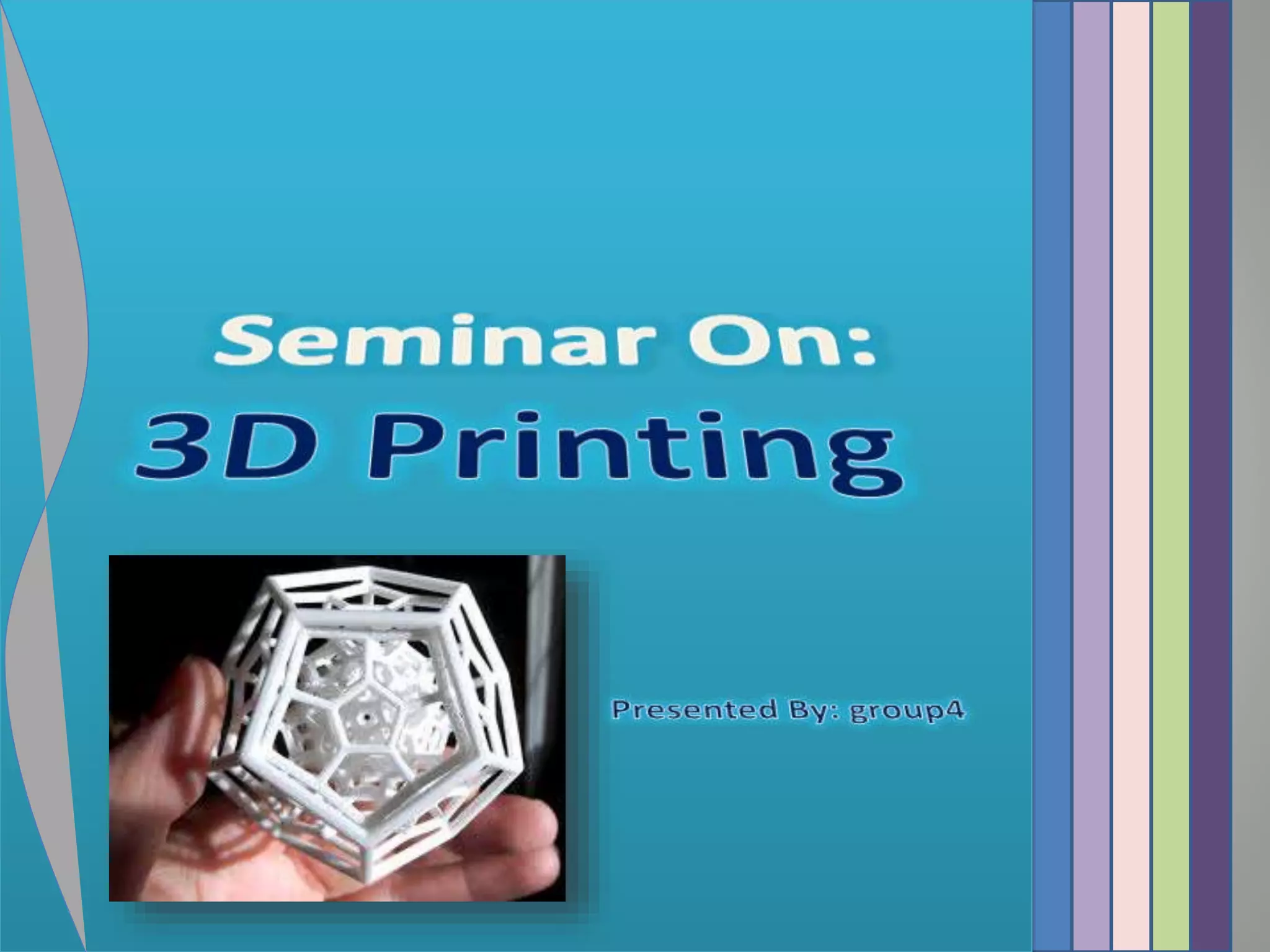
 3D printing is a form of additive manufacturing technology.
 It is also known as rapid prototyping.
 We can create a complete model in a single process using 3D
printing.
 And nowadays, 3D printing concept of custom manufacturing
is exciting to nearly everyone.
3D Model
Introduction To
3D Printing
 3D Printing is a process for making a physical object from a three-
dimensional Digital model, typically by laying down many successive
thin layers of a material.
 It brings a digital object(its CAD representation) into its physical
form by adding layer by layer of material.
 It is also Known as Additive Manufacturing.(Additive process ,where
successive layers of material are laid down in different shapes.)
History
 The Earliest Record of 3D Printing Through the Additive Process was
The Japanese Inventor Hideo Kodama in 1980.
 He Created a product that used ultraviolet lights to harden polymers
and Create Solid Objects. This is a Stepping Stone to
Lithography(SLA).
 The Technology for Printing Physical 3D Objects from Digital Data
Was First developed by Charles Hull in 1994.
 Charles Hull named the Technique as Stereo Lithography, A process
similar to 3D printing that uses technology to create smaller versions
of objects so they can be tested before spending Time and Money
on creating the actual products.
 In 2005,Z Corp launched a breakthrough product, named Spectrum
Z510,Which was the first high definition color 3D Printer in the
Market.
yTypes Of 3D
Scanner
 Photogrammetry is the science and technology of obtaining reliable
information about physical objects and the environment through the
process of recording, measuring and interpreting photographic
images and patterns of electromagnetic radiant imagery and other
phenomena.
 Light Based Scanning -
1. Structured Light Scanner
2. Laser Scanning
.
Components Of 3D
Printer
 Z RESOLUTION– LAYER THICKNESS
 BUILD AREA
 FILAMENT DIAMETER
 HOT END
 NOZZLE
 EXTRUDER
 COOLING FAN
 HEATING BAD
 LCD DISPLAY
 MULTIPLE EXTRUDERS
Components
Materials Used For 3d
Printer
 PLASTIC
 POWDER
 RESINS
 METAL
 CARBON FIBER
 GRAPHITE AND GRAPHENE
 NITINOL
 PAPER
Working of 3D Printing
The working of 3D Printing are divided into certain steps.
Working Of 3D Printing
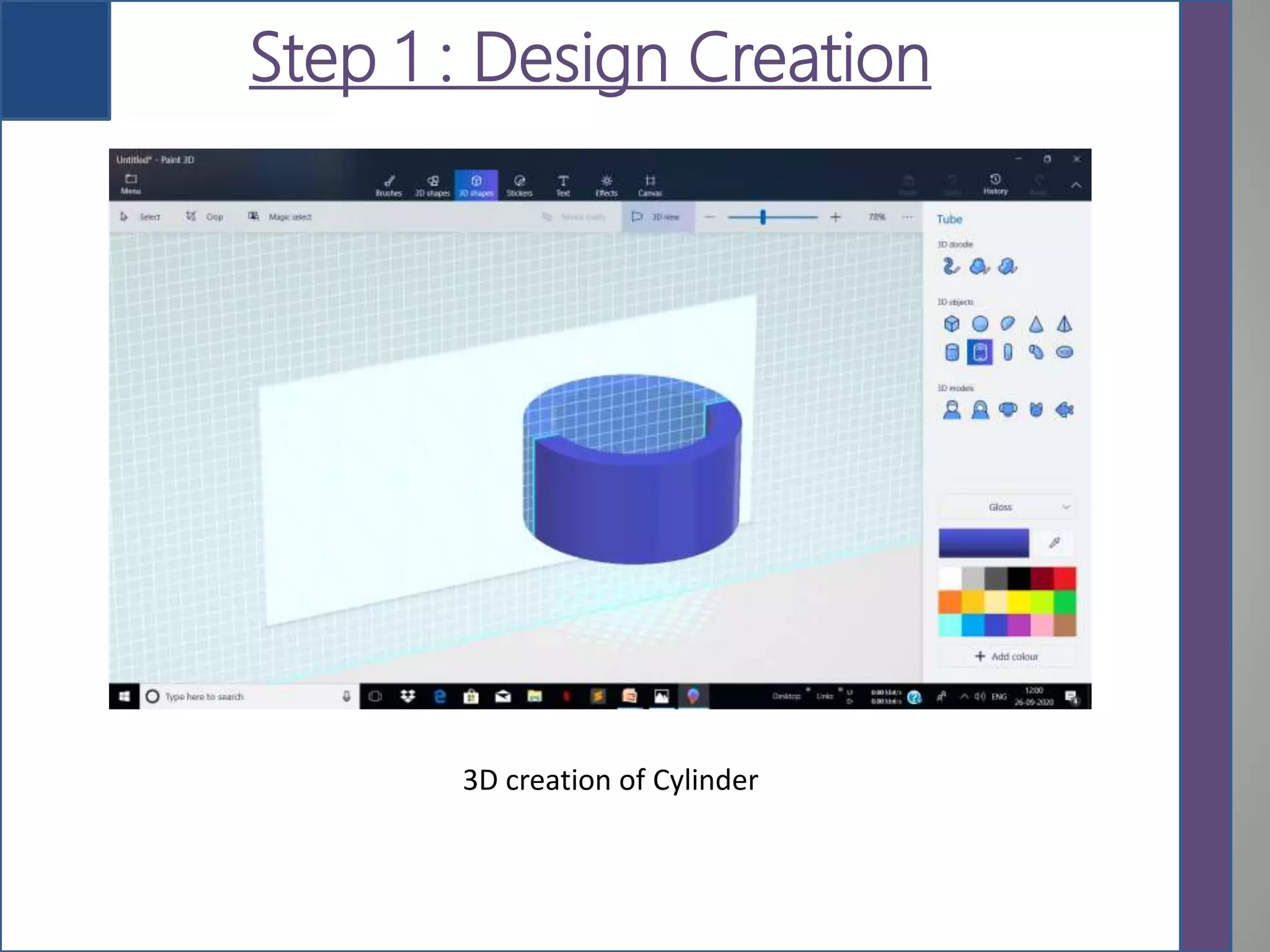
Step 1 : Design Creation
3D creation of Cylinder
Step 2 : STL File Format
Stereolithograpghy File Format
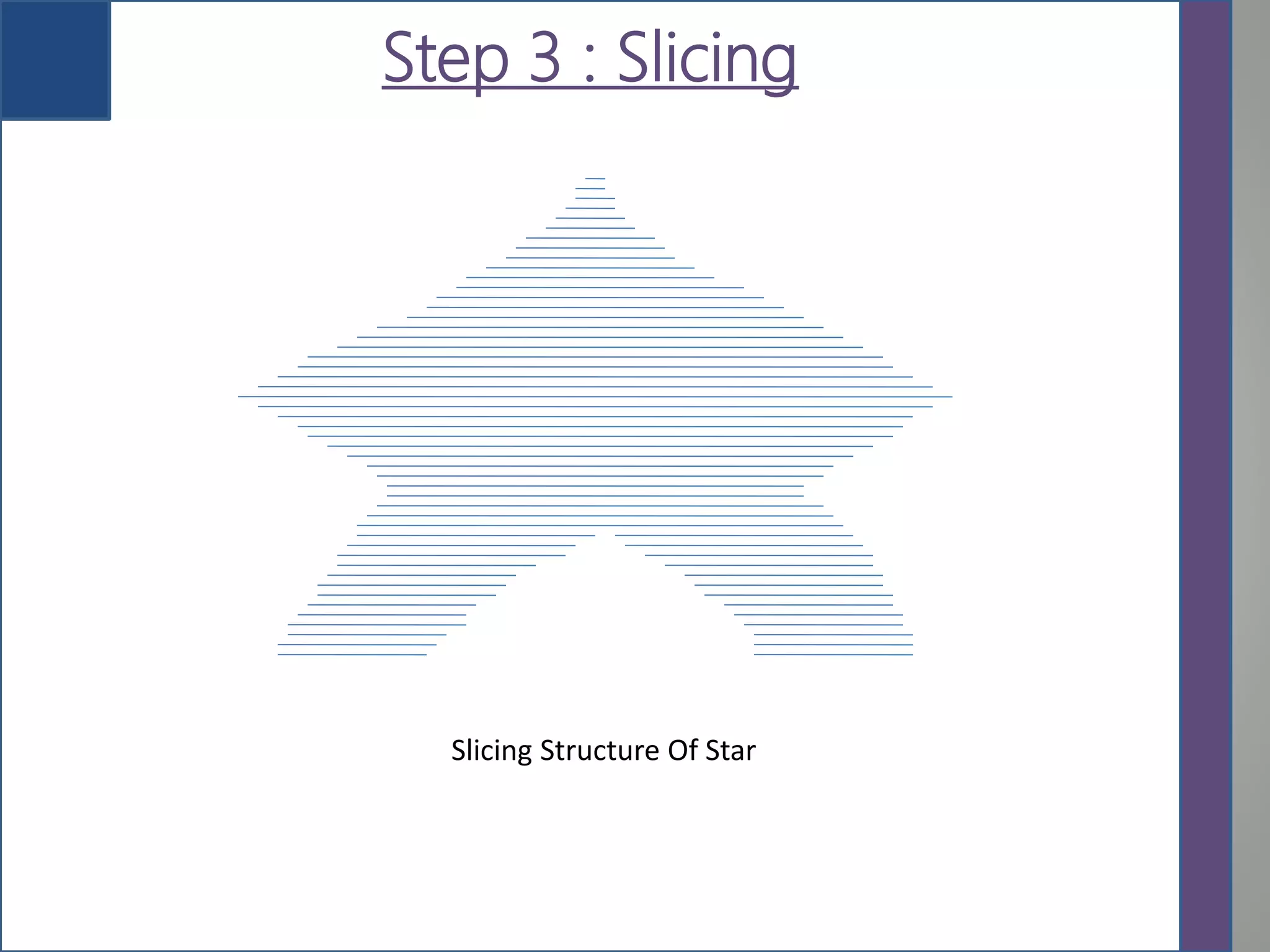
Step 3 : Slicing
Slicing Structure Of Star
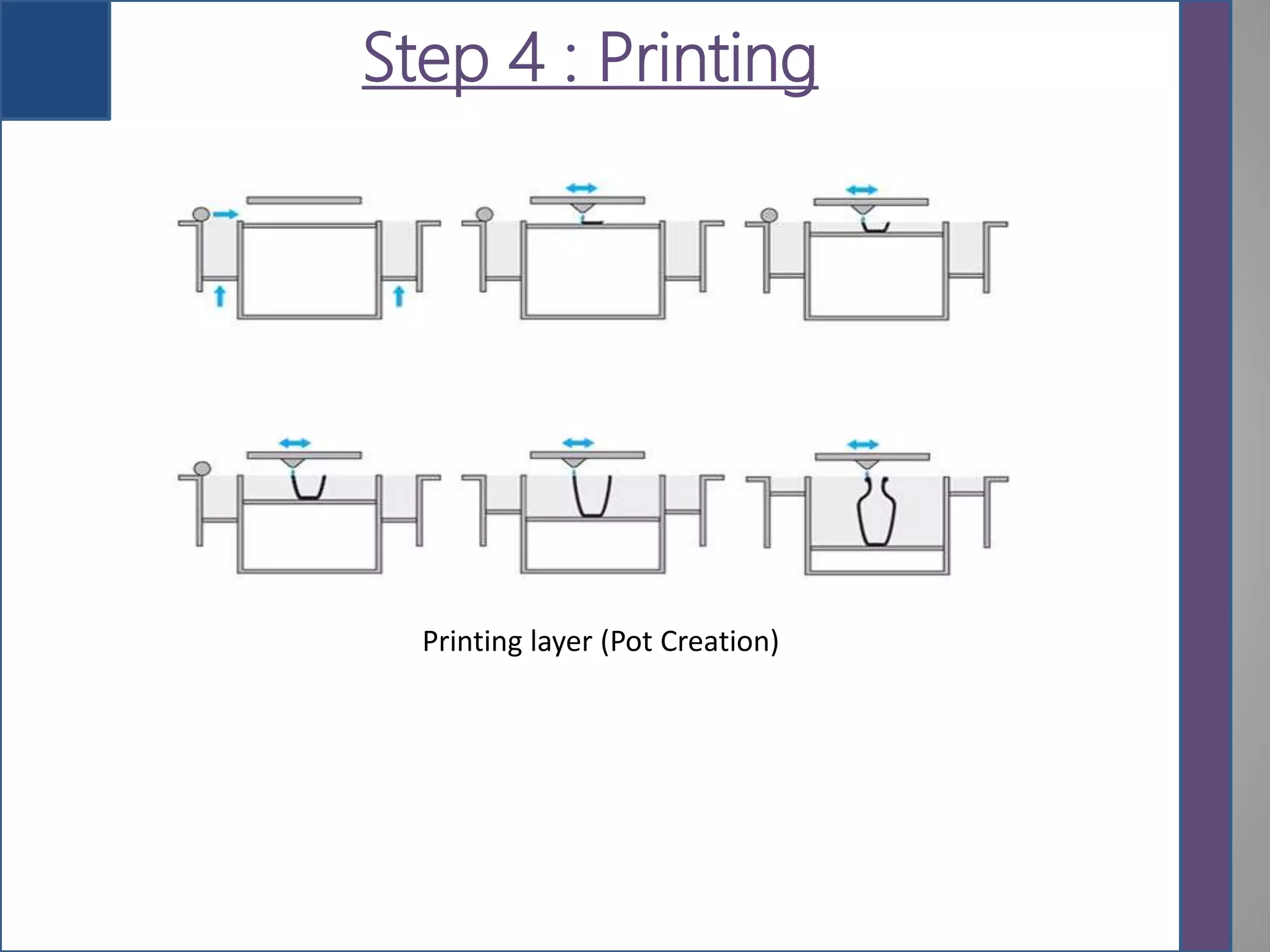
Step 4 : Printing
Printing layer (Pot Creation)
Step 5 : Removal/ Finishing
 Through the printer produced resolution is sufficient for many
applications, printing a slightly oversized version of the desire
object in standard resolution and then removing material with a
higher resolution subtractive process can achieve greater
precision.
 Supports are removable or dissolvable upon completion of the
print, and are used to support overhanging feature during
construction.
Software required by
3D Printing
To Turn Our ideas into 3D printable files We need some 3D Modeling
Software, Take a look on the Best 3D design and modeling software:-
 Simplify3D
 Slic3r
 Tinker cad
 Sketch UP Free
 Free CAD
uu
Advantages of 3D
Printing.
 This production process offers a range of advantages compared to
Traditional Manufacturing Methods. These advantages include
Design, Time, and Cost.
 Flexible Design
 Print on Demand
 Strong and Lightweight Parts.
 Minimizing Waste
Limitations
3D Printing Limitations at a Glance:
 Health Hazards
 Eco-Unfriendly
 High Energy Consumption
 Unemployment
 Printers are not large enough
Applications
 Medical Procedures
 Advances In Research
 Product Prototyping
 Historic Preservation
 Architectural Engineering
 Food Industry
 Automotive
 Accessories
3D Heart Model
3D Accessories
3D Architecture3D Automotive Design
Future Scope
 The scope of 3D printing encompasses objects like aircrafts
components musical Keyboards, interactive posters, human organs
and much more such as 3D printer model of a child’s heart.
 The advancement in the hardware, software material and
application suggests that 3D printing will eventually become yet
another manufacturer technology naturally the adoption rate of
3D printing will increase over time with some segment.
Conclusion
 Printing has only been used on small scale project in the construction
industry and there are a lot of challenges that need to be dealt with prior
to considering adopting it as one of the main construction technology.
References
 my3dconcepts.com
 www.slideshare.net
www.explianthatstuff.com
www.researchgate.net
3 d printing final (1) (1)

3 d printing final (1) (1)

  • 2.
    Team Members Name RollNo 1. Ashitos Raj 05 2. Bidhan Rakshit 23 3. Priya Yadav 29 4. Zeenat Parween 16 5. Mahima Kumari 36
  • 3.
    Content 1. Abstract 2. IntroductionTo 3D Printing 3. History 4. Types of 3D Scanner 5. Components Of 3D Printer 6. Material used for 3D Printing 7. Working 8. Software Required For 3D Printing 9. Advantages Of 3D Printing 10. Limitations Of 3D Printing 11. Applications 12. Future Scope 13. Conclusion 14. References
  • 4.
    Abstract  3D printingis a form of additive manufacturing technology.  It is also known as rapid prototyping.  We can create a complete model in a single process using 3D printing.  And nowadays, 3D printing concept of custom manufacturing is exciting to nearly everyone. 3D Model
  • 5.
    Introduction To 3D Printing 3D Printing is a process for making a physical object from a three- dimensional Digital model, typically by laying down many successive thin layers of a material.  It brings a digital object(its CAD representation) into its physical form by adding layer by layer of material.  It is also Known as Additive Manufacturing.(Additive process ,where successive layers of material are laid down in different shapes.)
  • 6.
    History  The EarliestRecord of 3D Printing Through the Additive Process was The Japanese Inventor Hideo Kodama in 1980.  He Created a product that used ultraviolet lights to harden polymers and Create Solid Objects. This is a Stepping Stone to Lithography(SLA).  The Technology for Printing Physical 3D Objects from Digital Data Was First developed by Charles Hull in 1994.  Charles Hull named the Technique as Stereo Lithography, A process similar to 3D printing that uses technology to create smaller versions of objects so they can be tested before spending Time and Money on creating the actual products.  In 2005,Z Corp launched a breakthrough product, named Spectrum Z510,Which was the first high definition color 3D Printer in the Market.
  • 7.
    yTypes Of 3D Scanner Photogrammetry is the science and technology of obtaining reliable information about physical objects and the environment through the process of recording, measuring and interpreting photographic images and patterns of electromagnetic radiant imagery and other phenomena.  Light Based Scanning - 1. Structured Light Scanner 2. Laser Scanning .
  • 8.
    Components Of 3D Printer Z RESOLUTION– LAYER THICKNESS  BUILD AREA  FILAMENT DIAMETER  HOT END  NOZZLE  EXTRUDER  COOLING FAN  HEATING BAD  LCD DISPLAY  MULTIPLE EXTRUDERS Components
  • 9.
    Materials Used For3d Printer  PLASTIC  POWDER  RESINS  METAL  CARBON FIBER  GRAPHITE AND GRAPHENE  NITINOL  PAPER
  • 10.
    Working of 3DPrinting The working of 3D Printing are divided into certain steps. Working Of 3D Printing
  • 11.
    Step 1 :Design Creation 3D creation of Cylinder
  • 12.
    Step 2 :STL File Format Stereolithograpghy File Format
  • 13.
    Step 3 :Slicing Slicing Structure Of Star
  • 14.
    Step 4 :Printing Printing layer (Pot Creation)
  • 15.
    Step 5 :Removal/ Finishing  Through the printer produced resolution is sufficient for many applications, printing a slightly oversized version of the desire object in standard resolution and then removing material with a higher resolution subtractive process can achieve greater precision.  Supports are removable or dissolvable upon completion of the print, and are used to support overhanging feature during construction.
  • 16.
    Software required by 3DPrinting To Turn Our ideas into 3D printable files We need some 3D Modeling Software, Take a look on the Best 3D design and modeling software:-  Simplify3D  Slic3r  Tinker cad  Sketch UP Free  Free CAD
  • 17.
    uu Advantages of 3D Printing. This production process offers a range of advantages compared to Traditional Manufacturing Methods. These advantages include Design, Time, and Cost.  Flexible Design  Print on Demand  Strong and Lightweight Parts.  Minimizing Waste
  • 18.
    Limitations 3D Printing Limitationsat a Glance:  Health Hazards  Eco-Unfriendly  High Energy Consumption  Unemployment  Printers are not large enough
  • 19.
    Applications  Medical Procedures Advances In Research  Product Prototyping  Historic Preservation  Architectural Engineering  Food Industry  Automotive  Accessories 3D Heart Model 3D Accessories 3D Architecture3D Automotive Design
  • 20.
    Future Scope  Thescope of 3D printing encompasses objects like aircrafts components musical Keyboards, interactive posters, human organs and much more such as 3D printer model of a child’s heart.  The advancement in the hardware, software material and application suggests that 3D printing will eventually become yet another manufacturer technology naturally the adoption rate of 3D printing will increase over time with some segment.
  • 21.
    Conclusion  Printing hasonly been used on small scale project in the construction industry and there are a lot of challenges that need to be dealt with prior to considering adopting it as one of the main construction technology.
  • 22.