DIFFERENTIATION USING
FIRST PRINCIPLES
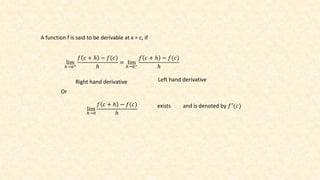
A function f is said to be derivable at x = c, if
lim
ℎ→0+
𝑓 𝑐 + ℎ − 𝑓(𝑐)
ℎ
= lim
ℎ→0−
𝑓 𝑐 + ℎ − 𝑓(𝑐)
ℎ
Right hand derivative Left hand derivative
Or
lim
ℎ→0
𝑓 𝑐 + ℎ − 𝑓(𝑐)
ℎ
exists and is denoted by 𝑓′
(𝑐)
Question 1
Discuss the differentiability of f(x) = 𝑥 − 5 at x = 5
Right hand derivative = lim
ℎ→0+
𝑓 5+ℎ −𝑓(5)
ℎ
=
= lim
ℎ→0+
ℎ
ℎ
= lim
ℎ→0
ℎ
ℎ
= 1
= lim
ℎ→0+
5 + ℎ − 5 − 5 − 5
ℎ
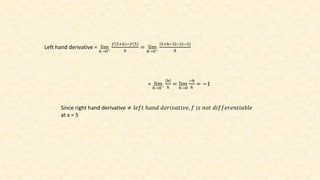
Left hand derivative = lim
ℎ→0−
𝑓 5+ℎ −𝑓(5)
ℎ
= lim
ℎ→0−
5+ℎ−5 − 5−5
ℎ
Since right hand derivative ≠ 𝑙𝑒𝑓𝑡 ℎ𝑎𝑛𝑑 𝑑𝑒𝑟𝑖𝑣𝑎𝑡𝑖𝑣𝑒, 𝑓 𝑖𝑠 𝑛𝑜𝑡 𝑑𝑖𝑓𝑓𝑒𝑟𝑒𝑛𝑡𝑖𝑎𝑏𝑙𝑒
at x = 5
= lim
ℎ→0−
ℎ
ℎ
= lim
ℎ→0
−ℎ
ℎ
= −1
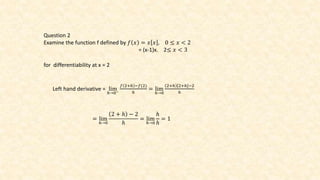
Question 2
Examine the function f defined by 𝑓 𝑥 = 𝑥 𝑥 , 0 ≤ 𝑥 < 2
= (x-1)x. 2≤ 𝑥 < 3
for differentiability at x = 2
Left hand derivative = lim
ℎ→0−
𝑓 2+ℎ −𝑓(2)
ℎ
= lim
ℎ→0
2+ℎ 2+ℎ −2
ℎ
= lim
ℎ→0
2 + ℎ − 2
ℎ
= lim
ℎ→0
ℎ
ℎ
= 1
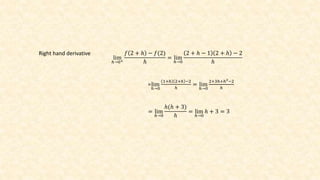
Right hand derivative
lim
ℎ→0+
𝑓 2 + ℎ − 𝑓(2)
ℎ
= lim
ℎ→0
2 + ℎ − 1 2 + ℎ − 2
ℎ
=lim
ℎ→0
1+ℎ 2+ℎ −2
ℎ
= lim
ℎ→0
2+3ℎ+ℎ2−2
ℎ
= lim
ℎ→0
ℎ(ℎ + 3)
ℎ
= lim
ℎ→0
ℎ + 3 = 3
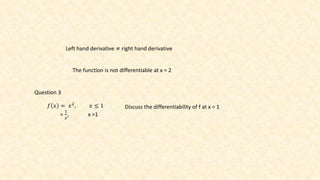
Left hand derivative ≠ right hand derivative
The function is not differentiable at x = 2
Question 3
𝑓 𝑥 = 𝑥2
, 𝑥 ≤ 1
=
1
𝑥
, x >1
Discuss the differentiability of f at x = 1
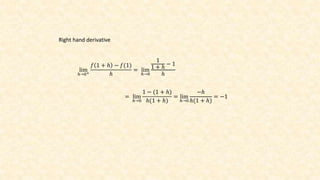
lim
ℎ→0+
𝑓 1 + ℎ − 𝑓(1)
ℎ
= lim
ℎ→0
1
1 + ℎ
− 1
ℎ
Right hand derivative
= lim
ℎ→0
1 − (1 + ℎ)
ℎ(1 + ℎ)
= lim
ℎ→0
−ℎ
ℎ(1 + ℎ)
= −1
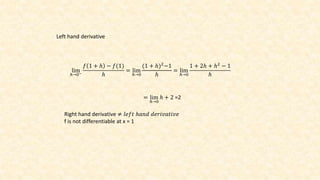
Left hand derivative
lim
ℎ→0−
𝑓 1 + ℎ − 𝑓(1)
ℎ
= lim
ℎ→0
(1 + ℎ)2−1
ℎ
= lim
ℎ→0
1 + 2ℎ + ℎ2 − 1
ℎ
= lim
ℎ→0
ℎ + 2 =2
Right hand derivative ≠ 𝑙𝑒𝑓𝑡 ℎ𝑎𝑛𝑑 𝑑𝑒𝑟𝑖𝑣𝑎𝑡𝑖𝑣𝑒
f is not differentiable at x = 1
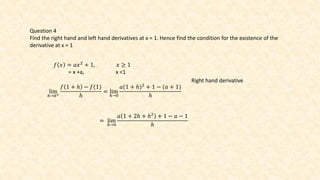
Question 4
Find the right hand and left hand derivatives at x = 1. Hence find the condition for the existence of the
derivative at x = 1
𝑓 𝑥 = 𝑎𝑥2
+ 1, 𝑥 ≥ 1
= x +a, x <1
lim
ℎ→0+
𝑓 1 + ℎ − 𝑓(1)
ℎ
= lim
ℎ→0
𝑎(1 + ℎ)2
+ 1 − (𝑎 + 1)
ℎ
= lim
ℎ→0
𝑎 1 + 2ℎ + ℎ2
+ 1 − 𝑎 − 1
ℎ
Right hand derivative
= lim
ℎ→0
𝑎 + 2𝑎ℎ + 𝑎ℎ2
+ 1 − 𝑎 − 1
ℎ
= lim
ℎ→0
2𝑎 + 𝑎ℎ
=2a
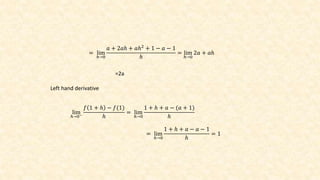
Left hand derivative
lim
ℎ→0−
𝑓 1 + ℎ − 𝑓(1)
ℎ
= lim
ℎ→0
1 + ℎ + 𝑎 − (𝑎 + 1)
ℎ
= lim
ℎ→0
1 + ℎ + 𝑎 − 𝑎 − 1
ℎ
= 1
2𝑎 = 1
Since f is derivable at x = 1
𝑎 =
1
2
**********************************

Differentiation by first principles

  • 1.
  • 2.
    A function fis said to be derivable at x = c, if lim ℎ→0+ 𝑓 𝑐 + ℎ − 𝑓(𝑐) ℎ = lim ℎ→0− 𝑓 𝑐 + ℎ − 𝑓(𝑐) ℎ Right hand derivative Left hand derivative Or lim ℎ→0 𝑓 𝑐 + ℎ − 𝑓(𝑐) ℎ exists and is denoted by 𝑓′ (𝑐)
  • 3.
    Question 1 Discuss thedifferentiability of f(x) = 𝑥 − 5 at x = 5 Right hand derivative = lim ℎ→0+ 𝑓 5+ℎ −𝑓(5) ℎ = = lim ℎ→0+ ℎ ℎ = lim ℎ→0 ℎ ℎ = 1 = lim ℎ→0+ 5 + ℎ − 5 − 5 − 5 ℎ
  • 4.
    Left hand derivative= lim ℎ→0− 𝑓 5+ℎ −𝑓(5) ℎ = lim ℎ→0− 5+ℎ−5 − 5−5 ℎ Since right hand derivative ≠ 𝑙𝑒𝑓𝑡 ℎ𝑎𝑛𝑑 𝑑𝑒𝑟𝑖𝑣𝑎𝑡𝑖𝑣𝑒, 𝑓 𝑖𝑠 𝑛𝑜𝑡 𝑑𝑖𝑓𝑓𝑒𝑟𝑒𝑛𝑡𝑖𝑎𝑏𝑙𝑒 at x = 5 = lim ℎ→0− ℎ ℎ = lim ℎ→0 −ℎ ℎ = −1
  • 5.
    Question 2 Examine thefunction f defined by 𝑓 𝑥 = 𝑥 𝑥 , 0 ≤ 𝑥 < 2 = (x-1)x. 2≤ 𝑥 < 3 for differentiability at x = 2 Left hand derivative = lim ℎ→0− 𝑓 2+ℎ −𝑓(2) ℎ = lim ℎ→0 2+ℎ 2+ℎ −2 ℎ = lim ℎ→0 2 + ℎ − 2 ℎ = lim ℎ→0 ℎ ℎ = 1
  • 6.
    Right hand derivative lim ℎ→0+ 𝑓2 + ℎ − 𝑓(2) ℎ = lim ℎ→0 2 + ℎ − 1 2 + ℎ − 2 ℎ =lim ℎ→0 1+ℎ 2+ℎ −2 ℎ = lim ℎ→0 2+3ℎ+ℎ2−2 ℎ = lim ℎ→0 ℎ(ℎ + 3) ℎ = lim ℎ→0 ℎ + 3 = 3
  • 7.
    Left hand derivative≠ right hand derivative The function is not differentiable at x = 2 Question 3 𝑓 𝑥 = 𝑥2 , 𝑥 ≤ 1 = 1 𝑥 , x >1 Discuss the differentiability of f at x = 1
  • 8.
    lim ℎ→0+ 𝑓 1 +ℎ − 𝑓(1) ℎ = lim ℎ→0 1 1 + ℎ − 1 ℎ Right hand derivative = lim ℎ→0 1 − (1 + ℎ) ℎ(1 + ℎ) = lim ℎ→0 −ℎ ℎ(1 + ℎ) = −1
  • 9.
    Left hand derivative lim ℎ→0− 𝑓1 + ℎ − 𝑓(1) ℎ = lim ℎ→0 (1 + ℎ)2−1 ℎ = lim ℎ→0 1 + 2ℎ + ℎ2 − 1 ℎ = lim ℎ→0 ℎ + 2 =2 Right hand derivative ≠ 𝑙𝑒𝑓𝑡 ℎ𝑎𝑛𝑑 𝑑𝑒𝑟𝑖𝑣𝑎𝑡𝑖𝑣𝑒 f is not differentiable at x = 1
  • 10.
    Question 4 Find theright hand and left hand derivatives at x = 1. Hence find the condition for the existence of the derivative at x = 1 𝑓 𝑥 = 𝑎𝑥2 + 1, 𝑥 ≥ 1 = x +a, x <1 lim ℎ→0+ 𝑓 1 + ℎ − 𝑓(1) ℎ = lim ℎ→0 𝑎(1 + ℎ)2 + 1 − (𝑎 + 1) ℎ = lim ℎ→0 𝑎 1 + 2ℎ + ℎ2 + 1 − 𝑎 − 1 ℎ Right hand derivative
  • 11.
    = lim ℎ→0 𝑎 +2𝑎ℎ + 𝑎ℎ2 + 1 − 𝑎 − 1 ℎ = lim ℎ→0 2𝑎 + 𝑎ℎ =2a Left hand derivative lim ℎ→0− 𝑓 1 + ℎ − 𝑓(1) ℎ = lim ℎ→0 1 + ℎ + 𝑎 − (𝑎 + 1) ℎ = lim ℎ→0 1 + ℎ + 𝑎 − 𝑎 − 1 ℎ = 1
  • 12.
    2𝑎 = 1 Sincef is derivable at x = 1 𝑎 = 1 2 **********************************