
What is
Resume?A resume is a summary of your relevant
education,experiences, skills and accomplishments
relevant to the field of work you are entering.
The resume is a simple, well-organized profile of
your qualifications.
A concise one to two page document that
highlights your most relevant experiences and
skills tailored to each position to which you are
applying
Your Résumé is your Advertisement
Purpose of Resume
The purpose of a resume is a way to get your
“foot in the door”– to get you an interview.
The purpose of a resume is to motivate an
employer to interview you. It should work in unison
with a cover letter to emphasize your strengths
and document your skills.
" Interviews get jobs; Resumes get
interviews"
Resumes are appropriate to submit for most
positionsin fields like business and public service. A
resume must have a clean, concise, organized,
and professional appearance. It should be easy to
scan and key information should stand out. A
resume should be one page - a general rule to follow
is no more than one page for every ten years of
experience.
Maximum number of pages=2
The first resumes
1482 - Leonardo De Vinci writes the first professional
resume
Opens the
Door In the job search, paper
is the great equalizer. Most
employers want to see you
on paper before meeting
you in person.
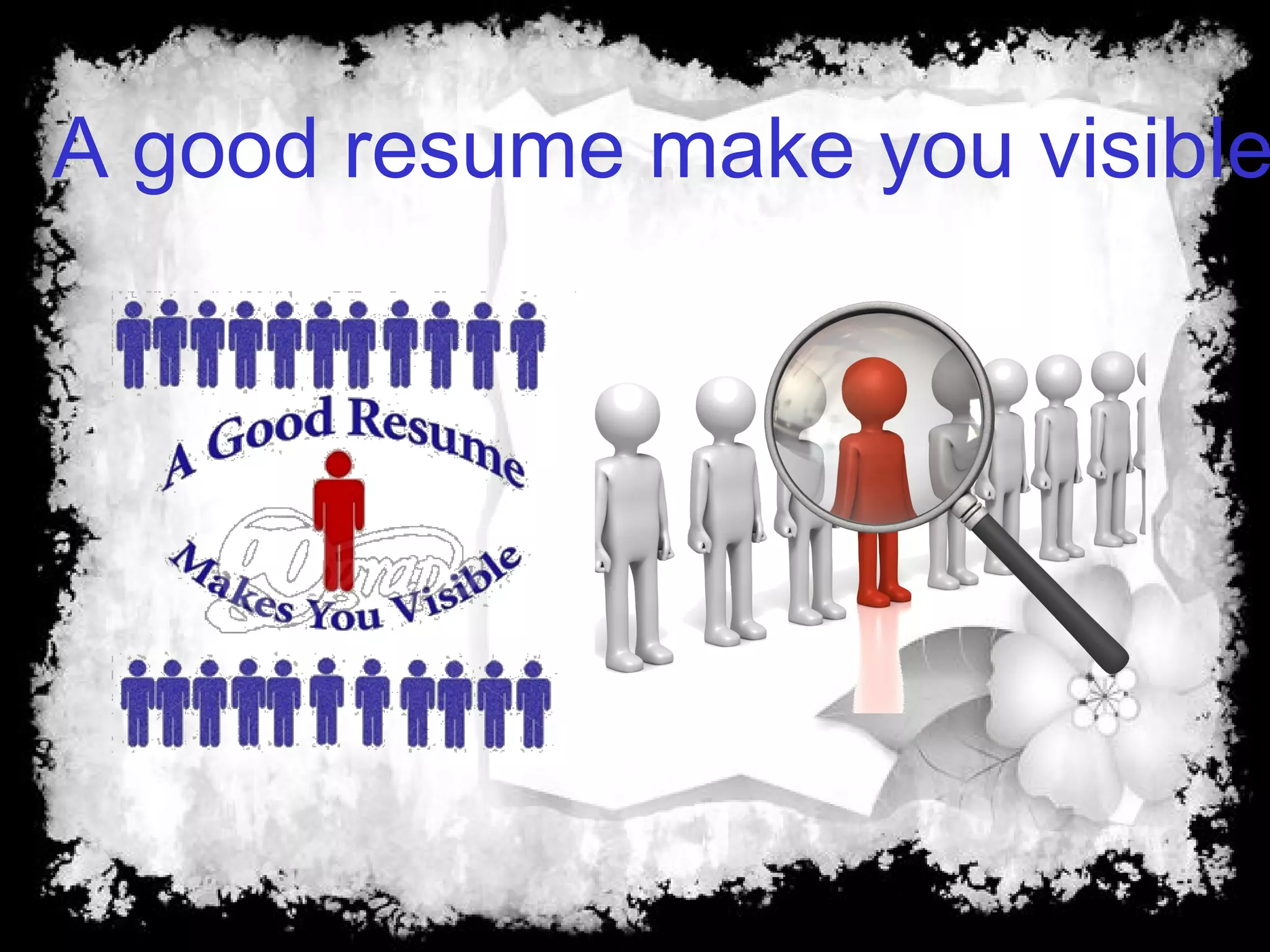
A good resume make you visible
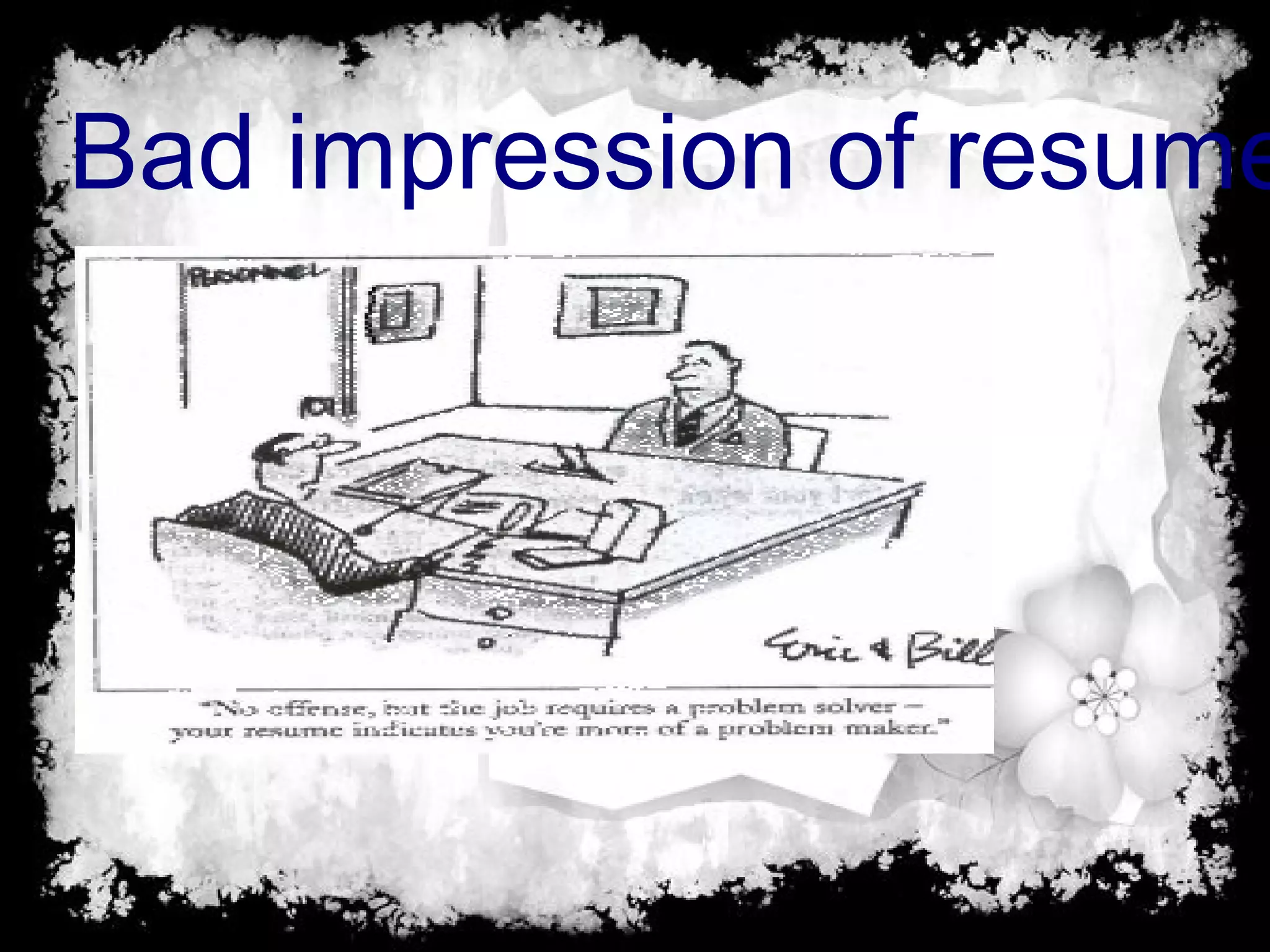
Bad impression of resume
THE 20 SECOND
RULE
The personnel directors of America’s top corporations say
again and again that if you haven’t presented the most
important information about yourself in the top half of the
first page of your resume, you can probably forget about
getting the job.
The head of personnel management for one of the largest
and most prestigious employers in the Washington, D.C.
area told the authors that she allows 20 seconds to scan
each resume she receives. If in that brief time, she does not
see anything that gets her attention,she rejects the resume.
Taken from The 110 Biggest Mistakes Job Hunters Makeby Richard L. Hermann and Linda P. Sutherland
SOME STEPS OF RESUME
DEVELOPMENT
• Analyze the Job Description
• Choose a Format
• Catch your reader's eye.
• Before emailing your resume, try to find out the
employer’s format preference
• Proof reading
• Do not include on a resume:
• religion, race, gender, high school information
(unless applying for an internship and it is
relevant), marital status, height/weight,
birthplace, date of birth, or a photograph
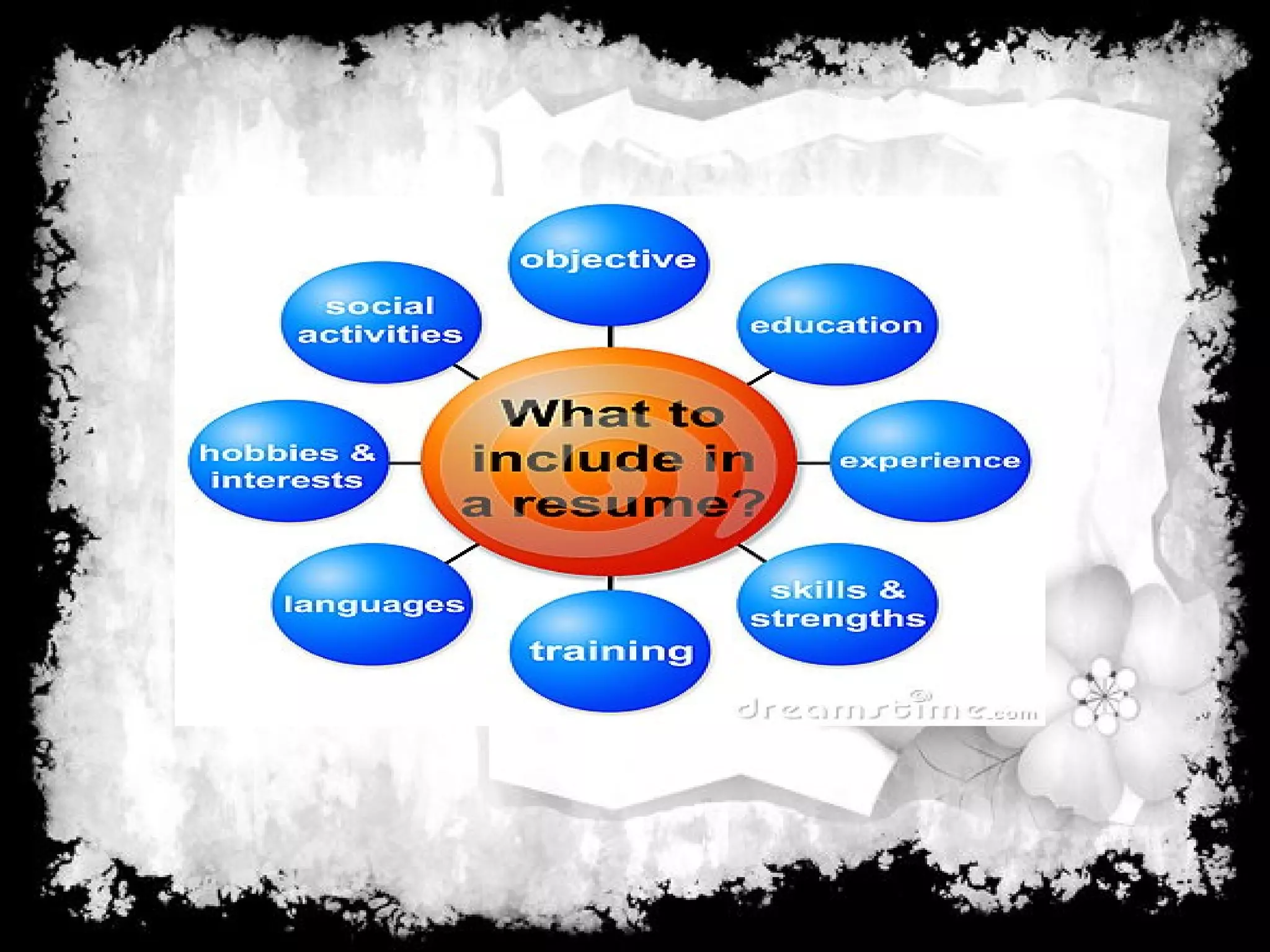
Specific Components of
a Resume
Contact information—What is your name and
how can you be reached?
Objective—What do you want to do?
Experience —What can you do?
Education—What have you learned?
Employment—What have you done?
Every resume needs to include certain
categories of information,as identified in the
other sections of this toolkit.Your resume
should provide answers to these questions:
Contact Information
The header ofyour resume should include
your name,address,phone number,and
email address,if you regularly use it. When
submitting a paper version ofyour
resume,it is visually appealing to use a
large font for your name.Include both a
local and permanent address and a phone
number so that an employer can easily
reach you.This is especially important for
graduating students
Job Objective
Although optional,a job objective statement shows
employers the direction you want to go,your
work preferences,and serves as a focal point for
employers to review and analyze your resume.It
allows employersto immediately identify the kind
ofposition you want.Education
In this section,include any information about your
degree(s),including where and when you
graduated;date(s);major,minor,orconcentration;certif
ication;and academic awards and honors. Make
sure you use the official names for
schools,degrees,and majors/minors
Education???
WHAT
WHERE
WHEN
Employment History
The way you structure the “experience”section will
depend on what you are looking for and what
you have done.This section lists in chronological
order the positions you have held,names and
locations of employers,and dates employed.You
should also list responsibilities, achievements,
significant contributions,and demonstrated
skills.*Stick to the What/Where/When
format
A resume reference is someone who can verify the
information you have provided in your resume and
can provide information about your character. If you
are new to the work force, they can be personal
references: former teacher / professor, acquaintance,
coach, etc.; or if you are using past work references,
they can be former bosses, clients, managers,
supervisors, etc. References are people who you
References
Resume Formats
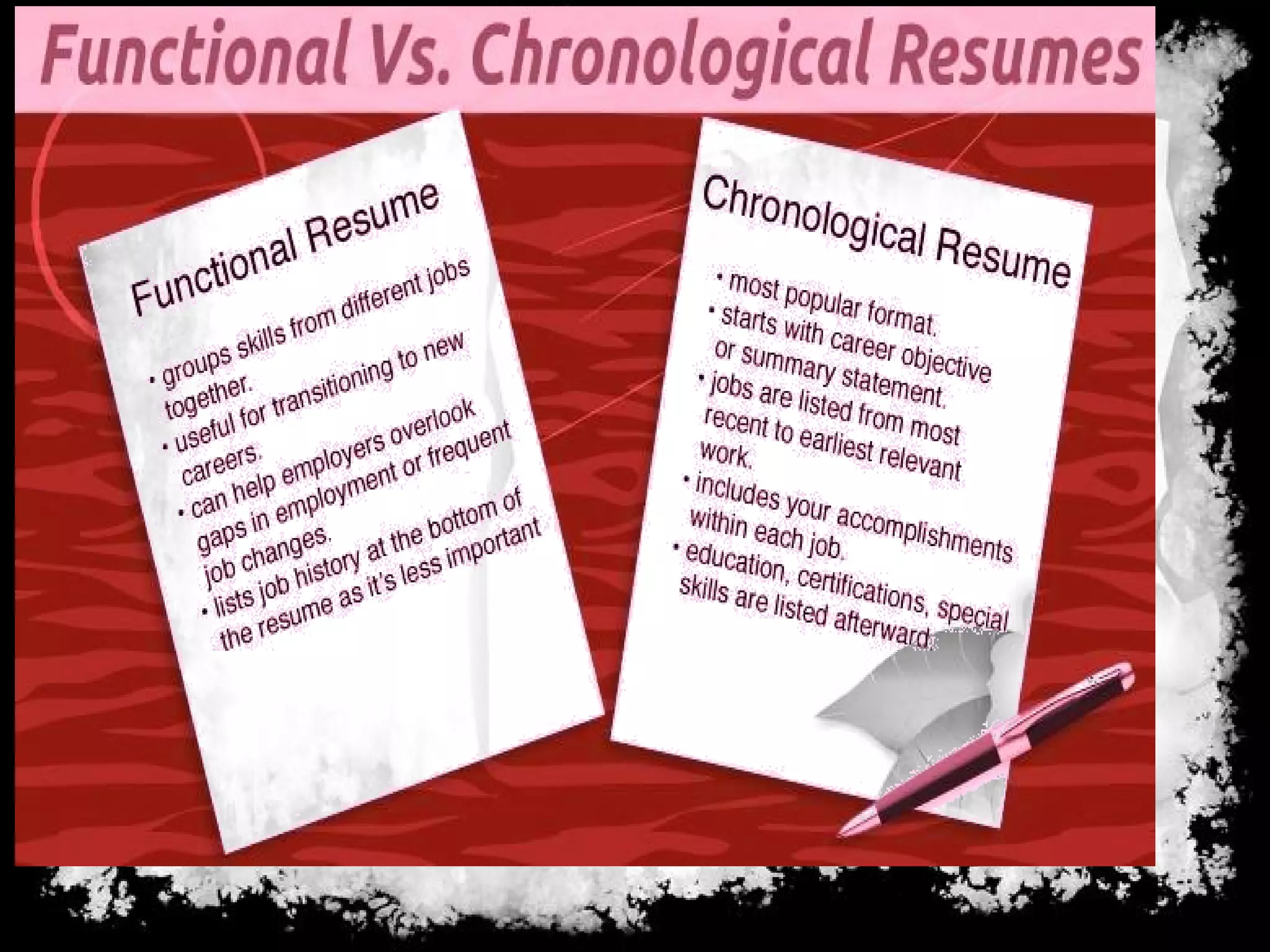
Chronological Format
Functional Format
Combination Format
Resume Formats
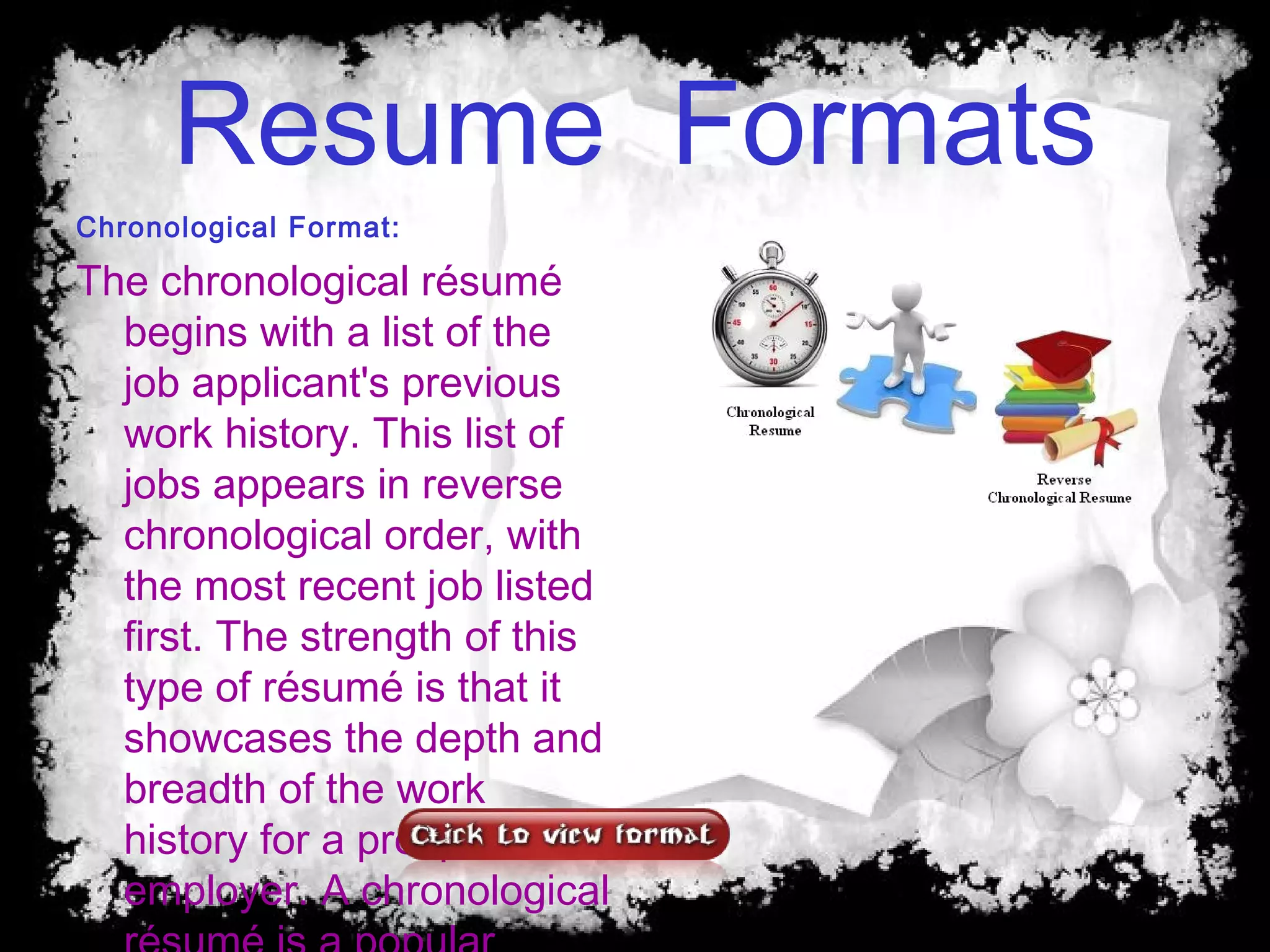
Chronological Format:
The chronological résumé
begins with a list of the
job applicant's previous
work history. This list of
jobs appears in reverse
chronological order, with
the most recent job listed
first. The strength of this
type of résumé is that it
showcases the depth and
breadth of the work
history for a prospective
employer. A chronological
Functional Format
The functional résumé emphasizes particular job skills
and experience rather than job history. The
functional résumé is popular with job seekers who
have gaps in their work history or have a varied
and erratic work history. It is also a good choice for
recent college graduates who may not have much
job experience, and have skills from experiences
other than gainful employment.
Combination
The combination résumé incorporates characteristics of the
chronological and the functional/skills résumé. Generally,
the combination résumé begins with a description of
specific skills and qualifications and then is followed by
employment history, listed in reverse-chronological
order.
ANY
QUESTION
• http://www.livecareer.
com/
• http://www.resume-
now.com/
• www.myperfectresum
e.com/
• http://office.microsoft.
com/en-
us/templates/results.a
spx?
qu=resumes#ai:TC10
3463069|
Make resume oNLINe
noW Mr.KASHIF will
procEED FURTHER

What is Resume ,purpose and objective of resume and type of resume

  • 2.
    What is Resume?A resumeis a summary of your relevant education,experiences, skills and accomplishments relevant to the field of work you are entering. The resume is a simple, well-organized profile of your qualifications. A concise one to two page document that highlights your most relevant experiences and skills tailored to each position to which you are applying Your Résumé is your Advertisement
  • 3.
    Purpose of Resume Thepurpose of a resume is a way to get your “foot in the door”– to get you an interview. The purpose of a resume is to motivate an employer to interview you. It should work in unison with a cover letter to emphasize your strengths and document your skills. " Interviews get jobs; Resumes get interviews"
  • 4.
    Resumes are appropriateto submit for most positionsin fields like business and public service. A resume must have a clean, concise, organized, and professional appearance. It should be easy to scan and key information should stand out. A resume should be one page - a general rule to follow is no more than one page for every ten years of experience. Maximum number of pages=2 The first resumes 1482 - Leonardo De Vinci writes the first professional resume
  • 5.
    Opens the Door Inthe job search, paper is the great equalizer. Most employers want to see you on paper before meeting you in person.
  • 6.
    A good resumemake you visible
  • 7.
  • 8.
    THE 20 SECOND RULE Thepersonnel directors of America’s top corporations say again and again that if you haven’t presented the most important information about yourself in the top half of the first page of your resume, you can probably forget about getting the job. The head of personnel management for one of the largest and most prestigious employers in the Washington, D.C. area told the authors that she allows 20 seconds to scan each resume she receives. If in that brief time, she does not see anything that gets her attention,she rejects the resume. Taken from The 110 Biggest Mistakes Job Hunters Makeby Richard L. Hermann and Linda P. Sutherland
  • 9.
    SOME STEPS OFRESUME DEVELOPMENT • Analyze the Job Description • Choose a Format • Catch your reader's eye. • Before emailing your resume, try to find out the employer’s format preference • Proof reading • Do not include on a resume: • religion, race, gender, high school information (unless applying for an internship and it is relevant), marital status, height/weight, birthplace, date of birth, or a photograph
  • 10.
    Specific Components of aResume Contact information—What is your name and how can you be reached? Objective—What do you want to do? Experience —What can you do? Education—What have you learned? Employment—What have you done? Every resume needs to include certain categories of information,as identified in the other sections of this toolkit.Your resume should provide answers to these questions:
  • 12.
    Contact Information The headerofyour resume should include your name,address,phone number,and email address,if you regularly use it. When submitting a paper version ofyour resume,it is visually appealing to use a large font for your name.Include both a local and permanent address and a phone number so that an employer can easily reach you.This is especially important for graduating students
  • 13.
    Job Objective Although optional,ajob objective statement shows employers the direction you want to go,your work preferences,and serves as a focal point for employers to review and analyze your resume.It allows employersto immediately identify the kind ofposition you want.Education In this section,include any information about your degree(s),including where and when you graduated;date(s);major,minor,orconcentration;certif ication;and academic awards and honors. Make sure you use the official names for schools,degrees,and majors/minors
  • 14.
  • 15.
    Employment History The wayyou structure the “experience”section will depend on what you are looking for and what you have done.This section lists in chronological order the positions you have held,names and locations of employers,and dates employed.You should also list responsibilities, achievements, significant contributions,and demonstrated skills.*Stick to the What/Where/When format A resume reference is someone who can verify the information you have provided in your resume and can provide information about your character. If you are new to the work force, they can be personal references: former teacher / professor, acquaintance, coach, etc.; or if you are using past work references, they can be former bosses, clients, managers, supervisors, etc. References are people who you References
  • 16.
  • 17.
    Resume Formats Chronological Format: Thechronological résumé begins with a list of the job applicant's previous work history. This list of jobs appears in reverse chronological order, with the most recent job listed first. The strength of this type of résumé is that it showcases the depth and breadth of the work history for a prospective employer. A chronological
  • 18.
    Functional Format The functionalrésumé emphasizes particular job skills and experience rather than job history. The functional résumé is popular with job seekers who have gaps in their work history or have a varied and erratic work history. It is also a good choice for recent college graduates who may not have much job experience, and have skills from experiences other than gainful employment.
  • 19.
    Combination The combination résuméincorporates characteristics of the chronological and the functional/skills résumé. Generally, the combination résumé begins with a description of specific skills and qualifications and then is followed by employment history, listed in reverse-chronological order.
  • 21.
  • 22.
    • http://www.livecareer. com/ • http://www.resume- now.com/ •www.myperfectresum e.com/ • http://office.microsoft. com/en- us/templates/results.a spx? qu=resumes#ai:TC10 3463069| Make resume oNLINe
  • 23.