Computer Vesion
Presentation On
Computer Vision
by
Adil Mehmood
adillm717@gmail.com
What is computer vesion
Definition:
The goal of computer vesion is to make useful decisions about real physical objects
and scenes based on sensed images.Or
Computer vision is a subfield of artificial intelligence where information is obtained
through the characteristics of images captured by industrial cameras. Below, there are
some of the techniques and applications performed at ITMA.
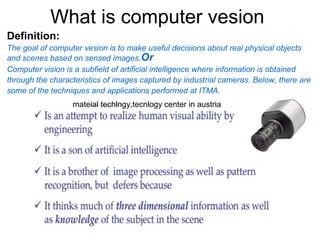
mateial techlngy,tecnlogy center in austria
 Computer vision (image understanding) is a discipline that studies
how to reconstruct, interpret and understand a 3D scene from its 2D
images in terms of the properties of the structures present in the scene.
 The ultimate goal of computer vision is to model and replicate human
vision
 using computer software and hardware at diferent levels.
 It combines knowledge in computer science,electrical engineering,
mathematics, physiology, biology, and cognitive science.
 It needs knowledge from all these fields in order to understand and
simulate the operation of the human vision system.
 that focuses on extracting useful information from images and videos.
Examples of "useful information" include detecting the presence and
identify of human faces in a photograph, recovering the 3D geometry of
the objects in a photograph, and tracking and recognizing different
types of motion in a video sequence.
 Computer vision algorithms have found a wide range of applications
from 3D laser scanning systems used in manufacturing, city planning,
entertainment, forensics, etc
Computer vision overlaps significantly with the following fields:
Image processing.
 Image processing focuses on image manipulation to enhance image
 quality,
 to restore an image or to compress/decompress an image.
 Most computer vision algorithms usually assumes a significant
 amount of image processing has taken place to improve image
 quality.
pattern recognition,
 Pattern recognition studies various techniques such as
 statistical techniques,
 neural network,
 support vector machine, etc
 to recognize/classify di erent patterns. Pattern recognition techniquesff
 are widely used in computer vision.
photogrammetry.
 Photogrammetry is concerned with obtaining accurate and reliable
 measurements from images.
 It focuses on accurate mensuration.
 Camera calibration and 3D reconstruction are two areas of interest to
 both.
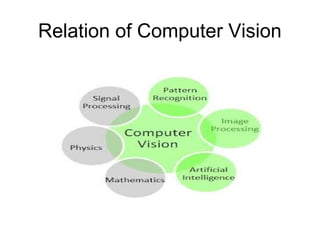
Relation of Computer Vision
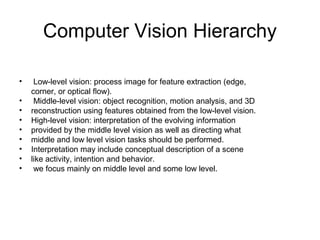
Computer Vision Hierarchy
• Low-level vision: process image for feature extraction (edge,
corner, or optical flow).
• Middle-level vision: object recognition, motion analysis, and 3D
• reconstruction using features obtained from the low-level vision.
• High-level vision: interpretation of the evolving information
• provided by the middle level vision as well as directing what
• middle and low level vision tasks should be performed.
• Interpretation may include conceptual description of a scene
• like activity, intention and behavior.
• we focus mainly on middle level and some low level.
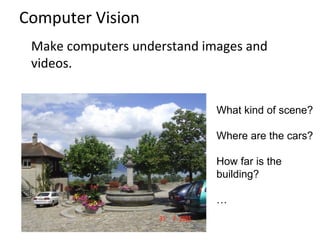
Computer Vision
Make computers understand images and
videos.
What kind of scene?
Where are the cars?
How far is the
building?
…
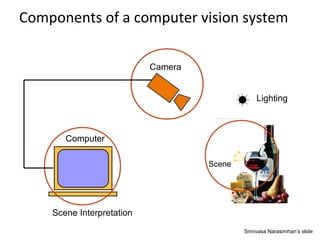
Components of a computer vision system
Lighting
Scene
Camera
Computer
Scene Interpretation
Srinivasa Narasimhan’s slide
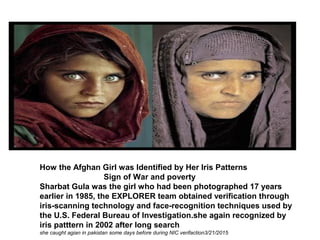
How the Afghan Girl was Identified by Her Iris Patterns
Sign of War and poverty
Sharbat Gula was the girl who had been photographed 17 years
earlier in 1985, the EXPLORER team obtained verification through
iris-scanning technology and face-recognition techniques used by
the U.S. Federal Bureau of Investigation.she again recognized by
iris patttern in 2002 after long search
she caught agian in pakistan some days before during NIC verifaction3/21/2015
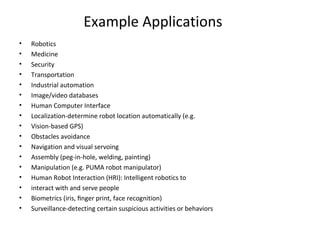
Example Applications
• Robotics
• Medicine
• Security
• Transportation
• Industrial automation
• Image/video databases
• Human Computer Interface
• Localization-determine robot location automatically (e.g.
• Vision-based GPS)
• Obstacles avoidance
• Navigation and visual servoing
• Assembly (peg-in-hole, welding, painting)
• Manipulation (e.g. PUMA robot manipulator)
• Human Robot Interaction (HRI): Intelligent robotics to
• interact with and serve people
• Biometrics (iris, finger print, face recognition)
• Surveillance-detecting certain suspicious activities or behaviors
References
• http://www.cns.nyu.edu/eero/vision-links.html
• http://www.cs.berkeley.edu/daf/book.html
• http://www.visionbib.com
• http://www.cs.virginia.edu/~gfx/Courses/2011/C
omputerVision/

Computer vesion

  • 1.
  • 2.
    Presentation On Computer Vision by AdilMehmood adillm717@gmail.com
  • 3.
    What is computervesion Definition: The goal of computer vesion is to make useful decisions about real physical objects and scenes based on sensed images.Or Computer vision is a subfield of artificial intelligence where information is obtained through the characteristics of images captured by industrial cameras. Below, there are some of the techniques and applications performed at ITMA. mateial techlngy,tecnlogy center in austria
  • 4.
     Computer vision(image understanding) is a discipline that studies how to reconstruct, interpret and understand a 3D scene from its 2D images in terms of the properties of the structures present in the scene.  The ultimate goal of computer vision is to model and replicate human vision  using computer software and hardware at diferent levels.  It combines knowledge in computer science,electrical engineering, mathematics, physiology, biology, and cognitive science.  It needs knowledge from all these fields in order to understand and simulate the operation of the human vision system.  that focuses on extracting useful information from images and videos. Examples of "useful information" include detecting the presence and identify of human faces in a photograph, recovering the 3D geometry of the objects in a photograph, and tracking and recognizing different types of motion in a video sequence.  Computer vision algorithms have found a wide range of applications from 3D laser scanning systems used in manufacturing, city planning, entertainment, forensics, etc
  • 5.
    Computer vision overlapssignificantly with the following fields: Image processing.  Image processing focuses on image manipulation to enhance image  quality,  to restore an image or to compress/decompress an image.  Most computer vision algorithms usually assumes a significant  amount of image processing has taken place to improve image  quality. pattern recognition,  Pattern recognition studies various techniques such as  statistical techniques,  neural network,  support vector machine, etc  to recognize/classify di erent patterns. Pattern recognition techniquesff  are widely used in computer vision. photogrammetry.  Photogrammetry is concerned with obtaining accurate and reliable  measurements from images.  It focuses on accurate mensuration.  Camera calibration and 3D reconstruction are two areas of interest to  both.
  • 6.
  • 7.
    Computer Vision Hierarchy •Low-level vision: process image for feature extraction (edge, corner, or optical flow). • Middle-level vision: object recognition, motion analysis, and 3D • reconstruction using features obtained from the low-level vision. • High-level vision: interpretation of the evolving information • provided by the middle level vision as well as directing what • middle and low level vision tasks should be performed. • Interpretation may include conceptual description of a scene • like activity, intention and behavior. • we focus mainly on middle level and some low level.
  • 8.
    Computer Vision Make computersunderstand images and videos. What kind of scene? Where are the cars? How far is the building? …
  • 9.
    Components of acomputer vision system Lighting Scene Camera Computer Scene Interpretation Srinivasa Narasimhan’s slide
  • 10.
    How the AfghanGirl was Identified by Her Iris Patterns Sign of War and poverty Sharbat Gula was the girl who had been photographed 17 years earlier in 1985, the EXPLORER team obtained verification through iris-scanning technology and face-recognition techniques used by the U.S. Federal Bureau of Investigation.she again recognized by iris patttern in 2002 after long search she caught agian in pakistan some days before during NIC verifaction3/21/2015
  • 11.
    Example Applications • Robotics •Medicine • Security • Transportation • Industrial automation • Image/video databases • Human Computer Interface • Localization-determine robot location automatically (e.g. • Vision-based GPS) • Obstacles avoidance • Navigation and visual servoing • Assembly (peg-in-hole, welding, painting) • Manipulation (e.g. PUMA robot manipulator) • Human Robot Interaction (HRI): Intelligent robotics to • interact with and serve people • Biometrics (iris, finger print, face recognition) • Surveillance-detecting certain suspicious activities or behaviors
  • 12.
    References • http://www.cns.nyu.edu/eero/vision-links.html • http://www.cs.berkeley.edu/daf/book.html •http://www.visionbib.com • http://www.cs.virginia.edu/~gfx/Courses/2011/C omputerVision/