Department of ComputerScience & Engineering
Unit -3 Network Layer
Prepared By:
Anju Bala
Assistant Professor
CSE
2.
Department of ComputerScience & Engineering
Network Layer
Switching, Logical addressing –
IPV4, IPV6, Address mapping – ARP,
RARP, BOOTP and DHCP–Delivery,
Forwarding and Unicast Routing
protocols.
3.
Department of ComputerScience & Engineering
Switching
In large networks, there can be multiple paths
from sender to receiver.
The switching technique will decide the best
route for data transmission.
Switching technique is used to connect the
systems for making one-to-one communication.
Department of ComputerScience & Engineering
Circuit Switching
Circuit switching is a switching technique that establishes a dedicated
path between
sender and receiver.
In the Circuit Switching Technique, once the connection is established
then the
dedicated path will remain to exist until the connection is terminated.
Circuit switching in a network operates in a similar way as the
telephone works.
A complete end-to-end path must exist before the communication
takes place.
6.
Department of ComputerScience & Engineering
Circuit Switching
In case of circuit switching technique, when any user wants to send
the data, voice,
video, a request signal is sent to the receiver then the receiver sends
back the
acknowledgment to ensure the availability of the dedicated path.
After receiving the
acknowledgment, dedicated path transfers the data.
Circuit switching is used in public telephone network. It is used for
voice transmission.
Fixed data can be transferred at a time in circuit switching
technology.
7.
Department of ComputerScience & Engineering
Circuit Switching
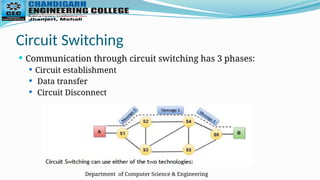
Communication through circuit switching has 3 phases:
Circuit establishment
Data transfer
Circuit Disconnect
8.
Department of ComputerScience & Engineering
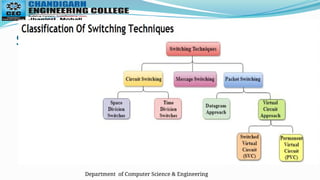
Space Division Switches:
Space Division Switching is a circuit switching technology in
which a single transmission path is accomplished in a switch
by using a physically separate set of crosspoints.
Space Division Switching can be achieved by using crossbar
switch. A crossbar switch is a metallic crosspoint or
semiconductor gate that can be enabled or disabled by a
control unit.
The Crossbar switch is made by using the semiconductor. For
example, Xilinx crossbar switch using FPGAs.
9.
Department of ComputerScience & Engineering
Space Division Switches:
Space Division Switching has high speed, high capacity, and nonblocking
switches.
Space Division Switches can be categorized in two ways:
Crossbar Switch
Multistage Switch
Crossbar Switch
The Crossbar switch is a switch that has n input lines and n output lines. The crossbar
Disadvantage of Crossbar switch:
The number of crosspoints increases as the number of stations is increased. Therefore, it
becomes very expensive for a large switch. The solution to this is to use a multistage
switch.
10.
Department of ComputerScience & Engineering
Space Division Switches:
Multistage Switch
•
Multistage Switch is made by splitting the crossbar switch
into the smaller units and then interconnecting them.
• It reduces the number of crosspoints.
• If one path fails, then there will be an availability of
another path.
Advantages Of Circuit Switching:
In the case of Circuit Switching technique, the communication channel
is dedicated.
It has fixed bandwidth.
11.
Department of ComputerScience & Engineering
Space Division Switches:
Disadvantages Of Circuit Switching:
Once the dedicated path is established, the only delay occurs in the speed of data
transmission.
It takes a long time to establish a connection approx 10 seconds during which no data
can be transmitted.
It is more expensive than other switching techniques as a dedicated path is required for
each connection.
It is inefficient to use because once the path is established and no data is transferred,
then the capacity of the path is wasted.
In this case, the connection is dedicated therefore no other data can be transferred
even if the channel is free.
In the case of Circuit Switching technique, the communication channel is dedicated.
It has fixed bandwidth.
12.
Department of ComputerScience & Engineering
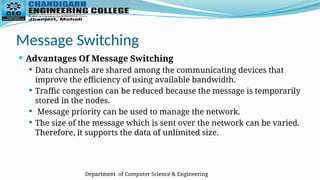
Message Switching
Message Switching is a switching technique in which a message is transferred as a
complete unit and routed through intermediate nodes at which it is stored and
forwarded.
In Message Switching technique, there is no establishment of a dedicated path
between the sender and receiver.
The destination address is appended to the message. Message Switching provides a
dynamic routing as the message is routed through the intermediate nodes based on
the
information available in the message.
Message switches are programmed in such a way so that they can provide the most
efficient routes.
Each and every node stores the entire message and then forward it to the next node.
This type of network is known as store and forward network.
Department of ComputerScience & Engineering
Message Switching
Advantages Of Message Switching
Data channels are shared among the communicating devices that
improve the efficiency of using available bandwidth.
Traffic congestion can be reduced because the message is temporarily
stored in the nodes.
Message priority can be used to manage the network.
The size of the message which is sent over the network can be varied.
Therefore, it supports the data of unlimited size.
15.
Department of ComputerScience & Engineering
Message Switching
Disadvantages Of Message Switching
The message switches must be equipped with
sufficient storage to enable them to store the
messages until the message is forwarded.
The Long delay can occur due to the storing and
forwarding facility provided by the message
switching technique.
16.
Department of ComputerScience & Engineering
Packet Switching
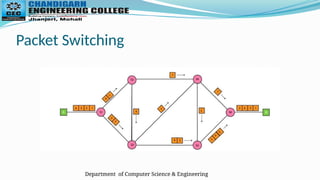
The packet switching is a switching technique in which the
message is sent in one go, but it is divided into smaller pieces, and
they are sent individually.
The message splits into smaller pieces known as packets and
packets are given a unique number to identify their order at the
receiving end.
Every packet contains some information in its headers such as
source address, destination address and sequence number.
Packets will travel across the network, taking the shortest path as
possible.
17.
Department of ComputerScience & Engineering
Packet Switching
If any packet is missing or corrupted, then the message will be
sent to resend the message.
If the correct order of the packets is reached, then the
acknowledgment message will be sent.
Department of ComputerScience & Engineering
Packet Switching
Approaches Of Packet Switching:
There are two approaches to Packet Switching:
Datagram Packet switching:
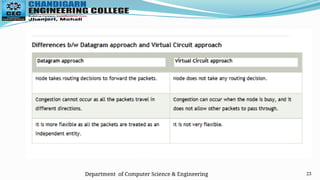
It is a packet switching technology in which packet is known as a datagram, is
considered as an independent entity. Each packet contains the information
about the destination and switch uses this information to forward the packet
to the correct destination.
The packets are reassembled at the receiving end in correct order.
In Datagram Packet Switching technique, the path is not fixed.
Intermediate nodes take the routing decisions to forward the packets.
Datagram Packet Switching is also known as connectionless switching.
20.
Department of ComputerScience & Engineering
Packet Switching
Approaches Of Packet Switching:
Virtual Circuit Switching :
Virtual Circuit Switching is also known as connection-oriented
switching
In the case of Virtual circuit switching, a preplanned route is
established before the messages are sent.
Call request and call accept packets are used to establish the
connection between sender and receiver.
In this case, the path is fixed for the duration of a logical connection.
Department of ComputerScience & Engineering
Packet Switching
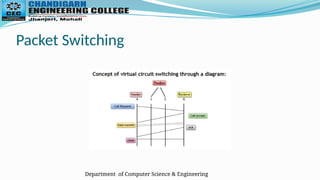
In the above diagram, A and B are the sender and receiver
respectively. 1 and 2 are the nodes.
Call request and call accept packets are used to establish a
connection between the sender and receiver.
When a route is established, data will be transferred.
After transmission of data, an acknowledgment signal is sent by
the receiver that the message has been received.
If the user wants to terminate the connection, a clear signal is sent
for the
termination.