












SYSTEM
INTERCONNECT
ARCHITECTURE
ADVANCED COMPUTER ARCHITECTURE
SEMINAR
- S. GAGAN KUMAR
SYSTEM INTERCONNECT
ARCHITECTURE
• Networks are used to interconnect computer sub-systems
to construct multiprocessors or multicomputer.
• These networks are used to provide internal connections
among processors, memory modules and I/O ports in a
computing sub-system.
• Various generalised topologies are used for building these
networks for efficient communication to give best parallel
computing performance.
1. Functionality : Data routing, Interrupt Handling, Synchronization,
Requests, etc.
2. Network Latency : Worst-case time delay for a unit message
transfer.
3. Bandwidth : Maximum data transfer rate.
4. Hardware Complexity : Implementation Cost for wires, switches,
connectors, etc.
5. Scalability : Ability to expand with increase in resources.
Factors affecting the network
performance :
TYPES OF CONNECTION NETWORKS
1. Static Connection Network
2. Dynamic Connection Network
STATIC CONNECTION NETWORK
1. LINEAR ARRAY
10 11
121315 14
0 1 2 3
67
8 9
5 4
Node Degree= 2
Diameter = 15
STATIC CONNECTION NETWORK
2. Ring
6
7
8
2
3
4
5
9
0
1
10
11
12
13
15
14
Node Degree = 2
Diameter = N/2 = 8
STATIC CONNECTION NETWORK
3. Chordal Ring
6
7
8
2
3
4
5
9
0
1
10
11
12
13
15
14
Node Degree= 3
Diameter = 5
STATIC CONNECTION NETWORK
3. Chordal Ring
6
7
8
2
3
4
5
9
0
1
10
11
12
13
15
14
Node Degree= 4
Diameter = 3
STATIC CONNECTION NETWORK
4. Barrel Shifter Ring
6
7
8
2
3
4
5
9
0
1
10
11
12
13
15
14
Node Degree= 7
Diameter = 2
STATIC CONNECTION NETWORK
5. Completely Connected
Node Degree= 15
Diameter = 1
6
7
8
2
3
4
5
9
0
1
10
11
12
13
15
14
STATIC CONNECTION NETWORK
6. Trees
1
3 4
7 10
0
98
2
5 6
11 141312
STATIC CONNECTION NETWORK
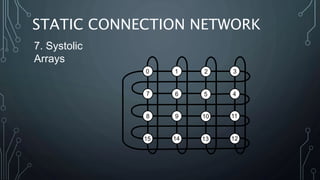
7. Systolic
Arrays
10 11
121315 14
0 1 2 3
67
8 9
5 4
THANK YOU

System interconnect architecture