Hello!
I am Tahrimur Rahman
My
Roll: 12102907
Session: 2011-12
3rd year 2nd semester
Dept. of Electronics and Communication Engineering
J.K.K.N.I.U.
Peripheral Interfacing
Outline:
My process is easy & simple
What?
A intruduction
Why?
Necessary
How?
Mechanism
What?
Peripheral
It means various components or devices
those are connected to CPU. Actually these
are input output devices. Thus, it sometimes
calls as I/O devices.
Interface
An interface is a concept that refers to a point of
interaction between objects or components and
is applicable at the level of both hardware and
software.
Thus PHERIPHERAL INTERFACING is a kind of interaction between processor and external or
peripheral devices.
To interface physically, a component or mediator between I/O device and processor is used which is
called I/O module.
“
Now a question may arise. Can’t we connect /
interface directly the I/O devices to processor ?
No!
◇ I/O devices are most of case usually electrical/ mechanical/ electronic
devices where processor is an electronic device. Also the data
transfer rates of I/O are often slower than the processor and
memory. So it is significant that the speed and electrical
characteristics of I/O are different from CPU.
◇ There are a variety of peripherals that exist and may need to be
connected to the same system bus. But it may be difficult to
incorporate all the peripheral device logic into CPU. This reduces
flexibility and creates hinderance in new developments.
◇ Peripheral often use different data formats and word lengths that
used by the CPU
Incorporation of I/O module helps to overcome these problems.
Why?
There are several reasons which lead to use I/O module:
Thus, we can say that
First
An I/O module is a mediator
between the processor and an I/O
device/devices.
Second
It controls the data exchange
between the external devices and
main memory; or external devices
and CPU registers.
Fourth
The I/O module should not only
communicate the information
from CPU to I/O device, but it
should also coordinate these two.
Fifth
In addition since there are speed differences between CPU and I/O
devices, the I/O module should have facilities like buffer (storage
area) and error detection mechanism.
Third
An I/O module provide an
interface internal to the computer
which connects it to CPU and
main memory and an interface
external to the computer
connecting it to external device or
peripheral.
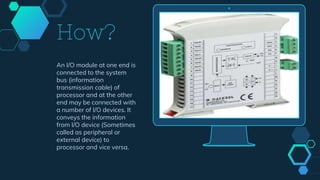
How?
An I/O module at one end is
connected to the system
bus (information
transmission cable) of
processor and at the other
end may be connected with
a number of I/O devices. It
conveys the information
from I/O device (Sometimes
called as peripheral or
external device) to
processor and vice versa.
A simplified block diagram of I/O module
An I/O module is not simply a set of mechanical
connectors that wire a device into the system bus.
Rather, the I/O module contains logic for
performing a communication function between the
peripheral and the bus.
Working functions:
1. CPU checks I/O module device status
2. I/O module returns status
3. If ready, CPU requests data transfer
4. I/O module gets data from device
5. I/O module transfers data to CPU
“
Same processor
Various flexible structures of I/O devices
New Era
Thanks!
Any questions?
You can find me at:
◇ www.facebook.com/tahrimur-rahman
◇ tahrimurrahman@gmail.com

peripheral interfacing

  • 1.
    Hello! I am TahrimurRahman My Roll: 12102907 Session: 2011-12 3rd year 2nd semester Dept. of Electronics and Communication Engineering J.K.K.N.I.U.
  • 2.
  • 3.
    Outline: My process iseasy & simple What? A intruduction Why? Necessary How? Mechanism
  • 4.
    What? Peripheral It means variouscomponents or devices those are connected to CPU. Actually these are input output devices. Thus, it sometimes calls as I/O devices. Interface An interface is a concept that refers to a point of interaction between objects or components and is applicable at the level of both hardware and software. Thus PHERIPHERAL INTERFACING is a kind of interaction between processor and external or peripheral devices. To interface physically, a component or mediator between I/O device and processor is used which is called I/O module.
  • 5.
    “ Now a questionmay arise. Can’t we connect / interface directly the I/O devices to processor ? No!
  • 6.
    ◇ I/O devicesare most of case usually electrical/ mechanical/ electronic devices where processor is an electronic device. Also the data transfer rates of I/O are often slower than the processor and memory. So it is significant that the speed and electrical characteristics of I/O are different from CPU. ◇ There are a variety of peripherals that exist and may need to be connected to the same system bus. But it may be difficult to incorporate all the peripheral device logic into CPU. This reduces flexibility and creates hinderance in new developments. ◇ Peripheral often use different data formats and word lengths that used by the CPU Incorporation of I/O module helps to overcome these problems. Why? There are several reasons which lead to use I/O module:
  • 7.
    Thus, we cansay that First An I/O module is a mediator between the processor and an I/O device/devices. Second It controls the data exchange between the external devices and main memory; or external devices and CPU registers. Fourth The I/O module should not only communicate the information from CPU to I/O device, but it should also coordinate these two. Fifth In addition since there are speed differences between CPU and I/O devices, the I/O module should have facilities like buffer (storage area) and error detection mechanism. Third An I/O module provide an interface internal to the computer which connects it to CPU and main memory and an interface external to the computer connecting it to external device or peripheral.
  • 8.
    How? An I/O moduleat one end is connected to the system bus (information transmission cable) of processor and at the other end may be connected with a number of I/O devices. It conveys the information from I/O device (Sometimes called as peripheral or external device) to processor and vice versa.
  • 9.
    A simplified blockdiagram of I/O module An I/O module is not simply a set of mechanical connectors that wire a device into the system bus. Rather, the I/O module contains logic for performing a communication function between the peripheral and the bus. Working functions: 1. CPU checks I/O module device status 2. I/O module returns status 3. If ready, CPU requests data transfer 4. I/O module gets data from device 5. I/O module transfers data to CPU
  • 10.
    “ Same processor Various flexiblestructures of I/O devices New Era
  • 11.
    Thanks! Any questions? You canfind me at: ◇ www.facebook.com/tahrimur-rahman ◇ tahrimurrahman@gmail.com