MULTIPLE INTELLIGENCE GROUP MEMBERS NOR SALWA MARLIZA NOR AZILA HAZILAH AINI
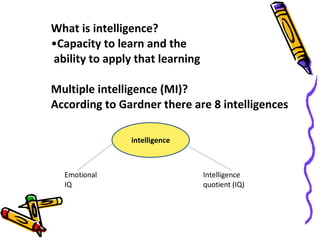
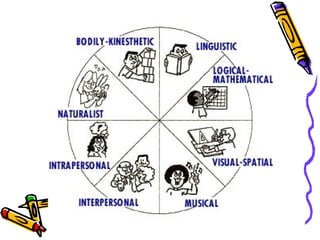
What is intelligence? Capacity to learn and the ability to apply that learning Multiple intelligence (MI)? According to Gardner there are 8 intelligences intelligence Emotional IQ Intelligence quotient (IQ)
 
WRONG CONCEPT ABOUT INTELLIGENCE Intelligence is fixed Each individual has only one type of intelligence
WHAT IS THE MULTIPLE INTELLIGENCE THEORY? Each individual has at least eight intelligence at different developmental levels The different intelligence function together in a complex manner Intelligences can be developed and changes throughout life
HOW TO IDENTIFY INTELLIGENCES OF PUPILS Observation of pupils when studying Activities pupils like to do during free time Achievement records and reports Intelligence profiles of pupils
Implications in educations Help student to obtain skills for new millennium Helps teacher understand influences on students intelligence Set up school that accept and appreciate the different intelligences among students
Linguistic intelligence Capability and ability of human beings to use basic language operations clearly and systematically Natural ability of pupils in acquiring, forming and processing language Example : Leading an oral discussion Writing poem, story,letter Keeping a journal/diary Like to give opinions
Pupils who have this intelligence : - have the capacity to think logically  and recognize geometric and numerical numbers easily. - also refer to ability of pupils to apply inductive and deductive reasoning as well as to abstract problems. - can easily solve problems that involve numbers. LOGICAL MATHEMATICAL INTELLIGENCE
- like to find evidence for something that is unclear and like question about all the kinds of phenomena. - they can do mental mathematics and solve estimation questions easily. - like to use computers, calculators and calculating tools. - possible occupation: scientist and mathematician.
APPLICATION IN T & L - to increase the sensitivity and ability to discern numerical pattern as well as to handle long chains of reasoning, pupils should be taught with discovery method and use rational and creative thinking to solve mathematical problems.
VISUAL-SPATIAL - ability to create mental pictures and observe the world visually - awareness of colour, line, shape and space - ability to visualize graphically, spatially and orientate oneself in a space matrix.
Kinesthetic intelligence Capability t o control and interpret their body movements and objects their environment Like to keep their physical and mental harmony in balance. Like to play sport, cannot sit still in one place for a long time Like to taking parts in sports Have high handicraft skills
RYTHMIC OR MUSICAL  INTELLIGENCE Pupils who have this intelligence: - have the ability to create  or interpret music. - have the ability to play musical instruments and have capability to utilize the basic elements of music. - very sensitive to rhythm, tones and the power of emotional music.
- in the school context, pupils can memorize musical lyrics easily. - like to engage themselves in learning situations that are accompanied by music . - possible occupation : composer and violinist.
APPLICATION IN T & L - to develop potential so as to produce and appreciate rhythm, pitch and timbre as well as to forms musical expressiveness, teachers should integrate music or rhythms with the teaching of mathematics, songs and languages, especially rhymes and verse.
Intrapersonal This area has to do with  introspective  and self-reflective capacities.  Those who are strongest in this intelligence are typically  introverts  and prefer to work alone.  They are usually highly self-aware and capable of understanding their own emotions, goals and motivations. They often have an affinity for thought-based pursuits such as philosophy. They learn best when allowed to concentrate on the subject by themselves. There is often a high level of perfectionism associated with this intelligence. Careers which suit those with this intelligence include philosophers, psychologists, theologians, writers and scientists.
INTERPERSONAL This area has to do with  interaction  with others.  People in this category are usually  extroverts  and are characterized by their sensitivity to others' moods, feelings, temperaments and motivations, and their ability to cooperate in order to work as part of a group.  They communicate effectively and  empathize  easily with others, and may be either leaders or followers.  They typically learn best by working with others and often enjoy discussion and debate. Careers which suit those with this intelligence include politicians, managers, teachers, social workers and diplomats.
Naturalist Intelligence The ability to appreciate, care for, discriminate, recognize, categorize, analyze and be sensitive towards all flora, fauna and nature in general. Suggested activities for teaching and learning: Fields trips Observation exercises School garden/indoor garden
Compare and contrast objects Keep-a-pet object Science park Natural world simulations Species classification
How you can incorporate MI in the teaching and learning process Verbal-linguistic How can I use verbal and written language Visual – spatial How can I use teaching that use visualization,art,colour and graphic organizers?  Logical-mathematical How can I use numbers,calculations,classification,critical thinking?  Music How can I use music,sounds,rhytmic elements and melody?
How you can incorporate MI in the teaching and learning process Kinesthetic How can I incorporate movement and hands on activities Interpersonal How can I involve pupils in group work,peer sharing? Intrapersonal How can I encourage pupils to do self introspection about their feelings? Naturalist How can I bring nature into the classroom or take pupils out into natural environment?
“  All students can learn and succeed, but not all on the same day in the same way .”    William G. Spady

Multiple Intelligence

  • 1.
    MULTIPLE INTELLIGENCE GROUPMEMBERS NOR SALWA MARLIZA NOR AZILA HAZILAH AINI
  • 2.
    What is intelligence?Capacity to learn and the ability to apply that learning Multiple intelligence (MI)? According to Gardner there are 8 intelligences intelligence Emotional IQ Intelligence quotient (IQ)
  • 3.
  • 4.
    WRONG CONCEPT ABOUTINTELLIGENCE Intelligence is fixed Each individual has only one type of intelligence
  • 5.
    WHAT IS THEMULTIPLE INTELLIGENCE THEORY? Each individual has at least eight intelligence at different developmental levels The different intelligence function together in a complex manner Intelligences can be developed and changes throughout life
  • 6.
    HOW TO IDENTIFYINTELLIGENCES OF PUPILS Observation of pupils when studying Activities pupils like to do during free time Achievement records and reports Intelligence profiles of pupils
  • 7.
    Implications in educationsHelp student to obtain skills for new millennium Helps teacher understand influences on students intelligence Set up school that accept and appreciate the different intelligences among students
  • 8.
    Linguistic intelligence Capabilityand ability of human beings to use basic language operations clearly and systematically Natural ability of pupils in acquiring, forming and processing language Example : Leading an oral discussion Writing poem, story,letter Keeping a journal/diary Like to give opinions
  • 9.
    Pupils who havethis intelligence : - have the capacity to think logically and recognize geometric and numerical numbers easily. - also refer to ability of pupils to apply inductive and deductive reasoning as well as to abstract problems. - can easily solve problems that involve numbers. LOGICAL MATHEMATICAL INTELLIGENCE
  • 10.
    - like tofind evidence for something that is unclear and like question about all the kinds of phenomena. - they can do mental mathematics and solve estimation questions easily. - like to use computers, calculators and calculating tools. - possible occupation: scientist and mathematician.
  • 11.
    APPLICATION IN T& L - to increase the sensitivity and ability to discern numerical pattern as well as to handle long chains of reasoning, pupils should be taught with discovery method and use rational and creative thinking to solve mathematical problems.
  • 12.
    VISUAL-SPATIAL - abilityto create mental pictures and observe the world visually - awareness of colour, line, shape and space - ability to visualize graphically, spatially and orientate oneself in a space matrix.
  • 13.
    Kinesthetic intelligence Capabilityt o control and interpret their body movements and objects their environment Like to keep their physical and mental harmony in balance. Like to play sport, cannot sit still in one place for a long time Like to taking parts in sports Have high handicraft skills
  • 14.
    RYTHMIC OR MUSICAL INTELLIGENCE Pupils who have this intelligence: - have the ability to create or interpret music. - have the ability to play musical instruments and have capability to utilize the basic elements of music. - very sensitive to rhythm, tones and the power of emotional music.
  • 15.
    - in theschool context, pupils can memorize musical lyrics easily. - like to engage themselves in learning situations that are accompanied by music . - possible occupation : composer and violinist.
  • 16.
    APPLICATION IN T& L - to develop potential so as to produce and appreciate rhythm, pitch and timbre as well as to forms musical expressiveness, teachers should integrate music or rhythms with the teaching of mathematics, songs and languages, especially rhymes and verse.
  • 17.
    Intrapersonal This areahas to do with introspective and self-reflective capacities. Those who are strongest in this intelligence are typically introverts and prefer to work alone. They are usually highly self-aware and capable of understanding their own emotions, goals and motivations. They often have an affinity for thought-based pursuits such as philosophy. They learn best when allowed to concentrate on the subject by themselves. There is often a high level of perfectionism associated with this intelligence. Careers which suit those with this intelligence include philosophers, psychologists, theologians, writers and scientists.
  • 18.
    INTERPERSONAL This areahas to do with interaction with others. People in this category are usually extroverts and are characterized by their sensitivity to others' moods, feelings, temperaments and motivations, and their ability to cooperate in order to work as part of a group. They communicate effectively and empathize easily with others, and may be either leaders or followers. They typically learn best by working with others and often enjoy discussion and debate. Careers which suit those with this intelligence include politicians, managers, teachers, social workers and diplomats.
  • 19.
    Naturalist Intelligence Theability to appreciate, care for, discriminate, recognize, categorize, analyze and be sensitive towards all flora, fauna and nature in general. Suggested activities for teaching and learning: Fields trips Observation exercises School garden/indoor garden
  • 20.
    Compare and contrastobjects Keep-a-pet object Science park Natural world simulations Species classification
  • 21.
    How you canincorporate MI in the teaching and learning process Verbal-linguistic How can I use verbal and written language Visual – spatial How can I use teaching that use visualization,art,colour and graphic organizers? Logical-mathematical How can I use numbers,calculations,classification,critical thinking? Music How can I use music,sounds,rhytmic elements and melody?
  • 22.
    How you canincorporate MI in the teaching and learning process Kinesthetic How can I incorporate movement and hands on activities Interpersonal How can I involve pupils in group work,peer sharing? Intrapersonal How can I encourage pupils to do self introspection about their feelings? Naturalist How can I bring nature into the classroom or take pupils out into natural environment?
  • 23.
    “ Allstudents can learn and succeed, but not all on the same day in the same way .” William G. Spady