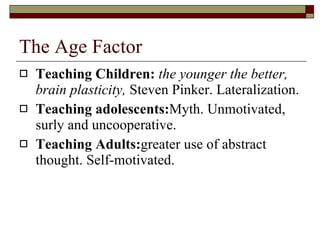
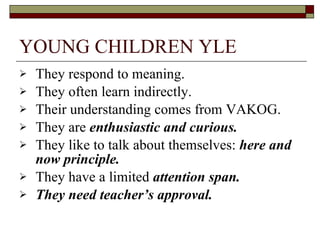
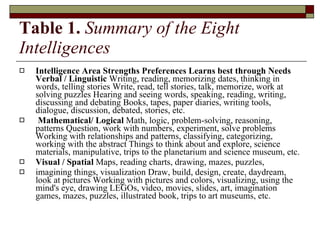
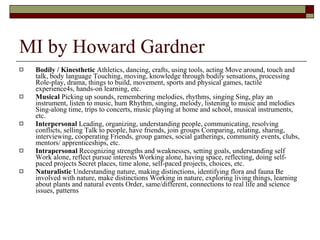
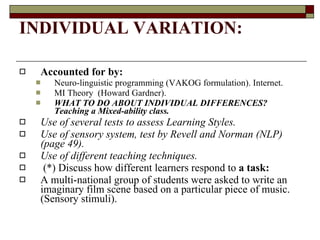
The document discusses different factors related to language learners, including age, aptitude, learner characteristics, styles, and individual differences. Younger children learn best through meaning and indirect learning that uses their visual, auditory, kinesthetic and olfactory senses. Adolescents are often portrayed as unmotivated but this is a myth. Adults have greater abstract thought and self-motivation. Learning styles refer to how each learner receives and processes information through their senses. Multiple intelligences include linguistic, logical, spatial, bodily, musical, interpersonal, intrapersonal, and naturalistic intelligences. The document advocates addressing individual differences through various assessment tests and teaching techniques.

![Teaching Vocabulary[1]](https://cdn.slidesharecdn.com/ss_thumbnails/teachingvocabulary1-1233330445671988-3-thumbnail.jpg?width=640&height=640&fit=bounds)


