



 According to Woolfolk, 2008:
“Ability or abilities to acquire and use knowledge for solving problems
and adapting to the world is known as intelligence”.
 We can also define intelligence as:
“Intelligence is what you do when you don't know what to do.”
 Other definitions of intelligence include:
 The ability to evaluate and judge,
 The ability to comprehend complex ideas,
 The capacity for original and productive thought,
 The ability to learn quickly.
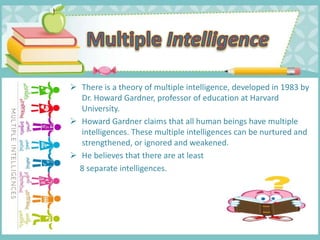
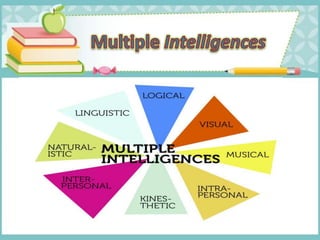
 There is a theory of multiple intelligence, developed in 1983 by
Dr. Howard Gardner, professor of education at Harvard
University.
 Howard Gardner claims that all human beings have multiple
intelligences. These multiple intelligences can be nurtured and
strengthened, or ignored and weakened.
 He believes that there are at least
8 separate intelligences.
 The ability to use spoken or written words effectively.
 These learners have highly developed auditory skills.
 They are elegant speakers.
 They like reading, playing word games, and making up stories.
 Tools include computers, games, multimedia, books, tape recorders, and
lecture.
Careers that suit those with high Linguistic intelligence are:
 writers
 Lawyers
 Journalists
 Speakers
 English teachers
 Translators
 TV and radio presenters
Related tasks and activities include:
 Use words to explain complicated subjects.
 Ask questions.
 Use your native ability to tell a story.
 Edit a peer’s paper.
 Give an oral presentation.
 List the strengths and weaknesses of a product.
 Write directions to accompany a map.
 People who are strong in logical-mathematical intelligence are good at
reasoning, calculating, recognizing patterns and logically analyze
problems.
 They like to experiment, solve puzzles, ask cosmic questions.
 They can be taught through logic games,
investigations, mysteries.
 Careers that suit those with high Logical-mathematical intelligence
are :
 Accountants
 Scientists
 Engineers
 Computer experts
 Bankers
 Insurance brokers
Related tasks and activities include:
 Create a process to measure something difficult.
 Analyze how a machine works
 Devise a strategy to achieve an aim
 Perform a mental mathematical calculation.
 Ask questions, and allow yourself to experiment with your own
hypotheses to find solutions or new answers.
 Visual Intelligence is the brain’s ability to perceive and
interpret visual stimuli.
 People who are strong in visual intelligence are good at
visualizing things.
 They use visual images as an aid in recalling information.
 They like to draw, do jigsaw puzzles, read maps.
 They can be taught through drawings, verbal and physical
imagery.
 Careers that suit those with high Visual Intelligence are:
 Artists
 Designers
 Cartoonists
 Architects
 Photographers
 Related tasks and activities include:
 Design a costume.
 Create a room layout.
 Design a building.
 Create an organizational logo.
 Design a historic costume.
 Interpret a painting.
 Bodily-kinesthetic intelligence is the ability to control one's body movements
and to handle objects skillfully.
 Those who have high bodily-kinesthetic intelligence are said to be good at
body movement, performing actions and physical control.
 They communicate well through body language and be taught through physical
activity, acting out and role playing.
 Careers that suit those with high bodily-kinesthetic
intelligence are:
 Athletes
 Dancers
 Actors
 Divers
 Soldiers
 Fire-fighters,
 Adventurers.
 Related tasks and activities include:
 Demonstrate a sports technique.
 Interpret a speech using sign language.
 Ride a horse.
 Stack books on a shelf.
 Toss a pancake.
 Fly a kite.
 The ability to produce and appreciate music as well as rhythms, tones and
beats.
 It is associated with enjoying music, singing, making music, and playing an
instrument.
 People with a high musical intelligence love music but they are also
sensitive to sounds as well as the emotions music conveys. .
 They may study better with music in the background.
 They can be taught by turning lessons into lyrics,
speaking rhythmically.
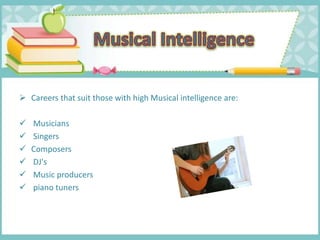
 Careers that suit those with high Musical intelligence are:
 Musicians
 Singers
 Composers
 DJ's
 Music producers
 piano tuners
 Related tasks and activities include:
 Perform a musical piece.
 Sing a song.
 Coach someone to play a musical instrument.
 Create a rhyme, song, or chant for material you would like to memorize.
 Whistle a tune.
 Associate what you're learning with a song you like.
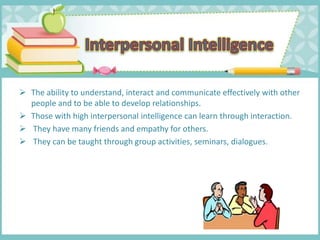
 The ability to understand, interact and communicate effectively with other
people and to be able to develop relationships.
 Those with high interpersonal intelligence can learn through interaction.
 They have many friends and empathy for others.
 They can be taught through group activities, seminars, dialogues.
Careers that suit those with high Interpersonal intelligence are:
 Therapists
 Care givers
 Leaders
 Counselors
 Politicians
 Sales-people
 Healers
 Organizers
 Related tasks and activities include:
 Interpret moods from facial expressions.
 Coach or counsel another person.
 Mentor a new faculty member.
 Give and receive feedback.
 Talk out problems.
 The ability to understand one’s own emotions, interests, goals
motivations, inner states of being, and self-reflection.
 These learners tend to shy away from others.
 They have wisdom, intuition and motivation, as well as a strong will,
confidence and opinions.
 They can be taught through independent study and introspection. Tools
include books, creative materials, diaries, privacy and time.
 Careers that suit those with high Intrapersonal intelligence
are:
 Can be anyone who is self-aware and involved in the process of changing
personal thoughts, beliefs and behavior in relation to their situation
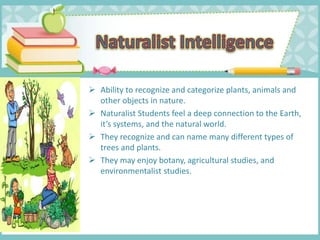
 Ability to recognize and categorize plants, animals and
other objects in nature.
 Naturalist Students feel a deep connection to the Earth,
it’s systems, and the natural world.
 They recognize and can name many different types of
trees and plants.
 They may enjoy botany, agricultural studies, and
environmentalist studies.
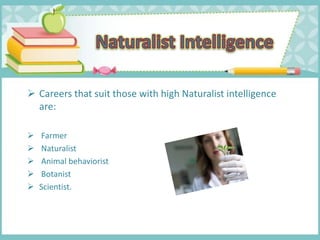
 Careers that suit those with high Naturalist intelligence
are:
 Farmer
 Naturalist
 Animal behaviorist
 Botanist
 Scientist.
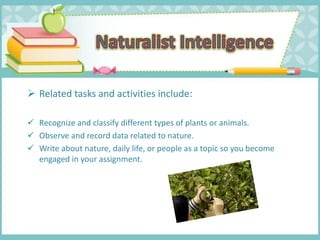
 Related tasks and activities include:
 Recognize and classify different types of plants or animals.
 Observe and record data related to nature.
 Write about nature, daily life, or people as a topic so you become
engaged in your assignment.
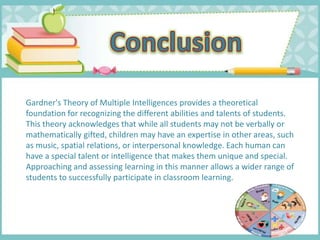
Gardner's Theory of Multiple Intelligences provides a theoretical
foundation for recognizing the different abilities and talents of students.
This theory acknowledges that while all students may not be verbally or
mathematically gifted, children may have an expertise in other areas, such
as music, spatial relations, or interpersonal knowledge. Each human can
have a special talent or intelligence that makes them unique and special.
Approaching and assessing learning in this manner allows a wider range of
students to successfully participate in classroom learning.
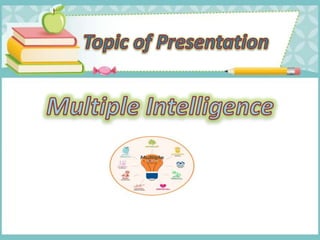
Multiple intelligence

Multiple intelligence

  • 3.
     According toWoolfolk, 2008: “Ability or abilities to acquire and use knowledge for solving problems and adapting to the world is known as intelligence”.  We can also define intelligence as: “Intelligence is what you do when you don't know what to do.”
  • 4.
     Other definitionsof intelligence include:  The ability to evaluate and judge,  The ability to comprehend complex ideas,  The capacity for original and productive thought,  The ability to learn quickly.
  • 5.
     There isa theory of multiple intelligence, developed in 1983 by Dr. Howard Gardner, professor of education at Harvard University.  Howard Gardner claims that all human beings have multiple intelligences. These multiple intelligences can be nurtured and strengthened, or ignored and weakened.  He believes that there are at least 8 separate intelligences.
  • 7.
     The abilityto use spoken or written words effectively.  These learners have highly developed auditory skills.  They are elegant speakers.  They like reading, playing word games, and making up stories.  Tools include computers, games, multimedia, books, tape recorders, and lecture.
  • 8.
    Careers that suitthose with high Linguistic intelligence are:  writers  Lawyers  Journalists  Speakers  English teachers  Translators  TV and radio presenters
  • 9.
    Related tasks andactivities include:  Use words to explain complicated subjects.  Ask questions.  Use your native ability to tell a story.  Edit a peer’s paper.  Give an oral presentation.  List the strengths and weaknesses of a product.  Write directions to accompany a map.
  • 10.
     People whoare strong in logical-mathematical intelligence are good at reasoning, calculating, recognizing patterns and logically analyze problems.  They like to experiment, solve puzzles, ask cosmic questions.  They can be taught through logic games, investigations, mysteries.
  • 11.
     Careers thatsuit those with high Logical-mathematical intelligence are :  Accountants  Scientists  Engineers  Computer experts  Bankers  Insurance brokers
  • 12.
    Related tasks andactivities include:  Create a process to measure something difficult.  Analyze how a machine works  Devise a strategy to achieve an aim  Perform a mental mathematical calculation.  Ask questions, and allow yourself to experiment with your own hypotheses to find solutions or new answers.
  • 13.
     Visual Intelligenceis the brain’s ability to perceive and interpret visual stimuli.  People who are strong in visual intelligence are good at visualizing things.  They use visual images as an aid in recalling information.  They like to draw, do jigsaw puzzles, read maps.  They can be taught through drawings, verbal and physical imagery.
  • 14.
     Careers thatsuit those with high Visual Intelligence are:  Artists  Designers  Cartoonists  Architects  Photographers
  • 15.
     Related tasksand activities include:  Design a costume.  Create a room layout.  Design a building.  Create an organizational logo.  Design a historic costume.  Interpret a painting.
  • 16.
     Bodily-kinesthetic intelligenceis the ability to control one's body movements and to handle objects skillfully.  Those who have high bodily-kinesthetic intelligence are said to be good at body movement, performing actions and physical control.  They communicate well through body language and be taught through physical activity, acting out and role playing.
  • 17.
     Careers thatsuit those with high bodily-kinesthetic intelligence are:  Athletes  Dancers  Actors  Divers  Soldiers  Fire-fighters,  Adventurers.
  • 18.
     Related tasksand activities include:  Demonstrate a sports technique.  Interpret a speech using sign language.  Ride a horse.  Stack books on a shelf.  Toss a pancake.  Fly a kite.
  • 19.
     The abilityto produce and appreciate music as well as rhythms, tones and beats.  It is associated with enjoying music, singing, making music, and playing an instrument.  People with a high musical intelligence love music but they are also sensitive to sounds as well as the emotions music conveys. .  They may study better with music in the background.  They can be taught by turning lessons into lyrics, speaking rhythmically.
  • 20.
     Careers thatsuit those with high Musical intelligence are:  Musicians  Singers  Composers  DJ's  Music producers  piano tuners
  • 21.
     Related tasksand activities include:  Perform a musical piece.  Sing a song.  Coach someone to play a musical instrument.  Create a rhyme, song, or chant for material you would like to memorize.  Whistle a tune.  Associate what you're learning with a song you like.
  • 22.
     The abilityto understand, interact and communicate effectively with other people and to be able to develop relationships.  Those with high interpersonal intelligence can learn through interaction.  They have many friends and empathy for others.  They can be taught through group activities, seminars, dialogues.
  • 23.
    Careers that suitthose with high Interpersonal intelligence are:  Therapists  Care givers  Leaders  Counselors  Politicians  Sales-people  Healers  Organizers
  • 24.
     Related tasksand activities include:  Interpret moods from facial expressions.  Coach or counsel another person.  Mentor a new faculty member.  Give and receive feedback.  Talk out problems.
  • 25.
     The abilityto understand one’s own emotions, interests, goals motivations, inner states of being, and self-reflection.  These learners tend to shy away from others.  They have wisdom, intuition and motivation, as well as a strong will, confidence and opinions.  They can be taught through independent study and introspection. Tools include books, creative materials, diaries, privacy and time.
  • 26.
     Careers thatsuit those with high Intrapersonal intelligence are:  Can be anyone who is self-aware and involved in the process of changing personal thoughts, beliefs and behavior in relation to their situation
  • 27.
     Ability torecognize and categorize plants, animals and other objects in nature.  Naturalist Students feel a deep connection to the Earth, it’s systems, and the natural world.  They recognize and can name many different types of trees and plants.  They may enjoy botany, agricultural studies, and environmentalist studies.
  • 28.
     Careers thatsuit those with high Naturalist intelligence are:  Farmer  Naturalist  Animal behaviorist  Botanist  Scientist.
  • 29.
     Related tasksand activities include:  Recognize and classify different types of plants or animals.  Observe and record data related to nature.  Write about nature, daily life, or people as a topic so you become engaged in your assignment.
  • 30.
    Gardner's Theory ofMultiple Intelligences provides a theoretical foundation for recognizing the different abilities and talents of students. This theory acknowledges that while all students may not be verbally or mathematically gifted, children may have an expertise in other areas, such as music, spatial relations, or interpersonal knowledge. Each human can have a special talent or intelligence that makes them unique and special. Approaching and assessing learning in this manner allows a wider range of students to successfully participate in classroom learning.