12.1
Multiple Access
Copyright © The McGraw-Hill Companies, Inc. Permission required for reproduction or display.
12.2
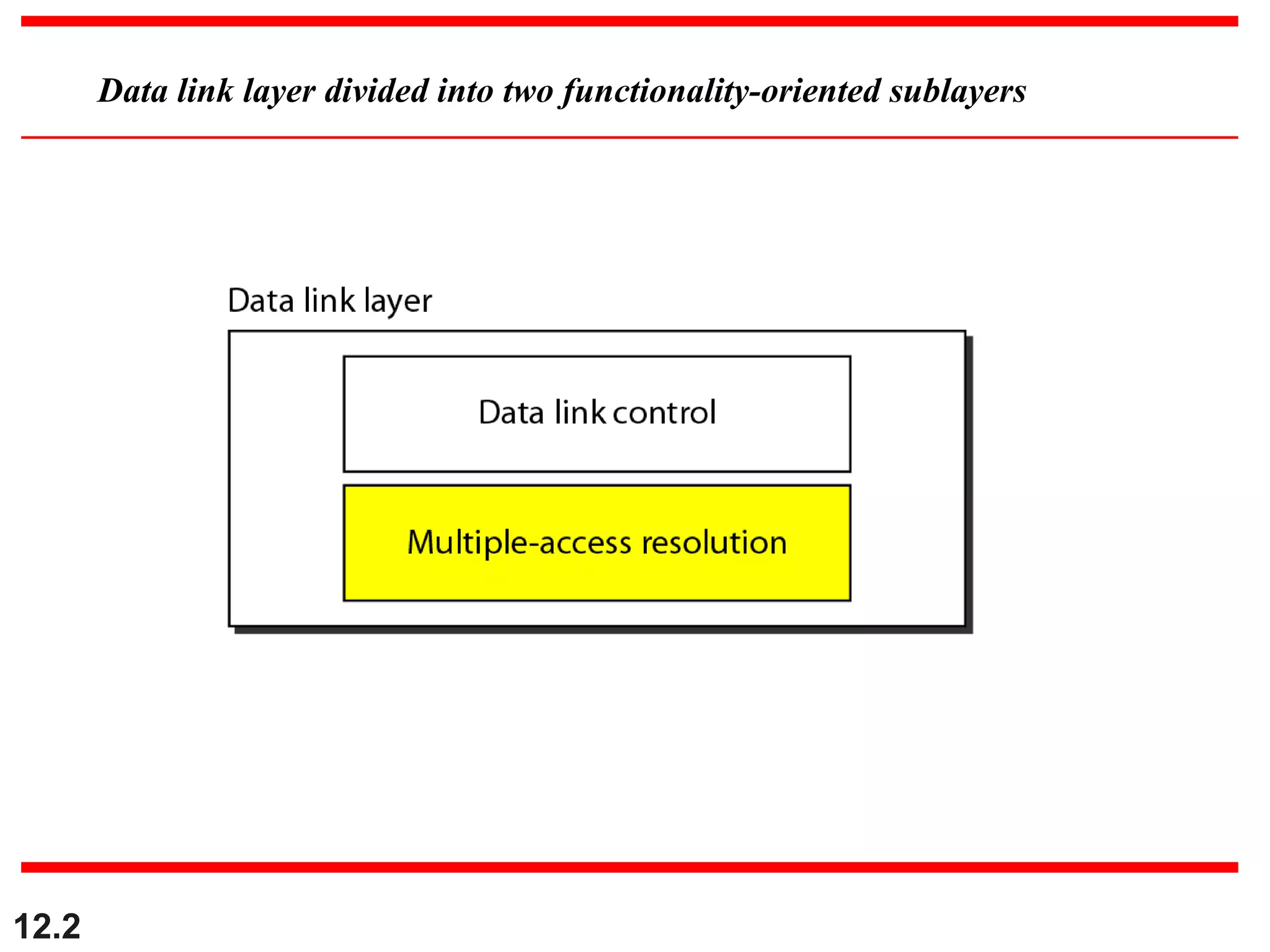
Data link layer divided into two functionality-oriented sublayers
12.3
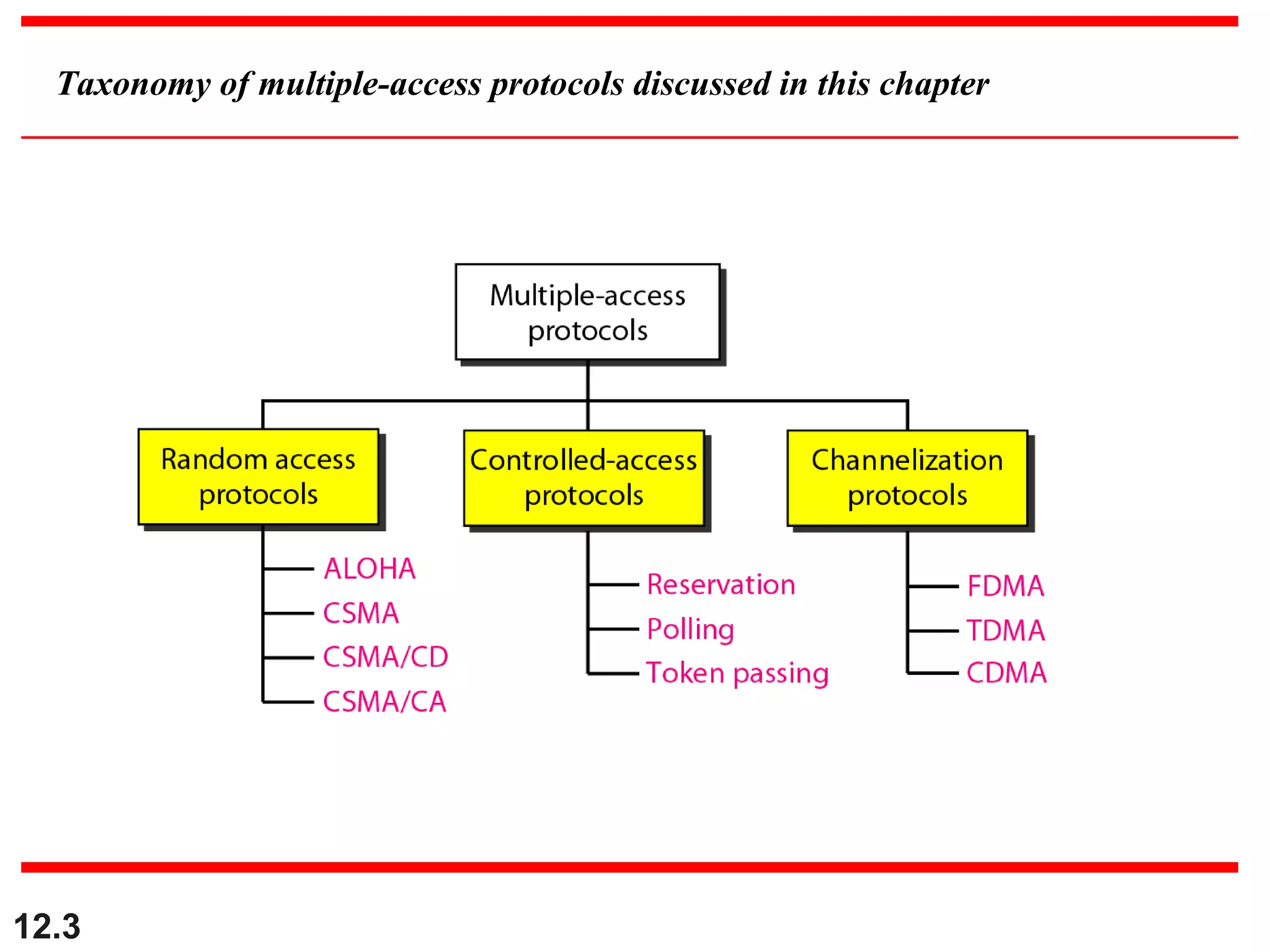
Taxonomy of multiple-access protocols discussed in this chapter
12.4
RANDOM ACCESSRANDOM ACCESS
InIn random accessrandom access oror contentioncontention methods, no station ismethods, no station is
superior to another station and none is assigned thesuperior to another station and none is assigned the
control over another. No station permits, or does notcontrol over another. No station permits, or does not
permit, another station to send. At each instance, apermit, another station to send. At each instance, a
station that has data to send uses a procedure definedstation that has data to send uses a procedure defined
by the protocol to make a decision on whether or notby the protocol to make a decision on whether or not
to send.to send.
ALOHA
Carrier Sense Multiple Access
Carrier Sense Multiple Access with Collision Detection
Carrier Sense Multiple Access with Collision Avoidance
Topics discussed in this section:Topics discussed in this section:
12.5
To avoid access conflict or to resolve it when itTo avoid access conflict or to resolve it when it
happens, each station follows a procedure that answerhappens, each station follows a procedure that answer
the following questions:the following questions:
 When can the station access the medium.When can the station access the medium.
What can the station do if the medium is busy.What can the station do if the medium is busy.
How can the station determine the success or failureHow can the station determine the success or failure
of the transmission.of the transmission.
What can the station do if there is an access conflict.What can the station do if there is an access conflict.
12.6
ALOHA
ALOHA, the earliest random access method, was developed at the University of Hawaii
in early 1970. It was designed for a radio (wireless) LAN, but it can be used on any
shared medium.
Pure ALOHA
Slotted ALOHA
12.7
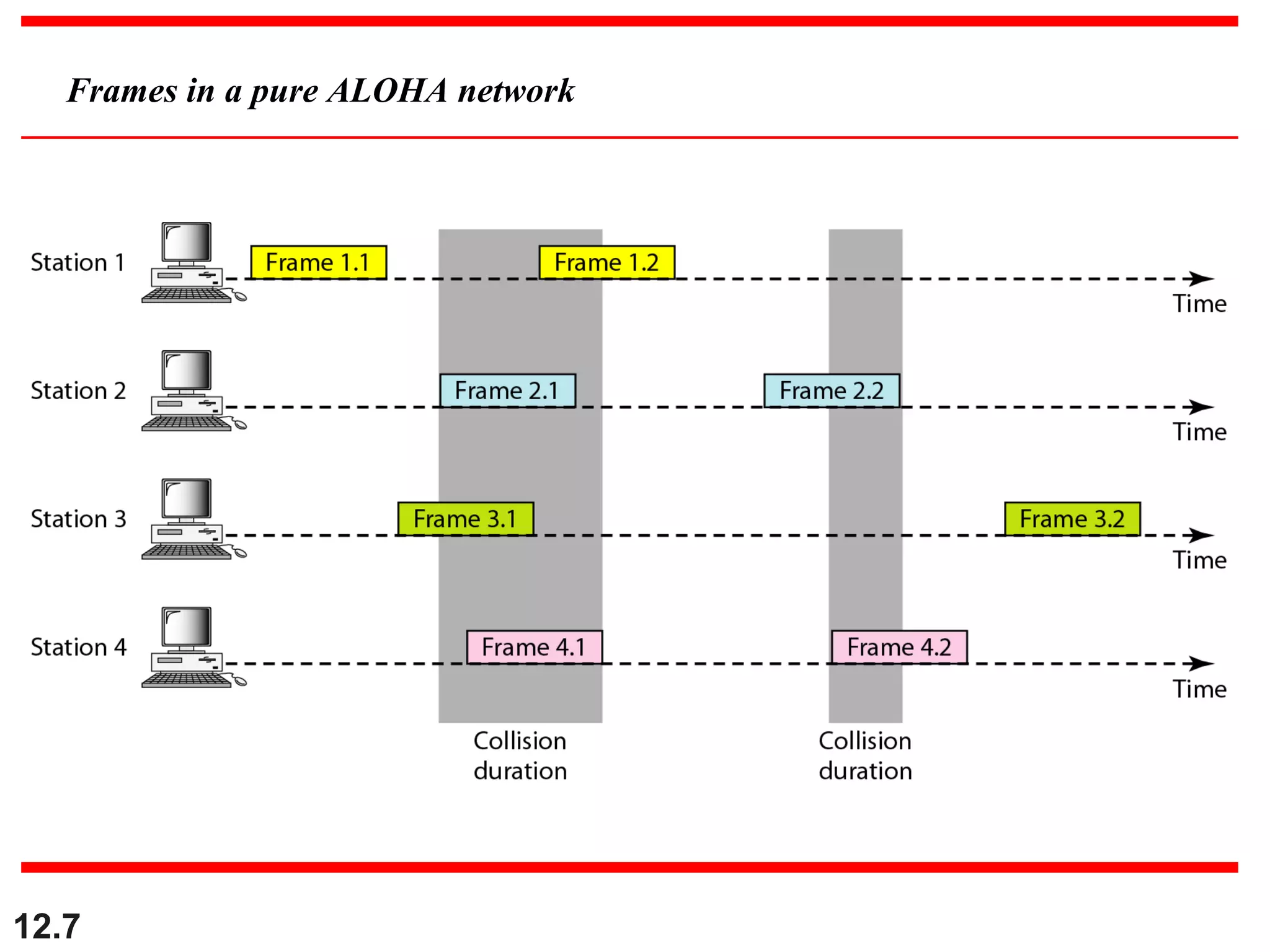
Frames in a pure ALOHA network
12.8
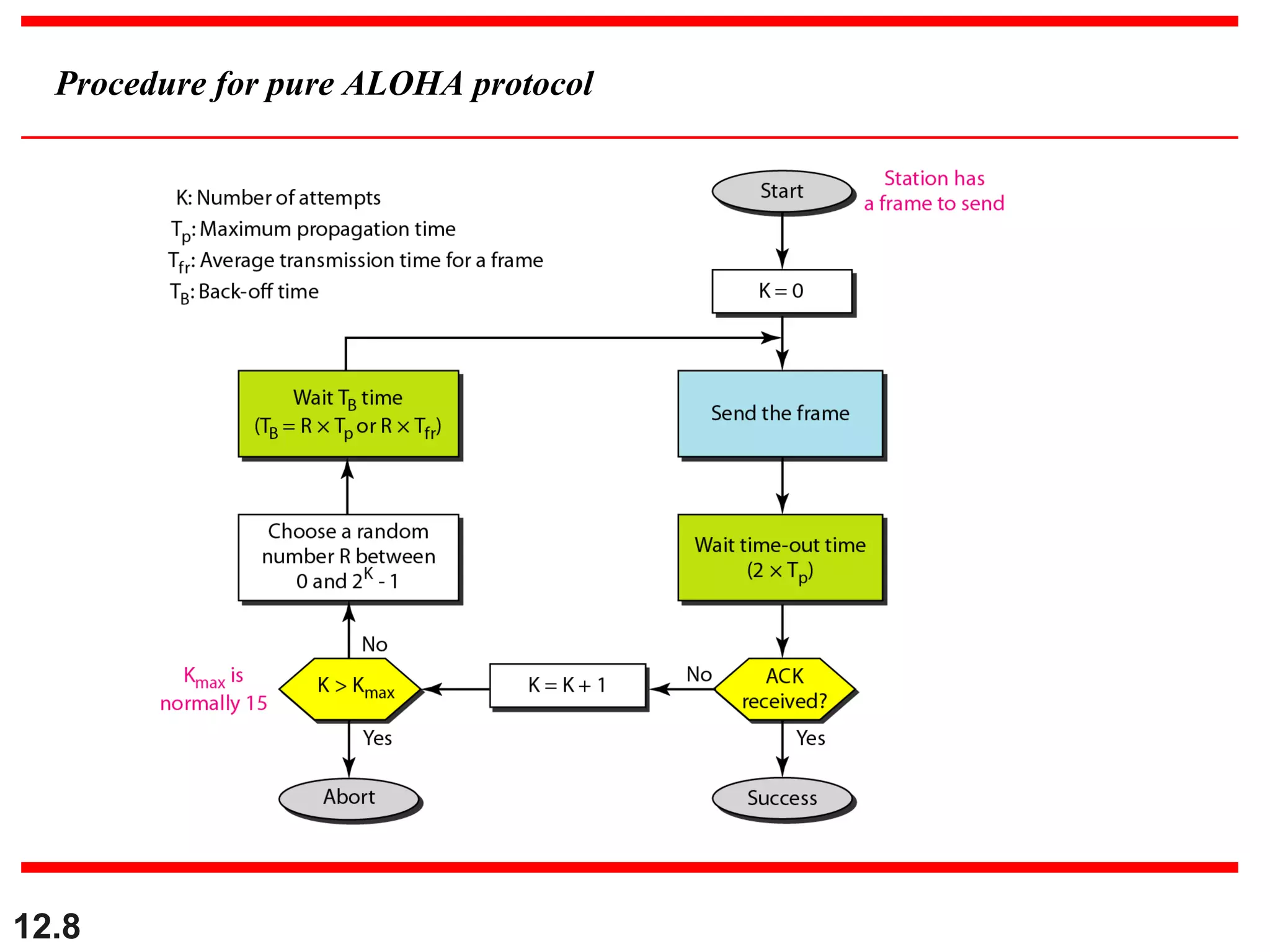
Procedure for pure ALOHA protocol
12.9
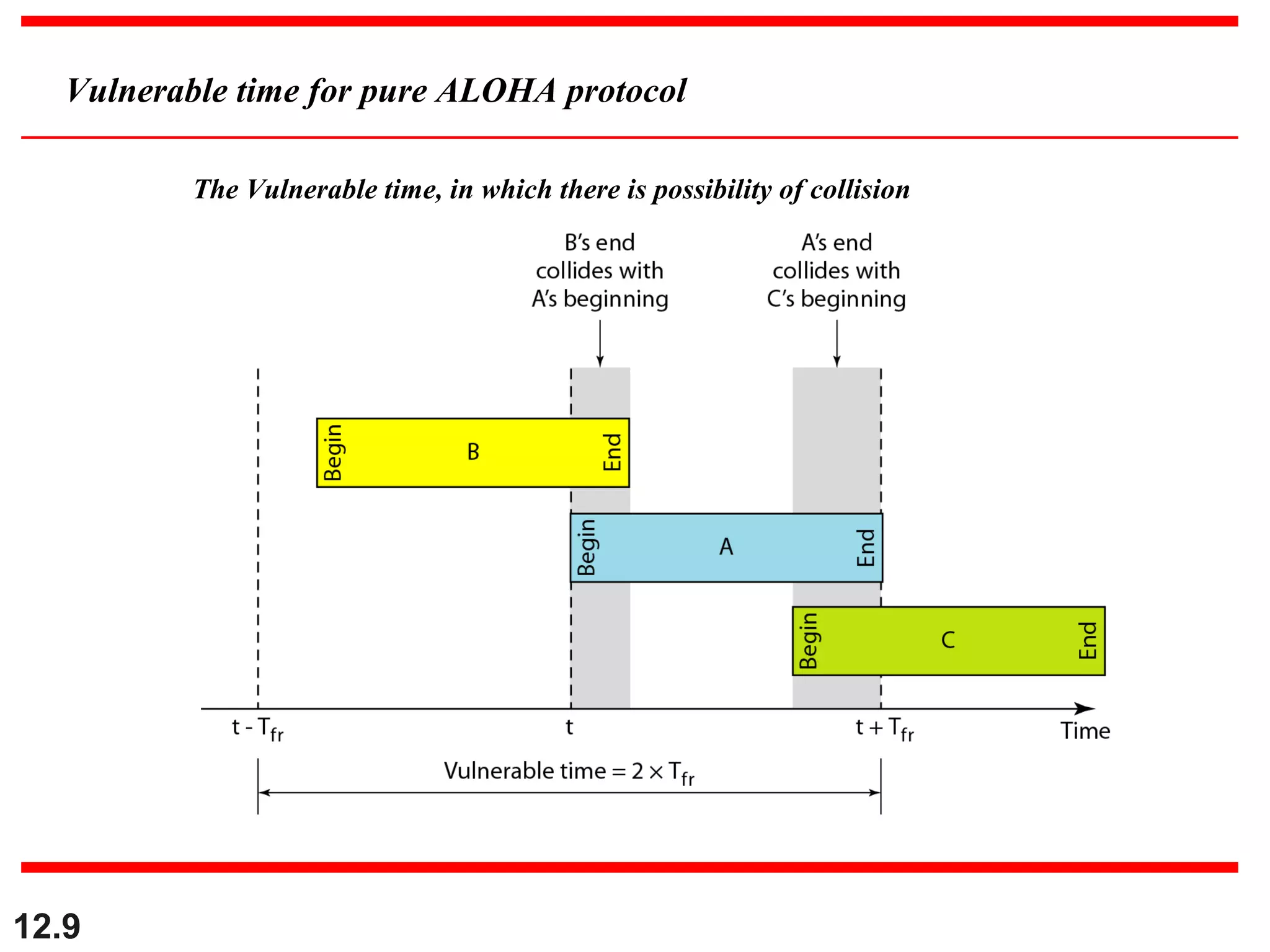
Vulnerable time for pure ALOHA protocol
The Vulnerable time, in which there is possibility of collision
12.10
Slotted ALOHA
12.11
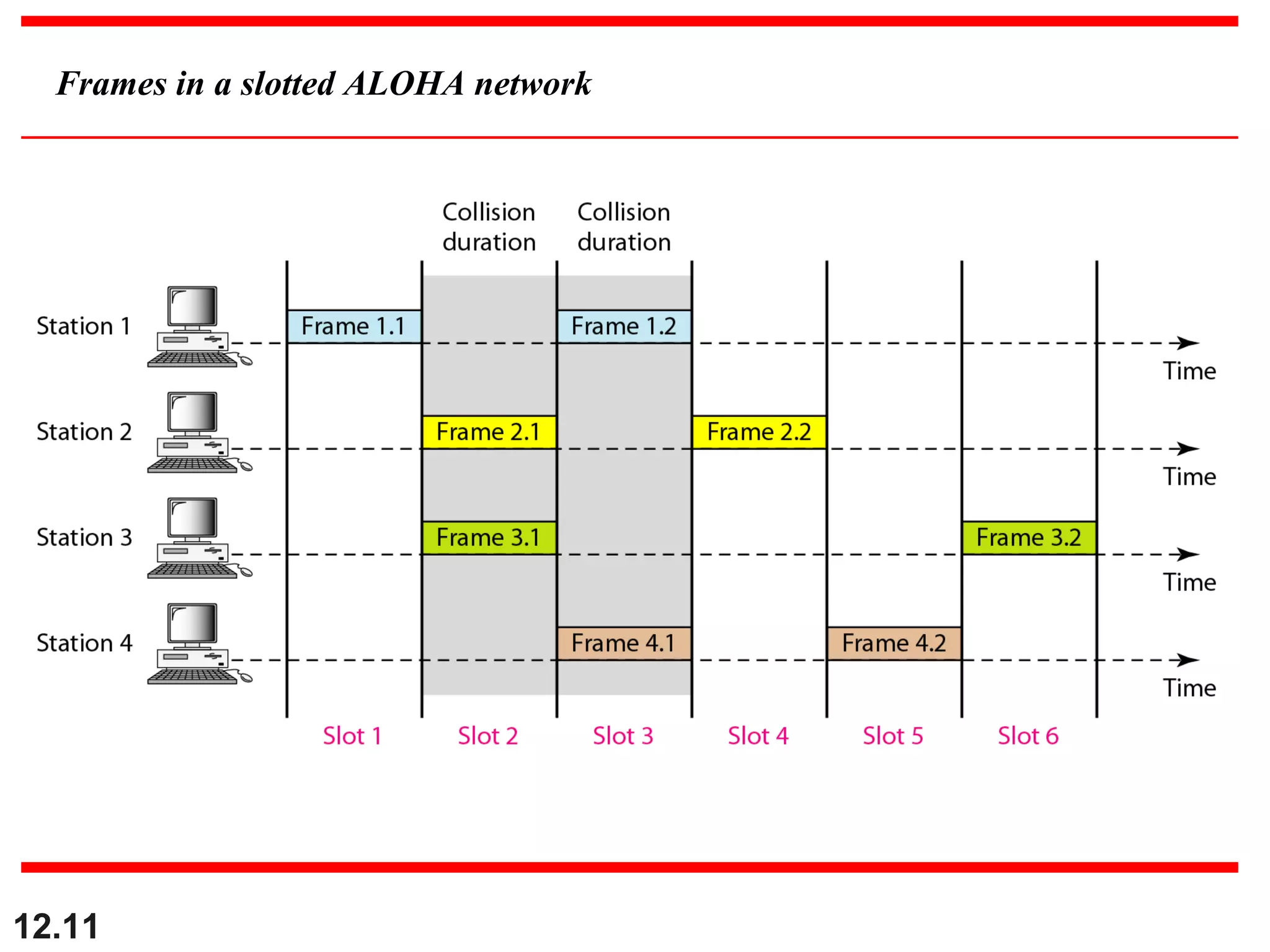
Frames in a slotted ALOHA network
12.12
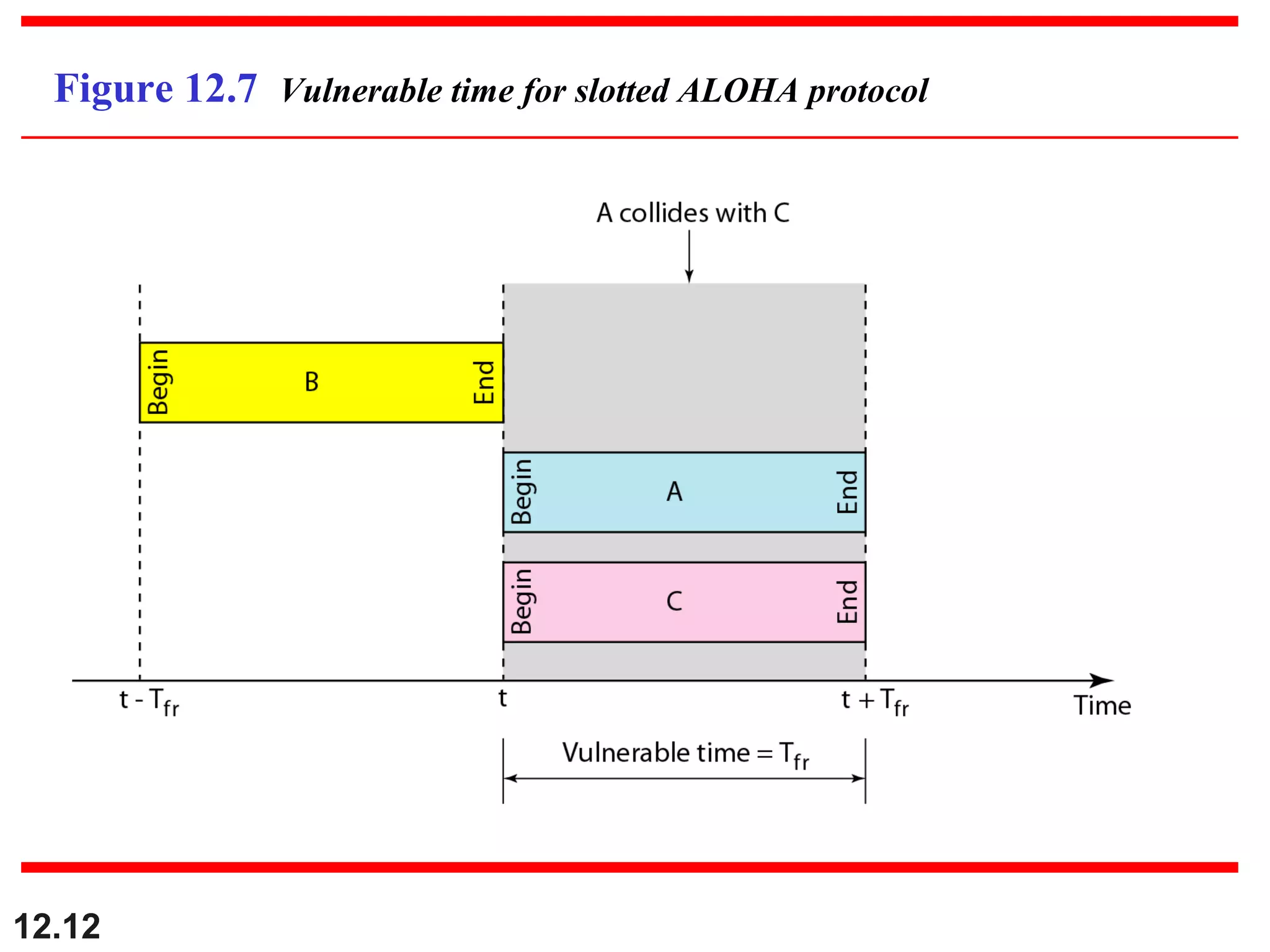
Figure 12.7 Vulnerable time for slotted ALOHA protocol
12.13
CSMA
Carrier Sense Multiple Access
12.14
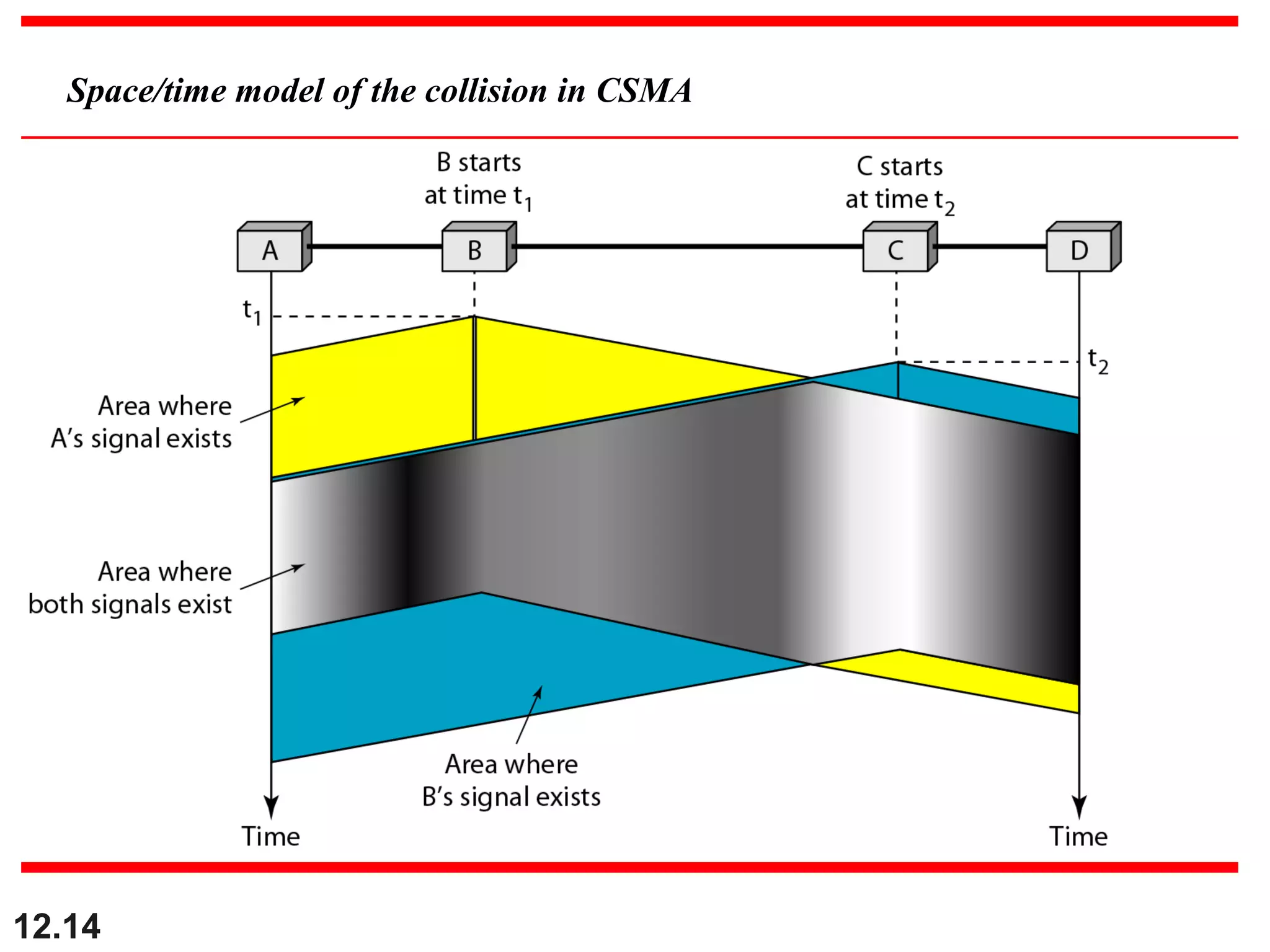
Space/time model of the collision in CSMA
12.15
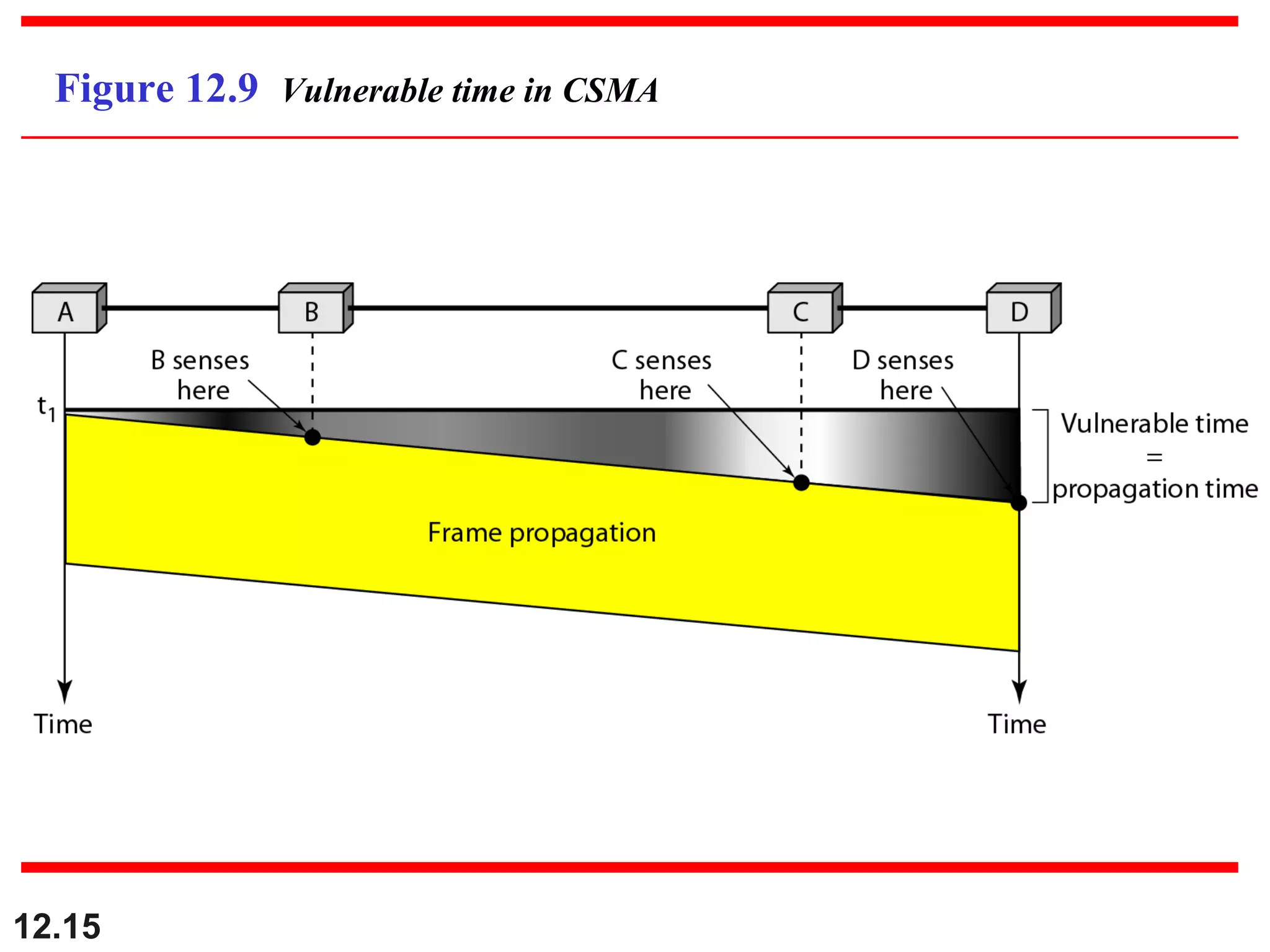
Figure 12.9 Vulnerable time in CSMA
12.16
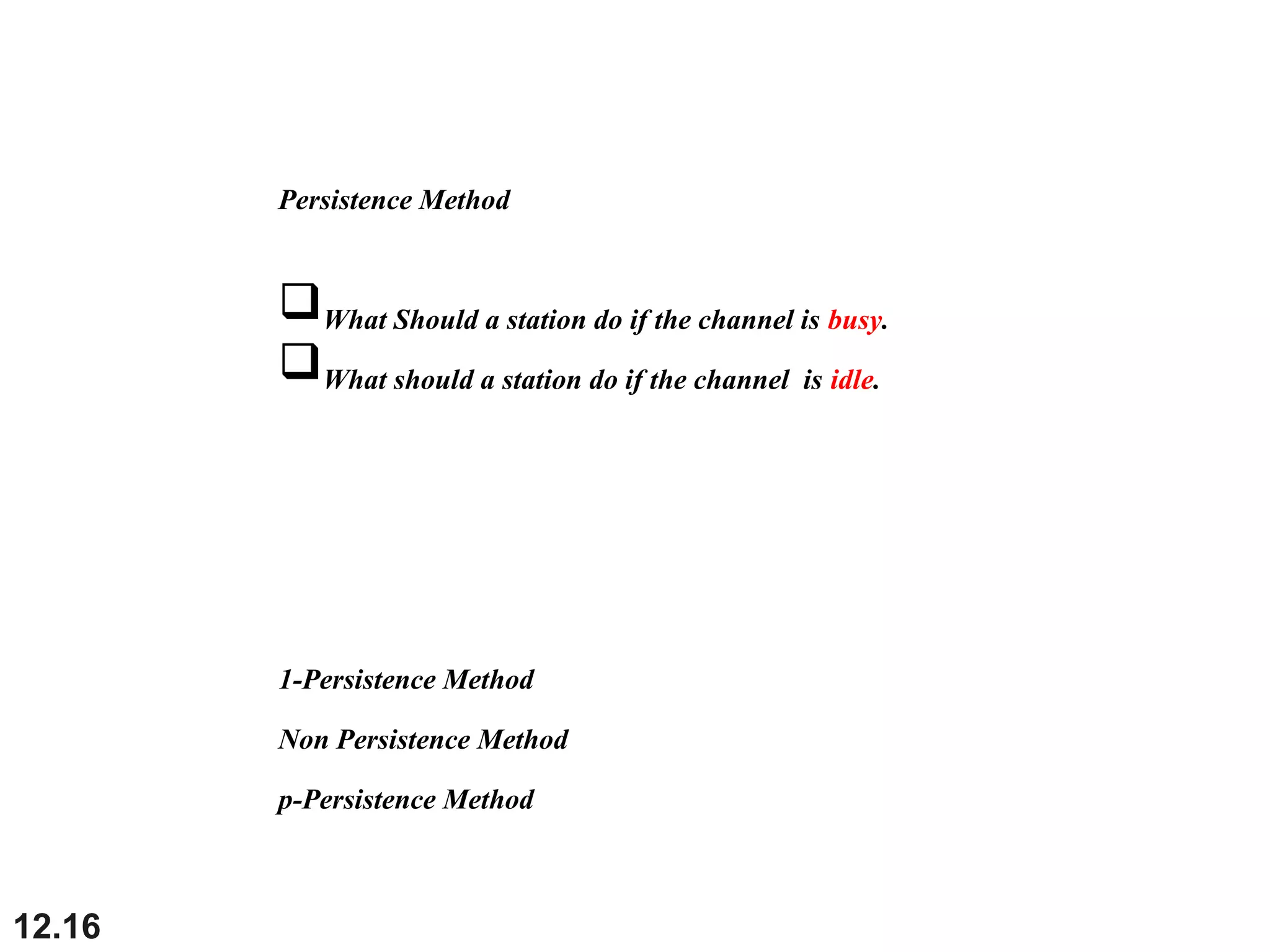
Persistence Method
What Should a station do if the channel is busy.
What should a station do if the channel is idle.
1-Persistence Method
Non Persistence Method
p-Persistence Method
12.17
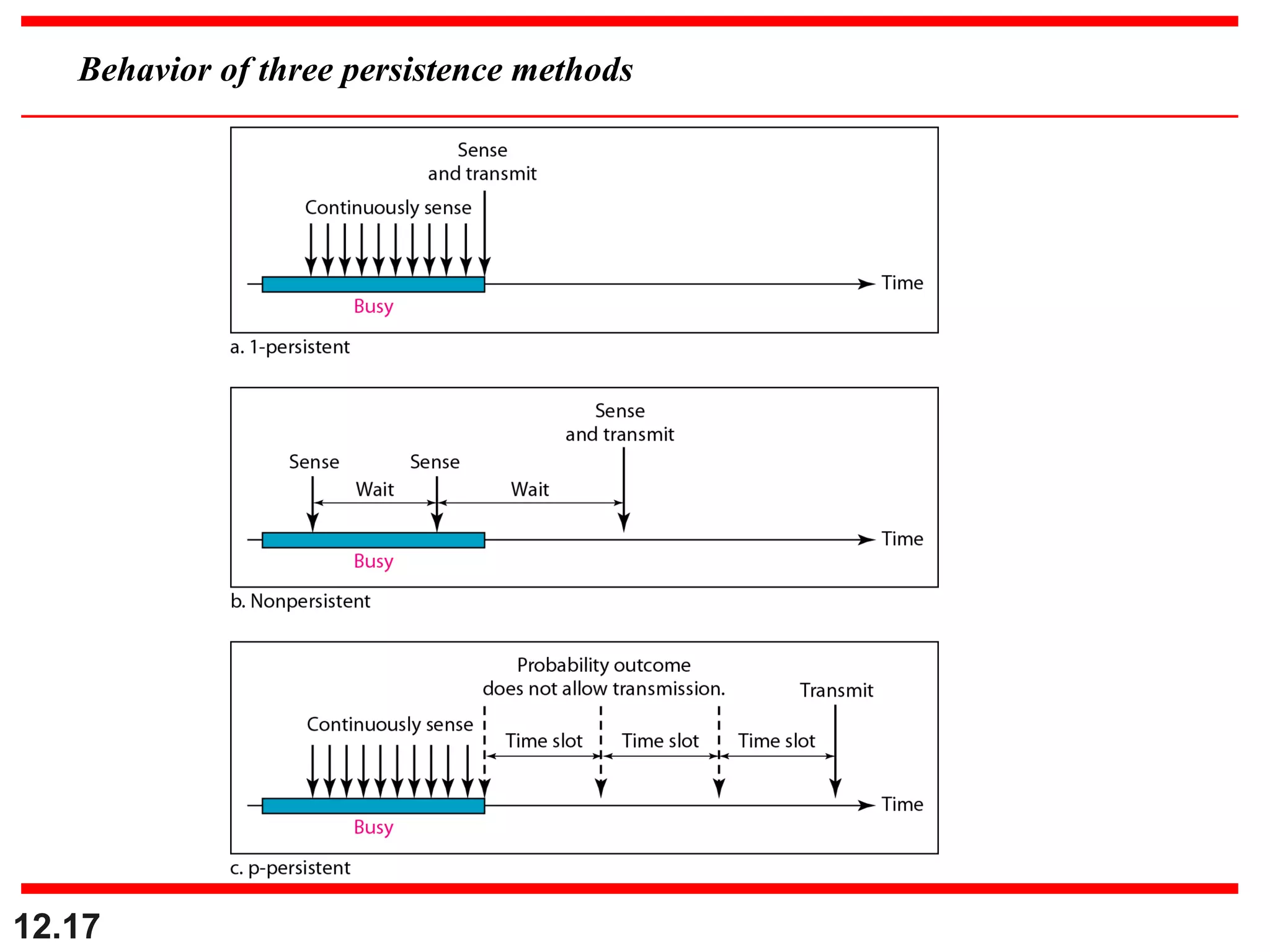
Behavior of three persistence methods
12.18
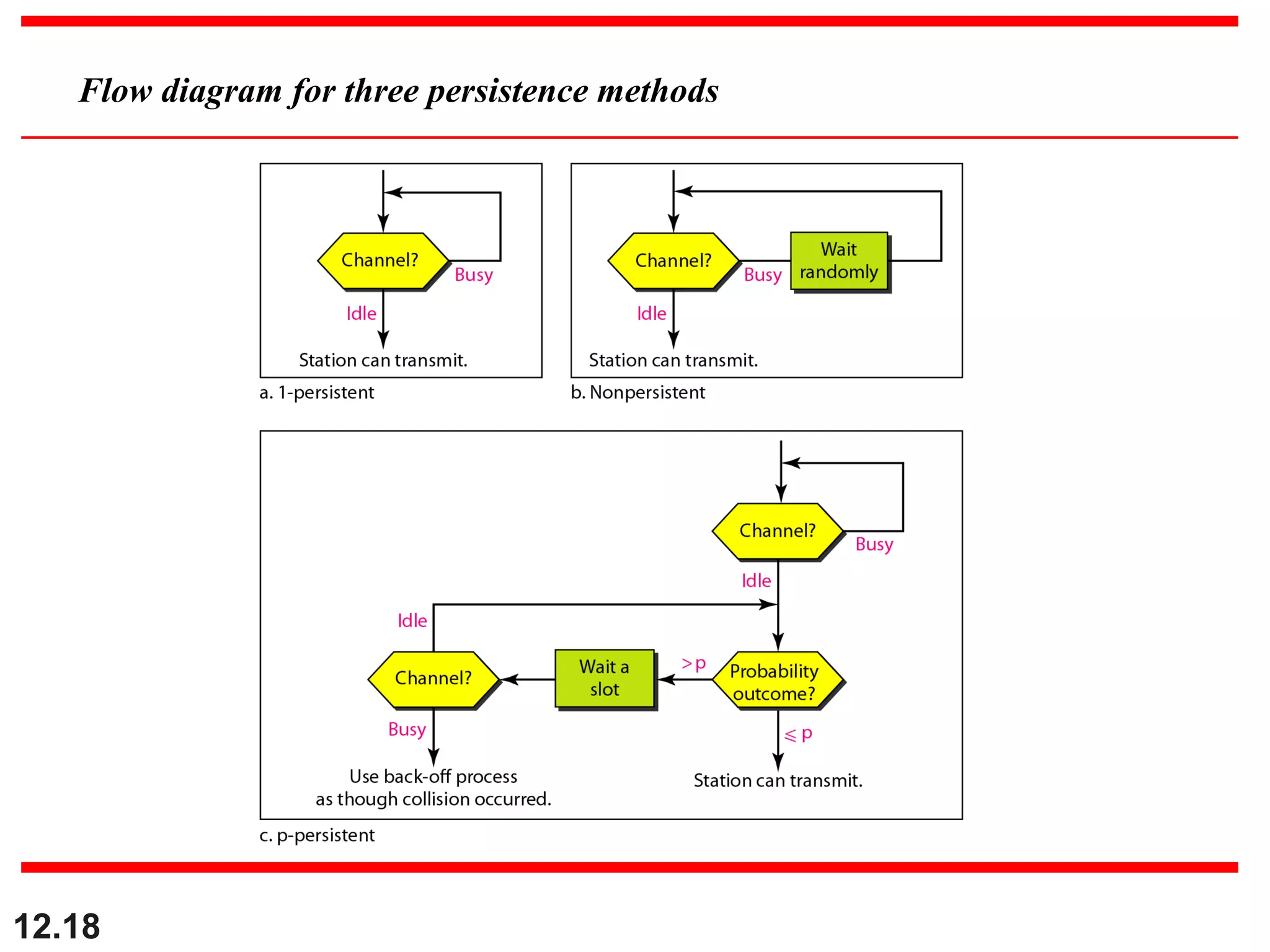
Flow diagram for three persistence methods
12.19
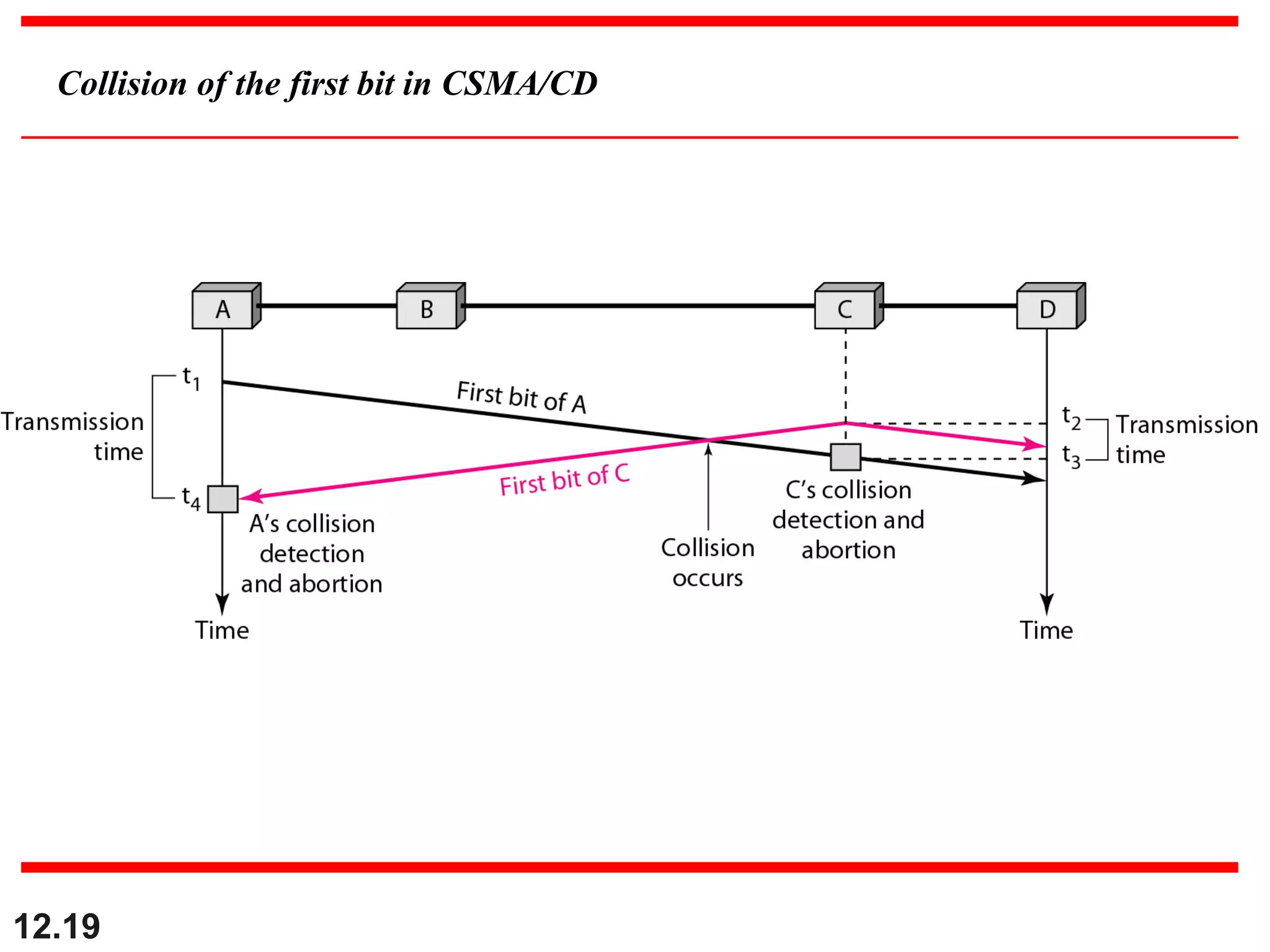
Collision of the first bit in CSMA/CD
12.20
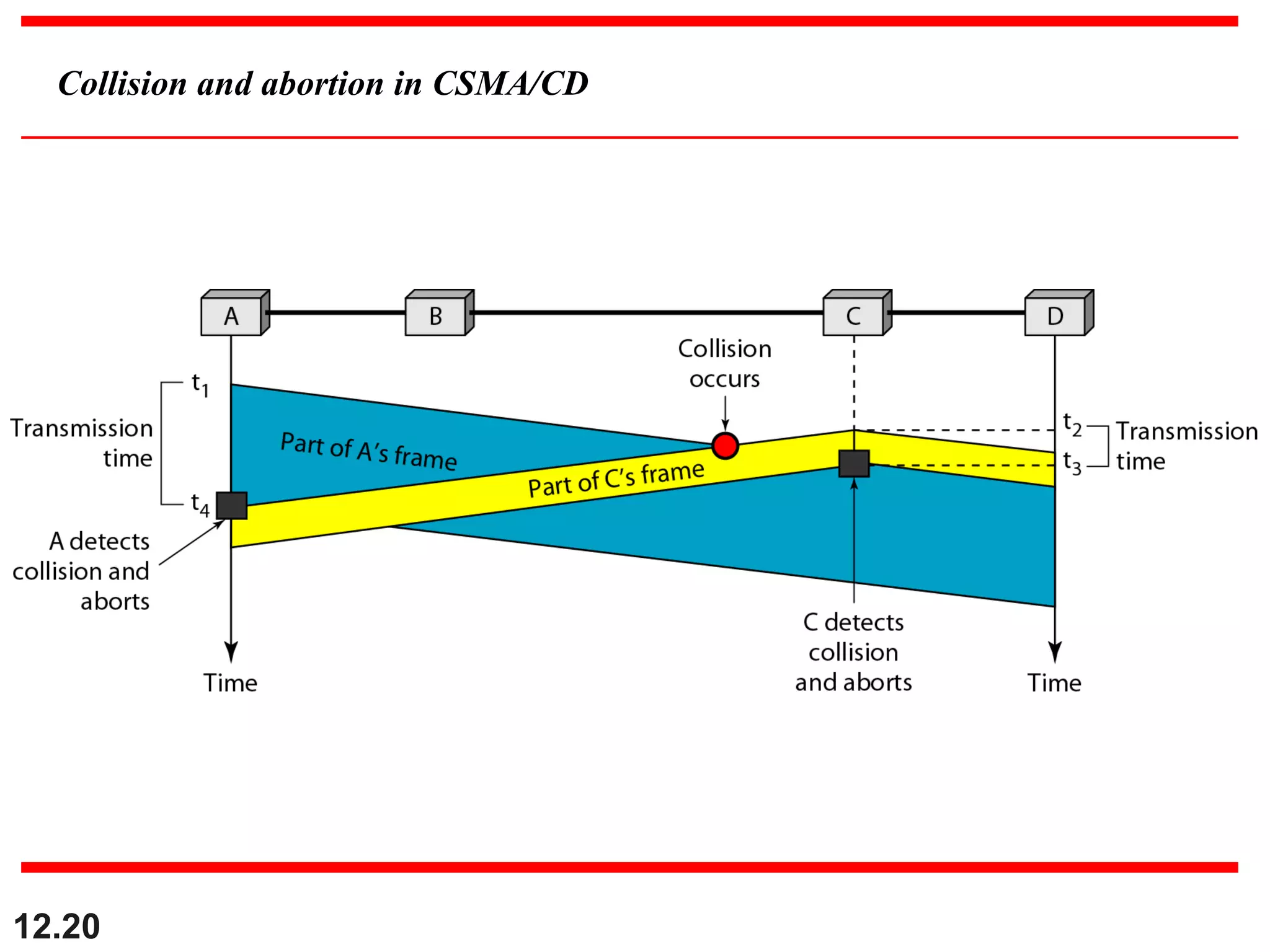
Collision and abortion in CSMA/CD
12.21
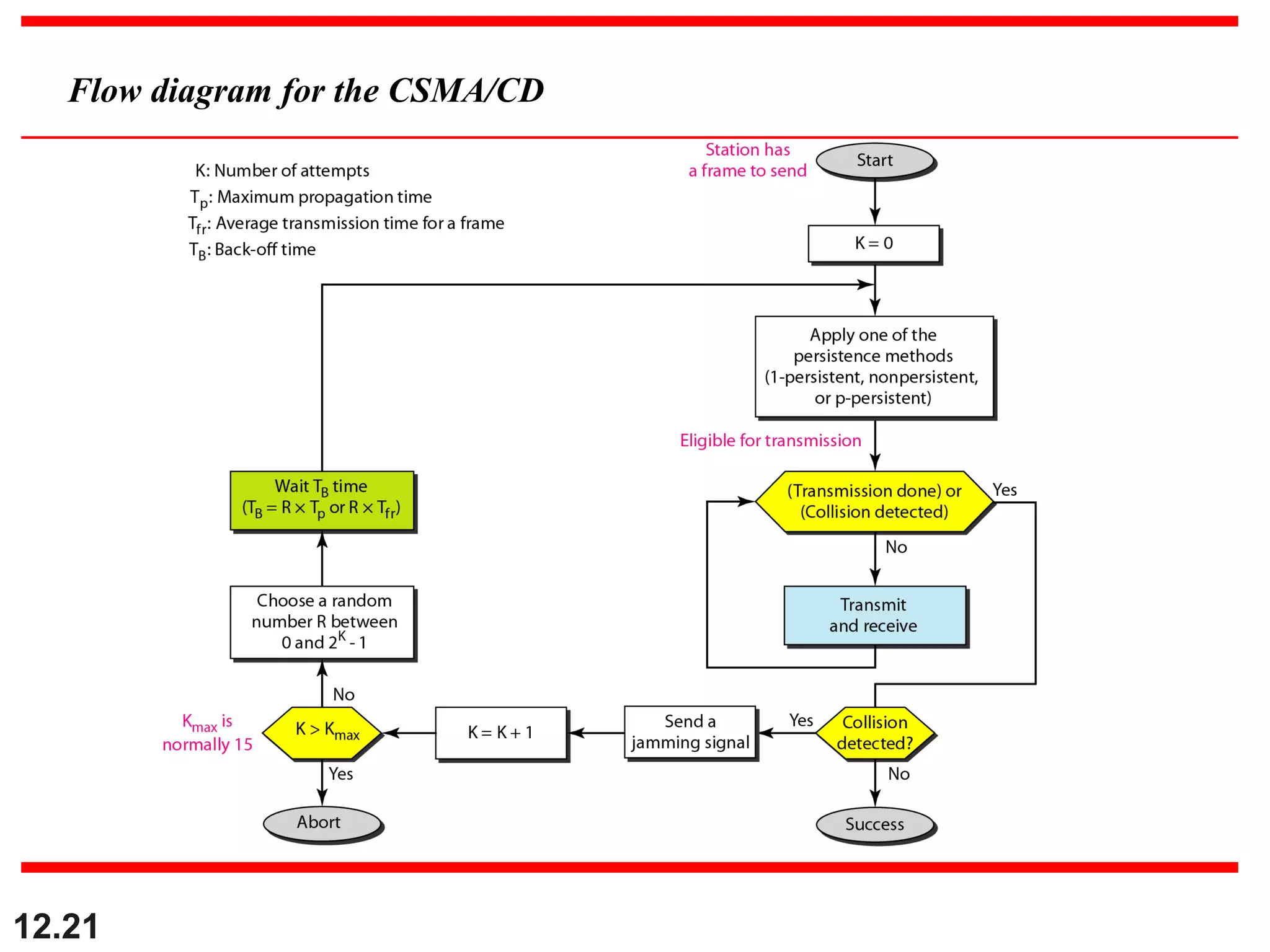
Flow diagram for the CSMA/CD
12.22
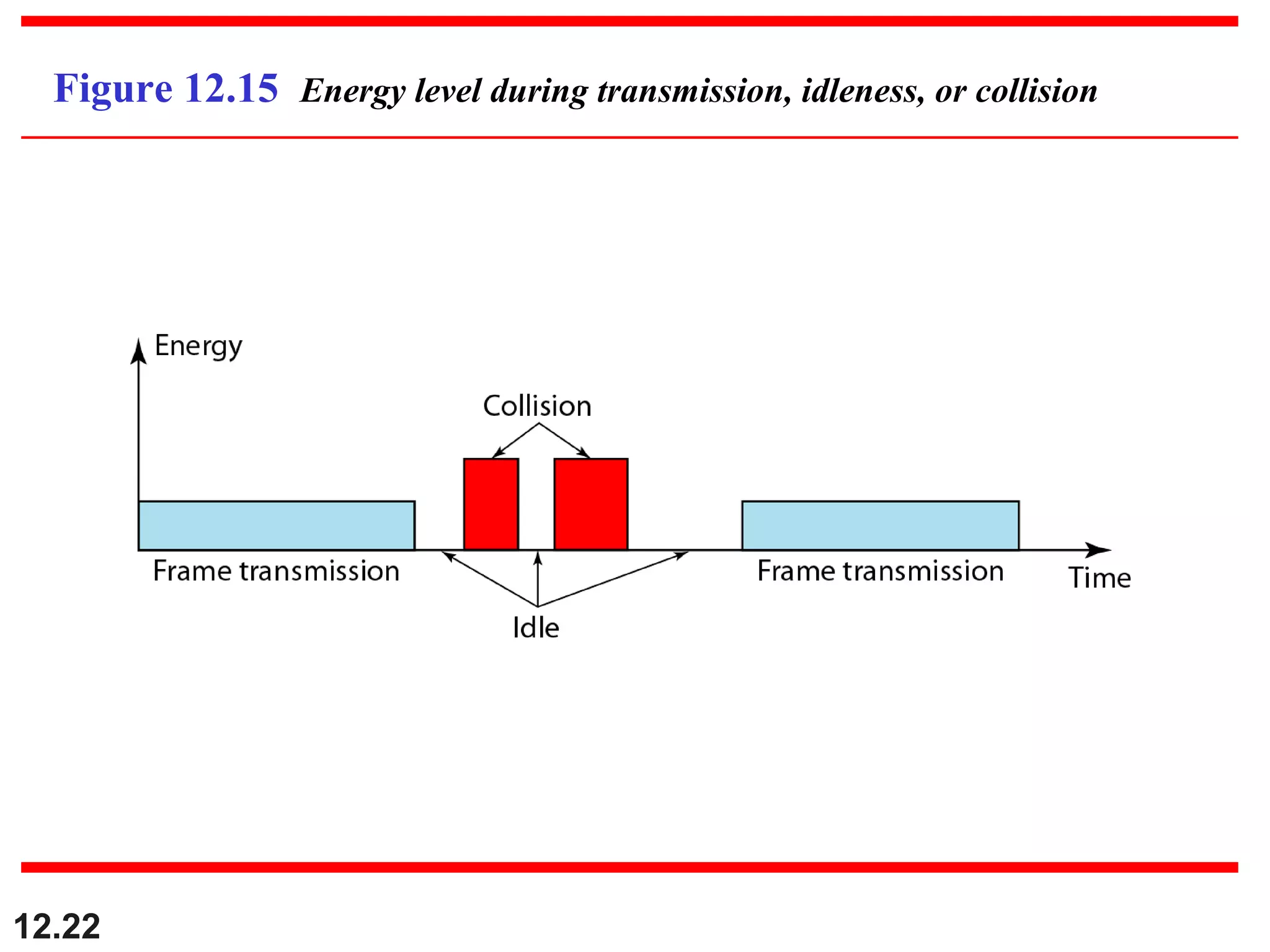
Figure 12.15 Energy level during transmission, idleness, or collision
12.23
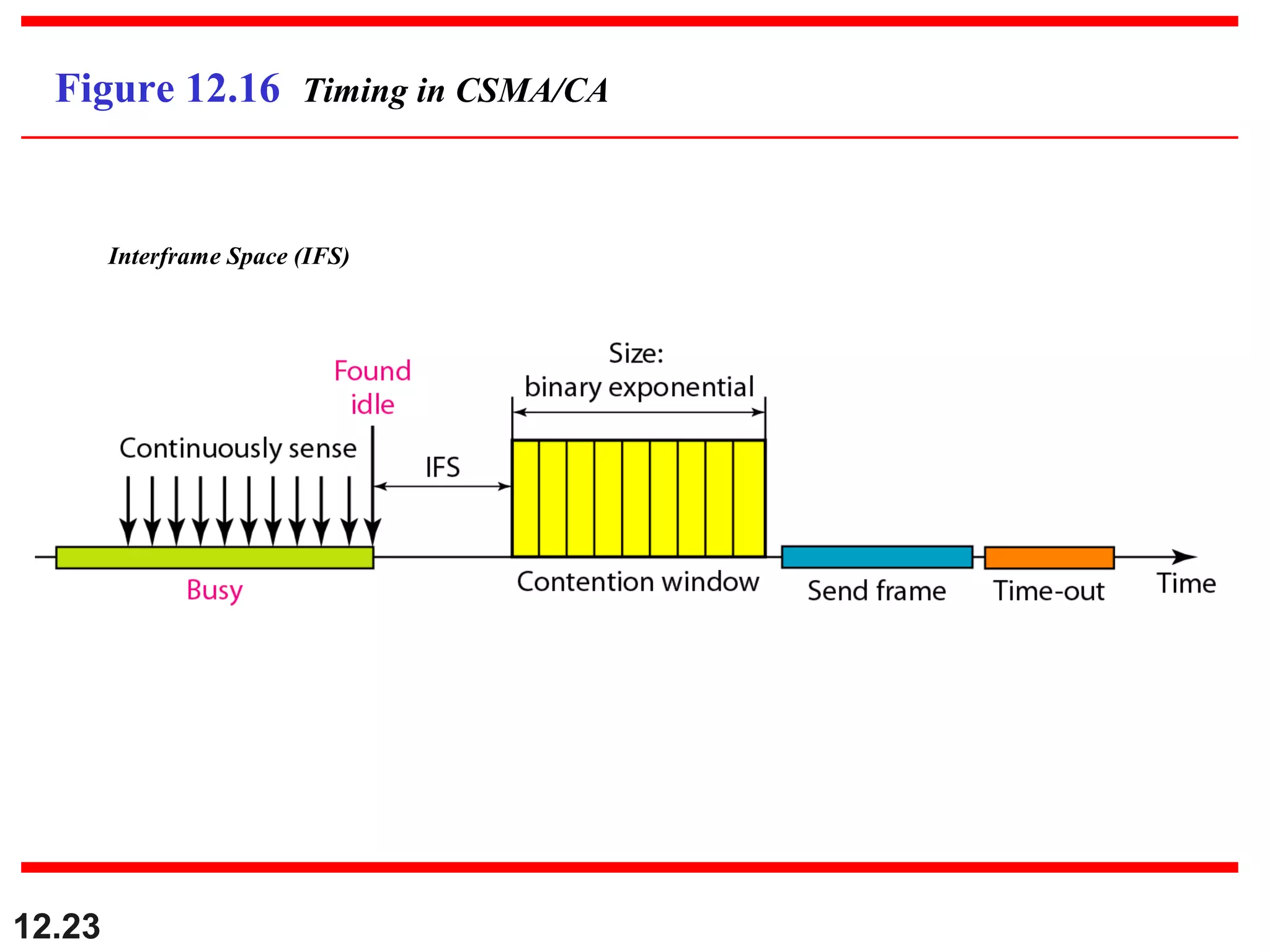
Figure 12.16 Timing in CSMA/CA
Interframe Space (IFS)
12.24
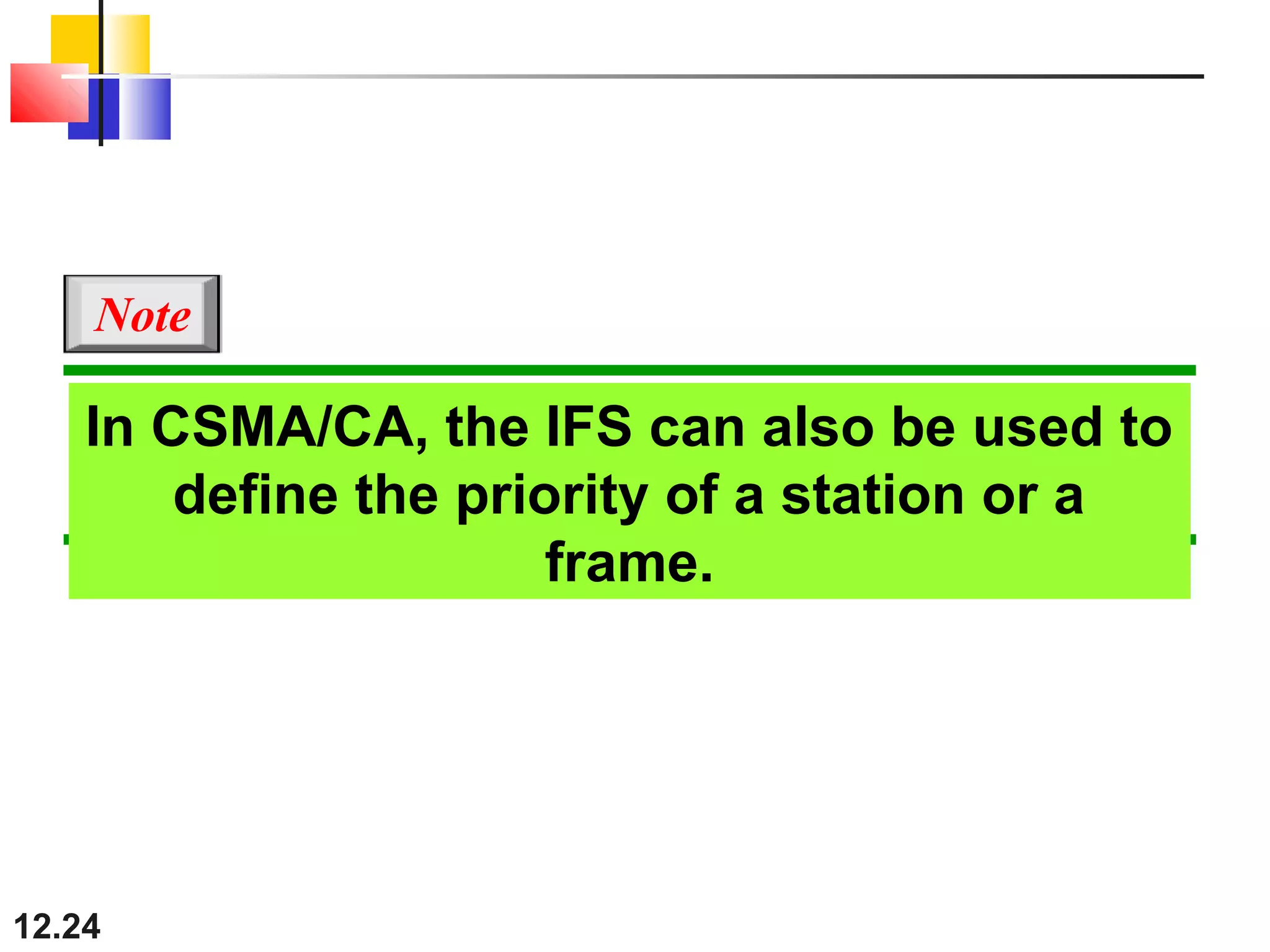
In CSMA/CA, the IFS can also be used to
define the priority of a station or a
frame.
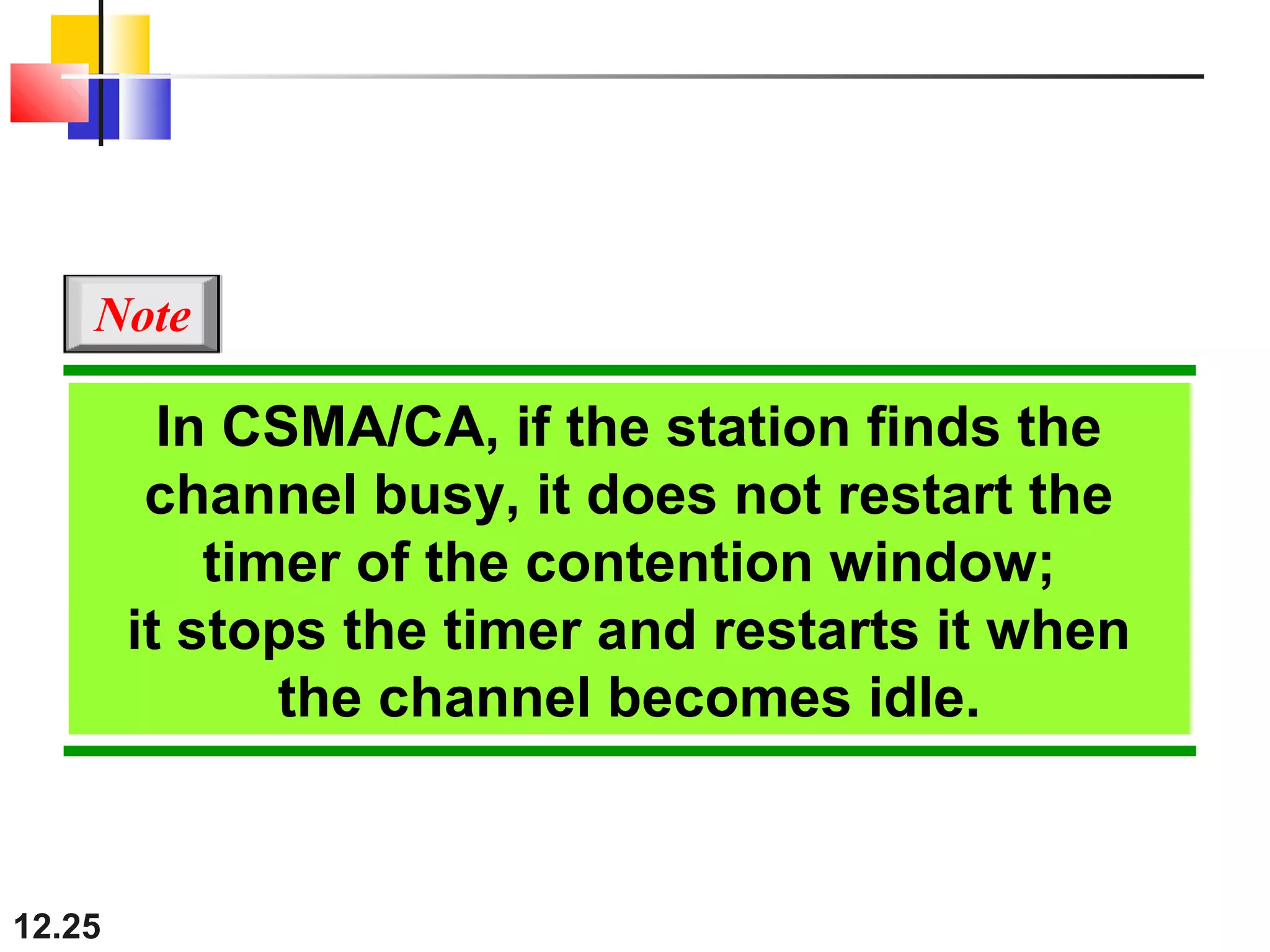
Note
12.25
In CSMA/CA, if the station finds the
channel busy, it does not restart the
timer of the contention window;
it stops the timer and restarts it when
the channel becomes idle.
Note
12.26
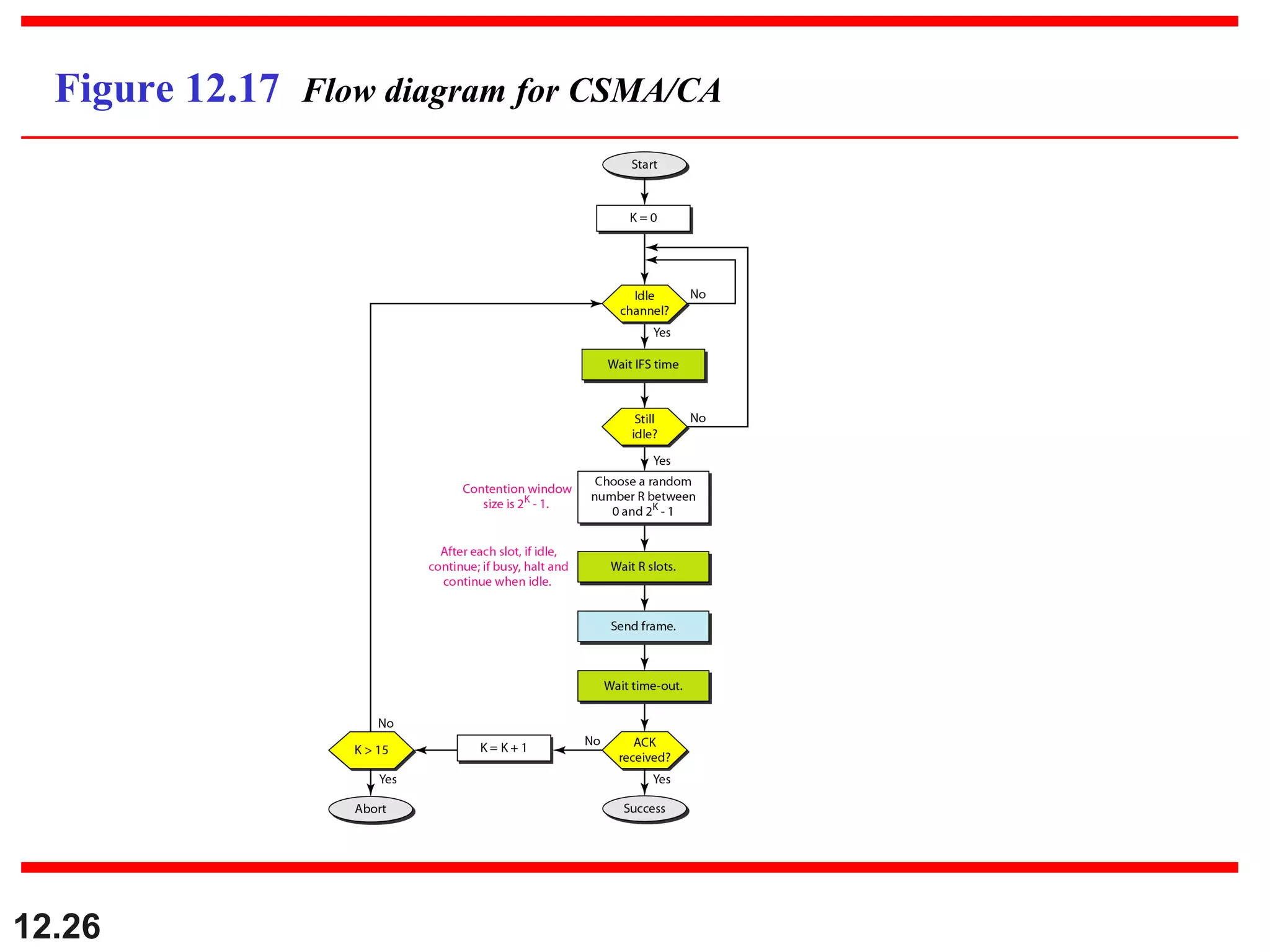
Figure 12.17 Flow diagram for CSMA/CA
12.27
CONTROLLED ACCESSCONTROLLED ACCESS
InIn controlled accesscontrolled access, the stations consult one another, the stations consult one another
to find which station has the right to send. A stationto find which station has the right to send. A station
cannot send unless it has been authorized by othercannot send unless it has been authorized by other
stations. We discuss three popular controlled-accessstations. We discuss three popular controlled-access
methods.methods.
Reservation
Polling
Token Passing
Topics discussed in this section:Topics discussed in this section:
12.28
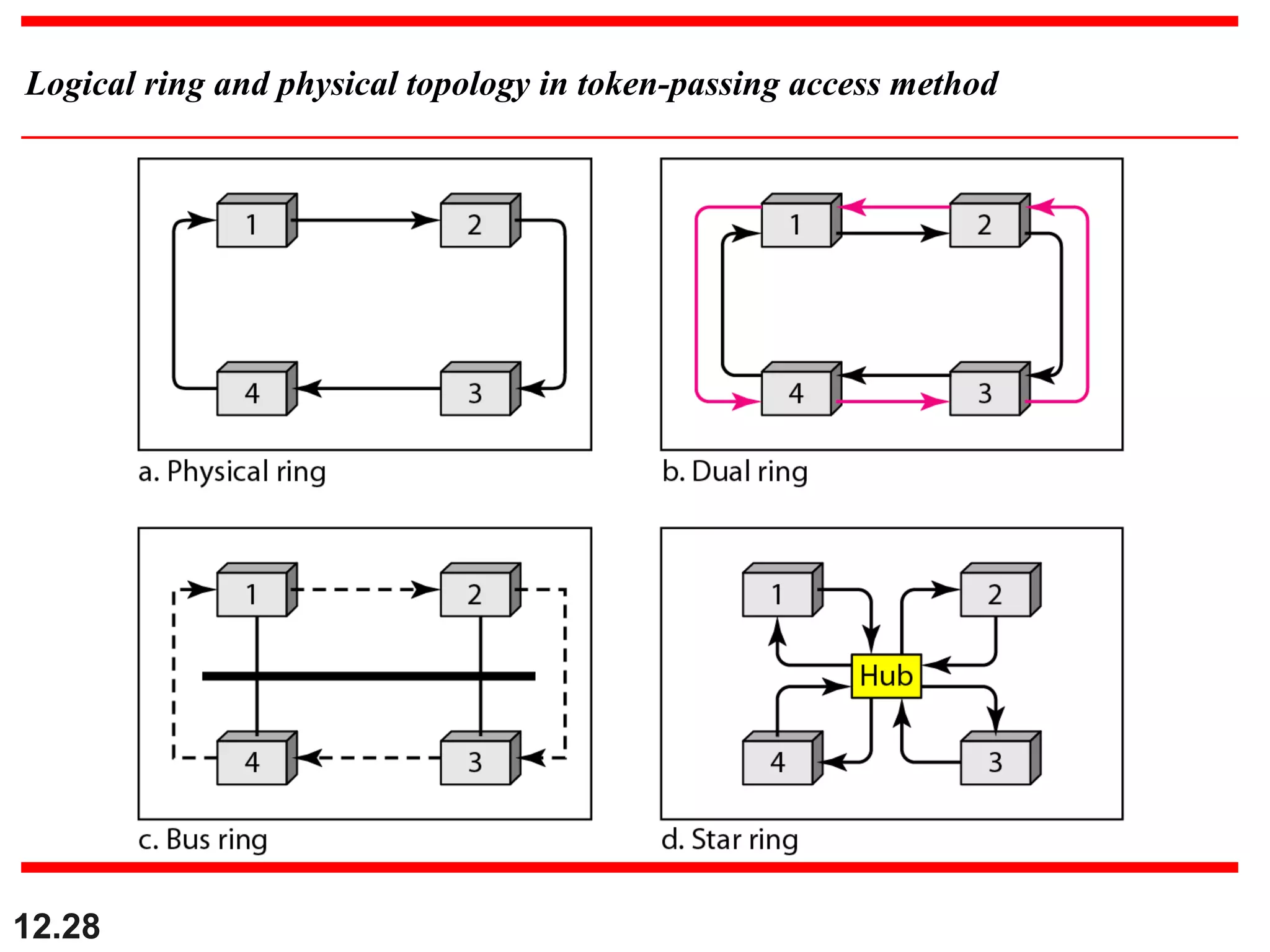
Logical ring and physical topology in token-passing access method
Computer Science & Engineering
Assignment
Semester- VI (I & II) Branch: CSE
Subject with Code: Computer Networks (IT-305-F)
-----------------------------------------------------------------------------------------------
Q:1 Explain Lacal Area Network.
Q:2 Explain IEEE 802 standards in Detail.

multiple access

  • 1.
    12.1 Multiple Access Copyright ©The McGraw-Hill Companies, Inc. Permission required for reproduction or display.
  • 2.
    12.2 Data link layerdivided into two functionality-oriented sublayers
  • 3.
    12.3 Taxonomy of multiple-accessprotocols discussed in this chapter
  • 4.
    12.4 RANDOM ACCESSRANDOM ACCESS InInrandom accessrandom access oror contentioncontention methods, no station ismethods, no station is superior to another station and none is assigned thesuperior to another station and none is assigned the control over another. No station permits, or does notcontrol over another. No station permits, or does not permit, another station to send. At each instance, apermit, another station to send. At each instance, a station that has data to send uses a procedure definedstation that has data to send uses a procedure defined by the protocol to make a decision on whether or notby the protocol to make a decision on whether or not to send.to send. ALOHA Carrier Sense Multiple Access Carrier Sense Multiple Access with Collision Detection Carrier Sense Multiple Access with Collision Avoidance Topics discussed in this section:Topics discussed in this section:
  • 5.
    12.5 To avoid accessconflict or to resolve it when itTo avoid access conflict or to resolve it when it happens, each station follows a procedure that answerhappens, each station follows a procedure that answer the following questions:the following questions:  When can the station access the medium.When can the station access the medium. What can the station do if the medium is busy.What can the station do if the medium is busy. How can the station determine the success or failureHow can the station determine the success or failure of the transmission.of the transmission. What can the station do if there is an access conflict.What can the station do if there is an access conflict.
  • 6.
    12.6 ALOHA ALOHA, the earliestrandom access method, was developed at the University of Hawaii in early 1970. It was designed for a radio (wireless) LAN, but it can be used on any shared medium. Pure ALOHA Slotted ALOHA
  • 7.
    12.7 Frames in apure ALOHA network
  • 8.
  • 9.
    12.9 Vulnerable time forpure ALOHA protocol The Vulnerable time, in which there is possibility of collision
  • 10.
  • 11.
    12.11 Frames in aslotted ALOHA network
  • 12.
    12.12 Figure 12.7 Vulnerabletime for slotted ALOHA protocol
  • 13.
  • 14.
    12.14 Space/time model ofthe collision in CSMA
  • 15.
  • 16.
    12.16 Persistence Method What Shoulda station do if the channel is busy. What should a station do if the channel is idle. 1-Persistence Method Non Persistence Method p-Persistence Method
  • 17.
    12.17 Behavior of threepersistence methods
  • 18.
    12.18 Flow diagram forthree persistence methods
  • 19.
    12.19 Collision of thefirst bit in CSMA/CD
  • 20.
  • 21.
  • 22.
    12.22 Figure 12.15 Energylevel during transmission, idleness, or collision
  • 23.
    12.23 Figure 12.16 Timingin CSMA/CA Interframe Space (IFS)
  • 24.
    12.24 In CSMA/CA, theIFS can also be used to define the priority of a station or a frame. Note
  • 25.
    12.25 In CSMA/CA, ifthe station finds the channel busy, it does not restart the timer of the contention window; it stops the timer and restarts it when the channel becomes idle. Note
  • 26.
    12.26 Figure 12.17 Flowdiagram for CSMA/CA
  • 27.
    12.27 CONTROLLED ACCESSCONTROLLED ACCESS InIncontrolled accesscontrolled access, the stations consult one another, the stations consult one another to find which station has the right to send. A stationto find which station has the right to send. A station cannot send unless it has been authorized by othercannot send unless it has been authorized by other stations. We discuss three popular controlled-accessstations. We discuss three popular controlled-access methods.methods. Reservation Polling Token Passing Topics discussed in this section:Topics discussed in this section:
  • 28.
    12.28 Logical ring andphysical topology in token-passing access method
  • 29.
    Computer Science &Engineering Assignment Semester- VI (I & II) Branch: CSE Subject with Code: Computer Networks (IT-305-F) ----------------------------------------------------------------------------------------------- Q:1 Explain Lacal Area Network. Q:2 Explain IEEE 802 standards in Detail.