Chapter 11 Link-Level Flow and Error Control
1
Chapter 11Chapter 11
Link-Level Flow and Error
Control
Chapter 11 Link-Level Flow and Error Control
2
IntroductionIntroduction
The need for flow and error control
Link control mechanisms
Performance of ARQ (Automatic Repeat
Request)
Chapter 11 Link-Level Flow and Error Control
3
Flow Control and Error ControlFlow Control and Error Control
 Fundamental mechanisms that determine
performance
 Can be implemented at different levels:
link, network, or application
 Difficult to model performance
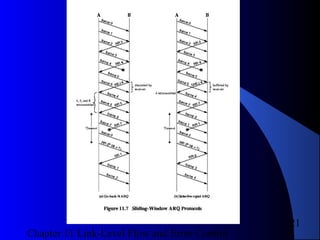
 Simplest case: point-to-point link
– Constant propagation
– Constant data rate
– Probabilistic error rate
– Traffic characteristics
Chapter 11 Link-Level Flow and Error Control
4
Flow ControlFlow Control
Limits the amount or rate of data that is
sent
Reasons:
– Source may send PDUs faster than destination
can process headers
– Higher-level protocol user at destination may
be slow in retrieving data
– Destination may need to limit incoming flow
to match outgoing flow for retransmission
Chapter 11 Link-Level Flow and Error Control
5
Flow Control at Multiple ProtocolFlow Control at Multiple Protocol
LayersLayers
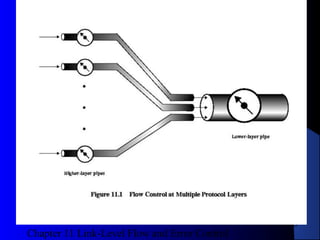
X.25 virtual circuits (level 3) multiplexed
over a data link using LAPB (X.25 level 2)
Multiple TCP connections over HDLC
link
Flow control at higher level applied to
each logical connection independently
Flow control at lower level applied to total
traffic
Chapter 11 Link-Level Flow and Error Control
6
Figure 11.1Figure 11.1
Chapter 11 Link-Level Flow and Error Control
7
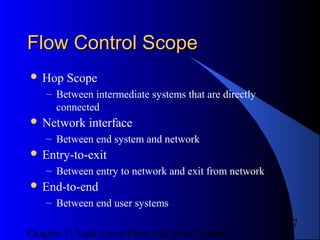
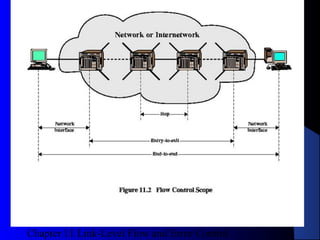
Flow Control ScopeFlow Control Scope
 Hop Scope
– Between intermediate systems that are directly
connected
 Network interface
– Between end system and network
 Entry-to-exit
– Between entry to network and exit from network
 End-to-end
– Between end user systems
Chapter 11 Link-Level Flow and Error Control
8
Figure 11.2Figure 11.2
Chapter 11 Link-Level Flow and Error Control
9
Error ControlError Control
Used to recover lost or damaged PDUs
Involves error detection and PDU
retransmission
Implemented together with flow control in
a single mechanism
Performed at various protocol levels
Chapter 11 Link-Level Flow and Error Control
10
Link Control MechanismsLink Control Mechanisms
3 techniques at link level:
 Stop-and-wait
 Go-back-N
 Selective-reject
Latter 2 are special cases of sliding-window
Assume 2 end systems connected by direct link
Chapter 11 Link-Level Flow and Error Control
11
Sequence of FramesSequence of Frames
Source breaks up message into sequence of
frames
Buffer size of receiver may be limited
Longer transmission are more likely to
have an error
On a shared medium, avoids one station
monopolizing medium
Chapter 11 Link-Level Flow and Error Control
12
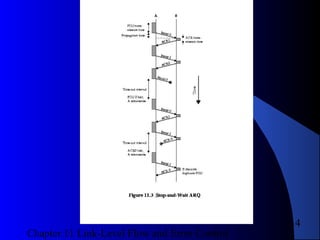
Stop and WaitStop and Wait
Source transmits frame
After reception, destination indicates
willingness to accept another frame in
acknowledgement
Source must wait for acknowledgement
before sending another frame
2 kinds of errors:
– Damaged frame at destination
– Damaged acknowledgement at source
Chapter 11 Link-Level Flow and Error Control
13
ARQARQ
Automatic Repeat Request
Uses:
– Error detection
– Timers
– Acknowledgements
– Retransmissions
Chapter 11 Link-Level Flow and Error Control
14
Figure 11.3Figure 11.3
Chapter 11 Link-Level Flow and Error Control
15
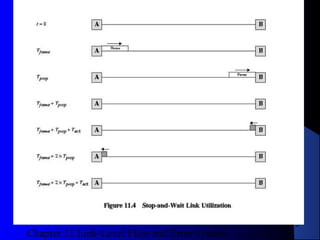
Figure 11.4Figure 11.4
Chapter 11 Link-Level Flow and Error Control
16
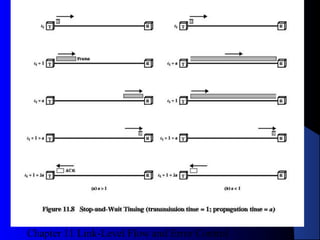
Stop-and-Wait Link UtilizationStop-and-Wait Link Utilization
If Tproplarge relative to Tframe then throughput
reduced
If propagation delay is long relative to
transmission time, line is mostly idle
Problem is only one frame in transit at a
time
Stop-and-Wait rarely used because of
inefficiency
Chapter 11 Link-Level Flow and Error Control
17
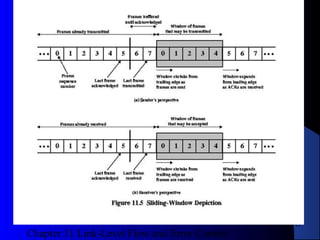
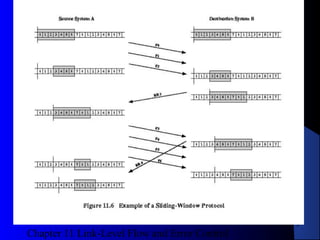
Sliding Window TechniquesSliding Window Techniques
Allow multiple frames to be in transit at
the same time
Source can send n frames without waiting
for acknowledgements
Destination can accept n frames
Destination acknowledges a frame by
sending acknowledgement with sequence
number of next frame expected (and
implicitly ready for next n frames)
Chapter 11 Link-Level Flow and Error Control
18
Figure 11.5Figure 11.5
Chapter 11 Link-Level Flow and Error Control
19
Figure 11.6Figure 11.6
Chapter 11 Link-Level Flow and Error Control
20
Go-back-N ARQGo-back-N ARQ
 Most common form of error control based on
sliding window
 Number of un-acknowledged frames determined
by window size
 Upon receiving a frame in error, destination
discards that frame and all subsequent frames
until damaged frame received correctly
 Sender resends frame (and all subsequent frames)
either when it receives a Reject message or timer
expires
Chapter 11 Link-Level Flow and Error Control
21
Figure 11.7Figure 11.7
Chapter 11 Link-Level Flow and Error Control
22
Figure 11.8Figure 11.8
Chapter 11 Link-Level Flow and Error Control
23
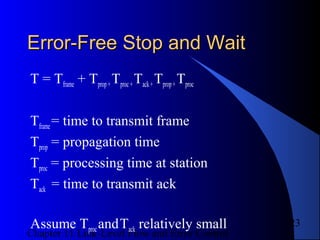
Error-Free Stop and WaitError-Free Stop and Wait
T = Tframe + Tprop+Tproc+Tack+Tprop+Tproc
Tframe= time to transmit frame
Tprop = propagation time
Tproc = processing time at station
Tack = time to transmit ack
Assume TprocandTack relatively small
Chapter 11 Link-Level Flow and Error Control
24
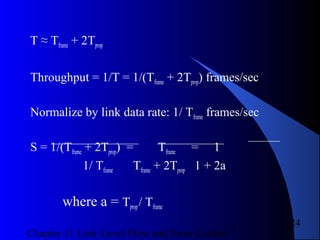
T ≈ Tframe + 2Tprop
Throughput = 1/T = 1/(Tframe + 2Tprop) frames/sec
Normalize by link data rate: 1/ Tframe frames/sec
S = 1/(Tframe + 2Tprop) = Tframe = 1
1/ Tframe Tframe + 2Tprop 1 + 2a
where a = Tprop/ Tframe
Chapter 11 Link-Level Flow and Error Control
25
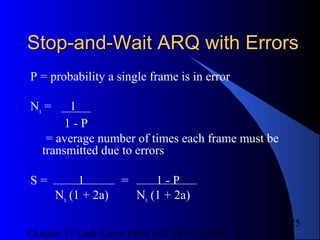
Stop-and-Wait ARQ with ErrorsStop-and-Wait ARQ with Errors
P = probability a single frame is in error
Nx = 1
1 - P
= average number of times each frame must be
transmitted due to errors
S = 1 = 1 - P
Nx (1 + 2a) Nx (1 + 2a)
Chapter 11 Link-Level Flow and Error Control
26
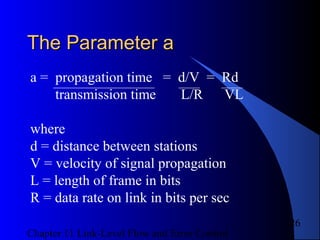
The Parameter aThe Parameter a
a = propagation time = d/V = Rd
transmission time L/R VL
where
d = distance between stations
V = velocity of signal propagation
L = length of frame in bits
R = data rate on link in bits per sec
Chapter 11 Link-Level Flow and Error Control
27
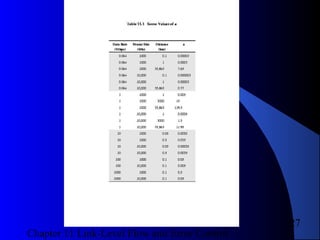
Table 11.1Table 11.1
Chapter 11 Link-Level Flow and Error Control
28
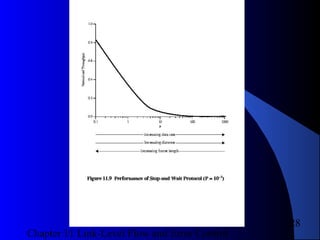
Figure 11.9Figure 11.9
Chapter 11 Link-Level Flow and Error Control
29
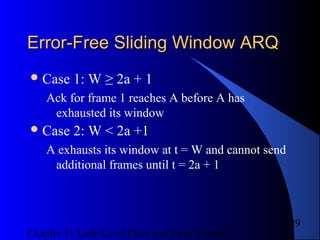
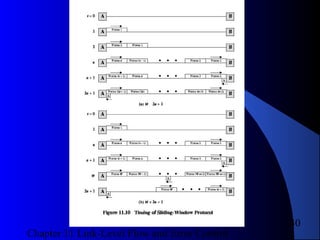
Error-Free Sliding Window ARQError-Free Sliding Window ARQ
Case 1: W ≥ 2a + 1
Ack for frame 1 reaches A before A has
exhausted its window
Case 2: W < 2a +1
A exhausts its window at t = W and cannot send
additional frames until t = 2a + 1
Chapter 11 Link-Level Flow and Error Control
30
Figure 11.10Figure 11.10
Chapter 11 Link-Level Flow and Error Control
31
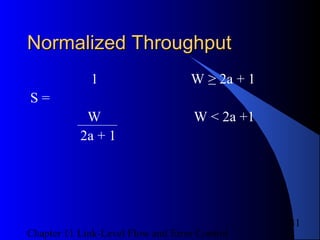
Normalized ThroughputNormalized Throughput
1 W ≥ 2a + 1
S =
W W < 2a +1
2a + 1
Chapter 11 Link-Level Flow and Error Control
32
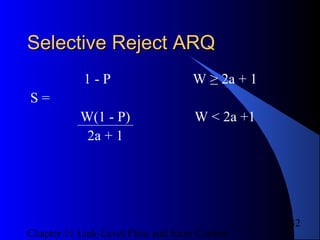
Selective Reject ARQSelective Reject ARQ
1 - P W ≥ 2a + 1
S =
W(1 - P) W < 2a +1
2a + 1
Chapter 11 Link-Level Flow and Error Control
33
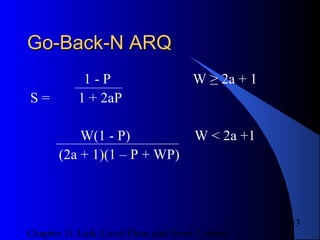
Go-Back-N ARQGo-Back-N ARQ
1 - P W ≥ 2a + 1
S = 1 + 2aP
W(1 - P) W < 2a +1
(2a + 1)(1 – P + WP)
Chapter 11 Link-Level Flow and Error Control
34
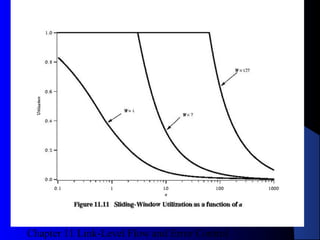
Figure 11.11Figure 11.11
Chapter 11 Link-Level Flow and Error Control
35
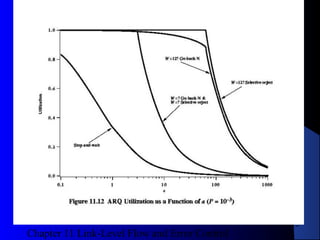
Figure 11.12Figure 11.12
Chapter 11 Link-Level Flow and Error Control
36
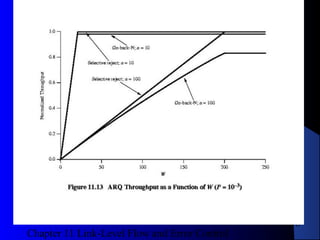
Figure 11.13Figure 11.13
Chapter 11 Link-Level Flow and Error Control
37
High-Level Data Link ControlHigh-Level Data Link Control
HDLC is the most important data link
control protocol
Widely used which forms basis of other
data link control protocols
Chapter 11 Link-Level Flow and Error Control
38
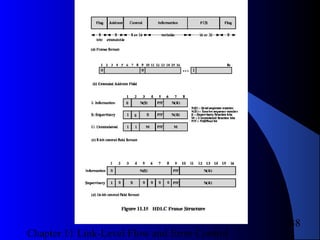
Figure 11.15Figure 11.15
Chapter 11 Link-Level Flow and Error Control
39
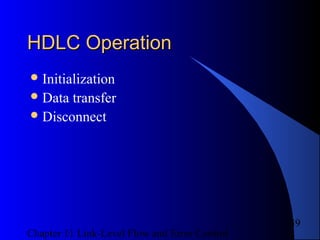
HDLC OperationHDLC Operation
Initialization
Data transfer
Disconnect
Chapter 11 Link-Level Flow and Error Control
40
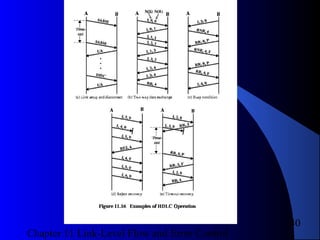
Figure 11.16Figure 11.16

Link-Level Flow and Error Control Chapter11

  • 1.
    Chapter 11 Link-LevelFlow and Error Control 1 Chapter 11Chapter 11 Link-Level Flow and Error Control
  • 2.
    Chapter 11 Link-LevelFlow and Error Control 2 IntroductionIntroduction The need for flow and error control Link control mechanisms Performance of ARQ (Automatic Repeat Request)
  • 3.
    Chapter 11 Link-LevelFlow and Error Control 3 Flow Control and Error ControlFlow Control and Error Control  Fundamental mechanisms that determine performance  Can be implemented at different levels: link, network, or application  Difficult to model performance  Simplest case: point-to-point link – Constant propagation – Constant data rate – Probabilistic error rate – Traffic characteristics
  • 4.
    Chapter 11 Link-LevelFlow and Error Control 4 Flow ControlFlow Control Limits the amount or rate of data that is sent Reasons: – Source may send PDUs faster than destination can process headers – Higher-level protocol user at destination may be slow in retrieving data – Destination may need to limit incoming flow to match outgoing flow for retransmission
  • 5.
    Chapter 11 Link-LevelFlow and Error Control 5 Flow Control at Multiple ProtocolFlow Control at Multiple Protocol LayersLayers X.25 virtual circuits (level 3) multiplexed over a data link using LAPB (X.25 level 2) Multiple TCP connections over HDLC link Flow control at higher level applied to each logical connection independently Flow control at lower level applied to total traffic
  • 6.
    Chapter 11 Link-LevelFlow and Error Control 6 Figure 11.1Figure 11.1
  • 7.
    Chapter 11 Link-LevelFlow and Error Control 7 Flow Control ScopeFlow Control Scope  Hop Scope – Between intermediate systems that are directly connected  Network interface – Between end system and network  Entry-to-exit – Between entry to network and exit from network  End-to-end – Between end user systems
  • 8.
    Chapter 11 Link-LevelFlow and Error Control 8 Figure 11.2Figure 11.2
  • 9.
    Chapter 11 Link-LevelFlow and Error Control 9 Error ControlError Control Used to recover lost or damaged PDUs Involves error detection and PDU retransmission Implemented together with flow control in a single mechanism Performed at various protocol levels
  • 10.
    Chapter 11 Link-LevelFlow and Error Control 10 Link Control MechanismsLink Control Mechanisms 3 techniques at link level:  Stop-and-wait  Go-back-N  Selective-reject Latter 2 are special cases of sliding-window Assume 2 end systems connected by direct link
  • 11.
    Chapter 11 Link-LevelFlow and Error Control 11 Sequence of FramesSequence of Frames Source breaks up message into sequence of frames Buffer size of receiver may be limited Longer transmission are more likely to have an error On a shared medium, avoids one station monopolizing medium
  • 12.
    Chapter 11 Link-LevelFlow and Error Control 12 Stop and WaitStop and Wait Source transmits frame After reception, destination indicates willingness to accept another frame in acknowledgement Source must wait for acknowledgement before sending another frame 2 kinds of errors: – Damaged frame at destination – Damaged acknowledgement at source
  • 13.
    Chapter 11 Link-LevelFlow and Error Control 13 ARQARQ Automatic Repeat Request Uses: – Error detection – Timers – Acknowledgements – Retransmissions
  • 14.
    Chapter 11 Link-LevelFlow and Error Control 14 Figure 11.3Figure 11.3
  • 15.
    Chapter 11 Link-LevelFlow and Error Control 15 Figure 11.4Figure 11.4
  • 16.
    Chapter 11 Link-LevelFlow and Error Control 16 Stop-and-Wait Link UtilizationStop-and-Wait Link Utilization If Tproplarge relative to Tframe then throughput reduced If propagation delay is long relative to transmission time, line is mostly idle Problem is only one frame in transit at a time Stop-and-Wait rarely used because of inefficiency
  • 17.
    Chapter 11 Link-LevelFlow and Error Control 17 Sliding Window TechniquesSliding Window Techniques Allow multiple frames to be in transit at the same time Source can send n frames without waiting for acknowledgements Destination can accept n frames Destination acknowledges a frame by sending acknowledgement with sequence number of next frame expected (and implicitly ready for next n frames)
  • 18.
    Chapter 11 Link-LevelFlow and Error Control 18 Figure 11.5Figure 11.5
  • 19.
    Chapter 11 Link-LevelFlow and Error Control 19 Figure 11.6Figure 11.6
  • 20.
    Chapter 11 Link-LevelFlow and Error Control 20 Go-back-N ARQGo-back-N ARQ  Most common form of error control based on sliding window  Number of un-acknowledged frames determined by window size  Upon receiving a frame in error, destination discards that frame and all subsequent frames until damaged frame received correctly  Sender resends frame (and all subsequent frames) either when it receives a Reject message or timer expires
  • 21.
    Chapter 11 Link-LevelFlow and Error Control 21 Figure 11.7Figure 11.7
  • 22.
    Chapter 11 Link-LevelFlow and Error Control 22 Figure 11.8Figure 11.8
  • 23.
    Chapter 11 Link-LevelFlow and Error Control 23 Error-Free Stop and WaitError-Free Stop and Wait T = Tframe + Tprop+Tproc+Tack+Tprop+Tproc Tframe= time to transmit frame Tprop = propagation time Tproc = processing time at station Tack = time to transmit ack Assume TprocandTack relatively small
  • 24.
    Chapter 11 Link-LevelFlow and Error Control 24 T ≈ Tframe + 2Tprop Throughput = 1/T = 1/(Tframe + 2Tprop) frames/sec Normalize by link data rate: 1/ Tframe frames/sec S = 1/(Tframe + 2Tprop) = Tframe = 1 1/ Tframe Tframe + 2Tprop 1 + 2a where a = Tprop/ Tframe
  • 25.
    Chapter 11 Link-LevelFlow and Error Control 25 Stop-and-Wait ARQ with ErrorsStop-and-Wait ARQ with Errors P = probability a single frame is in error Nx = 1 1 - P = average number of times each frame must be transmitted due to errors S = 1 = 1 - P Nx (1 + 2a) Nx (1 + 2a)
  • 26.
    Chapter 11 Link-LevelFlow and Error Control 26 The Parameter aThe Parameter a a = propagation time = d/V = Rd transmission time L/R VL where d = distance between stations V = velocity of signal propagation L = length of frame in bits R = data rate on link in bits per sec
  • 27.
    Chapter 11 Link-LevelFlow and Error Control 27 Table 11.1Table 11.1
  • 28.
    Chapter 11 Link-LevelFlow and Error Control 28 Figure 11.9Figure 11.9
  • 29.
    Chapter 11 Link-LevelFlow and Error Control 29 Error-Free Sliding Window ARQError-Free Sliding Window ARQ Case 1: W ≥ 2a + 1 Ack for frame 1 reaches A before A has exhausted its window Case 2: W < 2a +1 A exhausts its window at t = W and cannot send additional frames until t = 2a + 1
  • 30.
    Chapter 11 Link-LevelFlow and Error Control 30 Figure 11.10Figure 11.10
  • 31.
    Chapter 11 Link-LevelFlow and Error Control 31 Normalized ThroughputNormalized Throughput 1 W ≥ 2a + 1 S = W W < 2a +1 2a + 1
  • 32.
    Chapter 11 Link-LevelFlow and Error Control 32 Selective Reject ARQSelective Reject ARQ 1 - P W ≥ 2a + 1 S = W(1 - P) W < 2a +1 2a + 1
  • 33.
    Chapter 11 Link-LevelFlow and Error Control 33 Go-Back-N ARQGo-Back-N ARQ 1 - P W ≥ 2a + 1 S = 1 + 2aP W(1 - P) W < 2a +1 (2a + 1)(1 – P + WP)
  • 34.
    Chapter 11 Link-LevelFlow and Error Control 34 Figure 11.11Figure 11.11
  • 35.
    Chapter 11 Link-LevelFlow and Error Control 35 Figure 11.12Figure 11.12
  • 36.
    Chapter 11 Link-LevelFlow and Error Control 36 Figure 11.13Figure 11.13
  • 37.
    Chapter 11 Link-LevelFlow and Error Control 37 High-Level Data Link ControlHigh-Level Data Link Control HDLC is the most important data link control protocol Widely used which forms basis of other data link control protocols
  • 38.
    Chapter 11 Link-LevelFlow and Error Control 38 Figure 11.15Figure 11.15
  • 39.
    Chapter 11 Link-LevelFlow and Error Control 39 HDLC OperationHDLC Operation Initialization Data transfer Disconnect
  • 40.
    Chapter 11 Link-LevelFlow and Error Control 40 Figure 11.16Figure 11.16