20.1
IPv4
The Internet Protocol version 4 (IPv4) is the delivery
mechanism used by the TCP/IP protocols.
Datagram
Fragmentation
Checksum
Options
Topics discussed in this section:
20.2
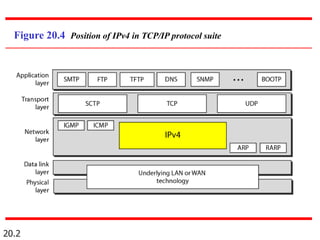
Figure 20.4 Position of IPv4 in TCP/IP protocol suite
20.3
IPv4 in TCP/IP protocol suite
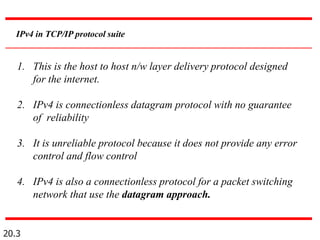
1. This is the host to host n/w layer delivery protocol designed
for the internet.
2. IPv4 is connectionless datagram protocol with no guarantee
of reliability
3. It is unreliable protocol because it does not provide any error
control and flow control
4. IPv4 is also a connectionless protocol for a packet switching
network that use the datagram approach.
20.4
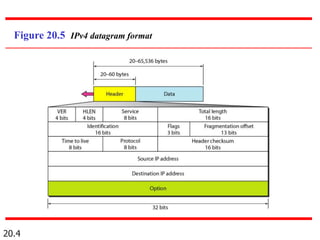
Figure 20.5 IPv4 datagram format
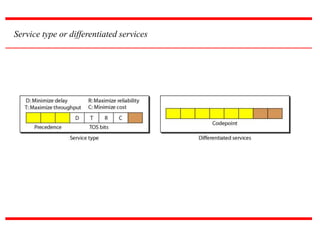
Service type or differentiated services
20.6
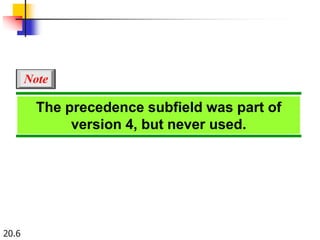
The precedence subfield was part of
version 4, but never used.
Note
20.7
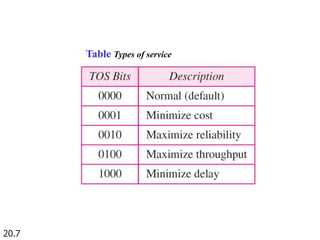
Table Types of service
20.8
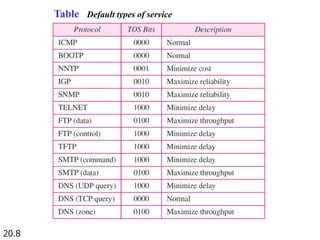
Table Default types of service
20.9
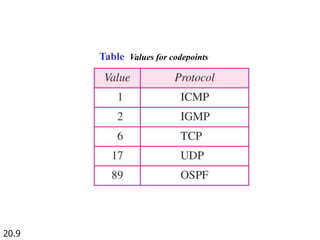
Table Values for codepoints
20.10
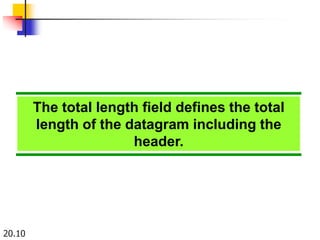
The total length field defines the total
length of the datagram including the
header.
20.11
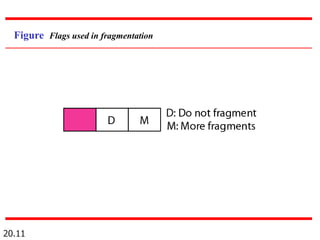
Figure Flags used in fragmentation
21.12
ADDRESS MAPPING
The delivery of a packet to a host or a router requires
two levels of addressing: logical and physical. We need
to be able to map a logical address to its corresponding
physical address and vice versa. This can be done by
using either static or dynamic mapping.
Mapping Logical to Physical Address
Mapping Physical to Logical Address
Topics discussed in this section:
21.13
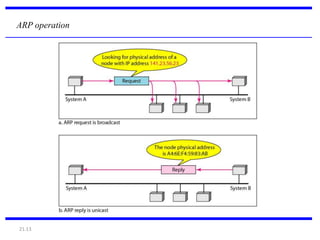
ARP operation
21.14
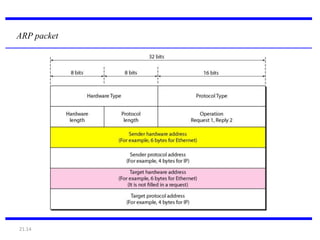
ARP packet
21.15
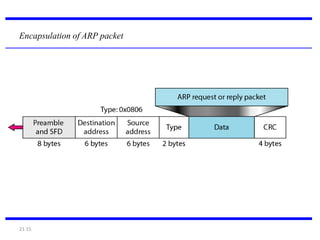
Encapsulation of ARP packet
21.16
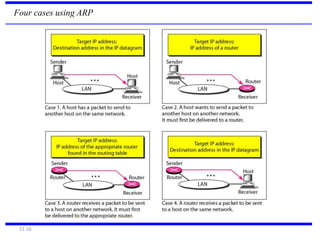
Four cases using ARP
21.17
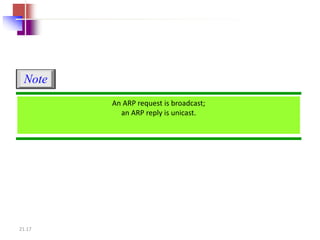
An ARP request is broadcast;
an ARP reply is unicast.
Note
21.18
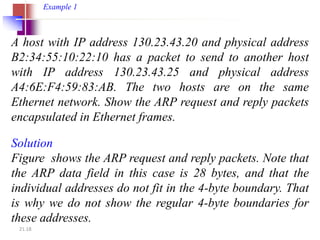
A host with IP address 130.23.43.20 and physical address
B2:34:55:10:22:10 has a packet to send to another host
with IP address 130.23.43.25 and physical address
A4:6E:F4:59:83:AB. The two hosts are on the same
Ethernet network. Show the ARP request and reply packets
encapsulated in Ethernet frames.
Solution
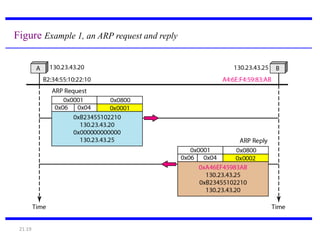
Figure shows the ARP request and reply packets. Note that
the ARP data field in this case is 28 bytes, and that the
individual addresses do not fit in the 4-byte boundary. That
is why we do not show the regular 4-byte boundaries for
these addresses.
Example 1
21.19
Figure Example 1, an ARP request and reply

ipv4

  • 1.
    20.1 IPv4 The Internet Protocolversion 4 (IPv4) is the delivery mechanism used by the TCP/IP protocols. Datagram Fragmentation Checksum Options Topics discussed in this section:
  • 2.
    20.2 Figure 20.4 Positionof IPv4 in TCP/IP protocol suite
  • 3.
    20.3 IPv4 in TCP/IPprotocol suite 1. This is the host to host n/w layer delivery protocol designed for the internet. 2. IPv4 is connectionless datagram protocol with no guarantee of reliability 3. It is unreliable protocol because it does not provide any error control and flow control 4. IPv4 is also a connectionless protocol for a packet switching network that use the datagram approach.
  • 4.
    20.4 Figure 20.5 IPv4datagram format
  • 5.
    Service type ordifferentiated services
  • 6.
    20.6 The precedence subfieldwas part of version 4, but never used. Note
  • 7.
  • 8.
  • 9.
  • 10.
    20.10 The total lengthfield defines the total length of the datagram including the header.
  • 11.
    20.11 Figure Flags usedin fragmentation
  • 12.
    21.12 ADDRESS MAPPING The deliveryof a packet to a host or a router requires two levels of addressing: logical and physical. We need to be able to map a logical address to its corresponding physical address and vice versa. This can be done by using either static or dynamic mapping. Mapping Logical to Physical Address Mapping Physical to Logical Address Topics discussed in this section:
  • 13.
  • 14.
  • 15.
  • 16.
  • 17.
    21.17 An ARP requestis broadcast; an ARP reply is unicast. Note
  • 18.
    21.18 A host withIP address 130.23.43.20 and physical address B2:34:55:10:22:10 has a packet to send to another host with IP address 130.23.43.25 and physical address A4:6E:F4:59:83:AB. The two hosts are on the same Ethernet network. Show the ARP request and reply packets encapsulated in Ethernet frames. Solution Figure shows the ARP request and reply packets. Note that the ARP data field in this case is 28 bytes, and that the individual addresses do not fit in the 4-byte boundary. That is why we do not show the regular 4-byte boundaries for these addresses. Example 1
  • 19.
    21.19 Figure Example 1,an ARP request and reply