Computer Science & Engineering
Computer Networks
(IT-305-F)
Hansraj Yadav
Computer Network
Syllabus
Section-A
OSI Reference Model and Network Architecture: Introduction to Computer Networks, Example networks ARPANET,
Internet, Private Networks, Network Topologies: Bus-, Star-, Ring-, Hybrid -, Tree -, Complete -, Irregular –Topology; Types of
Networks : Local Area Networks, Metropolitan Area Networks, Wide Area Networks; Layering architecture of networks, OSI
model, Functions of each layer, Services and Protocols of each layer
Section-B
TCP/IP: Introduction, History of TCP/IP, Layers of TCP/IP, Protocols, Internet Protocol, Transmission Control Protocol ,
User Datagram Protocol, IP Addressing, IP address classes, Subnet Addressing, Internet Control Protocols, ARP, RARP,
ICMP, Application Layer, Domain Name System, Email – SMTP, POP,IMAP; FTP, NNTP, HTTP, Overview of IP version 6.
Section-C
Local Area Networks: Introduction to LANs, Features of LANs, Components of LANs, Usage of LANs, LAN Standards,
IEEE 802 standards, Channel Access Methods, Aloha, CSMA, CSMA/CD, Token Passing, Ethernet, Layer 2 & 3 switching,
Fast Ethernet and Gigabit Ethernet, Token Ring, LAN interconnecting devices: Hubs, Switches, Bridges, Routers, Gateways.
Wide Area Networks: Introduction of WANs, Routing, Congestion Control, WAN Technologies, Distributed Queue Dual Bus
(DQDB),
Section-D
Synchronous Digital Hierarchy (SDH)/ Synchronous Optical Network (SONET), Asynchronous Transfer Mode (ATM), Frame
Relay.,Wireless Links.
Introduction to Network Management: Remote Monitoring Techniques: Polling, Traps, Performance Management, Class of
Service, Quality of Service, Security management, Firewalls, VLANs, Proxy Servers, Introduction to Network Operating
Systems: Client-Server infrastructure, Windows NT/2000.
Dronacharya College of Engineering
Computer Network
Books
• Data Communication & Networking, Behrouz A
Forouzan
• Computer Networks, Tanenbaum Andrew S.
Dronacharya College of Engineering
Computer Network
A BRIEF HISTORY OF COMPUTER NETWORK
1960s (ARPANET)
In the 1960s, the Advanced Research Projects Agency (ARPA) started funding the
design of the Advanced Research Projects Agency Network (ARPANET) for the
United States Department of Defense
1969s
The Advanced Research Projects Agency Network (ARPANET), was the world's first
operational packet switching network and the core network of a set that came to compose the
global Internet. The network was funded by the Defense Advanced Research Projects Agency
(DARPA) of the United States Department of Defense for use by its projects at universities and
research laboratories in the US
The cable modem was introduced in 1996,
Dronacharya College of Engineering
Chapter 1
Introduction
• Computer Network
• Data Communication
• Networks
• Protocols
• Data Flow
Dronacharya College of Engineering
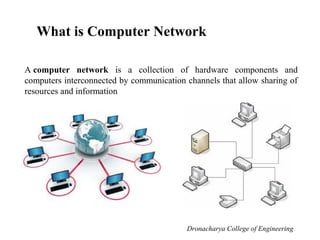
What is Computer Network
Dronacharya College of Engineering
A computer network is a collection of hardware components and
computers interconnected by communication channels that allow sharing of
resources and information
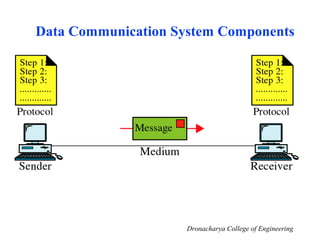
Data Communication System Components
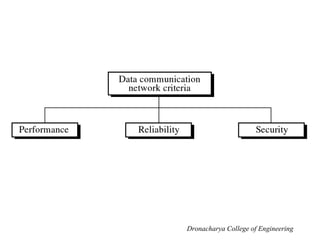
Data communication system depend on four fundamental characteristics
1.Delivery
2.Accuracy
3.Timeliness
4.Jitter
Data communication system has five component
1.Message
2.Sender
3.Receiver
4.Transmission Medium
5.Protocol
Dronacharya College of Engineering
Data Communication System Components
Dronacharya College of Engineering
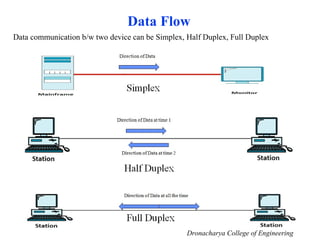
Data Flow
Data communication b/w two device can be Simplex, Half Duplex, Full Duplex
Dronacharya College of Engineering

computer networks

  • 1.
    Computer Science &Engineering Computer Networks (IT-305-F) Hansraj Yadav
  • 2.
    Computer Network Syllabus Section-A OSI ReferenceModel and Network Architecture: Introduction to Computer Networks, Example networks ARPANET, Internet, Private Networks, Network Topologies: Bus-, Star-, Ring-, Hybrid -, Tree -, Complete -, Irregular –Topology; Types of Networks : Local Area Networks, Metropolitan Area Networks, Wide Area Networks; Layering architecture of networks, OSI model, Functions of each layer, Services and Protocols of each layer Section-B TCP/IP: Introduction, History of TCP/IP, Layers of TCP/IP, Protocols, Internet Protocol, Transmission Control Protocol , User Datagram Protocol, IP Addressing, IP address classes, Subnet Addressing, Internet Control Protocols, ARP, RARP, ICMP, Application Layer, Domain Name System, Email – SMTP, POP,IMAP; FTP, NNTP, HTTP, Overview of IP version 6. Section-C Local Area Networks: Introduction to LANs, Features of LANs, Components of LANs, Usage of LANs, LAN Standards, IEEE 802 standards, Channel Access Methods, Aloha, CSMA, CSMA/CD, Token Passing, Ethernet, Layer 2 & 3 switching, Fast Ethernet and Gigabit Ethernet, Token Ring, LAN interconnecting devices: Hubs, Switches, Bridges, Routers, Gateways. Wide Area Networks: Introduction of WANs, Routing, Congestion Control, WAN Technologies, Distributed Queue Dual Bus (DQDB), Section-D Synchronous Digital Hierarchy (SDH)/ Synchronous Optical Network (SONET), Asynchronous Transfer Mode (ATM), Frame Relay.,Wireless Links. Introduction to Network Management: Remote Monitoring Techniques: Polling, Traps, Performance Management, Class of Service, Quality of Service, Security management, Firewalls, VLANs, Proxy Servers, Introduction to Network Operating Systems: Client-Server infrastructure, Windows NT/2000. Dronacharya College of Engineering
  • 3.
    Computer Network Books • DataCommunication & Networking, Behrouz A Forouzan • Computer Networks, Tanenbaum Andrew S. Dronacharya College of Engineering
  • 4.
    Computer Network A BRIEFHISTORY OF COMPUTER NETWORK 1960s (ARPANET) In the 1960s, the Advanced Research Projects Agency (ARPA) started funding the design of the Advanced Research Projects Agency Network (ARPANET) for the United States Department of Defense 1969s The Advanced Research Projects Agency Network (ARPANET), was the world's first operational packet switching network and the core network of a set that came to compose the global Internet. The network was funded by the Defense Advanced Research Projects Agency (DARPA) of the United States Department of Defense for use by its projects at universities and research laboratories in the US The cable modem was introduced in 1996, Dronacharya College of Engineering
  • 5.
    Chapter 1 Introduction • ComputerNetwork • Data Communication • Networks • Protocols • Data Flow Dronacharya College of Engineering
  • 6.
    What is ComputerNetwork Dronacharya College of Engineering A computer network is a collection of hardware components and computers interconnected by communication channels that allow sharing of resources and information
  • 7.
    Data Communication SystemComponents Data communication system depend on four fundamental characteristics 1.Delivery 2.Accuracy 3.Timeliness 4.Jitter Data communication system has five component 1.Message 2.Sender 3.Receiver 4.Transmission Medium 5.Protocol Dronacharya College of Engineering
  • 8.
    Data Communication SystemComponents Dronacharya College of Engineering
  • 9.
  • 10.
    Data Flow Data communicationb/w two device can be Simplex, Half Duplex, Full Duplex Dronacharya College of Engineering