Video Surveillance :
The Important Basics
Presentation Venue: Dronachaya College Of Engineering
Agenda
1. Why Video Surveillance?
2. Video Surveillance Application
3. Video Surveillance Solution Components
4. Services
5. Summary
1Why Video Surveillance?
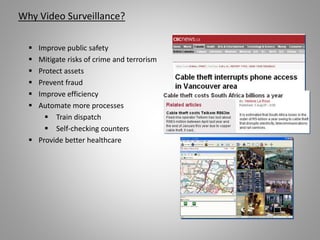
Why Video Surveillance?
 Improve public safety
 Mitigate risks of crime and terrorism
 Protect assets
 Prevent fraud
 Improve efficiency
 Automate more processes
 Train dispatch
 Self-checking counters
 Provide better healthcare
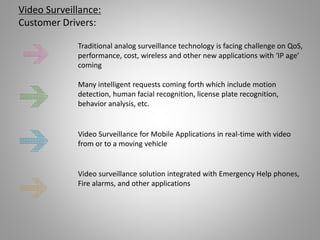
Video Surveillance:
Customer Drivers:
Traditional analog surveillance technology is facing challenge on QoS,
performance, cost, wireless and other new applications with ‘IP age’
coming
Video Surveillance for Mobile Applications in real-time with video
from or to a moving vehicle
Many intelligent requests coming forth which include motion
detection, human facial recognition, license plate recognition,
behavior analysis, etc.
Video surveillance solution integrated with Emergency Help phones,
Fire alarms, and other applications
2Video Surveillance Application
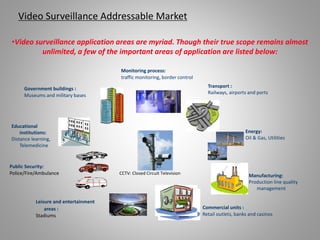
Video Surveillance Addressable Market
•Video surveillance application areas are myriad. Though their true scope remains almost
unlimited, a few of the important areas of application are listed below:
Monitoring process:
traffic monitoring, border control
Government buildings :
Museums and military bases
Manufacturing:
Production line quality
management
Commercial units :
Retail outlets, banks and casinos
Transport :
Railways, airports and ports
Educational
institutions:
Distance learning,
Telemedicine
Leisure and entertainment
areas :
Stadiums
Public Security:
Police/Fire/Ambulance
Energy:
Oil & Gas, Utilities
CCTV: Closed Circuit Television
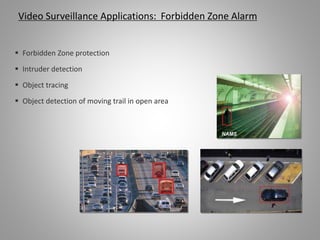
 Forbidden Zone protection
 Intruder detection
 Object tracing
 Object detection of moving trail in open area
Video Surveillance Applications: Forbidden Zone Alarm
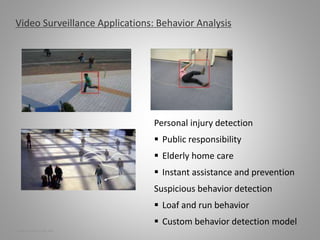
Personal injury detection
 Public responsibility
 Elderly home care
 Instant assistance and prevention
Suspicious behavior detection
 Loaf and run behavior
 Custom behavior detection model
Video Surveillance Applications: Behavior Analysis
9 | Video Surveillance | Sept. 2008
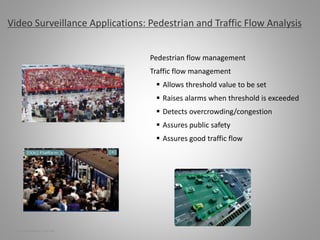
Pedestrian flow management
Traffic flow management
 Allows threshold value to be set
 Raises alarms when threshold is exceeded
 Detects overcrowding/congestion
 Assures public safety
 Assures good traffic flow
Video Surveillance Applications: Pedestrian and Traffic Flow Analysis
10 | Video Surveillance | Sept. 2008
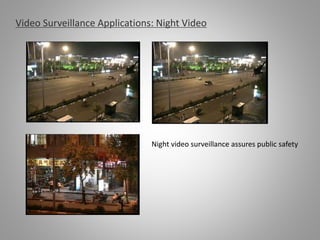
Video Surveillance Applications: Night Video
Night video surveillance assures public safety
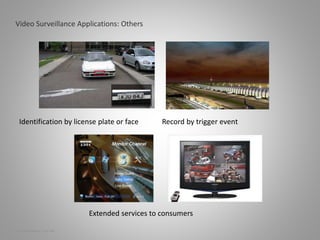
Video Surveillance Applications: Others
Record by trigger eventIdentification by license plate or face
Extended services to consumers
12 | Video Surveillance | Sept. 2008
3Video Surveillance Application
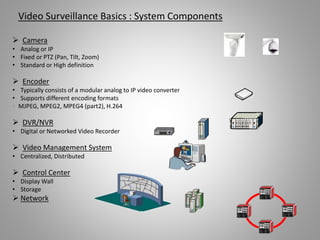
Video Surveillance Basics : System Components
 Camera
• Analog or IP
• Fixed or PTZ (Pan, Tilt, Zoom)
• Standard or High definition
 Encoder
• Typically consists of a modular analog to IP video converter
• Supports different encoding formats
• MJPEG, MPEG2, MPEG4 (part2), H.264
 DVR/NVR
• Digital or Networked Video Recorder
 Video Management System
• Centralized, Distributed
 Control Center
• Display Wall
• Storage
 Network
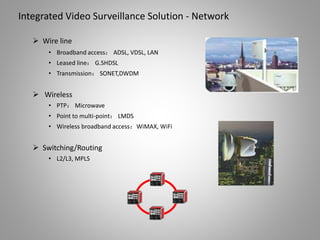
Integrated Video Surveillance Solution - Network
 Wire line
• Broadband access: ADSL, VDSL, LAN
• Leased line: G.SHDSL
• Transmission: SONET,DWDM
 Wireless
• PTP: Microwave
• Point to multi-point: LMDS
• Wireless broadband access:WiMAX, WiFi
 Switching/Routing
• L2/L3, MPLS
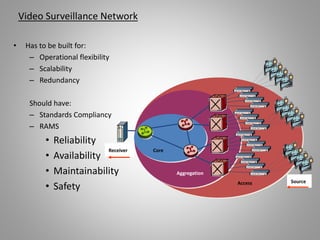
• Has to be built for:
– Operational flexibility
– Scalability
– Redundancy
Should have:
– Standards Compliancy
– RAMS
• Reliability
• Availability
• Maintainability
• Safety
Video Surveillance Network
Core
Aggregation
Access Receiver
Receiver
Source
Video Surveillance Bandwidth requirements
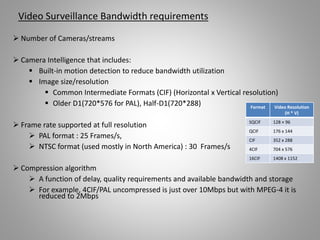
 Number of Cameras/streams
 Camera Intelligence that includes:
 Built-in motion detection to reduce bandwidth utilization
 Image size/resolution
 Common Intermediate Formats (CIF) (Horizontal x Vertical resolution)
 Older D1(720*576 for PAL), Half-D1(720*288)
 Frame rate supported at full resolution
 PAL format : 25 Frames/s,
 NTSC format (used mostly in North America) : 30 Frames/s
 Compression algorithm
 A function of delay, quality requirements and available bandwidth and storage
 For example, 4CIF/PAL uncompressed is just over 10Mbps but with MPEG-4 it is
reduced to 2Mbps
Format Video Resolution
(H * V)
SQCIF 128 × 96
QCIF 176 x 144
CIF 352 x 288
4CIF 704 x 576
16CIF 1408 x 1152
Video Surveillance Bandwidth requirements
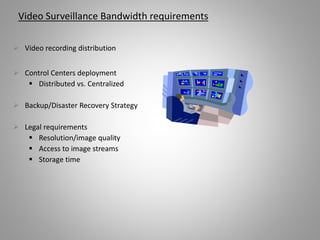
 Video recording distribution
 Control Centers deployment
 Distributed vs. Centralized
 Backup/Disaster Recovery Strategy
 Legal requirements
 Resolution/image quality
 Access to image streams
 Storage time
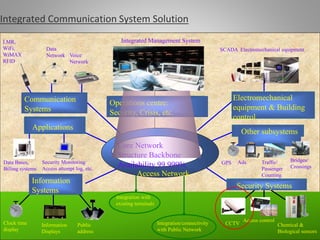
Integrated Communication System Solution
Operations centre:
Security, Crisis, etc.
CCTV Chemical &
Biological sensors
Security Systems
Access control
GPS
Other subsystems
Ads Traffic/
Passenger
Counting
Bridges/
Crossings
LMR,
WiFi,
WiMAX
RFID
Voice
Network
Communication
Systems
Data
Network
SCADA Electromechanical equipment
Electromechanical
equipment & Building
control
Integrated Management System
Public
address
Information
Displays
Information
Systems
Clock time
display
Integration with
existing terminals
Integration/connectivity
with Public Network
Applications
Data Bases,
Billing systems
Security Monitoring
Access attempt log, etc.
Access Network
Core Network
Structure Backbone
Availability 99.999%
4Video Surveillance Services
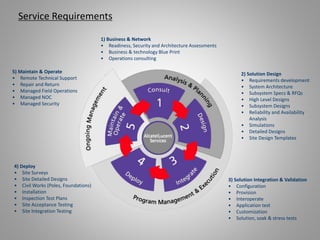
Service Requirements
1) Business & Network
• Readiness, Security and Architecture Assessments
• Business & technology Blue Print
• Operations consulting
2) Solution Design
• Requirements development
• System Architecture
• Subsystem Specs & RFQs
• High Level Designs
• Subsystem Designs
• Reliability and Availability
Analysis
• Simulations
• Detailed Designs
• Site Design Templates
3) Solution Integration & Validation
• Configuration
• Provision
• Interoperate
• Application test
• Customization
• Solution, soak & stress tests
4) Deploy
• Site Surveys
• Site Detailed Designs
• Civil Works (Poles, Foundations)
• Installation
• Inspection Test Plans
• Site Acceptance Testing
• Site Integration Testing
5) Maintain & Operate
• Remote Technical Support
• Repair and Return
• Managed Field Operations
• Managed NOC
• Managed Security
5Summary
Summary
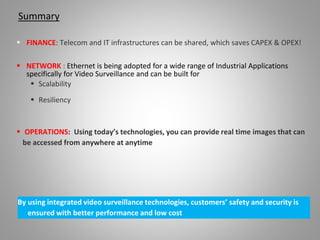
 FINANCE: Telecom and IT infrastructures can be shared, which saves CAPEX & OPEX!
 NETWORK : Ethernet is being adopted for a wide range of Industrial Applications
specifically for Video Surveillance and can be built for
 Scalability
 Resiliency
 OPERATIONS: Using today’s technologies, you can provide real time images that can
be accessed from anywhere at anytime
By using integrated video surveillance technologies, customers’ safety and security is
ensured with better performance and low cost
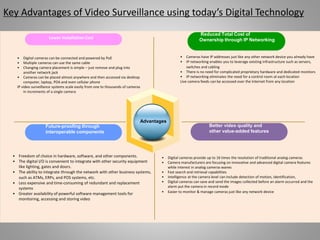
Key Advantages of Video Surveillance using today’s Digital Technology
Future-proofing through
interoperable components
Reduced Total Cost of
Ownership through IP Networking
Advantages
Lower Installation Cost
Better video quality and
other value-added features
• Digital cameras can be connected and powered by PoE
• Multiple cameras can use the same cable
• Changing camera placement is simple – just remove and plug into
another network jack
• Cameras can be placed almost anywhere and then accessed via desktop
computer, laptop, PDA and even cellular phone
IP video surveillance systems scale easily from one to thousands of cameras
in increments of a single camera
• Cameras have IP addresses just like any other network device you already have
• IP networking enables you to leverage existing infrastructure such as servers,
switches and cabling
• There is no need for complicated proprietary hardware and dedicated monitors
• IP networking eliminates the need for a control room at each location
Live camera feeds can be accessed over the Internet from any location
• Freedom of choice in hardware, software, and other components.
• The digital I/O is convenient to integrate with other security equipment
like lighting, gates and doors.
• The ability to integrate through the network with other business systems,
such as ATMs, ERPs, and POS systems, etc.
• Less expensive and time-consuming of redundant and replacement
systems
• Greater availability of powerful software management tools for
monitoring, accessing and storing video
• Digital cameras provide up to 16 times the resolution of traditional analog cameras
• Camera manufacturers are focusing on innovative and advanced digital camera features
while interest in analog cameras wanes
• Fast search and retrieval capabilities
• Intelligence at the camera level can include detection of motion, identification,
• Digital cameras can save and send the images collected before an alarm occurred and the
alarm put the camera in record mode
• Easier to monitor & manage cameras just like any network device
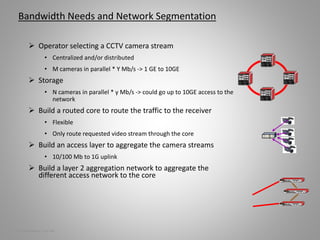
Bandwidth Needs and Network Segmentation
 Operator selecting a CCTV camera stream
• Centralized and/or distributed
• M cameras in parallel * Y Mb/s -> 1 GE to 10GE
 Storage
• N cameras in parallel * y Mb/s -> could go up to 10GE access to the
network
 Build a routed core to route the traffic to the receiver
• Flexible
• Only route requested video stream through the core
 Build an access layer to aggregate the camera streams
• 10/100 Mb to 1G uplink
 Build a layer 2 aggregation network to aggregate the
different access network to the core
25 | Video Surveillance | Sept. 2008
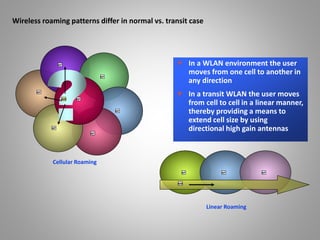
AP AP AP
MR
Linear Roaming
AP
AP
AP
AP
AP
AP
AP
MR
Cellular Roaming
Wireless roaming patterns differ in normal vs. transit case
▼ In a WLAN environment the user
moves from one cell to another in
any direction
▼ In a transit WLAN the user moves
from cell to cell in a linear manner,
thereby providing a means to
extend cell size by using
directional high gain antennas
Contact Information
AKSHIT KOHLI
Phone No. : +91-9650654745
Email: akshit.18200@ggnindia.dronacharya.info
Thank You

Surveilance ppt

  • 1.
    Video Surveillance : TheImportant Basics Presentation Venue: Dronachaya College Of Engineering
  • 2.
    Agenda 1. Why VideoSurveillance? 2. Video Surveillance Application 3. Video Surveillance Solution Components 4. Services 5. Summary
  • 3.
  • 4.
    Why Video Surveillance? Improve public safety  Mitigate risks of crime and terrorism  Protect assets  Prevent fraud  Improve efficiency  Automate more processes  Train dispatch  Self-checking counters  Provide better healthcare
  • 5.
    Video Surveillance: Customer Drivers: Traditionalanalog surveillance technology is facing challenge on QoS, performance, cost, wireless and other new applications with ‘IP age’ coming Video Surveillance for Mobile Applications in real-time with video from or to a moving vehicle Many intelligent requests coming forth which include motion detection, human facial recognition, license plate recognition, behavior analysis, etc. Video surveillance solution integrated with Emergency Help phones, Fire alarms, and other applications
  • 6.
  • 7.
    Video Surveillance AddressableMarket •Video surveillance application areas are myriad. Though their true scope remains almost unlimited, a few of the important areas of application are listed below: Monitoring process: traffic monitoring, border control Government buildings : Museums and military bases Manufacturing: Production line quality management Commercial units : Retail outlets, banks and casinos Transport : Railways, airports and ports Educational institutions: Distance learning, Telemedicine Leisure and entertainment areas : Stadiums Public Security: Police/Fire/Ambulance Energy: Oil & Gas, Utilities CCTV: Closed Circuit Television
  • 8.
     Forbidden Zoneprotection  Intruder detection  Object tracing  Object detection of moving trail in open area Video Surveillance Applications: Forbidden Zone Alarm
  • 9.
    Personal injury detection Public responsibility  Elderly home care  Instant assistance and prevention Suspicious behavior detection  Loaf and run behavior  Custom behavior detection model Video Surveillance Applications: Behavior Analysis 9 | Video Surveillance | Sept. 2008
  • 10.
    Pedestrian flow management Trafficflow management  Allows threshold value to be set  Raises alarms when threshold is exceeded  Detects overcrowding/congestion  Assures public safety  Assures good traffic flow Video Surveillance Applications: Pedestrian and Traffic Flow Analysis 10 | Video Surveillance | Sept. 2008
  • 11.
    Video Surveillance Applications:Night Video Night video surveillance assures public safety
  • 12.
    Video Surveillance Applications:Others Record by trigger eventIdentification by license plate or face Extended services to consumers 12 | Video Surveillance | Sept. 2008
  • 13.
  • 14.
    Video Surveillance Basics: System Components  Camera • Analog or IP • Fixed or PTZ (Pan, Tilt, Zoom) • Standard or High definition  Encoder • Typically consists of a modular analog to IP video converter • Supports different encoding formats • MJPEG, MPEG2, MPEG4 (part2), H.264  DVR/NVR • Digital or Networked Video Recorder  Video Management System • Centralized, Distributed  Control Center • Display Wall • Storage  Network
  • 15.
    Integrated Video SurveillanceSolution - Network  Wire line • Broadband access: ADSL, VDSL, LAN • Leased line: G.SHDSL • Transmission: SONET,DWDM  Wireless • PTP: Microwave • Point to multi-point: LMDS • Wireless broadband access:WiMAX, WiFi  Switching/Routing • L2/L3, MPLS
  • 16.
    • Has tobe built for: – Operational flexibility – Scalability – Redundancy Should have: – Standards Compliancy – RAMS • Reliability • Availability • Maintainability • Safety Video Surveillance Network Core Aggregation Access Receiver Receiver Source
  • 17.
    Video Surveillance Bandwidthrequirements  Number of Cameras/streams  Camera Intelligence that includes:  Built-in motion detection to reduce bandwidth utilization  Image size/resolution  Common Intermediate Formats (CIF) (Horizontal x Vertical resolution)  Older D1(720*576 for PAL), Half-D1(720*288)  Frame rate supported at full resolution  PAL format : 25 Frames/s,  NTSC format (used mostly in North America) : 30 Frames/s  Compression algorithm  A function of delay, quality requirements and available bandwidth and storage  For example, 4CIF/PAL uncompressed is just over 10Mbps but with MPEG-4 it is reduced to 2Mbps Format Video Resolution (H * V) SQCIF 128 × 96 QCIF 176 x 144 CIF 352 x 288 4CIF 704 x 576 16CIF 1408 x 1152
  • 18.
    Video Surveillance Bandwidthrequirements  Video recording distribution  Control Centers deployment  Distributed vs. Centralized  Backup/Disaster Recovery Strategy  Legal requirements  Resolution/image quality  Access to image streams  Storage time
  • 19.
    Integrated Communication SystemSolution Operations centre: Security, Crisis, etc. CCTV Chemical & Biological sensors Security Systems Access control GPS Other subsystems Ads Traffic/ Passenger Counting Bridges/ Crossings LMR, WiFi, WiMAX RFID Voice Network Communication Systems Data Network SCADA Electromechanical equipment Electromechanical equipment & Building control Integrated Management System Public address Information Displays Information Systems Clock time display Integration with existing terminals Integration/connectivity with Public Network Applications Data Bases, Billing systems Security Monitoring Access attempt log, etc. Access Network Core Network Structure Backbone Availability 99.999%
  • 20.
  • 21.
    Service Requirements 1) Business& Network • Readiness, Security and Architecture Assessments • Business & technology Blue Print • Operations consulting 2) Solution Design • Requirements development • System Architecture • Subsystem Specs & RFQs • High Level Designs • Subsystem Designs • Reliability and Availability Analysis • Simulations • Detailed Designs • Site Design Templates 3) Solution Integration & Validation • Configuration • Provision • Interoperate • Application test • Customization • Solution, soak & stress tests 4) Deploy • Site Surveys • Site Detailed Designs • Civil Works (Poles, Foundations) • Installation • Inspection Test Plans • Site Acceptance Testing • Site Integration Testing 5) Maintain & Operate • Remote Technical Support • Repair and Return • Managed Field Operations • Managed NOC • Managed Security
  • 22.
  • 23.
    Summary  FINANCE: Telecomand IT infrastructures can be shared, which saves CAPEX & OPEX!  NETWORK : Ethernet is being adopted for a wide range of Industrial Applications specifically for Video Surveillance and can be built for  Scalability  Resiliency  OPERATIONS: Using today’s technologies, you can provide real time images that can be accessed from anywhere at anytime By using integrated video surveillance technologies, customers’ safety and security is ensured with better performance and low cost
  • 24.
    Key Advantages ofVideo Surveillance using today’s Digital Technology Future-proofing through interoperable components Reduced Total Cost of Ownership through IP Networking Advantages Lower Installation Cost Better video quality and other value-added features • Digital cameras can be connected and powered by PoE • Multiple cameras can use the same cable • Changing camera placement is simple – just remove and plug into another network jack • Cameras can be placed almost anywhere and then accessed via desktop computer, laptop, PDA and even cellular phone IP video surveillance systems scale easily from one to thousands of cameras in increments of a single camera • Cameras have IP addresses just like any other network device you already have • IP networking enables you to leverage existing infrastructure such as servers, switches and cabling • There is no need for complicated proprietary hardware and dedicated monitors • IP networking eliminates the need for a control room at each location Live camera feeds can be accessed over the Internet from any location • Freedom of choice in hardware, software, and other components. • The digital I/O is convenient to integrate with other security equipment like lighting, gates and doors. • The ability to integrate through the network with other business systems, such as ATMs, ERPs, and POS systems, etc. • Less expensive and time-consuming of redundant and replacement systems • Greater availability of powerful software management tools for monitoring, accessing and storing video • Digital cameras provide up to 16 times the resolution of traditional analog cameras • Camera manufacturers are focusing on innovative and advanced digital camera features while interest in analog cameras wanes • Fast search and retrieval capabilities • Intelligence at the camera level can include detection of motion, identification, • Digital cameras can save and send the images collected before an alarm occurred and the alarm put the camera in record mode • Easier to monitor & manage cameras just like any network device
  • 25.
    Bandwidth Needs andNetwork Segmentation  Operator selecting a CCTV camera stream • Centralized and/or distributed • M cameras in parallel * Y Mb/s -> 1 GE to 10GE  Storage • N cameras in parallel * y Mb/s -> could go up to 10GE access to the network  Build a routed core to route the traffic to the receiver • Flexible • Only route requested video stream through the core  Build an access layer to aggregate the camera streams • 10/100 Mb to 1G uplink  Build a layer 2 aggregation network to aggregate the different access network to the core 25 | Video Surveillance | Sept. 2008
  • 26.
    AP AP AP MR LinearRoaming AP AP AP AP AP AP AP MR Cellular Roaming Wireless roaming patterns differ in normal vs. transit case ▼ In a WLAN environment the user moves from one cell to another in any direction ▼ In a transit WLAN the user moves from cell to cell in a linear manner, thereby providing a means to extend cell size by using directional high gain antennas
  • 27.
    Contact Information AKSHIT KOHLI PhoneNo. : +91-9650654745 Email: akshit.18200@ggnindia.dronacharya.info Thank You