Multi-phase buck converter with low
side switching for high current
application
Mtech Technical Seminar
By,
Kaushik Kushalappa Naik
naikkaushik93@gmail.com
Contact for detailed report, ppt and MATLAB simulation file
Contents
2
• Introduction
• Multiphase Buck Converter Overview
• Advantages of Multiphase Converters
• Multiphase Design
• Simulation and Results
• Conclusion
• References
Introduction
3
• The basic buck converter design and the component selection
as well as the efficiency for higher power ratings are
considerably difficult and needs to take care of many
constraints.
• Since the switch is high side driven, the control is also a major
concern.
• These difficulties can be overcome by using multi phases of
buck converter and the control problem can be solved by
switching it at negative side driving.
Introduction Contd.
4
• The advantages of using multi-phase buck converter over
single phase buck converter is explained.
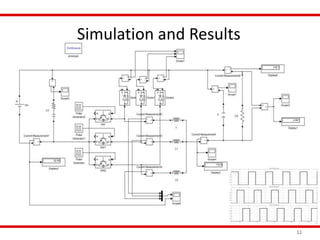
• The three phase buck converter is simulated in MATLAB-
simulink tool.
Multiphase Buck Converter Overview
5
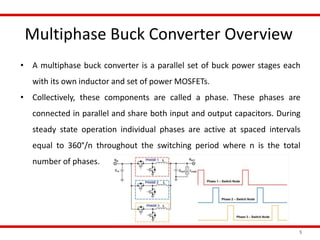
• A multiphase buck converter is a parallel set of buck power stages each
with its own inductor and set of power MOSFETs.
• Collectively, these components are called a phase. These phases are
connected in parallel and share both input and output capacitors. During
steady state operation individual phases are active at spaced intervals
equal to 360°/n throughout the switching period where n is the total
number of phases.
Advantages of Multiphase Converters
6
1. Input Capacitance Reduction
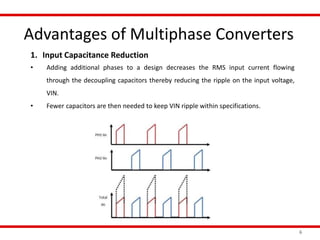
• Adding additional phases to a design decreases the RMS input current flowing
through the decoupling capacitors thereby reducing the ripple on the input voltage,
VIN.
• Fewer capacitors are then needed to keep VIN ripple within specifications.
Advantages of Multiphase Converters
7
2. Output Capacitance Reduction
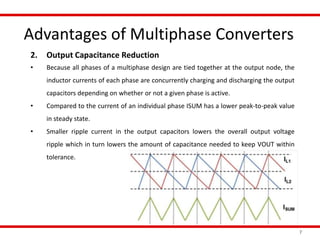
• Because all phases of a multiphase design are tied together at the output node, the
inductor currents of each phase are concurrently charging and discharging the output
capacitors depending on whether or not a given phase is active.
• Compared to the current of an individual phase ISUM has a lower peak-to-peak value
in steady state.
• Smaller ripple current in the output capacitors lowers the overall output voltage
ripple which in turn lowers the amount of capacitance needed to keep VOUT within
tolerance.
Advantages of Multiphase Converters
8
3. Thermal Performance and Efficiency Improvements
• Single-phase converters by definition have all the out power flowing through a single
inductor and pair of FETs. Any power loss is contained solely within those
components.
• For an application with greater than 100 A of output current, sourcing FETs and
inductors rated to such large currents becomes difficult and expensive.
• Multiphase converters spread power loss evenly across all phases. Since each phase is
dealing with only a portion of the total output current selecting FETs and inductors
becomes easier as less thermal strain is placed on these components.
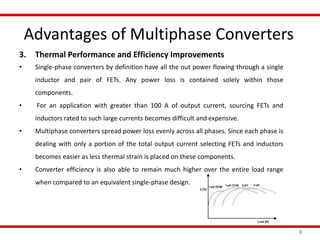
• Converter efficiency is also able to remain much higher over the entire load range
when compared to an equivalent single-phase design.
Advantages of Multiphase Converters
9
4. Transient Response Improvements
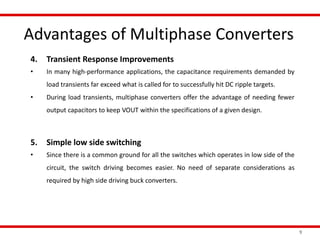
• In many high-performance applications, the capacitance requirements demanded by
load transients far exceed what is called for to successfully hit DC ripple targets.
• During load transients, multiphase converters offer the advantage of needing fewer
output capacitors to keep VOUT within the specifications of a given design.
5. Simple low side switching
• Since there is a common ground for all the switches which operates in low side of the
circuit, the switch driving becomes easier. No need of separate considerations as
required by high side driving buck converters.
Multiphase Design
10
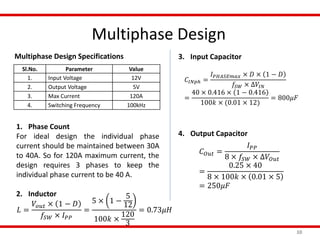
Sl.No. Parameter Value
1. Input Voltage 12V
2. Output Voltage 5V
3. Max Current 120A
4. Switching Frequency 100kHz
Multiphase Design Specifications
1. Phase Count
For ideal design the individual phase
current should be maintained between 30A
to 40A. So for 120A maximum current, the
design requires 3 phases to keep the
individual phase current to be 40 A.
2. Inductor
𝐿 =
𝑉𝑜𝑢𝑡 × 1 − 𝐷
𝑓𝑆𝑊 × 𝐼 𝑃𝑃
=
5 × 1 −
5
12
100𝑘 ×
120
3
= 0.73𝜇𝐻
3. Input Capacitor
4. Output Capacitor
𝐶𝐼𝑁𝑝ℎ =
𝐼 𝑃𝐻𝐴𝑆𝐸𝑚𝑎𝑥 × 𝐷 × 1 − 𝐷
𝑓𝑆𝑊 × ∆𝑉𝐼𝑁
=
40 × 0.416 × 1 − 0.416
100𝑘 × (0.01 × 12)
= 800𝜇𝐹
𝐶 𝑂𝑢𝑡 =
𝐼 𝑃𝑃
8 × 𝑓𝑆𝑊 × ∆𝑉𝑂𝑢𝑡
=
0.25 × 40
8 × 100𝑘 × 0.01 × 5
= 250𝜇𝐹
Simulation and Results
11
Simulation and Results
12
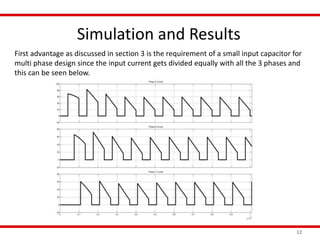
First advantage as discussed in section 3 is the requirement of a small input capacitor for
multi phase design since the input current gets divided equally with all the 3 phases and
this can be seen below.
Simulation and Results
13
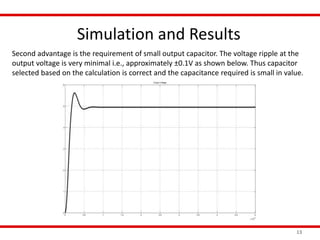
Second advantage is the requirement of small output capacitor. The voltage ripple at the
output voltage is very minimal i.e., approximately ±0.1V as shown below. Thus capacitor
selected based on the calculation is correct and the capacitance required is small in value.
Simulation and Results
14
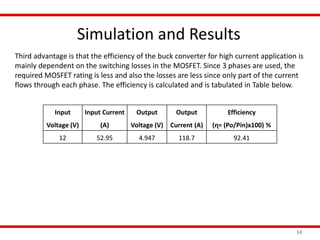
Third advantage is that the efficiency of the buck converter for high current application is
mainly dependent on the switching losses in the MOSFET. Since 3 phases are used, the
required MOSFET rating is less and also the losses are less since only part of the current
flows through each phase. The efficiency is calculated and is tabulated in Table below.
Input
Voltage (V)
Input Current
(A)
Output
Voltage (V)
Output
Current (A)
Efficiency
(ɳ= (Po/Pin)x100) %
12 52.95 4.947 118.7 92.41
Simulation and Results
15
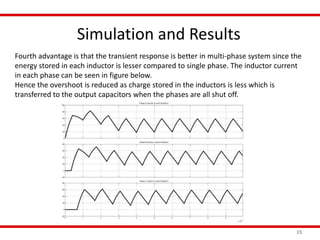
Fourth advantage is that the transient response is better in multi-phase system since the
energy stored in each inductor is lesser compared to single phase. The inductor current
in each phase can be seen in figure below.
Hence the overshoot is reduced as charge stored in the inductors is less which is
transferred to the output capacitors when the phases are all shut off.
Conclusion
16
A brief advantage of multi-phase over single phase has been
explained and a three phase buck converter is designed and
simulated in MATLAB. The advantages are verified using
simulation results.
References
17
[1] Y. Ahn, I. Jeon and J. Roh, "A Multiphase Buck Converter With a Rotating Phase-Shedding Scheme
For Efficient Light-Load Control," in IEEE Journal of Solid-State Circuits, vol. 49, no. 11, pp. 2673-2683,
Nov. 2014.
[2] W. Huang and B. Lehman, "A Compact Coupled Inductor for Interleaved Multiphase DC–DC
Converters," in IEEE Transactions on Power Electronics, vol. 31, no. 10, pp. 6770-6775, Oct. 2016.
[3] N. Altin, S. Balci, S. Ozdemir and I. Sefa, "A comparison of single and three phase DC/DC converter
structures for battery charging," 2013 International Conference on Renewable Energy Research and
Applications (ICRERA), Madrid, 2013, pp. 1228-1233.
[4] Baba, David, “Benefits of a multiphase buck converter,” (SLYT449), Texas Instruments, 2012.
[5] Carmen Parisi, “Multiphase Buck Design From Start to Finish”, (SLVA882), Texas Instruments, 2017.
18

Multi-phase buck converter with low side switching for high current application

  • 1.
    Multi-phase buck converterwith low side switching for high current application Mtech Technical Seminar By, Kaushik Kushalappa Naik naikkaushik93@gmail.com Contact for detailed report, ppt and MATLAB simulation file
  • 2.
    Contents 2 • Introduction • MultiphaseBuck Converter Overview • Advantages of Multiphase Converters • Multiphase Design • Simulation and Results • Conclusion • References
  • 3.
    Introduction 3 • The basicbuck converter design and the component selection as well as the efficiency for higher power ratings are considerably difficult and needs to take care of many constraints. • Since the switch is high side driven, the control is also a major concern. • These difficulties can be overcome by using multi phases of buck converter and the control problem can be solved by switching it at negative side driving.
  • 4.
    Introduction Contd. 4 • Theadvantages of using multi-phase buck converter over single phase buck converter is explained. • The three phase buck converter is simulated in MATLAB- simulink tool.
  • 5.
    Multiphase Buck ConverterOverview 5 • A multiphase buck converter is a parallel set of buck power stages each with its own inductor and set of power MOSFETs. • Collectively, these components are called a phase. These phases are connected in parallel and share both input and output capacitors. During steady state operation individual phases are active at spaced intervals equal to 360°/n throughout the switching period where n is the total number of phases.
  • 6.
    Advantages of MultiphaseConverters 6 1. Input Capacitance Reduction • Adding additional phases to a design decreases the RMS input current flowing through the decoupling capacitors thereby reducing the ripple on the input voltage, VIN. • Fewer capacitors are then needed to keep VIN ripple within specifications.
  • 7.
    Advantages of MultiphaseConverters 7 2. Output Capacitance Reduction • Because all phases of a multiphase design are tied together at the output node, the inductor currents of each phase are concurrently charging and discharging the output capacitors depending on whether or not a given phase is active. • Compared to the current of an individual phase ISUM has a lower peak-to-peak value in steady state. • Smaller ripple current in the output capacitors lowers the overall output voltage ripple which in turn lowers the amount of capacitance needed to keep VOUT within tolerance.
  • 8.
    Advantages of MultiphaseConverters 8 3. Thermal Performance and Efficiency Improvements • Single-phase converters by definition have all the out power flowing through a single inductor and pair of FETs. Any power loss is contained solely within those components. • For an application with greater than 100 A of output current, sourcing FETs and inductors rated to such large currents becomes difficult and expensive. • Multiphase converters spread power loss evenly across all phases. Since each phase is dealing with only a portion of the total output current selecting FETs and inductors becomes easier as less thermal strain is placed on these components. • Converter efficiency is also able to remain much higher over the entire load range when compared to an equivalent single-phase design.
  • 9.
    Advantages of MultiphaseConverters 9 4. Transient Response Improvements • In many high-performance applications, the capacitance requirements demanded by load transients far exceed what is called for to successfully hit DC ripple targets. • During load transients, multiphase converters offer the advantage of needing fewer output capacitors to keep VOUT within the specifications of a given design. 5. Simple low side switching • Since there is a common ground for all the switches which operates in low side of the circuit, the switch driving becomes easier. No need of separate considerations as required by high side driving buck converters.
  • 10.
    Multiphase Design 10 Sl.No. ParameterValue 1. Input Voltage 12V 2. Output Voltage 5V 3. Max Current 120A 4. Switching Frequency 100kHz Multiphase Design Specifications 1. Phase Count For ideal design the individual phase current should be maintained between 30A to 40A. So for 120A maximum current, the design requires 3 phases to keep the individual phase current to be 40 A. 2. Inductor 𝐿 = 𝑉𝑜𝑢𝑡 × 1 − 𝐷 𝑓𝑆𝑊 × 𝐼 𝑃𝑃 = 5 × 1 − 5 12 100𝑘 × 120 3 = 0.73𝜇𝐻 3. Input Capacitor 4. Output Capacitor 𝐶𝐼𝑁𝑝ℎ = 𝐼 𝑃𝐻𝐴𝑆𝐸𝑚𝑎𝑥 × 𝐷 × 1 − 𝐷 𝑓𝑆𝑊 × ∆𝑉𝐼𝑁 = 40 × 0.416 × 1 − 0.416 100𝑘 × (0.01 × 12) = 800𝜇𝐹 𝐶 𝑂𝑢𝑡 = 𝐼 𝑃𝑃 8 × 𝑓𝑆𝑊 × ∆𝑉𝑂𝑢𝑡 = 0.25 × 40 8 × 100𝑘 × 0.01 × 5 = 250𝜇𝐹
  • 11.
  • 12.
    Simulation and Results 12 Firstadvantage as discussed in section 3 is the requirement of a small input capacitor for multi phase design since the input current gets divided equally with all the 3 phases and this can be seen below.
  • 13.
    Simulation and Results 13 Secondadvantage is the requirement of small output capacitor. The voltage ripple at the output voltage is very minimal i.e., approximately ±0.1V as shown below. Thus capacitor selected based on the calculation is correct and the capacitance required is small in value.
  • 14.
    Simulation and Results 14 Thirdadvantage is that the efficiency of the buck converter for high current application is mainly dependent on the switching losses in the MOSFET. Since 3 phases are used, the required MOSFET rating is less and also the losses are less since only part of the current flows through each phase. The efficiency is calculated and is tabulated in Table below. Input Voltage (V) Input Current (A) Output Voltage (V) Output Current (A) Efficiency (ɳ= (Po/Pin)x100) % 12 52.95 4.947 118.7 92.41
  • 15.
    Simulation and Results 15 Fourthadvantage is that the transient response is better in multi-phase system since the energy stored in each inductor is lesser compared to single phase. The inductor current in each phase can be seen in figure below. Hence the overshoot is reduced as charge stored in the inductors is less which is transferred to the output capacitors when the phases are all shut off.
  • 16.
    Conclusion 16 A brief advantageof multi-phase over single phase has been explained and a three phase buck converter is designed and simulated in MATLAB. The advantages are verified using simulation results.
  • 17.
    References 17 [1] Y. Ahn,I. Jeon and J. Roh, "A Multiphase Buck Converter With a Rotating Phase-Shedding Scheme For Efficient Light-Load Control," in IEEE Journal of Solid-State Circuits, vol. 49, no. 11, pp. 2673-2683, Nov. 2014. [2] W. Huang and B. Lehman, "A Compact Coupled Inductor for Interleaved Multiphase DC–DC Converters," in IEEE Transactions on Power Electronics, vol. 31, no. 10, pp. 6770-6775, Oct. 2016. [3] N. Altin, S. Balci, S. Ozdemir and I. Sefa, "A comparison of single and three phase DC/DC converter structures for battery charging," 2013 International Conference on Renewable Energy Research and Applications (ICRERA), Madrid, 2013, pp. 1228-1233. [4] Baba, David, “Benefits of a multiphase buck converter,” (SLYT449), Texas Instruments, 2012. [5] Carmen Parisi, “Multiphase Buck Design From Start to Finish”, (SLVA882), Texas Instruments, 2017.
  • 18.