International Research Journal of Engineering and Technology (IRJET) e-ISSN: 2395-0056
Volume: 04 Issue: 10 | Oct -2017 www.irjet.net p-ISSN: 2395-0072
© 2017, IRJET | Impact Factor value: 6.171 | ISO 9001:2008 Certified Journal | Page 1014
Control of a Modular Multilevel DC/DC Converter for Regenerative
Applications
L. Rajesh Kumar
M.Tech. in power electronics, Dept. of EEE, RGMCET, Nandyal, A.P., India
---------------------------------------------------------------------***--------------------------------------------------------------------
Abstract - In this paper, different cascaded (buck, boost)and
multilevel topologies are compared for regenerative
applications to interface super capacitors as energy storage
device to dc bus. It shows modular multilevel dc/dc converter
(MMC) is best in front of cascaded converters in terms of
weight and volume reduction of inductance when phase
shifting modulation strategy is used. The proposed control
method can balance super capacitor voltage by using specific
output current. The converter topologies and control methods
are verified by simulation results.
Keywords: Modular multilevel dc/dc converetrs(MMCs),
supercapacitors(SCs), buck conveter,boost converter
phase shifting, control techniques.
1. INTRODUCTION
In response to the changing global backdrop, scientific
group of people and major countries are focusing only on the
energy requirements for their development. So, mainly
focused on the high energy storage devices which are not
present in present world. Hence, super capacitors represent
one of the recent innovations in the field of electrical energy
storage [1], and will find their position in many applications
like electric traction and hybrid electricvehicles(HEV)where
high power levels are needed during short period of time,
from milliseconds to some hundreds of seconds. Since, super
capacitors are used as energystorage devices in regenerative
braking applications to store braking energy of HEV [2].
This paper focuses in interfacing super capacitors to a dc
bus by cascaded and multilevel converters [3].Through
parallelization of batteries and SCs has many drawbacks that
there is no control of energy flowing to or from and the
voltages across the super capacitors are almost constant. To
achieve energy management capabilities, converters are
needed to control the energy flow in the SCs.
SCs are low voltage devices. So, to achieve high voltage
which is neededintractionapplicationslargenumbersofcells
have to be connected in series. But it leads voltage imbalance
across the SCs due to difference in capacitances of each super
capacitors.
To attain high voltage from low voltage devices, or vice
versa, cascaded and multilevel converters [4], [5] have been
employed in literature. Normally, modular multilevel dc/dc
converter (MMC) is used as a traction converter in HEV to
achieve charge balance in batteries.
The usage of MMC in traction applications has many
advantages which includes the fall of the voltage across the
inductor, splitting one inductance into several inductances.
Splitting the converter into a number of converters also
reduces the voltage rating of the transistors (IGBT’s). Low
voltage transistors (IGBT’s) can attain higher switching
frequencies and high current capability. One more important
advantage is modularity thatcanmakesimplersystemdesign
and cooling, andcan amplifyreliabilityinN+1surplussystem.
Self-regulating energy management can be achieved for
each of the low voltage sources and increases the output
frequency which reduces the inductive components size [6].
Multilevel converter topologies are the good swapping
solution between performance and cost, as control obscurity
increases compared to usual converters.
2. CASCADED AND MMCs
Two quadrant dc/dc converters is neededinregenerative
applications with SCs as energy storage devices. When
braking, energy flows from load to storage devices and in
traction mode, energy flows from energy storage devices to
load. All the dc/dc converters are presented in this paper are
based on the HB topology.
2.1 HB Converter
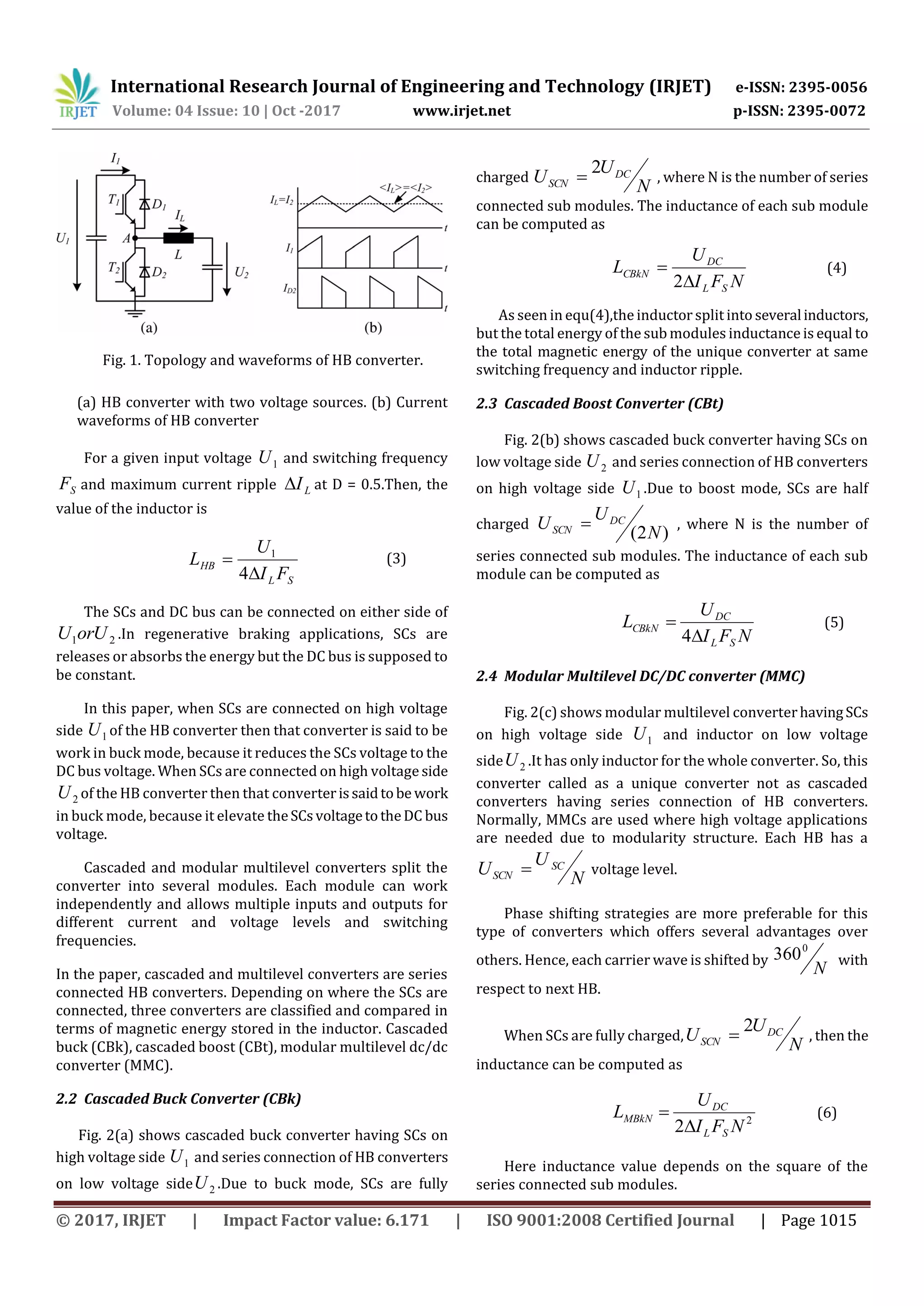
Fig. 1(a) shows the HB converter having two transistors
with anti-parallel diodes connected in series. This converter
has two voltages U1 and U2 connected on both sides with one
inductor. The HB converter is unidirectional in voltage but
bidirectional in current.
When converter working in continuousconductionmode,
the transfer function of the two voltages and currents are
12 .UDU  (1)
21 .IDI  (2)
‘D’ is the duty cycle and it is in range between 10  D
and I1, I2 are the two currents on both sides of the converter
where I2 =IL. But, the condition 21 UU  must be always
satisfied.
International Research Journal of Engineering and Technology (IRJET) e-ISSN: 2395-0056
Volume: 04 Issue: 10 | Oct -2017 www.irjet.net p-ISSN: 2395-0072
© 2017, IRJET | Impact Factor value: 6.171 | ISO 9001:2008 Certified Journal | Page 1015
Fig. 1. Topology and waveforms of HB converter.
(a) HB converter with two voltage sources. (b) Current
waveforms of HB converter
For a given input voltage 1U and switching frequency
SF and maximum current ripple LI at D = 0.5.Then, the
value of the inductor is
SL
HB
FI
U
L


4
1
(3)
The SCs and DC bus can be connected on either side of
21orUU .In regenerative braking applications, SCs are
releases or absorbs the energy but the DC bus is supposed to
be constant.
In this paper, when SCs are connected on high voltage
side 1U of the HB converter then that converter is said to be
work in buck mode, because it reduces the SCs voltage to the
DC bus voltage. When SCs are connected on high voltage side
2U of the HB converter then that converterissaidtobe work
in buck mode, because it elevate theSCsvoltagetotheDC bus
voltage.
Cascaded and modular multilevel converters split the
converter into several modules. Each module can work
independently and allows multiple inputs and outputs for
different current and voltage levels and switching
frequencies.
In the paper, cascaded and multilevel converters are series
connected HB converters. Depending on where the SCs are
connected, three converters are classified and compared in
terms of magnetic energy stored in the inductor. Cascaded
buck (CBk), cascaded boost (CBt), modular multilevel dc/dc
converter (MMC).
2.2 Cascaded Buck Converter (CBk)
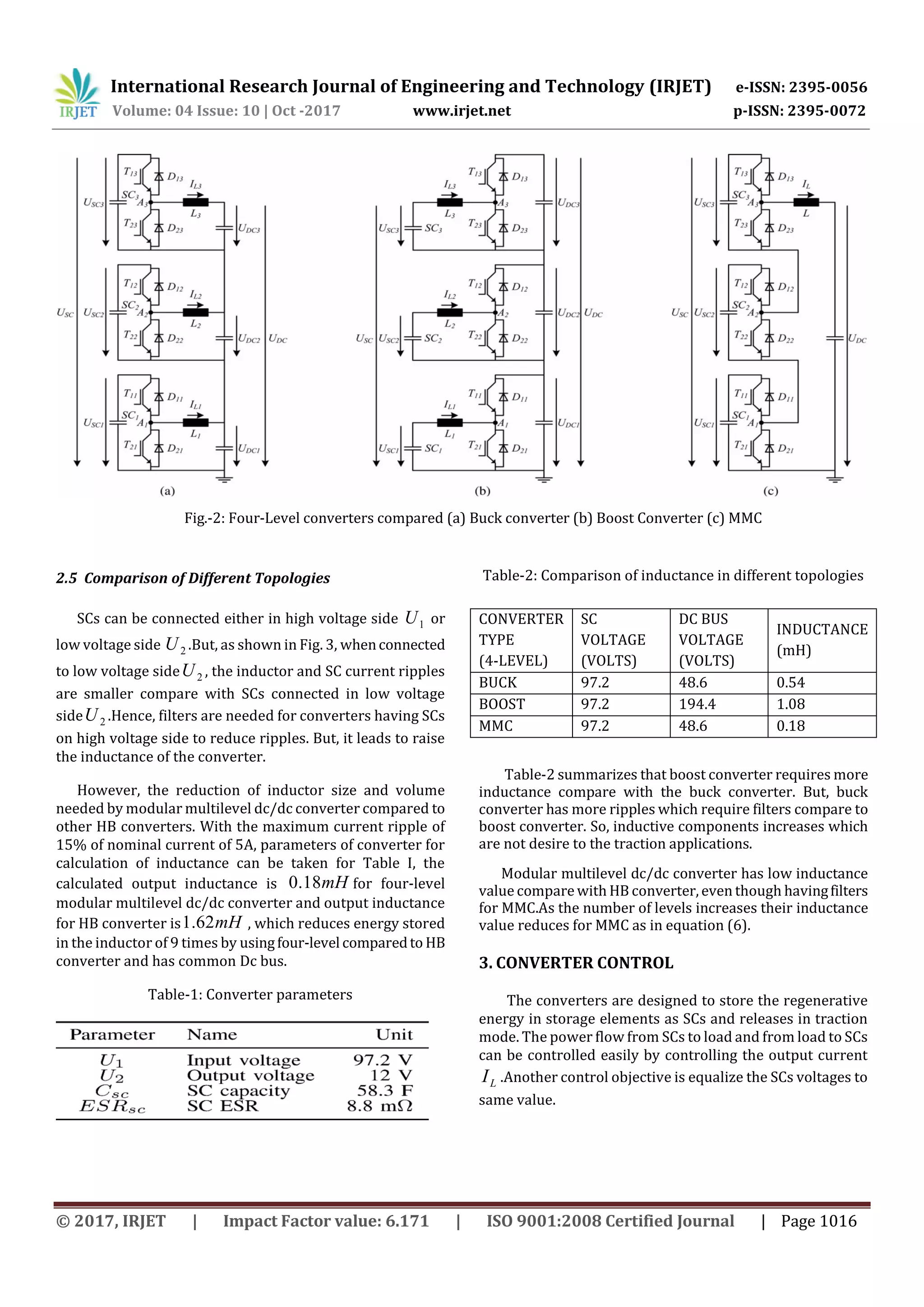
Fig. 2(a) shows cascaded buck converter having SCs on
high voltage side 1U and series connection of HB converters
on low voltage side 2U .Due to buck mode, SCs are fully
charged
N
U
U DC
SCN
2
 , where N is the number of series
connected sub modules. The inductance of each sub module
can be computed as
NFI
U
L
SL
DC
CBkN


2
(4)
As seen in equ(4),the inductor split into severalinductors,
but the total energy of the sub modules inductance is equal to
the total magnetic energy of the unique converter at same
switching frequency and inductor ripple.
2.3 Cascaded Boost Converter (CBt)
Fig. 2(b) shows cascaded buck converter having SCs on
low voltage side 2U and series connection of HB converters
on high voltage side 1U .Due to boost mode, SCs are half
charged
)2( N
U
U DC
SCN  , where N is the number of
series connected sub modules. The inductance of each sub
module can be computed as
NFI
U
L
SL
DC
CBkN


4
(5)
2.4 Modular Multilevel DC/DC converter (MMC)
Fig. 2(c) shows modular multilevel converterhavingSCs
on high voltage side 1U and inductor on low voltage
side 2U .It has only inductor for the whole converter. So, this
converter called as a unique converter not as cascaded
converters having series connection of HB converters.
Normally, MMCs are used where high voltage applications
are needed due to modularity structure. Each HB has a
N
U
U SC
SCN  voltage level.
Phase shifting strategies are more preferable for this
type of converters which offers several advantages over
others. Hence, each carrier wave is shifted by
N
0
360 with
respect to next HB.
When SCs are fully charged,
N
U
U DC
SCN
2
 , then the
inductance can be computed as
2
2 NFI
U
L
SL
DC
MBkN

 (6)
Here inductance value depends on the square of the
series connected sub modules.
International Research Journal of Engineering and Technology (IRJET) e-ISSN: 2395-0056
Volume: 04 Issue: 10 | Oct -2017 www.irjet.net p-ISSN: 2395-0072
© 2017, IRJET | Impact Factor value: 6.171 | ISO 9001:2008 Certified Journal | Page 1016
Fig.-2: Four-Level converters compared (a) Buck converter (b) Boost Converter (c) MMC
2.5 Comparison of Different Topologies
SCs can be connected either in high voltage side 1U or
low voltage side 2U .But, as shown in Fig. 3, whenconnected
to low voltage side 2U , the inductor and SC current ripples
are smaller compare with SCs connected in low voltage
side 2U .Hence, filters are needed for converters having SCs
on high voltage side to reduce ripples. But, it leads to raise
the inductance of the converter.
However, the reduction of inductor size and volume
needed by modular multilevel dc/dc converter compared to
other HB converters. With the maximum current ripple of
15% of nominal current of 5A, parameters of converter for
calculation of inductance can be taken for Table I, the
calculated output inductance is mH18.0 for four-level
modular multilevel dc/dc converter and output inductance
for HB converter is mH62.1 , which reduces energy stored
in the inductor of 9 times by usingfour-level comparedto HB
converter and has common Dc bus.
Table-1: Converter parameters
Table-2: Comparison of inductance in different topologies
CONVERTER
TYPE
(4-LEVEL)
SC
VOLTAGE
(VOLTS)
DC BUS
VOLTAGE
(VOLTS)
INDUCTANCE
(mH)
BUCK 97.2 48.6 0.54
BOOST 97.2 194.4 1.08
MMC 97.2 48.6 0.18
Table-2 summarizes that boost converter requires more
inductance compare with the buck converter. But, buck
converter has more ripples which require filters compare to
boost converter. So, inductive components increases which
are not desire to the traction applications.
Modular multilevel dc/dc converter has low inductance
value compare with HB converter, even though havingfilters
for MMC.As the number of levels increases their inductance
value reduces for MMC as in equation (6).
3. CONVERTER CONTROL
The converters are designed to store the regenerative
energy in storage elements as SCs and releases in traction
mode. The power flow from SCs to load and from load to SCs
can be controlled easily by controlling the output current
LI .Another control objective is equalize the SCs voltages to
same value.
International Research Journal of Engineering and Technology (IRJET) e-ISSN: 2395-0056
Volume: 04 Issue: 10 | Oct -2017 www.irjet.net p-ISSN: 2395-0072
© 2017, IRJET | Impact Factor value: 6.171 | ISO 9001:2008 Certified Journal | Page 1017
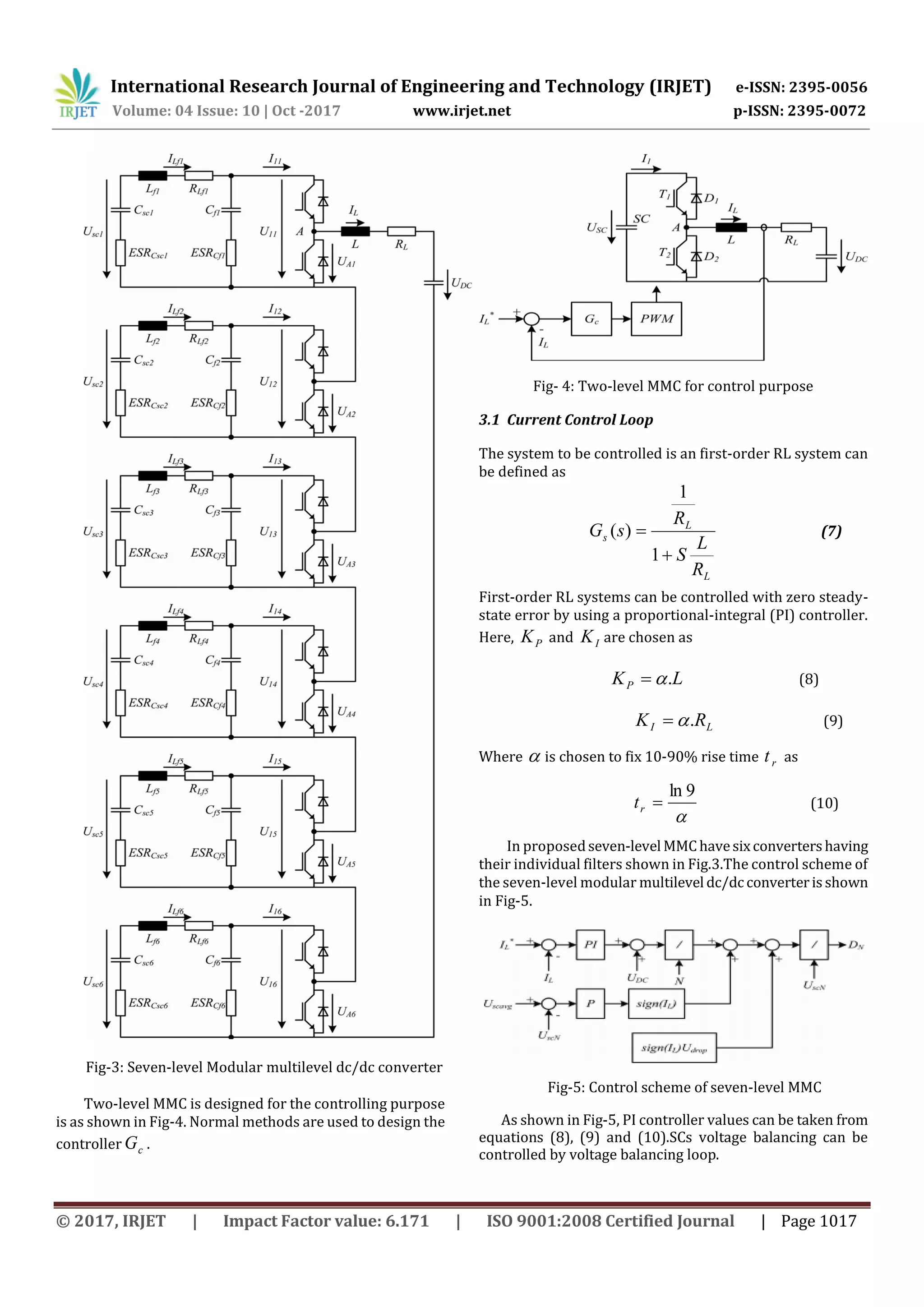
Fig-3: Seven-level Modular multilevel dc/dc converter
Two-level MMC is designed for the controlling purpose
is as shown in Fig-4. Normal methods are used to design the
controller cG .
Fig- 4: Two-level MMC for control purpose
3.1 Current Control Loop
The system to be controlled is an first-order RL system can
be defined as
L
L
s
R
L
S
R
sG


1
1
)( (7)
First-order RL systems can be controlled with zero steady-
state error by using a proportional-integral (PI) controller.
Here, PK and IK are chosen as
LKP . (8)
LI RK . (9)
Where  is chosen to fix 10-90% rise time rt as

9ln
rt (10)
In proposedseven-level MMChavesixconvertershaving
their individual filters shown in Fig.3.The control scheme of
the seven-level modular multilevel dc/dcconverterisshown
in Fig-5.
Fig-5: Control scheme of seven-level MMC
As shown in Fig-5, PI controller values can be taken from
equations (8), (9) and (10).SCs voltage balancing can be
controlled by voltage balancing loop.
International Research Journal of Engineering and Technology (IRJET) e-ISSN: 2395-0056
Volume: 04 Issue: 10 | Oct -2017 www.irjet.net p-ISSN: 2395-0072
© 2017, IRJET | Impact Factor value: 6.171 | ISO 9001:2008 Certified Journal | Page 1018
3.2 SC voltage balancing loop
SCs voltage balancing is very crucial and it can be
controlled by controlling the output inductor current.
From Fig-3,thesixconverterscanperformindependently.
So, the SCs voltages are need not be equal. The control
objective can be done by comparing the average SCs voltage
with the individual voltages.
SC
SC
sC
sG
1
)(  (11)
In SCs voltage balancing looponlyPcontrollerisusedand
the PSCK can be selected as
SC
C
PSC
C
K
1
1020
3

 (12)
Where, C is the desired bandwidth of closed loop
converter
3.3 Compensation of semiconductor voltage drop
To get current response good, semiconductor voltage drop
must be compensated as in equation (13)
SC
drop
drop
U
U
IsignD )( 2 (13)
The converter parameters for seven-level MMC can be
taken from Table-3.
Table-3: Converter parameters of seven-level mmc
(a)
(b)
(c)
Fig-6: Simulation results of HB converter
a) Input current (b) Diode current (c) Output current
Fig-7: Inductor current of four-level buck converter
International Research Journal of Engineering and Technology (IRJET) e-ISSN: 2395-0056
Volume: 04 Issue: 10 | Oct -2017 www.irjet.net p-ISSN: 2395-0072
© 2017, IRJET | Impact Factor value: 6.171 | ISO 9001:2008 Certified Journal | Page 1019
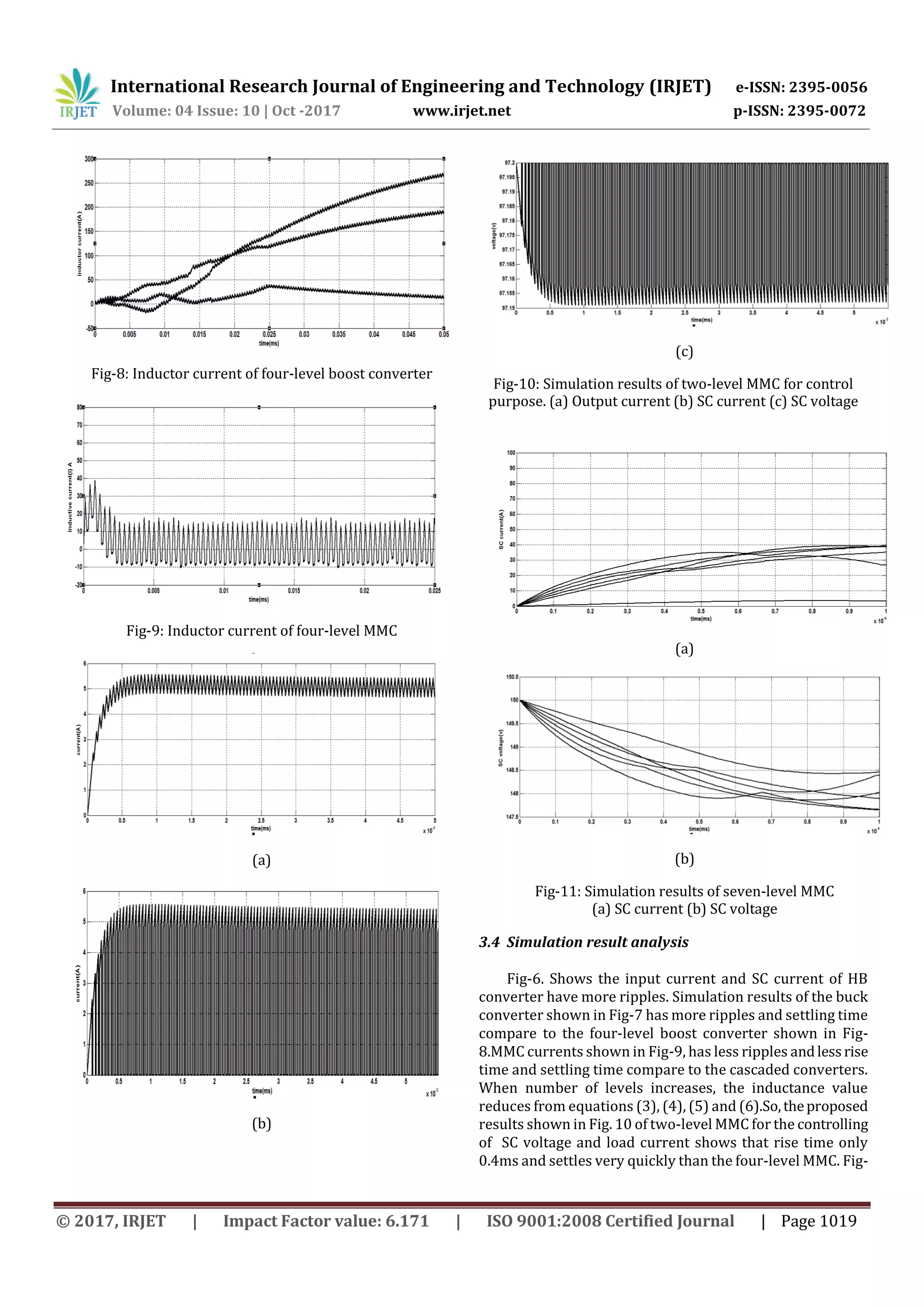
Fig-8: Inductor current of four-level boost converter
Fig-9: Inductor current of four-level MMC
(a)
(b)
(c)
Fig-10: Simulation results of two-level MMC for control
purpose. (a) Output current (b) SC current (c) SC voltage
(a)
(b)
Fig-11: Simulation results of seven-level MMC
(a) SC current (b) SC voltage
3.4 Simulation result analysis
Fig-6. Shows the input current and SC current of HB
converter have more ripples. Simulation results of the buck
converter shown in Fig-7 has more ripples and settling time
compare to the four-level boost converter shown in Fig-
8.MMC currents shown in Fig-9, has less ripples andlessrise
time and settling time compare to the cascaded converters.
When number of levels increases, the inductance value
reduces from equations (3), (4), (5) and (6).So,theproposed
results shown in Fig. 10 of two-level MMC for the controlling
of SC voltage and load current shows that rise time only
0.4ms and settles very quickly than the four-level MMC. Fig-
International Research Journal of Engineering and Technology (IRJET) e-ISSN: 2395-0056
Volume: 04 Issue: 10 | Oct -2017 www.irjet.net p-ISSN: 2395-0072
© 2017, IRJET | Impact Factor value: 6.171 | ISO 9001:2008 Certified Journal | Page 1020
11 shows that seven level MMC has SC voltage and current
balancing.
3. CONCLUSION
The paper presents a modular multilevel dc/dc converter
(MMC) used in regenerative applications to interfaceenergy
storage devices to the DC bus. The main objective is to
reduce magnetic components size and volumewhichismost
suitable for electric hybrid vehicles(EHV)alongwithvoltage
balancing in SCs is accomplished.
REFERENCES
[1] A. Rufer and P. Barrade,“Asupercapacitor-basedenergy-
storage system for elevators with soft commutated
interface,” IEEE Trans. Ind. Appl., vol. 38, no. 5, pp. 1151–
1159, Sep.–Oct. 2002.
[2] P. Thounthong and S. Rael, “The benefits of
hybridization,” IEEE Ind. Electron. Mag., vol. 3, no. 3, pp. 25–
37, Sep. 2009.
[3] J. Dixon, S. Bosch, C. Castillo, and M. Mura, “Ultra
capacitors as unique energy storage for a city-car using five-
level converter,” in Proc. 35th Annu. Conf. IEEEInd.Electron.,
2009, pp. 3854–3859.
[4] F. Zhang, F. Z. Peng, and Z. Qian, “Study of the multilevel
converters in DC-DC applications,” in Proc. IEEE 35th Annu.
Power Electron. Spec.Conf.PESC2004,vol.2,pp.1702–1706.
[5] G. R. Walker and P. C. Sernia, “CascadedDC-DCconverter
connection of photovoltaic modules,” IEEE Trans. Power
Electron., vol. 19, no. 4, pp. 1130–1139, Jul. 2004.
[6] V. Vorperian, “Synthesis of medium voltage DC-to-DC
convertersfromlow-voltage, high-frequencyPWMswitching
converters,” IEEE Trans. Power Electron., vol. 22, no. 5, pp.
1619–1635, Sep. 2007.

Control of a Modular Multilevel DC/DC Converter for Regenerative Applications

  • 1.
    International Research Journalof Engineering and Technology (IRJET) e-ISSN: 2395-0056 Volume: 04 Issue: 10 | Oct -2017 www.irjet.net p-ISSN: 2395-0072 © 2017, IRJET | Impact Factor value: 6.171 | ISO 9001:2008 Certified Journal | Page 1014 Control of a Modular Multilevel DC/DC Converter for Regenerative Applications L. Rajesh Kumar M.Tech. in power electronics, Dept. of EEE, RGMCET, Nandyal, A.P., India ---------------------------------------------------------------------***-------------------------------------------------------------------- Abstract - In this paper, different cascaded (buck, boost)and multilevel topologies are compared for regenerative applications to interface super capacitors as energy storage device to dc bus. It shows modular multilevel dc/dc converter (MMC) is best in front of cascaded converters in terms of weight and volume reduction of inductance when phase shifting modulation strategy is used. The proposed control method can balance super capacitor voltage by using specific output current. The converter topologies and control methods are verified by simulation results. Keywords: Modular multilevel dc/dc converetrs(MMCs), supercapacitors(SCs), buck conveter,boost converter phase shifting, control techniques. 1. INTRODUCTION In response to the changing global backdrop, scientific group of people and major countries are focusing only on the energy requirements for their development. So, mainly focused on the high energy storage devices which are not present in present world. Hence, super capacitors represent one of the recent innovations in the field of electrical energy storage [1], and will find their position in many applications like electric traction and hybrid electricvehicles(HEV)where high power levels are needed during short period of time, from milliseconds to some hundreds of seconds. Since, super capacitors are used as energystorage devices in regenerative braking applications to store braking energy of HEV [2]. This paper focuses in interfacing super capacitors to a dc bus by cascaded and multilevel converters [3].Through parallelization of batteries and SCs has many drawbacks that there is no control of energy flowing to or from and the voltages across the super capacitors are almost constant. To achieve energy management capabilities, converters are needed to control the energy flow in the SCs. SCs are low voltage devices. So, to achieve high voltage which is neededintractionapplicationslargenumbersofcells have to be connected in series. But it leads voltage imbalance across the SCs due to difference in capacitances of each super capacitors. To attain high voltage from low voltage devices, or vice versa, cascaded and multilevel converters [4], [5] have been employed in literature. Normally, modular multilevel dc/dc converter (MMC) is used as a traction converter in HEV to achieve charge balance in batteries. The usage of MMC in traction applications has many advantages which includes the fall of the voltage across the inductor, splitting one inductance into several inductances. Splitting the converter into a number of converters also reduces the voltage rating of the transistors (IGBT’s). Low voltage transistors (IGBT’s) can attain higher switching frequencies and high current capability. One more important advantage is modularity thatcanmakesimplersystemdesign and cooling, andcan amplifyreliabilityinN+1surplussystem. Self-regulating energy management can be achieved for each of the low voltage sources and increases the output frequency which reduces the inductive components size [6]. Multilevel converter topologies are the good swapping solution between performance and cost, as control obscurity increases compared to usual converters. 2. CASCADED AND MMCs Two quadrant dc/dc converters is neededinregenerative applications with SCs as energy storage devices. When braking, energy flows from load to storage devices and in traction mode, energy flows from energy storage devices to load. All the dc/dc converters are presented in this paper are based on the HB topology. 2.1 HB Converter Fig. 1(a) shows the HB converter having two transistors with anti-parallel diodes connected in series. This converter has two voltages U1 and U2 connected on both sides with one inductor. The HB converter is unidirectional in voltage but bidirectional in current. When converter working in continuousconductionmode, the transfer function of the two voltages and currents are 12 .UDU  (1) 21 .IDI  (2) ‘D’ is the duty cycle and it is in range between 10  D and I1, I2 are the two currents on both sides of the converter where I2 =IL. But, the condition 21 UU  must be always satisfied.
  • 2.
    International Research Journalof Engineering and Technology (IRJET) e-ISSN: 2395-0056 Volume: 04 Issue: 10 | Oct -2017 www.irjet.net p-ISSN: 2395-0072 © 2017, IRJET | Impact Factor value: 6.171 | ISO 9001:2008 Certified Journal | Page 1015 Fig. 1. Topology and waveforms of HB converter. (a) HB converter with two voltage sources. (b) Current waveforms of HB converter For a given input voltage 1U and switching frequency SF and maximum current ripple LI at D = 0.5.Then, the value of the inductor is SL HB FI U L   4 1 (3) The SCs and DC bus can be connected on either side of 21orUU .In regenerative braking applications, SCs are releases or absorbs the energy but the DC bus is supposed to be constant. In this paper, when SCs are connected on high voltage side 1U of the HB converter then that converter is said to be work in buck mode, because it reduces the SCs voltage to the DC bus voltage. When SCs are connected on high voltage side 2U of the HB converter then that converterissaidtobe work in buck mode, because it elevate theSCsvoltagetotheDC bus voltage. Cascaded and modular multilevel converters split the converter into several modules. Each module can work independently and allows multiple inputs and outputs for different current and voltage levels and switching frequencies. In the paper, cascaded and multilevel converters are series connected HB converters. Depending on where the SCs are connected, three converters are classified and compared in terms of magnetic energy stored in the inductor. Cascaded buck (CBk), cascaded boost (CBt), modular multilevel dc/dc converter (MMC). 2.2 Cascaded Buck Converter (CBk) Fig. 2(a) shows cascaded buck converter having SCs on high voltage side 1U and series connection of HB converters on low voltage side 2U .Due to buck mode, SCs are fully charged N U U DC SCN 2  , where N is the number of series connected sub modules. The inductance of each sub module can be computed as NFI U L SL DC CBkN   2 (4) As seen in equ(4),the inductor split into severalinductors, but the total energy of the sub modules inductance is equal to the total magnetic energy of the unique converter at same switching frequency and inductor ripple. 2.3 Cascaded Boost Converter (CBt) Fig. 2(b) shows cascaded buck converter having SCs on low voltage side 2U and series connection of HB converters on high voltage side 1U .Due to boost mode, SCs are half charged )2( N U U DC SCN  , where N is the number of series connected sub modules. The inductance of each sub module can be computed as NFI U L SL DC CBkN   4 (5) 2.4 Modular Multilevel DC/DC converter (MMC) Fig. 2(c) shows modular multilevel converterhavingSCs on high voltage side 1U and inductor on low voltage side 2U .It has only inductor for the whole converter. So, this converter called as a unique converter not as cascaded converters having series connection of HB converters. Normally, MMCs are used where high voltage applications are needed due to modularity structure. Each HB has a N U U SC SCN  voltage level. Phase shifting strategies are more preferable for this type of converters which offers several advantages over others. Hence, each carrier wave is shifted by N 0 360 with respect to next HB. When SCs are fully charged, N U U DC SCN 2  , then the inductance can be computed as 2 2 NFI U L SL DC MBkN   (6) Here inductance value depends on the square of the series connected sub modules.
  • 3.
    International Research Journalof Engineering and Technology (IRJET) e-ISSN: 2395-0056 Volume: 04 Issue: 10 | Oct -2017 www.irjet.net p-ISSN: 2395-0072 © 2017, IRJET | Impact Factor value: 6.171 | ISO 9001:2008 Certified Journal | Page 1016 Fig.-2: Four-Level converters compared (a) Buck converter (b) Boost Converter (c) MMC 2.5 Comparison of Different Topologies SCs can be connected either in high voltage side 1U or low voltage side 2U .But, as shown in Fig. 3, whenconnected to low voltage side 2U , the inductor and SC current ripples are smaller compare with SCs connected in low voltage side 2U .Hence, filters are needed for converters having SCs on high voltage side to reduce ripples. But, it leads to raise the inductance of the converter. However, the reduction of inductor size and volume needed by modular multilevel dc/dc converter compared to other HB converters. With the maximum current ripple of 15% of nominal current of 5A, parameters of converter for calculation of inductance can be taken for Table I, the calculated output inductance is mH18.0 for four-level modular multilevel dc/dc converter and output inductance for HB converter is mH62.1 , which reduces energy stored in the inductor of 9 times by usingfour-level comparedto HB converter and has common Dc bus. Table-1: Converter parameters Table-2: Comparison of inductance in different topologies CONVERTER TYPE (4-LEVEL) SC VOLTAGE (VOLTS) DC BUS VOLTAGE (VOLTS) INDUCTANCE (mH) BUCK 97.2 48.6 0.54 BOOST 97.2 194.4 1.08 MMC 97.2 48.6 0.18 Table-2 summarizes that boost converter requires more inductance compare with the buck converter. But, buck converter has more ripples which require filters compare to boost converter. So, inductive components increases which are not desire to the traction applications. Modular multilevel dc/dc converter has low inductance value compare with HB converter, even though havingfilters for MMC.As the number of levels increases their inductance value reduces for MMC as in equation (6). 3. CONVERTER CONTROL The converters are designed to store the regenerative energy in storage elements as SCs and releases in traction mode. The power flow from SCs to load and from load to SCs can be controlled easily by controlling the output current LI .Another control objective is equalize the SCs voltages to same value.
  • 4.
    International Research Journalof Engineering and Technology (IRJET) e-ISSN: 2395-0056 Volume: 04 Issue: 10 | Oct -2017 www.irjet.net p-ISSN: 2395-0072 © 2017, IRJET | Impact Factor value: 6.171 | ISO 9001:2008 Certified Journal | Page 1017 Fig-3: Seven-level Modular multilevel dc/dc converter Two-level MMC is designed for the controlling purpose is as shown in Fig-4. Normal methods are used to design the controller cG . Fig- 4: Two-level MMC for control purpose 3.1 Current Control Loop The system to be controlled is an first-order RL system can be defined as L L s R L S R sG   1 1 )( (7) First-order RL systems can be controlled with zero steady- state error by using a proportional-integral (PI) controller. Here, PK and IK are chosen as LKP . (8) LI RK . (9) Where  is chosen to fix 10-90% rise time rt as  9ln rt (10) In proposedseven-level MMChavesixconvertershaving their individual filters shown in Fig.3.The control scheme of the seven-level modular multilevel dc/dcconverterisshown in Fig-5. Fig-5: Control scheme of seven-level MMC As shown in Fig-5, PI controller values can be taken from equations (8), (9) and (10).SCs voltage balancing can be controlled by voltage balancing loop.
  • 5.
    International Research Journalof Engineering and Technology (IRJET) e-ISSN: 2395-0056 Volume: 04 Issue: 10 | Oct -2017 www.irjet.net p-ISSN: 2395-0072 © 2017, IRJET | Impact Factor value: 6.171 | ISO 9001:2008 Certified Journal | Page 1018 3.2 SC voltage balancing loop SCs voltage balancing is very crucial and it can be controlled by controlling the output inductor current. From Fig-3,thesixconverterscanperformindependently. So, the SCs voltages are need not be equal. The control objective can be done by comparing the average SCs voltage with the individual voltages. SC SC sC sG 1 )(  (11) In SCs voltage balancing looponlyPcontrollerisusedand the PSCK can be selected as SC C PSC C K 1 1020 3   (12) Where, C is the desired bandwidth of closed loop converter 3.3 Compensation of semiconductor voltage drop To get current response good, semiconductor voltage drop must be compensated as in equation (13) SC drop drop U U IsignD )( 2 (13) The converter parameters for seven-level MMC can be taken from Table-3. Table-3: Converter parameters of seven-level mmc (a) (b) (c) Fig-6: Simulation results of HB converter a) Input current (b) Diode current (c) Output current Fig-7: Inductor current of four-level buck converter
  • 6.
    International Research Journalof Engineering and Technology (IRJET) e-ISSN: 2395-0056 Volume: 04 Issue: 10 | Oct -2017 www.irjet.net p-ISSN: 2395-0072 © 2017, IRJET | Impact Factor value: 6.171 | ISO 9001:2008 Certified Journal | Page 1019 Fig-8: Inductor current of four-level boost converter Fig-9: Inductor current of four-level MMC (a) (b) (c) Fig-10: Simulation results of two-level MMC for control purpose. (a) Output current (b) SC current (c) SC voltage (a) (b) Fig-11: Simulation results of seven-level MMC (a) SC current (b) SC voltage 3.4 Simulation result analysis Fig-6. Shows the input current and SC current of HB converter have more ripples. Simulation results of the buck converter shown in Fig-7 has more ripples and settling time compare to the four-level boost converter shown in Fig- 8.MMC currents shown in Fig-9, has less ripples andlessrise time and settling time compare to the cascaded converters. When number of levels increases, the inductance value reduces from equations (3), (4), (5) and (6).So,theproposed results shown in Fig. 10 of two-level MMC for the controlling of SC voltage and load current shows that rise time only 0.4ms and settles very quickly than the four-level MMC. Fig-
  • 7.
    International Research Journalof Engineering and Technology (IRJET) e-ISSN: 2395-0056 Volume: 04 Issue: 10 | Oct -2017 www.irjet.net p-ISSN: 2395-0072 © 2017, IRJET | Impact Factor value: 6.171 | ISO 9001:2008 Certified Journal | Page 1020 11 shows that seven level MMC has SC voltage and current balancing. 3. CONCLUSION The paper presents a modular multilevel dc/dc converter (MMC) used in regenerative applications to interfaceenergy storage devices to the DC bus. The main objective is to reduce magnetic components size and volumewhichismost suitable for electric hybrid vehicles(EHV)alongwithvoltage balancing in SCs is accomplished. REFERENCES [1] A. Rufer and P. Barrade,“Asupercapacitor-basedenergy- storage system for elevators with soft commutated interface,” IEEE Trans. Ind. Appl., vol. 38, no. 5, pp. 1151– 1159, Sep.–Oct. 2002. [2] P. Thounthong and S. Rael, “The benefits of hybridization,” IEEE Ind. Electron. Mag., vol. 3, no. 3, pp. 25– 37, Sep. 2009. [3] J. Dixon, S. Bosch, C. Castillo, and M. Mura, “Ultra capacitors as unique energy storage for a city-car using five- level converter,” in Proc. 35th Annu. Conf. IEEEInd.Electron., 2009, pp. 3854–3859. [4] F. Zhang, F. Z. Peng, and Z. Qian, “Study of the multilevel converters in DC-DC applications,” in Proc. IEEE 35th Annu. Power Electron. Spec.Conf.PESC2004,vol.2,pp.1702–1706. [5] G. R. Walker and P. C. Sernia, “CascadedDC-DCconverter connection of photovoltaic modules,” IEEE Trans. Power Electron., vol. 19, no. 4, pp. 1130–1139, Jul. 2004. [6] V. Vorperian, “Synthesis of medium voltage DC-to-DC convertersfromlow-voltage, high-frequencyPWMswitching converters,” IEEE Trans. Power Electron., vol. 22, no. 5, pp. 1619–1635, Sep. 2007.