23/03/2013


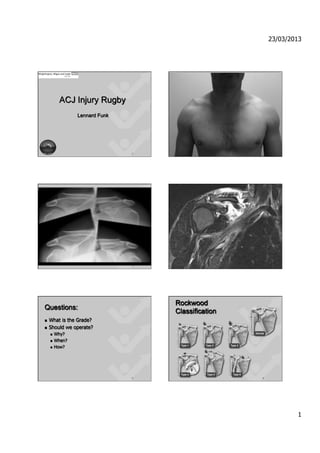
          ACJ Injury Rugby
                Lennard Funk


                               1                    2


                               3                    4


                                   Rockwood
Questions:
                                   Classification
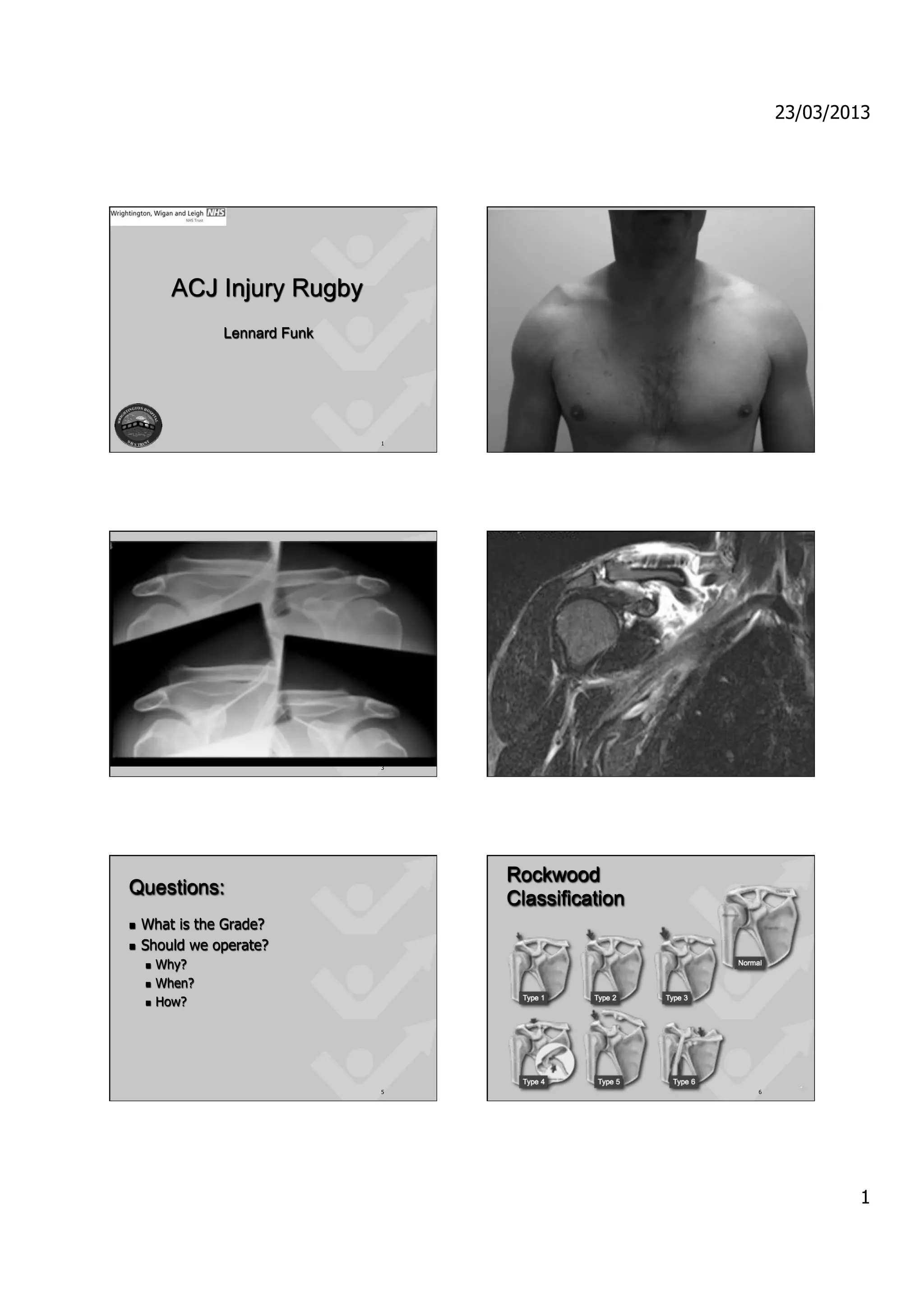
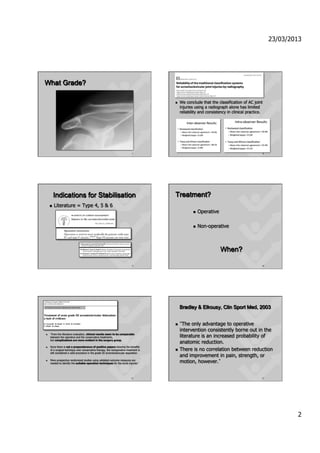
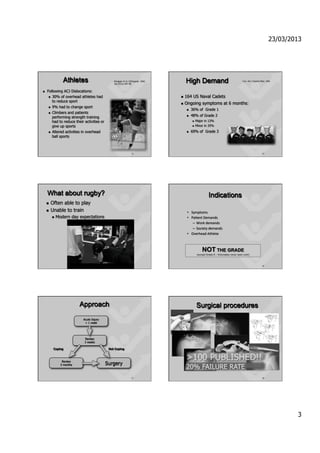
    What is the Grade?
    Should we operate?
       Why?
       When?
       How?


                               5                    6


                                                                1
23/03/2013


What Grade?

                                                                                             We conclude that the classification of AC joint
                                                                                              injuries using a radiograph alone has limited
                                                                                              reliability and consistency in clinical practice.


                                                                              7                                                                   8


          Indications for Stabilisation                                                  Treatment?
         Literature = Type 4, 5 & 6
                                                                                                          Operative

                                                                                                          Non-operative


                                                                                                                       When?

                                                                              9                                                               10


                                Ceccarelli et al. 2008                                        Bradley & Elkousy, Clin Sport Med, 2003


                                                                                             The only advantage to operative
                                                                                            intervention consistently borne out in the
     From the literature evaluation, clinical results seem to be comparable
     between the operative and the conservative treatments,                                 literature is an increased probability of
     but complications are more evident in the surgery group.
                                                                                            anatomic reduction.
     Since there is not a preponderance of positive papers showing the benefits
                                                                                           There is no correlation between reduction
 
     of a surgical technique over conservative therapy, the nonoperative treatment is
     still considered a valid procedure in the grade III acromioclavicular separation.
                                                                                            and improvement in pain, strength, or
    More prospective randomized studies using validated outcome measures are
     needed to identify the suitable operation techniques for the acute injuries.           motion, however.


                                                                              11                                                              12


                                                                                                                                                              2
23/03/2013


                   Athletes                        Rangger et al. Orthopade 2002
                                                   Jun;31(6):587-90
                                                                                        High Demand                     Cox. Am J Sports Med, 1981


    Following ACJ Dislocations:
        30% of overhead athletes had                                                  164 US Naval Cadets
         to reduce sport
                                                                                       Ongoing symptoms at 6 months:
          9% had to change sport
                                                                                            36% of Grade 1
          Climbers and patients
           performing strength training                                                     48% of Grade 2
           had to reduce their activities or                                                     Major in 13%
           give up sports                                                                        Minor in 35%

          Altered activities in overhead                                                   69% of Grade 3
           ball sports


                                                                   13                                                                     14


     What about rugby?                                                                                    Indications
         Often able to play
         Unable to train                                                                •  Symptoms(
               Modern day expectations                                                  •  Pa+ent(Demands(
                                                                                             –  Work(demands(
                                                                                             –  Society(demands(
                                                                                         •  Overhead(Athlete(


                                                                   15                                                                     16


                             Approach                                                             Surgical procedures
                              Acute Injury
                               < 1 week


                               Review
                               3 weeks

            Coping                              Not Coping


                   Review
                  3 months                     Surgery

                                                                   17                                                                     18


                                                                                                                                                        3
23/03/2013


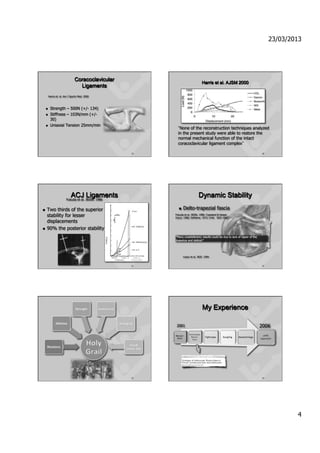
                             Coracoclavicular
                                                                                Harris et al. AJSM 2000
                               Ligaments
      Harris et. al. Am J Sports Med. 2000


         Strength – 500N (+/- 134)
         Stiffness – 103N/mm (+/-
          30)
         Uniaxial Tension 25mm/min
                                                          None of the reconstruction techniques analyzed
                                                         in the present study were able to restore the
                                                         normal mechanical function of the intact
                                                         coracoclavicular ligament complex

                                                  19                                                       20


                          ACJ Ligaments
                      Fukuda et al. JBJSA. 1986
                                                                             Dynamic Stability

    Two thirds of the superior                               Delto-trapezial fascia
     stability for lesser                              Fukuda et al. JBJSA. 1986: Copeland & Kessel.
                                                       Injury. 1980; DePalma. 1973; Urist. JBJS 1963.
     displacements
    90% the posterior stability


                                                               Lizaur et al. JBJS. 1994


                                                  21                                                       22


                                                                                My Experience

                                                        2001                                              2006


                                                  23                                                       24


                                                                                                                        4
23/03/2013


                      LARS Ligament (Corin)                                                LARS Ligament

  Braided Polyethylenetraphthalate
  1500N tensile strength (30 LAC)
  No reduction in mechanical resilience
   after over 10 million wear cycles loaded
   in torsion, traction and flexion [Fialka et al. 2005;
  Vascularisation & Fibrous ingrowth -
   Collagen Type 1 [Trieb et al. Eur Surg Res. 2004; Yu et al. 2005;
     Pelletier & Durand]


                                                               25                                                                 26


     3 weeks post-op                                                        LARS Ligament Outcomes
                                                                              Wright & Funk, 2010. BESS


                                                               27                                                                 28


          LARS Ligament Outcomes                                              LARS Ligament Outcomes
      All patients returned to their previous level of work &             The median postoperative residual displacement of the ACJ
       sports post LARS reconstruction in a mean time of 3                  was 15%.
       months
      The mean patient satisfaction score was 93%
      In one patient who did not follow the prescribed
       rehabilitation protocol the reconstruction failed in the
       early postoperative period.


                                                               29                                                                 30


                                                                                                                                                5
23/03/2013


31


             6

Acj injury rugby

  • 1.
    23/03/2013 ACJ Injury Rugby Lennard Funk 1 2 3 4 Rockwood Questions: Classification   What is the Grade?   Should we operate?   Why?   When?   How? 5 6 1
  • 2.
    23/03/2013 What Grade?   We conclude that the classification of AC joint injuries using a radiograph alone has limited reliability and consistency in clinical practice. 7 8 Indications for Stabilisation Treatment?   Literature = Type 4, 5 & 6   Operative   Non-operative When? 9 10 Ceccarelli et al. 2008 Bradley & Elkousy, Clin Sport Med, 2003   The only advantage to operative intervention consistently borne out in the   From the literature evaluation, clinical results seem to be comparable between the operative and the conservative treatments, literature is an increased probability of but complications are more evident in the surgery group. anatomic reduction. Since there is not a preponderance of positive papers showing the benefits   There is no correlation between reduction   of a surgical technique over conservative therapy, the nonoperative treatment is still considered a valid procedure in the grade III acromioclavicular separation. and improvement in pain, strength, or   More prospective randomized studies using validated outcome measures are needed to identify the suitable operation techniques for the acute injuries. motion, however. 11 12 2
  • 3.
    23/03/2013 Athletes Rangger et al. Orthopade 2002 Jun;31(6):587-90 High Demand Cox. Am J Sports Med, 1981   Following ACJ Dislocations:   30% of overhead athletes had   164 US Naval Cadets to reduce sport   Ongoing symptoms at 6 months:   9% had to change sport   36% of Grade 1   Climbers and patients performing strength training   48% of Grade 2 had to reduce their activities or   Major in 13% give up sports   Minor in 35%   Altered activities in overhead   69% of Grade 3 ball sports 13 14 What about rugby? Indications   Often able to play   Unable to train •  Symptoms(   Modern day expectations •  Pa+ent(Demands( –  Work(demands( –  Society(demands( •  Overhead(Athlete( 15 16 Approach Surgical procedures Acute Injury < 1 week Review 3 weeks Coping Not Coping Review 3 months Surgery 17 18 3
  • 4.
    23/03/2013 Coracoclavicular Harris et al. AJSM 2000 Ligaments Harris et. al. Am J Sports Med. 2000   Strength – 500N (+/- 134)   Stiffness – 103N/mm (+/- 30)   Uniaxial Tension 25mm/min None of the reconstruction techniques analyzed in the present study were able to restore the normal mechanical function of the intact coracoclavicular ligament complex 19 20 ACJ Ligaments Fukuda et al. JBJSA. 1986 Dynamic Stability   Two thirds of the superior   Delto-trapezial fascia stability for lesser Fukuda et al. JBJSA. 1986: Copeland & Kessel. Injury. 1980; DePalma. 1973; Urist. JBJS 1963. displacements   90% the posterior stability Lizaur et al. JBJS. 1994 21 22 My Experience 2001 2006 23 24 4
  • 5.
    23/03/2013 LARS Ligament (Corin) LARS Ligament   Braided Polyethylenetraphthalate   1500N tensile strength (30 LAC)   No reduction in mechanical resilience after over 10 million wear cycles loaded in torsion, traction and flexion [Fialka et al. 2005;   Vascularisation & Fibrous ingrowth - Collagen Type 1 [Trieb et al. Eur Surg Res. 2004; Yu et al. 2005; Pelletier & Durand] 25 26 3 weeks post-op LARS Ligament Outcomes Wright & Funk, 2010. BESS 27 28 LARS Ligament Outcomes LARS Ligament Outcomes   All patients returned to their previous level of work &   The median postoperative residual displacement of the ACJ sports post LARS reconstruction in a mean time of 3 was 15%. months   The mean patient satisfaction score was 93%   In one patient who did not follow the prescribed rehabilitation protocol the reconstruction failed in the early postoperative period. 29 30 5
  • 6.