Providing)the)best)possible)care!@shoulderpedia
Atraumatic Instability-
Principles and assessment
Puneet Monga
Consultant Orthopaedic Shoulder Surgeon
Providing)the)best)possible)care!@shoulderpedia
Scenario 1
16 year old girl. Comes with her Mum, who is
very concerned. Mum says her daughter is
“double-jointed” and can demonstrate shoulder
dislocation in clinic…..but has no pain or other
symptoms.
• Hyperlax?
• Unstable?
• Management?
Providing)the)best)possible)care!@shoulderpedia
Scenario 2
16 year old girl. Comes with her Mum, who is
very concerned. Mum says her daughter is
“double-jointed” and dislocates her shoulder
when swimming. It is very painful and she has
been to Casualty 5 times.
• Hyperlax?
• Unstable?
• Management ?
Providing)the)best)possible)care!@shoulderpedia
Scenario 3
16 year old girl. Comes with her Mum, who is
very concerned. Mum says her daughter is
“double-jointed” and dislocates her shoulder
every morning. Mum feels “queasy” and daughter
has missed school for weeks.
• Hyperlax?
• Unstable?
• Management ?
Providing)the)best)possible)care!@shoulderpedia
Scenario 4
16 year old girl. Comes with her Mum, who is
very concerned. Mum says her daughter is
“double-jointed” and injured her shoulder when
fell off a horse 3 months ago. Since then it keeps
coming out of the joint on relatively minor tasks.
• Hyperlax?
• Unstable?
• Management ?
Providing)the)best)possible)care!@shoulderpedia
Defining Instability
Providing)the)best)possible)care!@shoulderpedia
Instability
• “Symptomatic” “abnormal translation” of
humeral head
• Important to differentiate from hyperlaxity
Providing)the)best)possible)care!@shoulderpedia
Understanding Instability
Providing)the)best)possible)care!@shoulderpedia
Understanding Stability
Static Stabilisers
Bone
Providing)the)best)possible)care!@shoulderpedia
Anterior Posterior
Providing)the)best)possible)care!@shoulderpedia
Anterior Posterior
Providing)the)best)possible)care!@shoulderpedia
Anterior Posterior
Providing)the)best)possible)care!@shoulderpedia
Anterior Posterior
Providing)the)best)possible)care!@shoulderpedia
Hill Sach’s lesion
Bony Bankart’s
Anterior Posterior
Providing)the)best)possible)care!@shoulderpedia
Reverse
Hill Sach’s lesion
Reverse Bony
Banakart’s
Anterior Posterior
Providing)the)best)possible)care!@shoulderpedia
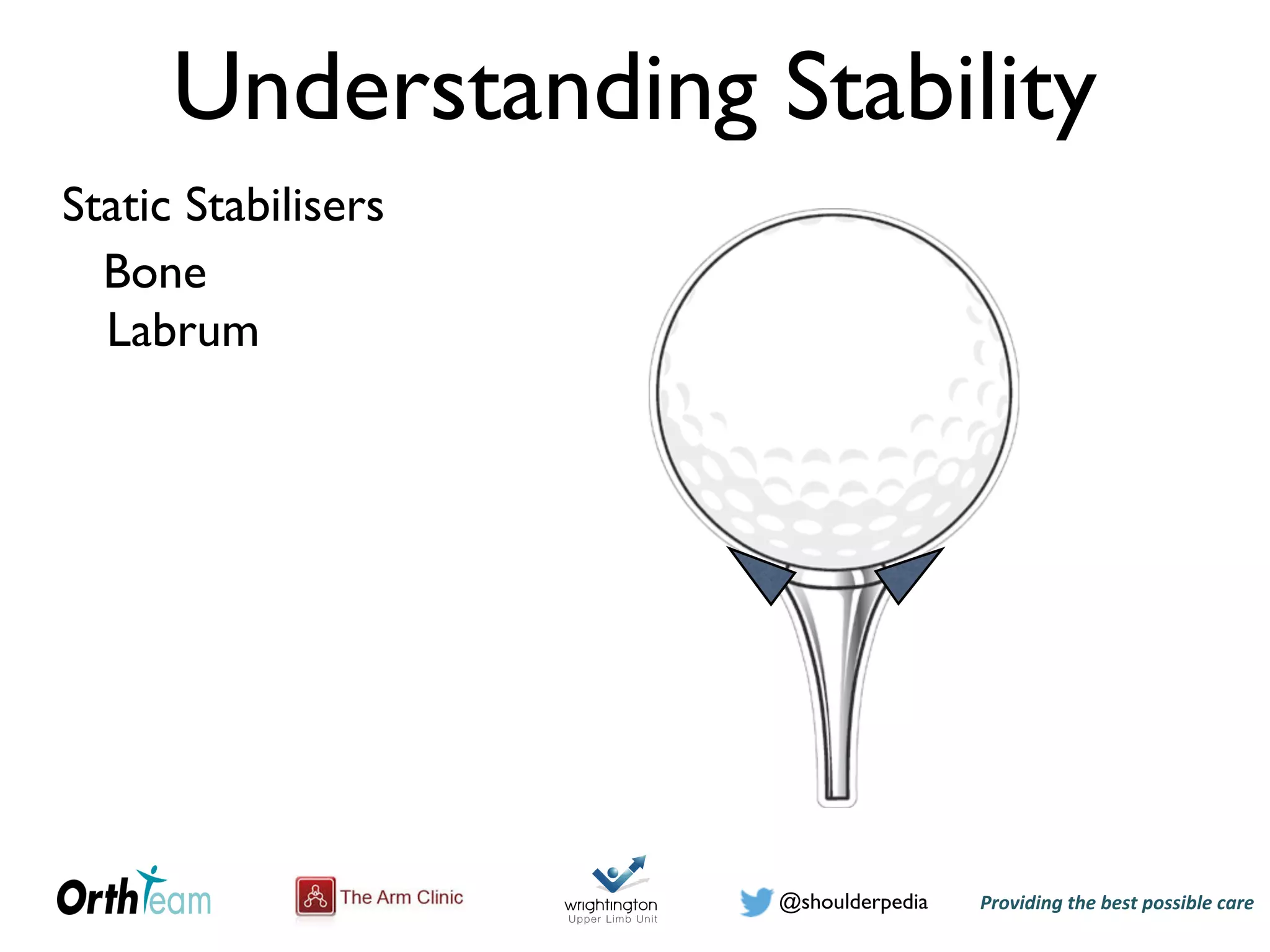
Understanding Stability
Static Stabilisers
Bone
Labrum
Providing)the)best)possible)care!@shoulderpedia
Wheel Chocks
Providing)the)best)possible)care!@shoulderpedia
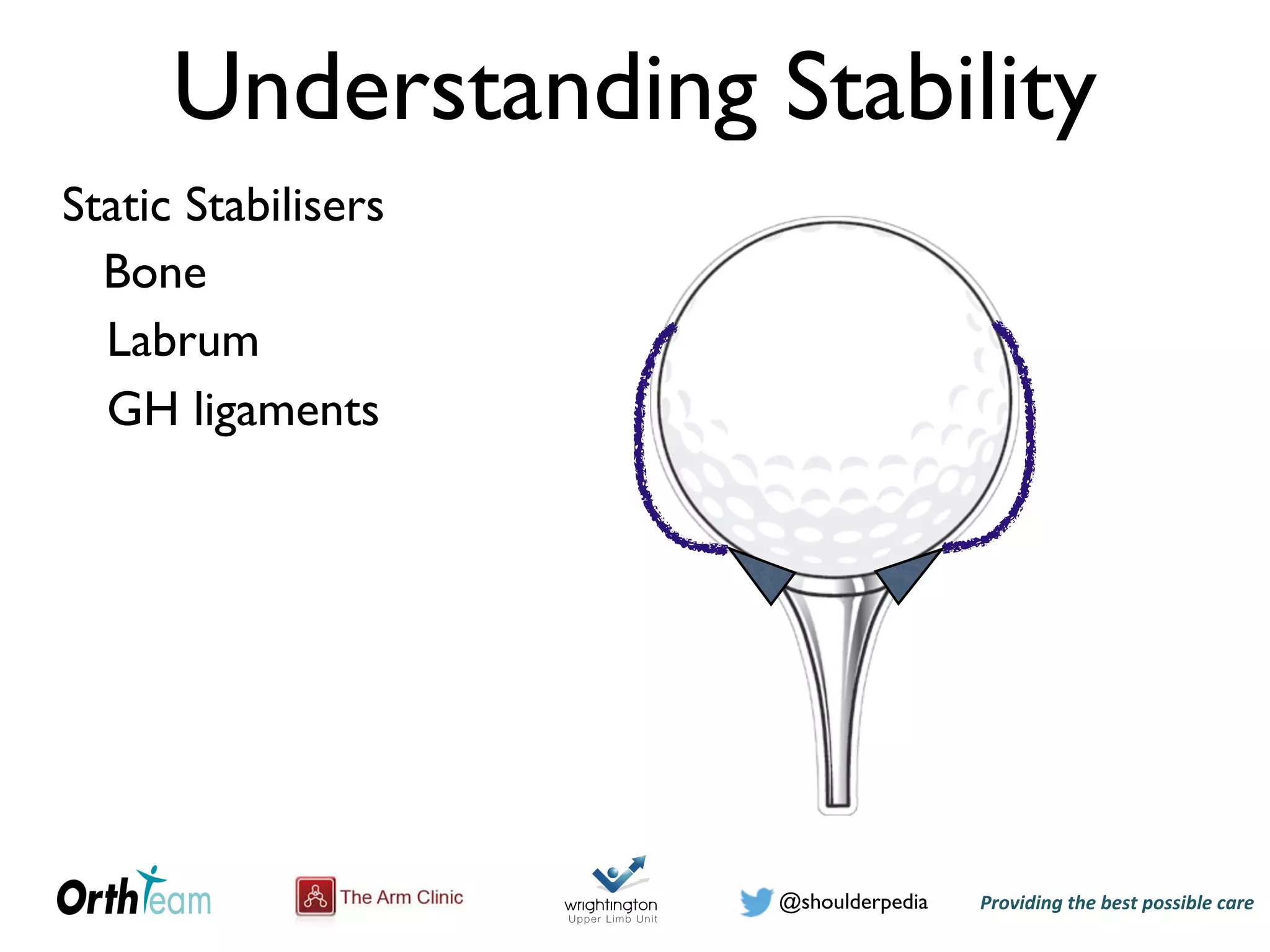
Understanding Stability
Static Stabilisers
Bone
Labrum
GH ligaments
Providing)the)best)possible)care!@shoulderpedia
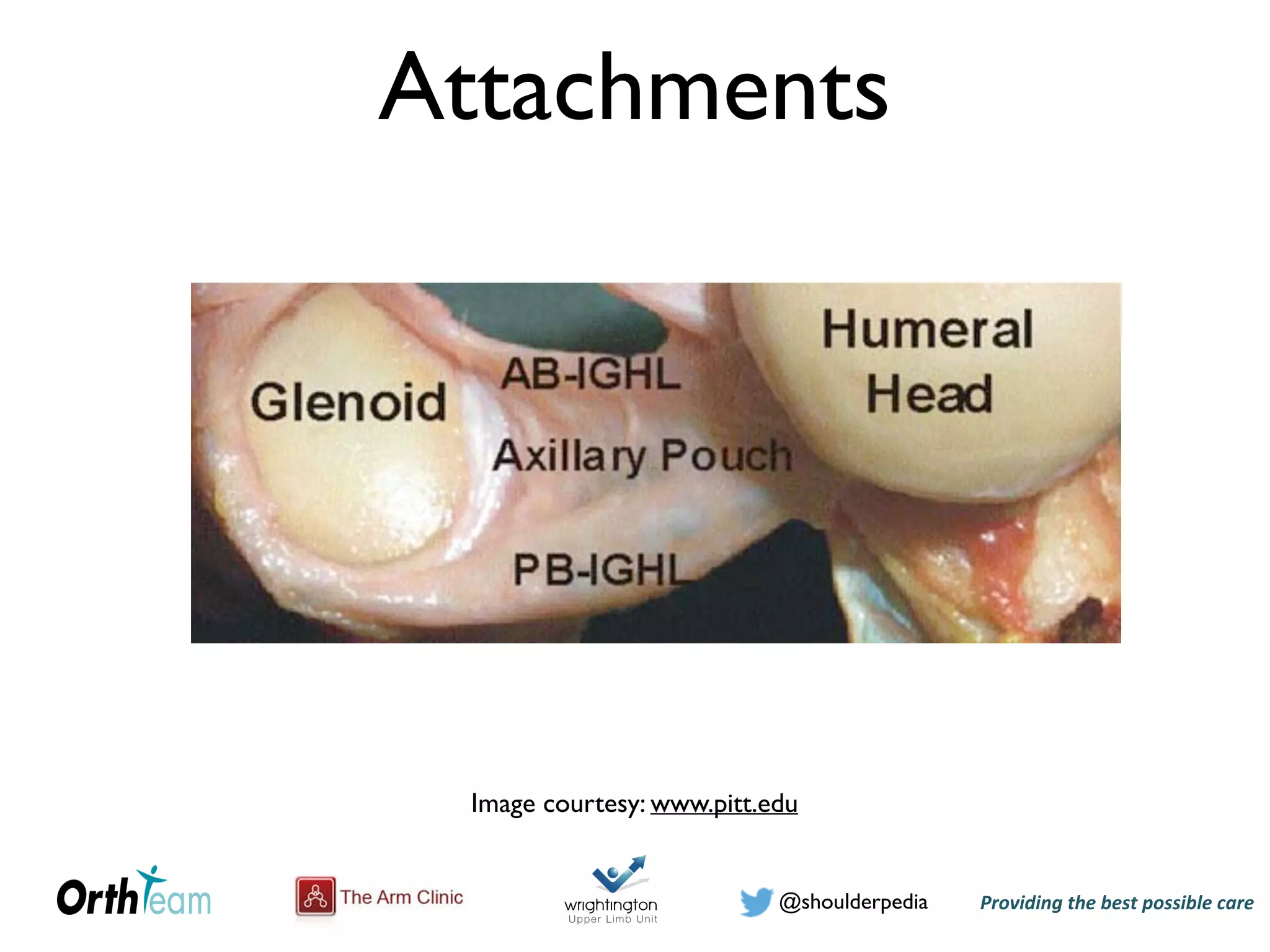
Attachments
Image courtesy: www.pitt.edu
Providing)the)best)possible)care!@shoulderpedia
Understanding Instability
Providing)the)best)possible)care!@shoulderpedia
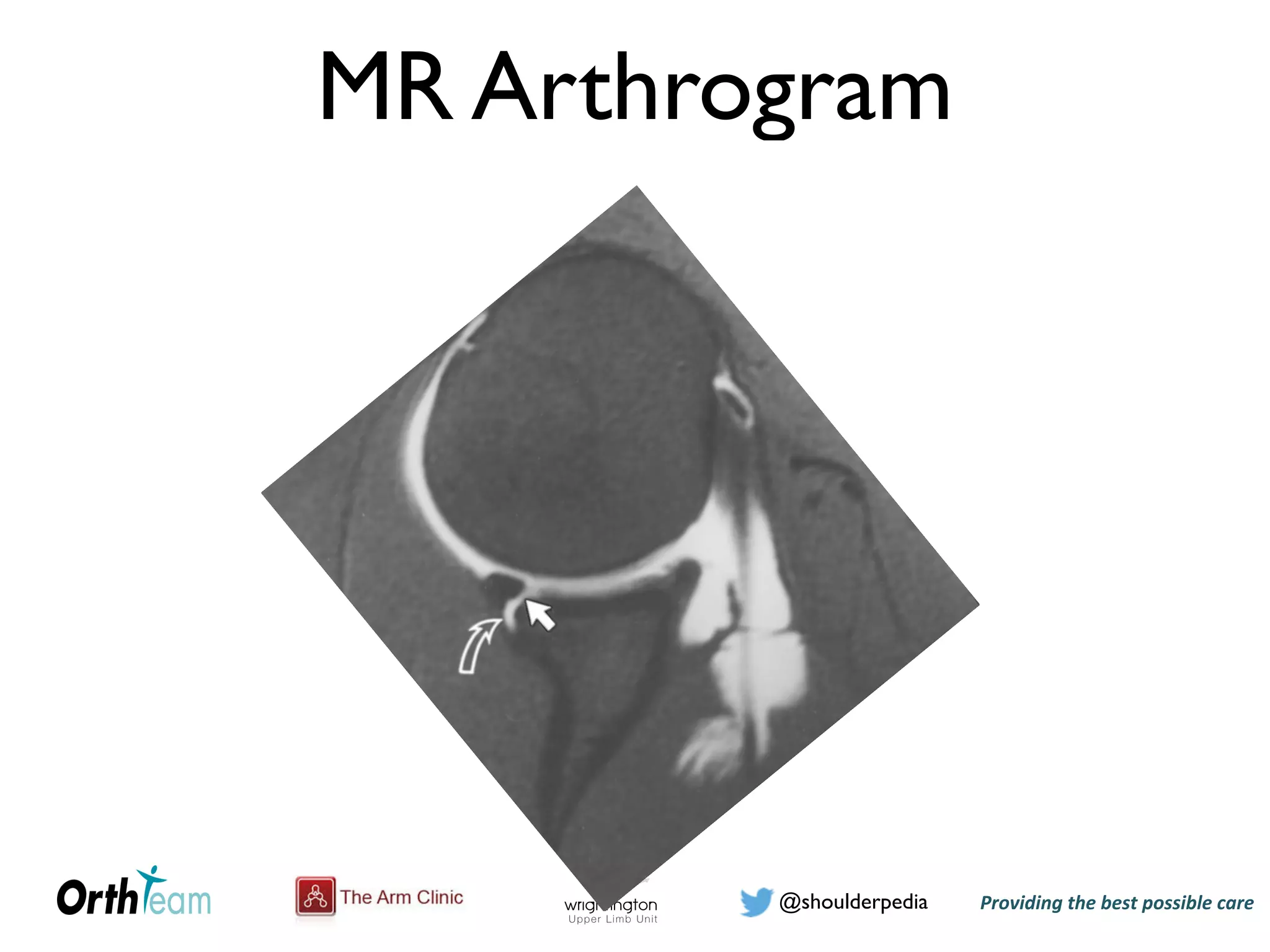
MR Arthrogram
Providing)the)best)possible)care!@shoulderpedia
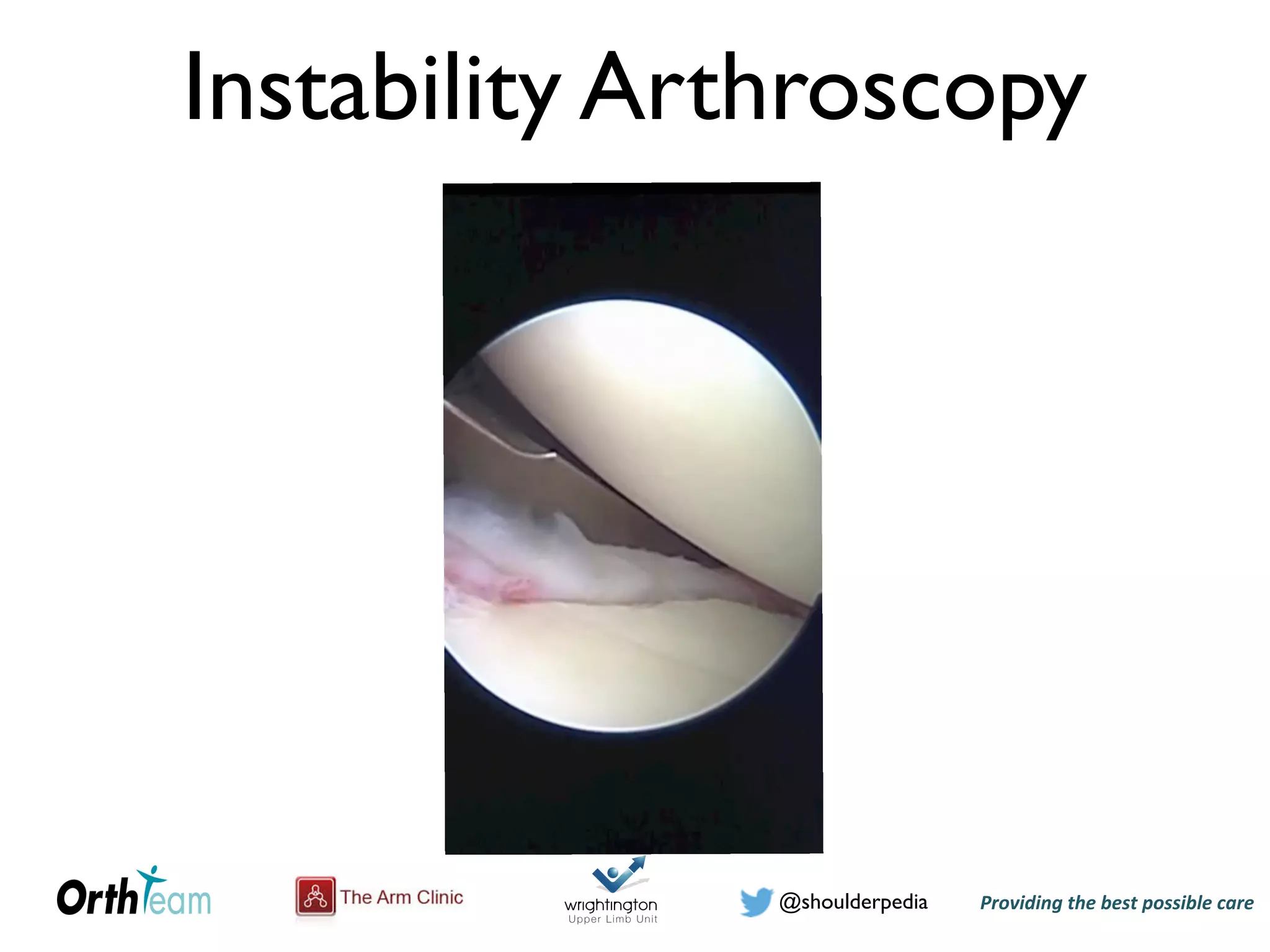
Instability Arthroscopy
Providing)the)best)possible)care!@shoulderpedia
Understanding Instability
Providing)the)best)possible)care!@shoulderpedia
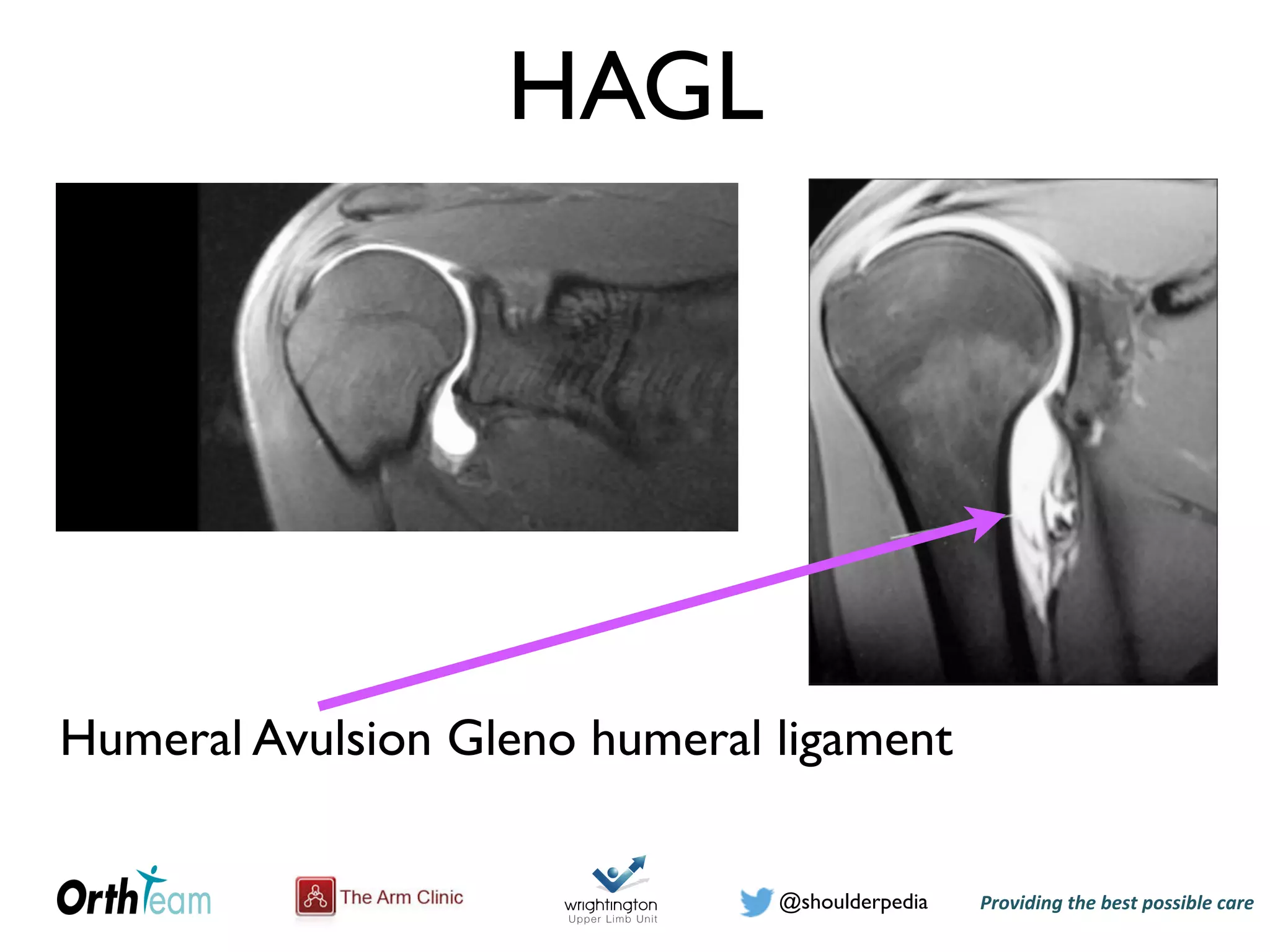
HAGL
Humeral Avulsion Gleno humeral ligament
Providing)the)best)possible)care!@shoulderpedia
Understanding Stability
Static Stabilisers
Bone
Labrum
GH ligaments
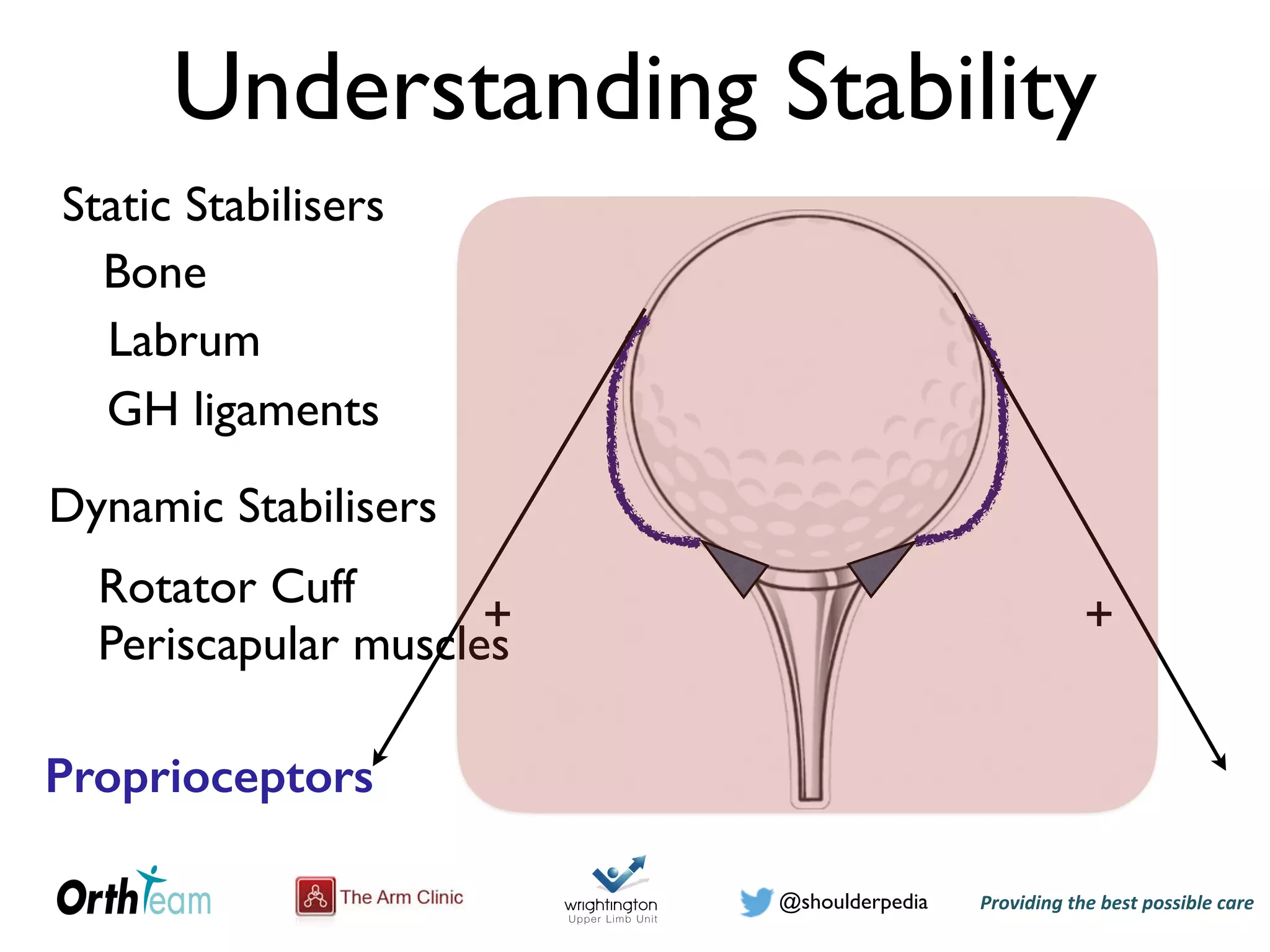
Dynamic Stabilisers
Rotator Cuff
Periscapular muscles
+ +
Providing)the)best)possible)care!@shoulderpedia
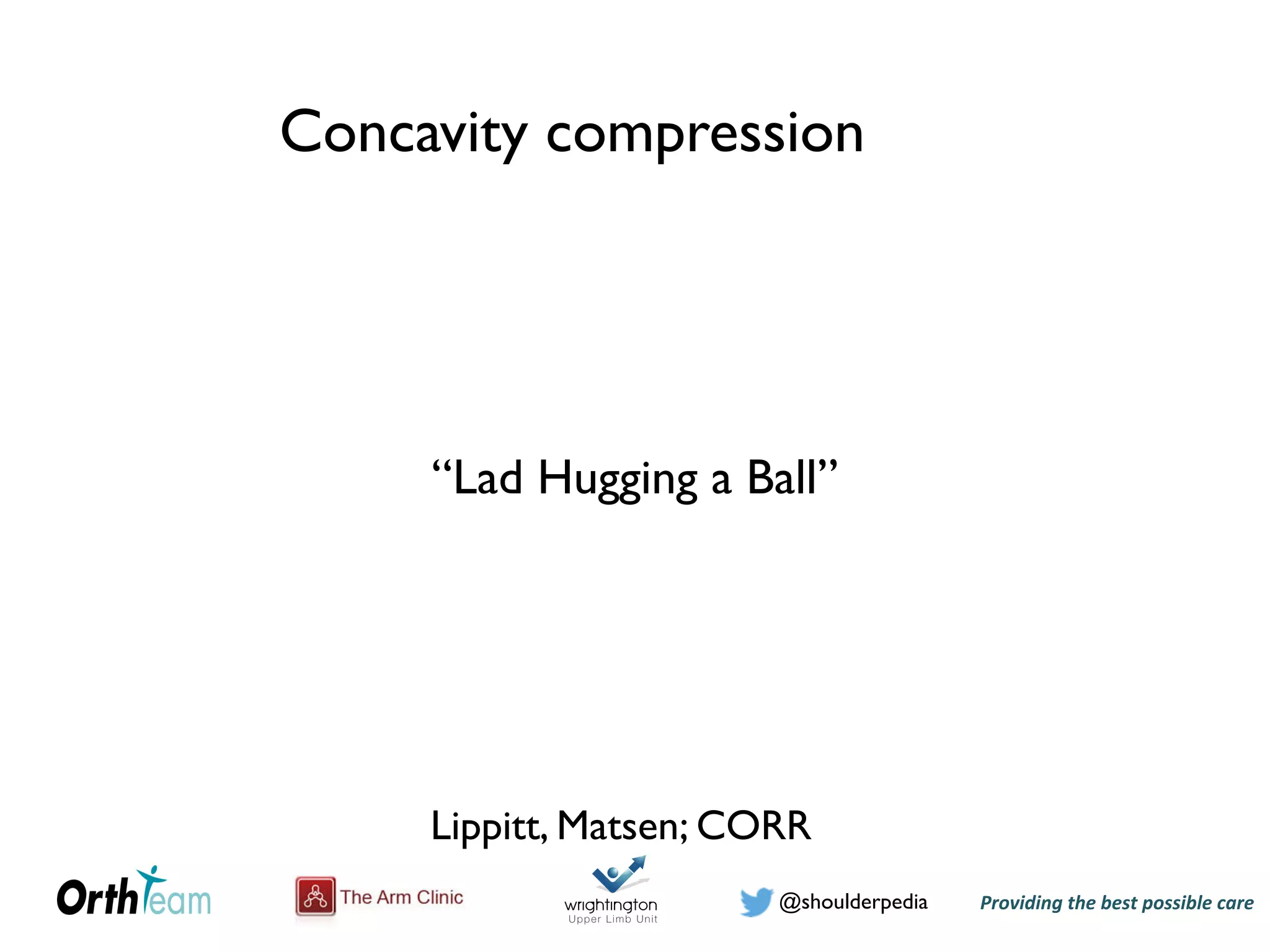
Concavity compression
Lippitt, Matsen; CORR
“Lad Hugging a Ball”
Providing)the)best)possible)care!@shoulderpedia
Scapulo-humeral balance
+ +
Providing)the)best)possible)care!@shoulderpedia
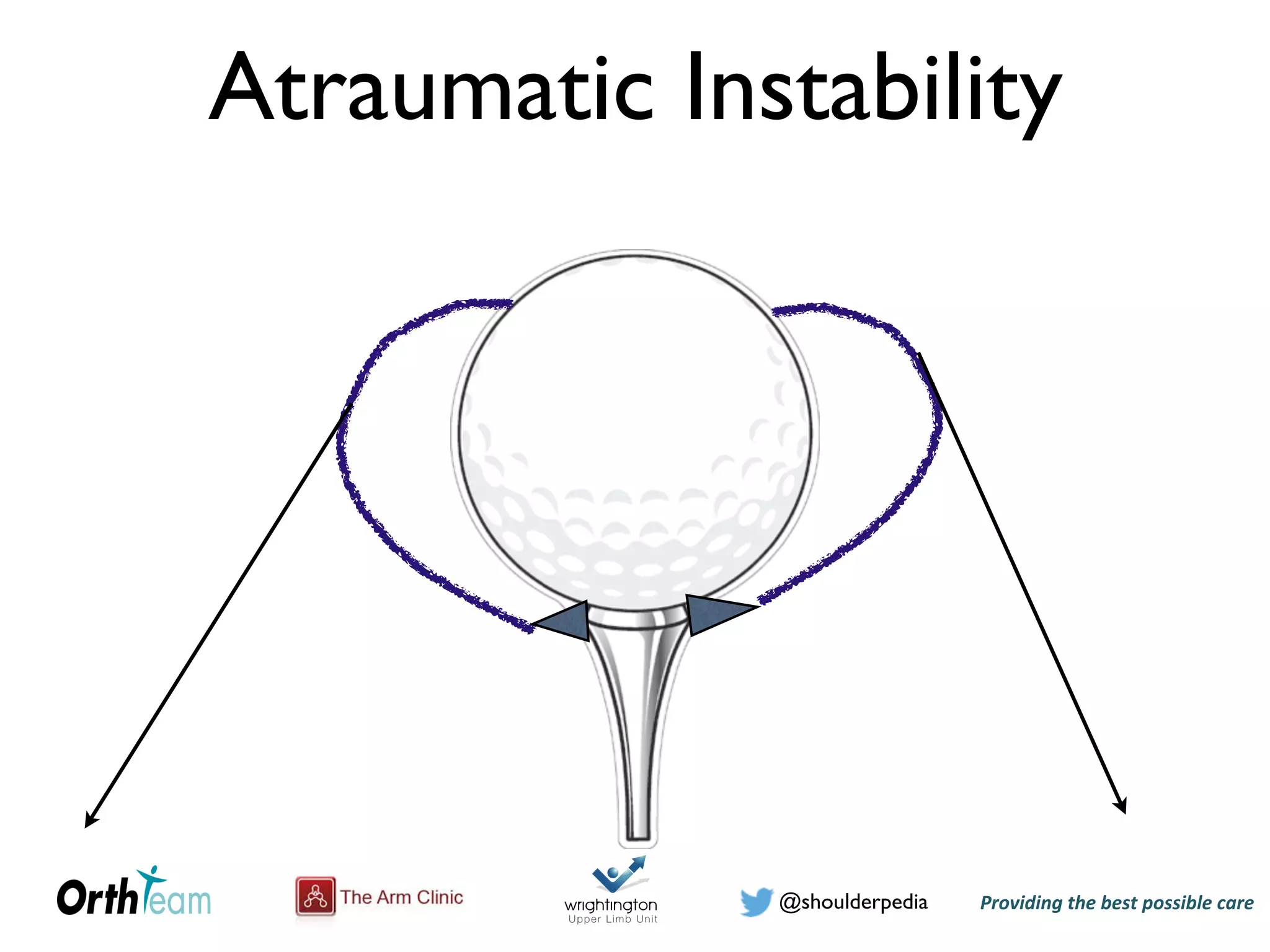
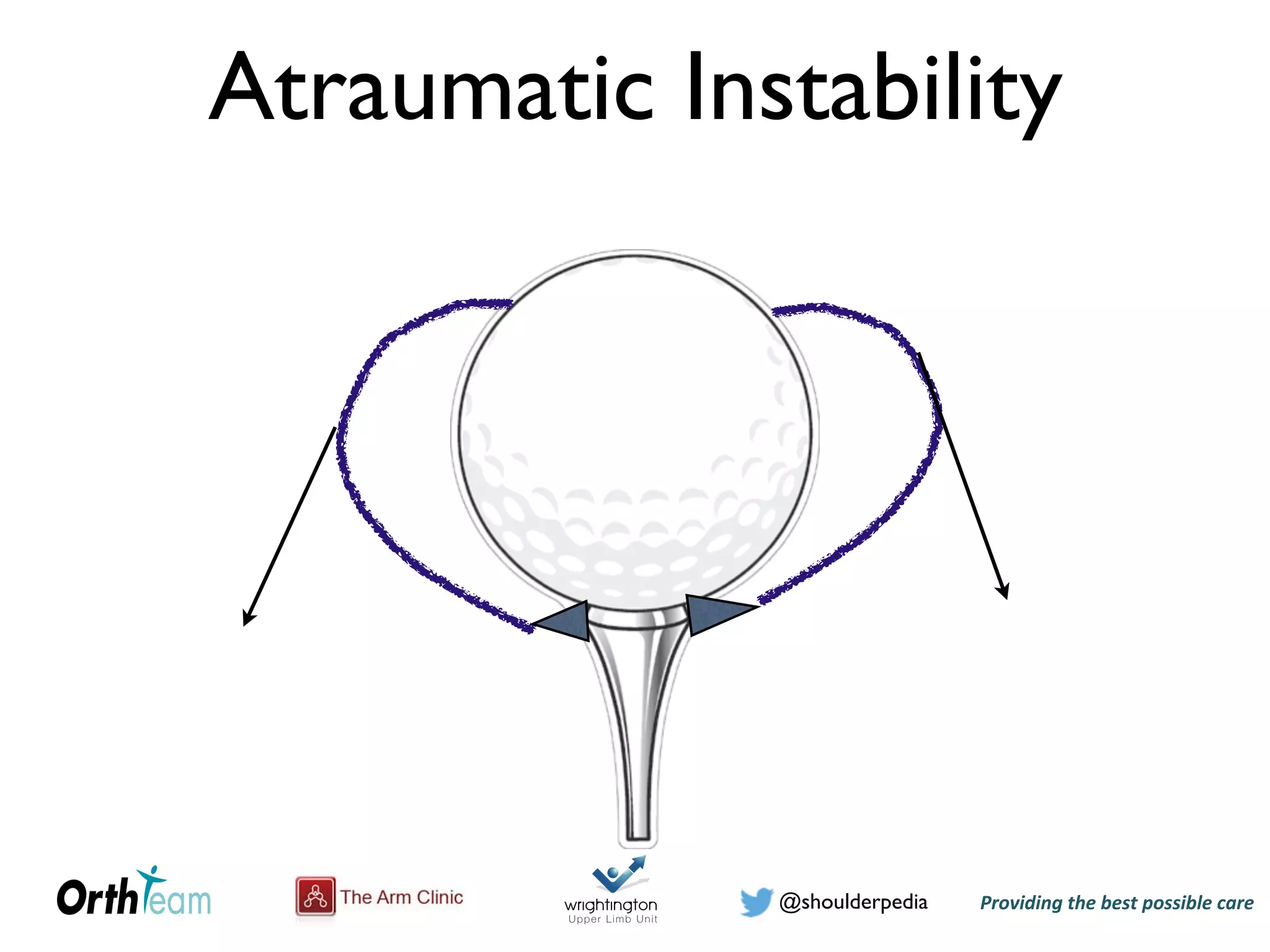
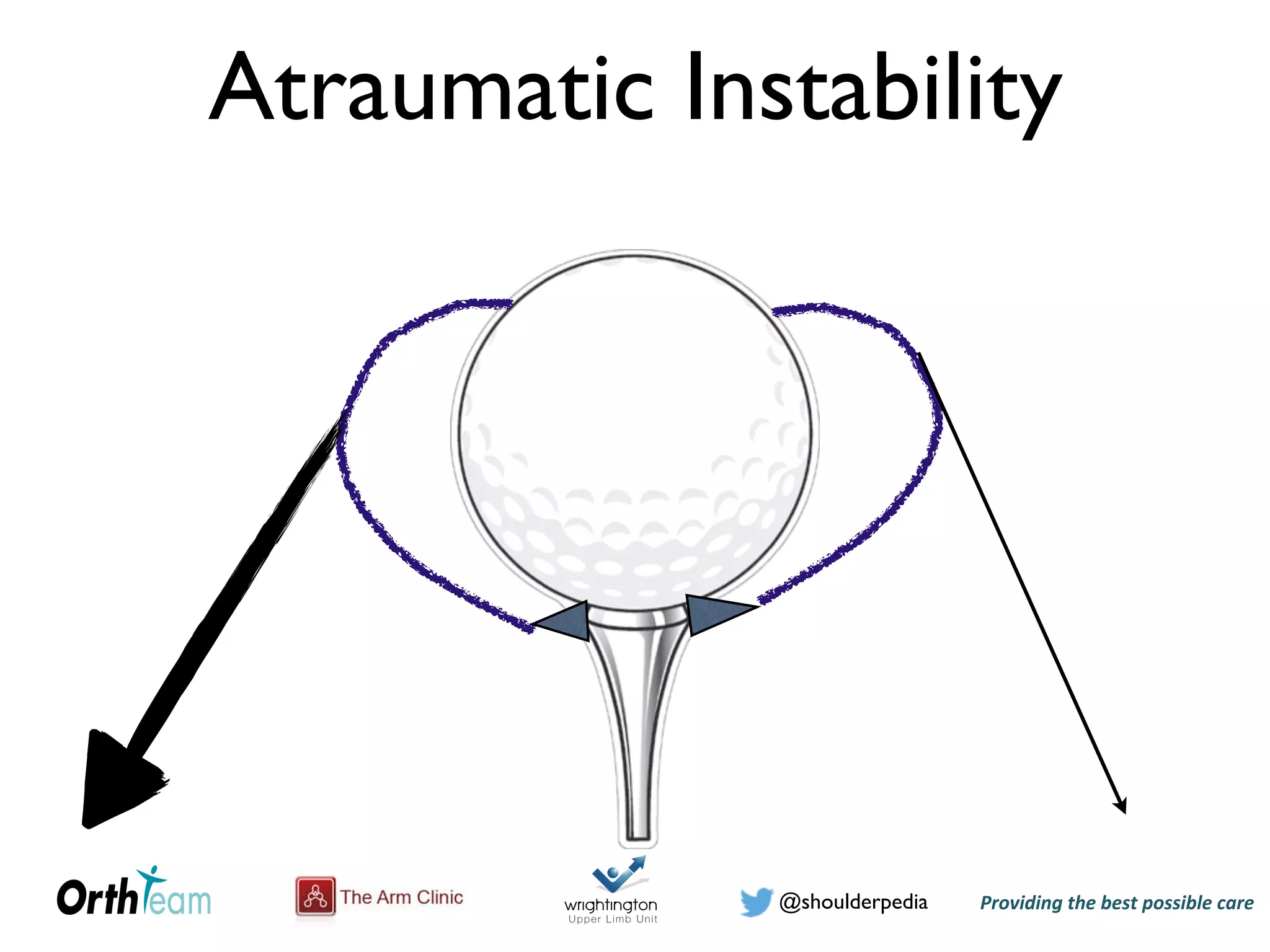
Atraumatic Instability
Providing)the)best)possible)care!@shoulderpedia
Atraumatic Instability
Providing)the)best)possible)care!@shoulderpedia
Atraumatic Instability
Providing)the)best)possible)care!@shoulderpedia
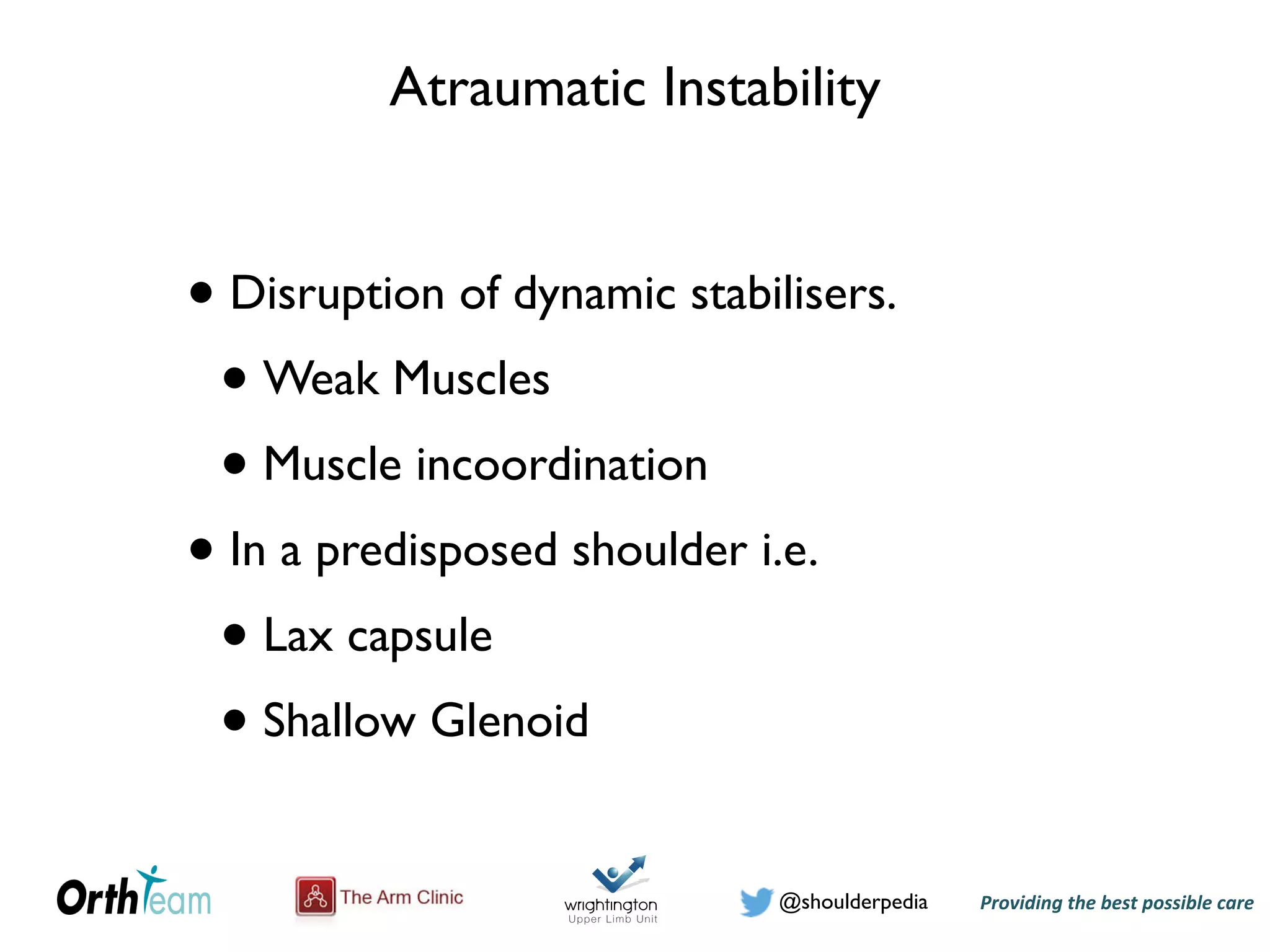
Atraumatic Instability
• Disruption of dynamic stabilisers.
• Weak Muscles
• Muscle incoordination
• In a predisposed shoulder i.e.
• Lax capsule
• Shallow Glenoid
Providing)the)best)possible)care!@shoulderpedia
Atraumatic instability
Providing)the)best)possible)care!@shoulderpedia
Understanding Stability
Static Stabilisers
Bone
Labrum
GH ligaments
Dynamic Stabilisers
Rotator Cuff
Periscapular muscles
+ +
Proprioceptors
Providing)the)best)possible)care!@shoulderpedia
Classification
Providing)the)best)possible)care!@shoulderpedia
Classification
• Rockwood
• Type I; traumatic. h/o prior dislocation
• Type II; traumatic. no prior dislocation
• Type III; atraumatic. a) with, b) without psychiatric
issues
• Type IV; involuntary
Providing)the)best)possible)care!@shoulderpedia
Classification
• Thomas and Matsen
• TUBS;Traumatic Unidirectional Bankart’s Surgery
• AMBRII;Atraumatic Multidirectional Bilateral Rehab
Inferior Capsular shift
Providing)the)best)possible)care!@shoulderpedia
Classification
• Gerber
• Static
• Dynamic
• Voluntary
Providing)the)best)possible)care!@shoulderpedia
ClassificationFigure 5: The Stanmore classification of instability
It is apparent from the above discussion that the presentation of patients with instability
can vary significantly and hence for the purposes of this study only patients with
recurrent anterior glenohumeral dislocations following a traumatic episode were
included.
Treatment of traumatic anterior shoulder dislocation may range from initial
immobilization followed by rehabilitation to early operative stabilization. The patient’s
Stanmore triangle
Providing)the)best)possible)care!@shoulderpedia@shoulderpedia Puneet Monga
Understanding Instability
Tuesday, 24 May 16
Atraumatic Instability
Tuesday, 24 May 16
+++ +
Tuesday, 24 May 16
Figure 5: The Stanmore classification of instability
It is apparent from the above discussion that the presentation of patients with instability
can vary significantly and hence for the purposes of this study only patients with
recurrent anterior glenohumeral dislocations following a traumatic episode were
included.
Treatment of traumatic anterior shoulder dislocation may range from initial
immobilization followed by rehabilitation to early operative stabilization. The patient’s
age, previous dislocations, joint laxity, co-morbidities, compliance and activity level
Tuesday, 24 May 16
Providing)the)best)possible)care!@shoulderpedia
Clinical Assessment
Providing)the)best)possible)care!@shoulderpedia
Age at Presentation
Ref; Matsen et al
Providing)the)best)possible)care!@shoulderpedia
History
• Usually begins with a minor injury/innocuous
event/s.
• Tilts a compensated “at risk” shoulder
towards symptomatic instability.
• Ask about position of instability
Providing)the)best)possible)care!@shoulderpedia
Assessment
Assess contributions from the three poles
@shoulderpedia Puneet Monga
Understanding Instability
Tuesday, 24 May 16
Atraumatic Instability
Tuesday, 24 May 16
+++ +
Tuesday, 24 May 16
! "$!
Figure 5: The Stanmore classification of instability
It is apparent from the above discussion that the presentation of patients with instability
can vary significantly and hence for the purposes of this study only patients with
recurrent anterior glenohumeral dislocations following a traumatic episode were
included.
Treatment of traumatic anterior shoulder dislocation may range from initial
immobilization followed by rehabilitation to early operative stabilization. The patient’s
age, previous dislocations, joint laxity, co-morbidities, compliance and activity level
guide the choice of treatment. It is common practice to reserve surgical treatment for
patients having recurrent dislocations. Non-operative management generally involves an
initial reduction of the dislocation followed by immobilization of the shoulder for a
period of three to six weeks. This is followed by physiotherapy focusing initially on
regaining the range of motion and then subscapularis strengthening exercises {O'Brien
et al., 1987}. However, 66% of those between 12 to 22 years of age have a recurrence
of dislocation {Hovelius et al., 1996}.
In the past, tendon or muscle units were shortened to stabilize the shoulder. For
example, the Putti-Platt procedure involved surgical shortening of the subscapularis to
achieve stability. This however led to a loss of movement, especially external rotation,
Tuesday, 24 May 16
Tuesday, 24 May 16
Providing)the)best)possible)care!@shoulderpedia
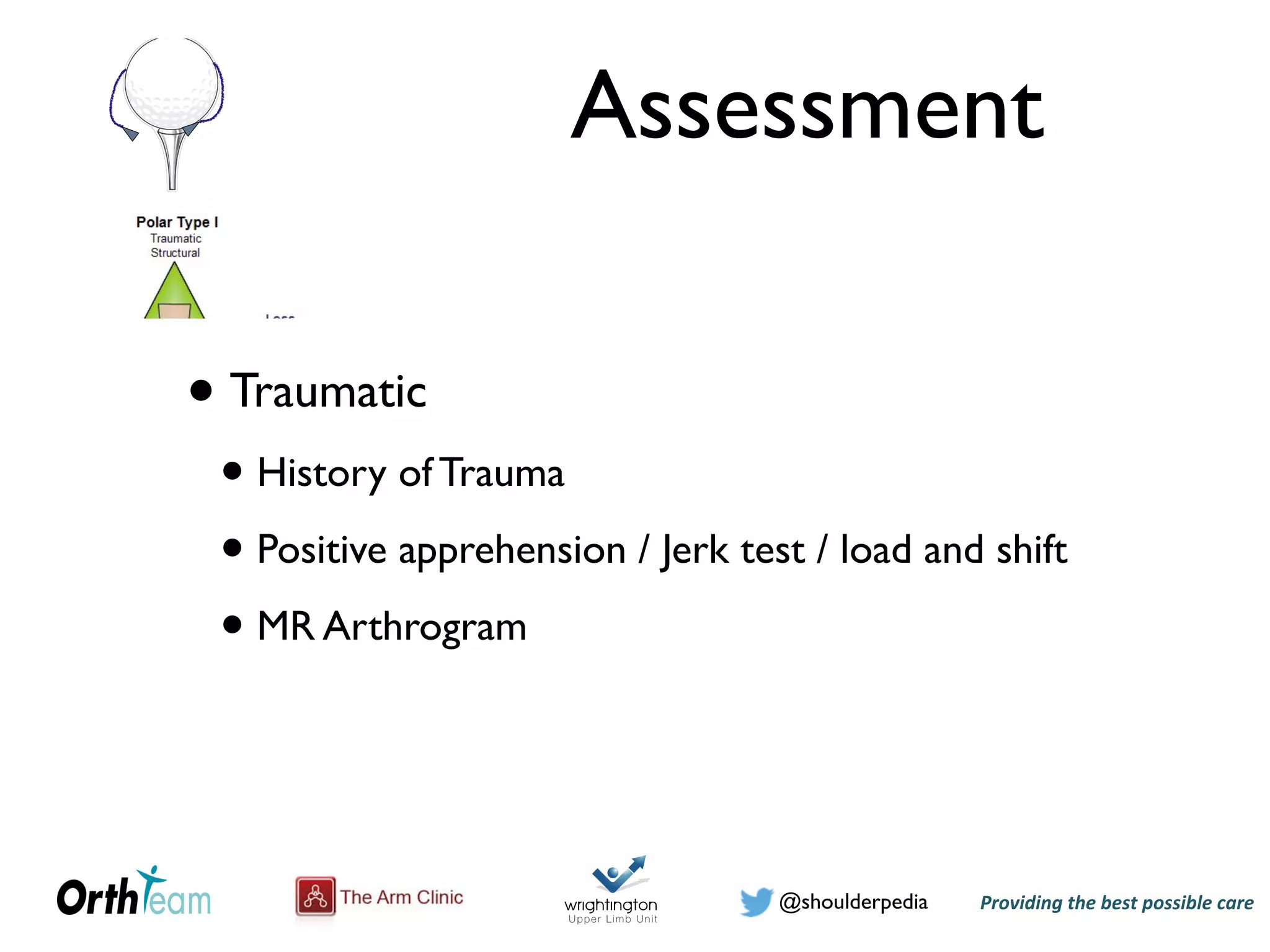
Assessment
• Traumatic
• History of Trauma
• Positive apprehension / Jerk test / load and shift
• MR Arthrogram
@shoulderpedia Puneet Monga
Tuesday, 24 May 16
Atraumatic Instability
Tuesday, 24 May 16
Figure 5: The Stanmore classification of instability
om the above discussion that the presentation of patients with instability
icantly and hence for the purposes of this study only patients with
or glenohumeral dislocations following a traumatic episode were
traumatic anterior shoulder dislocation may range from initial
followed by rehabilitation to early operative stabilization. The patient’s
islocations, joint laxity, co-morbidities, compliance and activity level
e of treatment. It is common practice to reserve surgical treatment for
ecurrent dislocations. Non-operative management generally involves an
of the dislocation followed by immobilization of the shoulder for a
to six weeks. This is followed by physiotherapy focusing initially on
nge of motion and then subscapularis strengthening exercises {O'Brien
owever, 66% of those between 12 to 22 years of age have a recurrence
Hovelius et al., 1996}.
Tuesday, 24 May 16
Providing)the)best)possible)care!@shoulderpedia
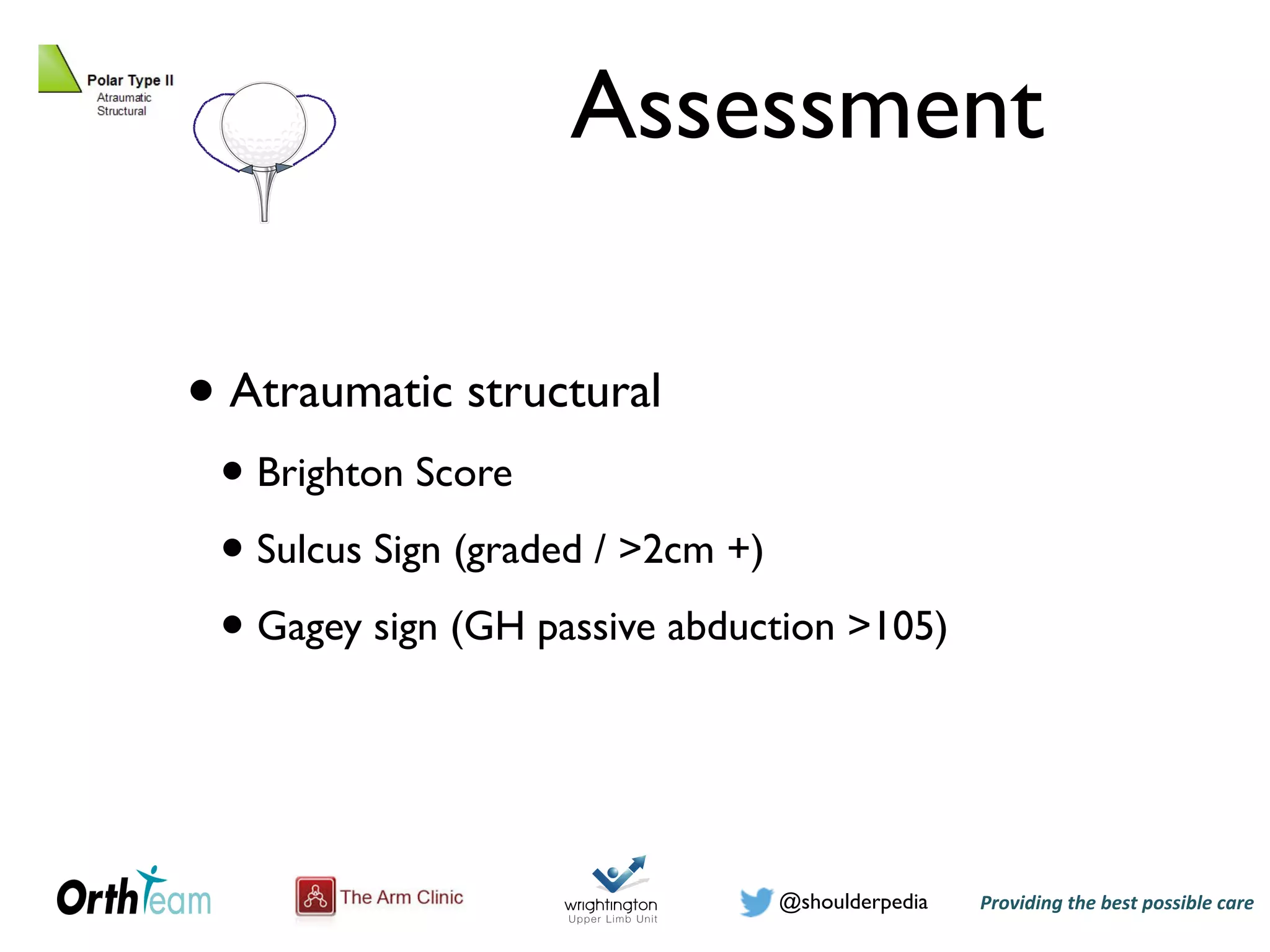
Assessment
• Atraumatic structural
• Brighton Score
• Sulcus Sign (graded / >2cm +)
• Gagey sign (GH passive abduction >105)
@shoulderpedia Puneet Monga
Atraumatic Instability
Tuesday, 24 May 16
presentation of patients with instability
poses of this study only patients with
following a traumatic episode were
dislocation may range from initial
ly operative stabilization. The patient’s
bidities, compliance and activity level
actice to reserve surgical treatment for
ative management generally involves an
y immobilization of the shoulder for a
by physiotherapy focusing initially on
ularis strengthening exercises {O'Brien
12 to 22 years of age have a recurrence
ortened to stabilize the shoulder. For
gical shortening of the subscapularis to
movement, especially external rotation,
Providing)the)best)possible)care!@shoulderpedia
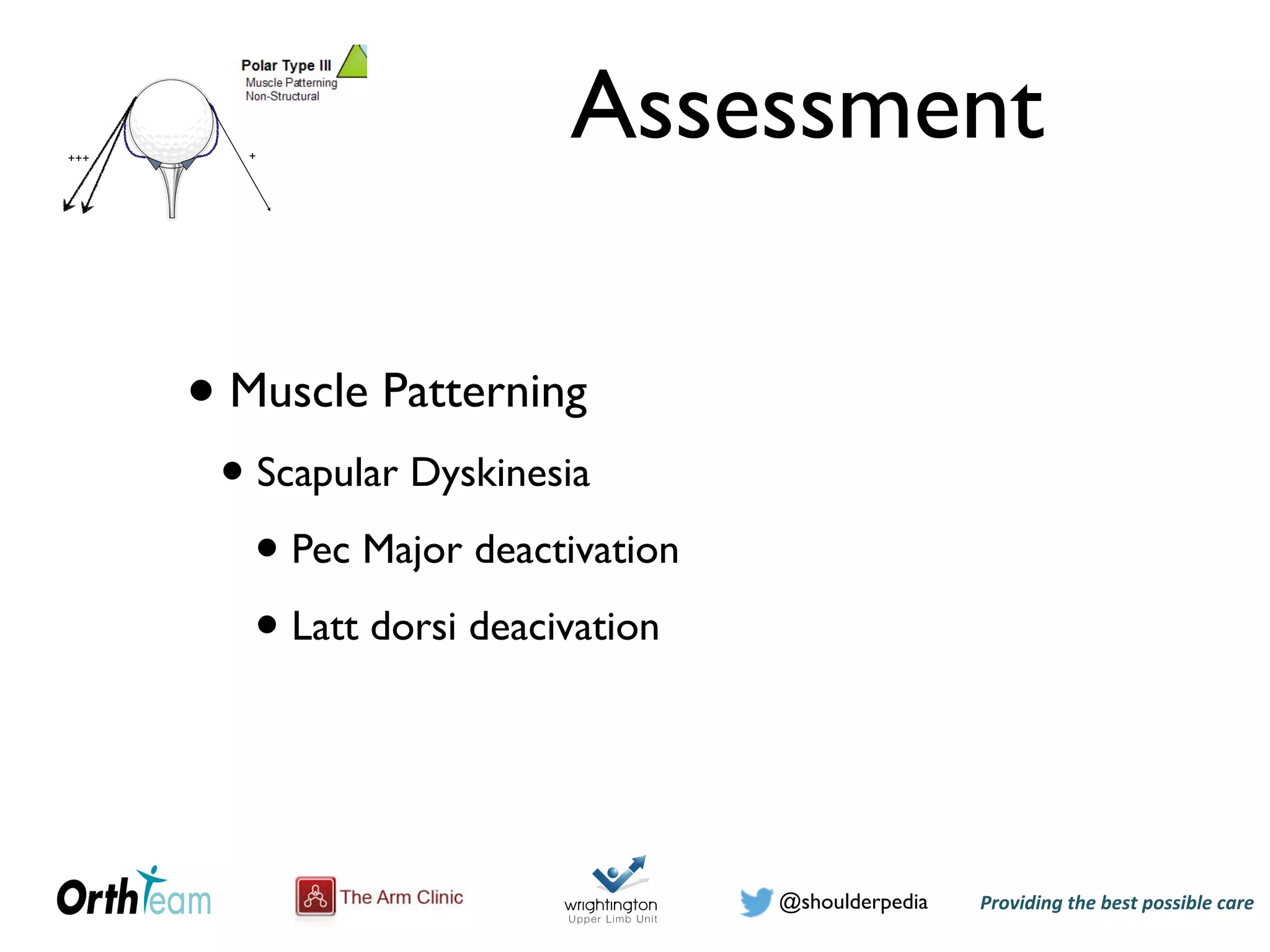
Assessment
• Muscle Patterning
• Scapular Dyskinesia
• Pec Major deactivation
• Latt dorsi deacivation
@shoulderpedia Puneet Monga
Atraumatic Instability
Tuesday, 24 May 16
+++ +
Tuesday, 24 May 16
! "$!
It is apparent from the above discussion that the presentation of patients with instability
can vary significantly and hence for the purposes of this study only patients with
recurrent anterior glenohumeral dislocations following a traumatic episode were
included.
Treatment of traumatic anterior shoulder dislocation may range from initial
immobilization followed by rehabilitation to early operative stabilization. The patient’s
age, previous dislocations, joint laxity, co-morbidities, compliance and activity level
guide the choice of treatment. It is common practice to reserve surgical treatment for
patients having recurrent dislocations. Non-operative management generally involves an
initial reduction of the dislocation followed by immobilization of the shoulder for a
period of three to six weeks. This is followed by physiotherapy focusing initially on
regaining the range of motion and then subscapularis strengthening exercises {O'Brien
et al., 1987}. However, 66% of those between 12 to 22 years of age have a recurrence
of dislocation {Hovelius et al., 1996}.
In the past, tendon or muscle units were shortened to stabilize the shoulder. For
example, the Putti-Platt procedure involved surgical shortening of the subscapularis to
achieve stability. This however led to a loss of movement, especially external rotation,
Tuesday, 24 May 16
, 24 May 16
Providing)the)best)possible)care!@shoulderpedia
Scenario 1
16 year old girl. Comes with her Mum, who is
very concerned. Mum says her daughter is
“double-jointed” and can demonstrate shoulder
dislocation in clinic…..but has no pain or other
symptoms.
• Hyperlax
• Instability?
• Management?
Providing)the)best)possible)care!@shoulderpedia
Scenario 2
16 year old girl. Comes with her Mum, who is
very concerned. Mum says her daughter is
“double-jointed” and dislocates her shoulder
when swimming. It is very painful and she has
been to Casualty 5 times.
• Hyperlax?
• Instability
• Management ?
Providing)the)best)possible)care!@shoulderpedia
Scenario 3
16 year old girl. Comes with her Mum, who is
very concerned. Mum says her daughter is
“double-jointed” and dislocates her shoulder
when every morning. Mum feels “queasy” and
daughter has has missed school for weeks.
• Hyperlax?
• Unstable- Consider the other Issues
• Management ?
Providing)the)best)possible)care!@shoulderpedia
Scenario 4
16 year old girl. Comes with her Mum, who is
very concerned. Mum says her daughter is
“double-jointed” and injured her shoulder when
fell off a horse 3 months ago. Since then it keeps
coming out of the joint on relatively minor tasks.
• Hyperlax?
• Instability - consider traumatic lesions
• Management ?
Providing)the)best)possible)care!@shoulderpedia
Questions and
comments….
@shoulderpedia Puneet Monga
Understanding Instability
Tuesday, 24 May 16
Atraumatic Instability
Tuesday, 24 May 16
+++ +
Tuesday, 24 May 16
! "$!
Figure 5: The Stanmore classification of instability
It is apparent from the above discussion that the presentation of patients with instability
can vary significantly and hence for the purposes of this study only patients with
recurrent anterior glenohumeral dislocations following a traumatic episode were
included.
Treatment of traumatic anterior shoulder dislocation may range from initial
immobilization followed by rehabilitation to early operative stabilization. The patient’s
age, previous dislocations, joint laxity, co-morbidities, compliance and activity level
guide the choice of treatment. It is common practice to reserve surgical treatment for
patients having recurrent dislocations. Non-operative management generally involves an
initial reduction of the dislocation followed by immobilization of the shoulder for a
period of three to six weeks. This is followed by physiotherapy focusing initially on
regaining the range of motion and then subscapularis strengthening exercises {O'Brien
et al., 1987}. However, 66% of those between 12 to 22 years of age have a recurrence
of dislocation {Hovelius et al., 1996}.
In the past, tendon or muscle units were shortened to stabilize the shoulder. For
example, the Putti-Platt procedure involved surgical shortening of the subscapularis to
achieve stability. This however led to a loss of movement, especially external rotation,
Tuesday, 24 May 16
Tuesday, 24 May 16

Atraumatic Shoulder Instability Principles and Assessment