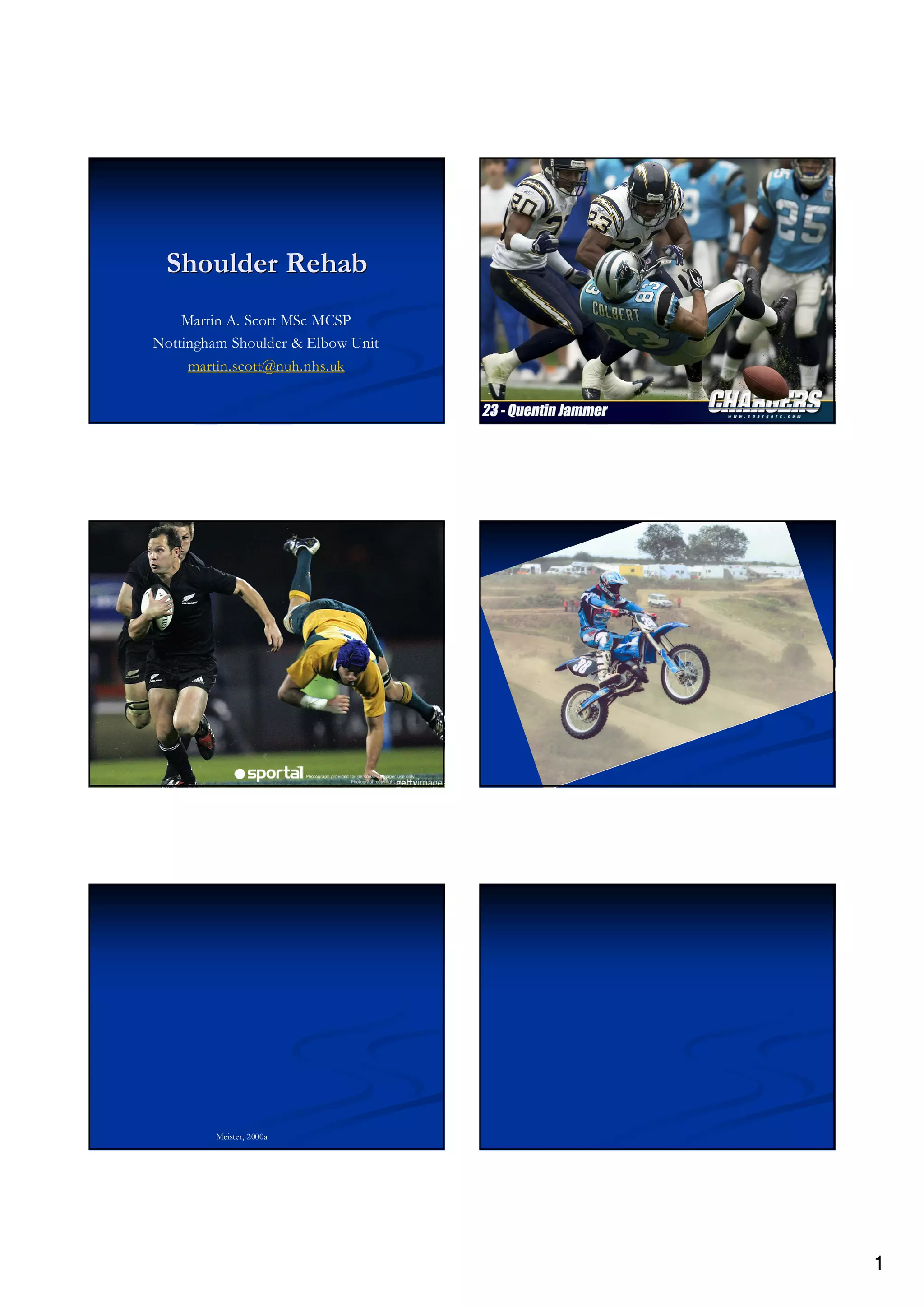
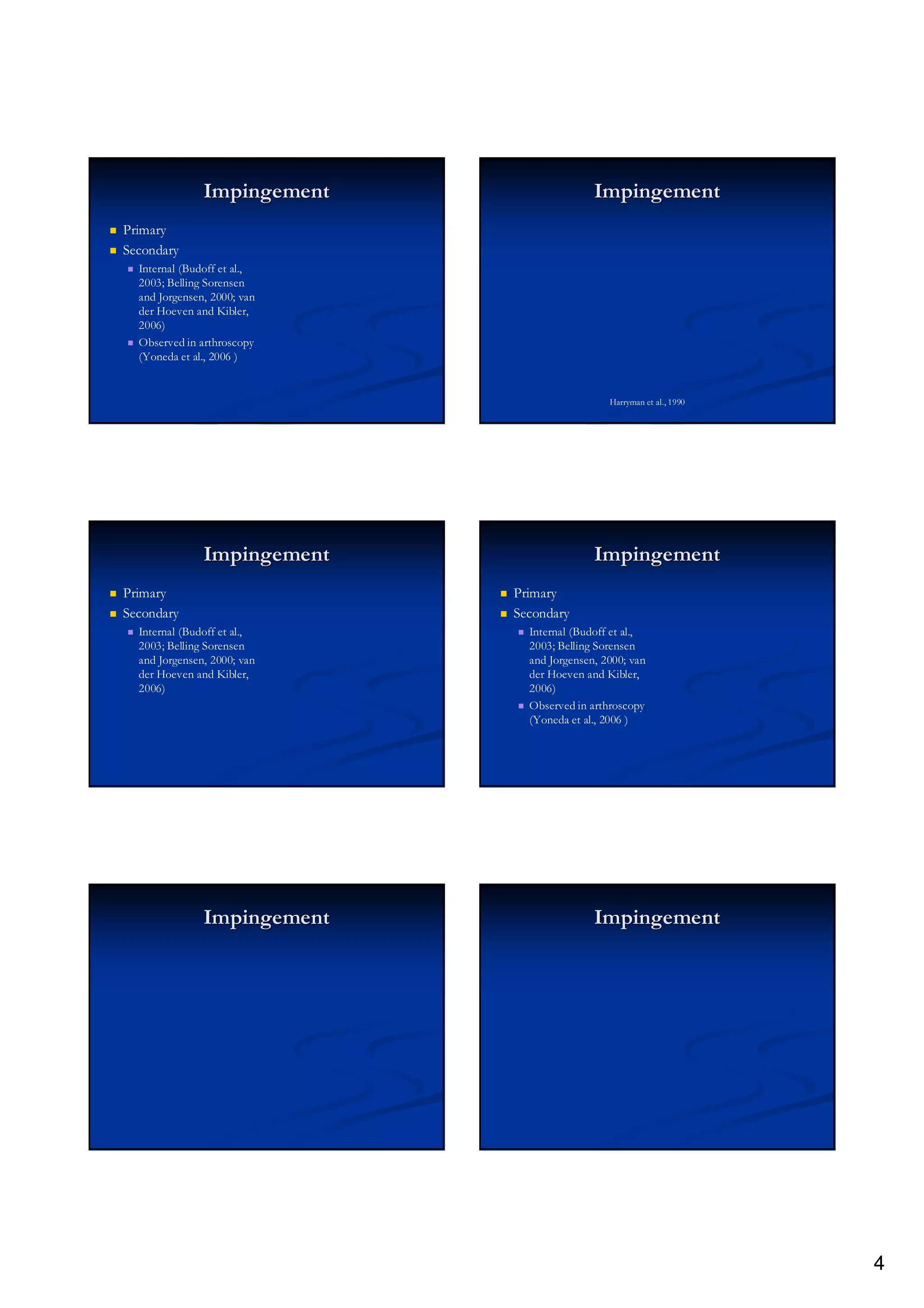
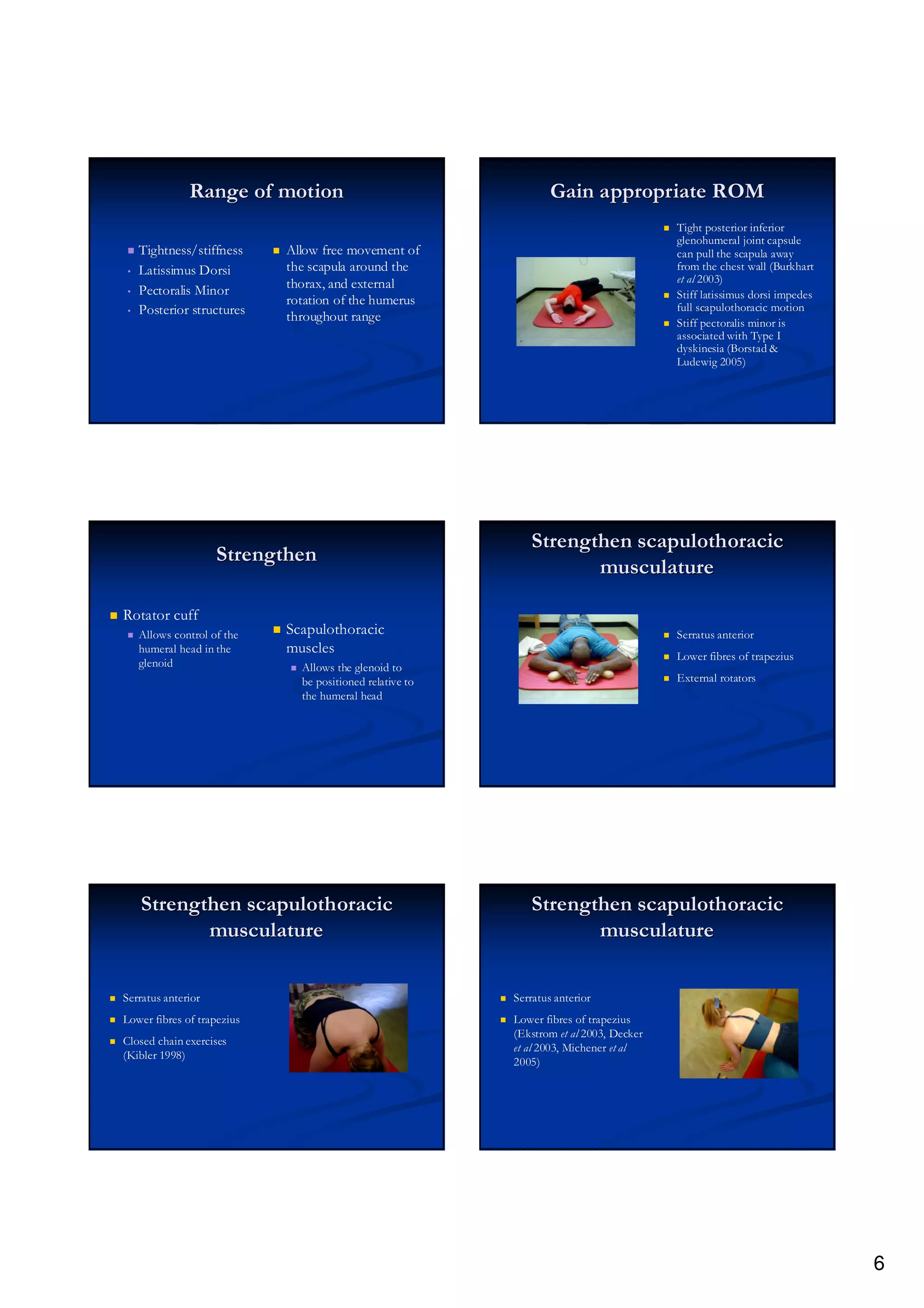
Shoulder Rehab
    Martin A. Scott MSc MCSP
Nottingham Shoulder & Elbow Unit
     martin.scott@nuh.nhs.uk


        Meister, 2000a


                                   1
© Bodies


                                    Factors affecting glenohumeral
  The “hypermobile” shoulder
       hypermobile”
                                             joint stability
                                    Labrum                X
                                    Joint capsule         X
Stability is lost to increase the
range of motion (Tennent,
                    (Tennent,
                                    Ligaments             X
Beach & Meyers (2003))              Internal pressure     ?
                                    gradient
Dynamic control is a major          Bony cam              ?
issue
                                    Dynamic muscle        √
                                    contraction


                                                                         2
Dislocation                                                          Dislocation
     Traumatic                         Atraumatic                        Traumatic                           Atraumatic
End of range                      Mid range                         End of range                        Mid range
Ligament/labral damage            Not constrained by                Ligament/labral damage              Not constrained by
                                  ligaments                                                             ligaments
                                                                                                        Controlled by
                                                                                                        muscles

                             Lippitt S & Matsen F (1993) CORR 291                                   Lippitt S & Matsen F (1993) CORR 291
                             Lee SB et al (2000) JBJS 82A(6)                                        Lee SB et al (2000) JBJS 82A(6)


                 Instability                                                           Instability
High risk sports                                                    TUBS
  Contact +/- throwing (Boileau et al., 2006 )
          +/-          (Boileau                                       Can be hyper lax (eg
                                                                                        (eg                   At 4 year mean follow up,
                                                                      26/91, Boileau et al.,                  subscapularis function
Return to sport (mean 36 months post-op)
                                post-                                 2006)                                   correlates with outcome
  14/91 failures (further instability)                                Conservative treatment                  from surgery (Sachs et al.,
                                                                      gives 17-96% recurrence
                                                                             17-                              2005)
                                                                                                              2005 )
  58/91 at same level                                                 in patients <30 (Bottoni
                                                                                      (Bottoni
  13/91 at a lower level                                              et al., 2002)
  6/91 stopped participation (Boileau et al., 2006)
                               (Boileau


                 Instability                                                       Impingement


                                                                                      Harryman et al., 1990
                    Sachs et al., 2005


                                                                                                                                            3
Impingement                  Impingement
Primary
Secondary
  Internal (Budoff et al.,
           (Budoff
  2003; Belling Sorensen
  and Jorgensen, 2000; van
  der Hoeven and Kibler,
                   Kibler,
  2006)
  Observed in arthroscopy
  (Yoneda et al., 2006 )


                                               Harryman et al., 1990


               Impingement                  Impingement
Primary                      Primary
Secondary                    Secondary
  Internal (Budoff et al.,
           (Budoff             Internal (Budoff et al.,
                                        (Budoff
  2003; Belling Sorensen       2003; Belling Sorensen
  and Jorgensen, 2000; van     and Jorgensen, 2000; van
  der Hoeven and Kibler,
                   Kibler,     der Hoeven and Kibler,
                                                Kibler,
  2006)                        2006)
                               Observed in arthroscopy
                               (Yoneda et al., 2006 )


               Impingement                  Impingement


                                                                       4
Impingement                                   Impingement
Primary
Secondary
  Internal (Budoff et al.,
           (Budoff
  2003; Belling Sorensen
  and Jorgensen, 2000; van
  der Hoeven and Kibler,
                   Kibler,
  2006)


                                                      Neer, 1972; Yanai and Hay, 2000; Wilk et al., 2002


               Impingement                                   Impingement


                     Labriola et al., 2005                                Elliott, 2006


                  Instability                                  Assessment
                                             Muscle patterning                       Observation
                                             Under/over recruitment                  Relative alignment of
                                             Low/high tone                           bony landmarks
                                             Movement patterns                       Relative timing of
                                                                                     movements of body
                                                                                     segments


                                                                                                             5
Range of motion                                                          Gain appropriate ROM
                                                                                                                  Tight posterior inferior
                                                                                                                  glenohumeral joint capsule
         Tightness/stiffness                       Allow free movement of                                         can pull the scapula away
     •   Latissimus Dorsi                          the scapula around the                                         from the chest wall (Burkhart
                                                   thorax, and external                                           et al 2003)
     •   Pectoralis Minor                                                                                         Stiff latissimus dorsi impedes
                                                   rotation of the humerus                                        full scapulothoracic motion
     •   Posterior structures                      throughout range                                               Stiff pectoralis minor is
                                                                                                                  associated with Type I
                                                                                                                  dyskinesia (Borstad &
                                                                                                                               (Borstad
                                                                                                                  Ludewig 2005)

Silliman JF & Hawkins RJ (1993) CORR 291
Borstad JD & Ludewig PM (2005) JOSPT 35(4)


                                                                                       Strengthen scapulothoracic
                            Strengthen
                                                                                              musculature

    Rotator cuff
         Allows control of the                     Scapulothoracic                                                Serratus anterior
         humeral head in the                       muscles                                                        Lower fibres of trapezius
         glenoid                                        Allows the glenoid to
                                                        be positioned relative to                                 External rotators
                                                        the humeral head


                    Hawkins RJ & Saddemi SR (1990) Cur Orth 4
                 Kibler, W. B. (1998). Medicine & Science in Sports &
                            Exercise 30(4 Suppl): S40-50.


         Strengthen scapulothoracic                                                    Strengthen scapulothoracic
                musculature                                                                   musculature


    Serratus anterior                                                               Serratus anterior
    Lower fibres of trapezius                                                       Lower fibres of trapezius
                                                                                    (Ekstrom et al 2003, Decker
    Closed chain exercises
                                                                                    et al 2003, Michener et al
    (Kibler 1998)
                                                                                    2005)


                                                                                                                                                   6
Maintain scapular dynamic
Gain scapular dynamic control
                                                         control

                                                                         Scapulothoracic
                                                                         movement
                                                                         Glenohumeral rhythm
                                                                         Multiplanar exercises
                                                                         Visual feedback


   Maintain scapular dynamic                    Maintain scapular dynamic
            control                                      control

                                                                         Scapulothoracic
Scapulothoracic                                                          movement
movement                                                                 Glenohumeral rhythm
Glenohumeral rhythm                                                      Multiplanar exercises
Multiplanar exercises                                                    Visual feedback


   Maintain scapular dynamic
                                                    From the feet up!
            control

                        Scapulothoracic
                        movement
                        Glenohumeral rhythm
                        Multiplanar exercises
                        Visual feedback
                        Function!


                                                        Limpisvasti et al., 2007


                                                                                                 7
Harmonious rotation(s)
              rotation(s)                      Good alignment


            Limpisvasti et al., 2007


       Good alignment
                                       Exactly what are effective throwing
                                                  mechanics?
                                                by Paul Nyman
                                                 May 02, 2008


  Maintain scapular dynamic            Maintain dynamic control – and
control – and take it into sport!             take it into sport!


                                                                             8
Maintain dynamic control – and                     Maintain dynamic control – and
           take it into sport!                                take it into sport!


                  Thank you


            Martin A. Scott MSc MCSP
        Nottingham Shoulder & Elbow Unit
             martin.scott@nuh.nhs.uk


        Stretch before Strengthen                                         Rugby
●   Establish tissue mobility to allow normal
    kinematics                                     ● Scrum
●   Allows greater muscle volume to contract and   ● Rook
    release                                        ● Lineout

●   Reduces risk of secondary compensation         ● Tackle(pile on,collision,shirt pull,ankle tap)


                                                   ● Pass


                                                   ● Handoff


                                                                                                      9
Football                    Basketball/handball/volleyball
●   Collision(with other player or ground)   ●   Blockshot/
                                                 Blockshot/
●   Throw in                                 ●   Hookpass/shot
                                                 Hookpass/shot
●   Goalkeeping dives                        ●   Ball dribbling


                                                                  Boxing
                     Cricket
●   Outfield throws                          ●   Impact
●   Bowling                                  ●   Missed punch
●   Wicketkeeping/slip
    Wicketkeeping/slip dives                 ●   Fatigue
●   Crease slides                            ●   Poor defensive posture


                                                                                  10

2012 rehab

  • 1.
    Shoulder Rehab Martin A. Scott MSc MCSP Nottingham Shoulder & Elbow Unit martin.scott@nuh.nhs.uk Meister, 2000a 1
  • 2.
    © Bodies Factors affecting glenohumeral The “hypermobile” shoulder hypermobile” joint stability Labrum X Joint capsule X Stability is lost to increase the range of motion (Tennent, (Tennent, Ligaments X Beach & Meyers (2003)) Internal pressure ? gradient Dynamic control is a major Bony cam ? issue Dynamic muscle √ contraction 2
  • 3.
    Dislocation Dislocation Traumatic Atraumatic Traumatic Atraumatic End of range Mid range End of range Mid range Ligament/labral damage Not constrained by Ligament/labral damage Not constrained by ligaments ligaments Controlled by muscles Lippitt S & Matsen F (1993) CORR 291 Lippitt S & Matsen F (1993) CORR 291 Lee SB et al (2000) JBJS 82A(6) Lee SB et al (2000) JBJS 82A(6) Instability Instability High risk sports TUBS Contact +/- throwing (Boileau et al., 2006 ) +/- (Boileau Can be hyper lax (eg (eg At 4 year mean follow up, 26/91, Boileau et al., subscapularis function Return to sport (mean 36 months post-op) post- 2006) correlates with outcome 14/91 failures (further instability) Conservative treatment from surgery (Sachs et al., gives 17-96% recurrence 17- 2005) 2005 ) 58/91 at same level in patients <30 (Bottoni (Bottoni 13/91 at a lower level et al., 2002) 6/91 stopped participation (Boileau et al., 2006) (Boileau Instability Impingement Harryman et al., 1990 Sachs et al., 2005 3
  • 4.
    Impingement Impingement Primary Secondary Internal (Budoff et al., (Budoff 2003; Belling Sorensen and Jorgensen, 2000; van der Hoeven and Kibler, Kibler, 2006) Observed in arthroscopy (Yoneda et al., 2006 ) Harryman et al., 1990 Impingement Impingement Primary Primary Secondary Secondary Internal (Budoff et al., (Budoff Internal (Budoff et al., (Budoff 2003; Belling Sorensen 2003; Belling Sorensen and Jorgensen, 2000; van and Jorgensen, 2000; van der Hoeven and Kibler, Kibler, der Hoeven and Kibler, Kibler, 2006) 2006) Observed in arthroscopy (Yoneda et al., 2006 ) Impingement Impingement 4
  • 5.
    Impingement Impingement Primary Secondary Internal (Budoff et al., (Budoff 2003; Belling Sorensen and Jorgensen, 2000; van der Hoeven and Kibler, Kibler, 2006) Neer, 1972; Yanai and Hay, 2000; Wilk et al., 2002 Impingement Impingement Labriola et al., 2005 Elliott, 2006 Instability Assessment Muscle patterning Observation Under/over recruitment Relative alignment of Low/high tone bony landmarks Movement patterns Relative timing of movements of body segments 5
  • 6.
    Range of motion Gain appropriate ROM Tight posterior inferior glenohumeral joint capsule Tightness/stiffness Allow free movement of can pull the scapula away • Latissimus Dorsi the scapula around the from the chest wall (Burkhart thorax, and external et al 2003) • Pectoralis Minor Stiff latissimus dorsi impedes rotation of the humerus full scapulothoracic motion • Posterior structures throughout range Stiff pectoralis minor is associated with Type I dyskinesia (Borstad & (Borstad Ludewig 2005) Silliman JF & Hawkins RJ (1993) CORR 291 Borstad JD & Ludewig PM (2005) JOSPT 35(4) Strengthen scapulothoracic Strengthen musculature Rotator cuff Allows control of the Scapulothoracic Serratus anterior humeral head in the muscles Lower fibres of trapezius glenoid Allows the glenoid to be positioned relative to External rotators the humeral head Hawkins RJ & Saddemi SR (1990) Cur Orth 4 Kibler, W. B. (1998). Medicine & Science in Sports & Exercise 30(4 Suppl): S40-50. Strengthen scapulothoracic Strengthen scapulothoracic musculature musculature Serratus anterior Serratus anterior Lower fibres of trapezius Lower fibres of trapezius (Ekstrom et al 2003, Decker Closed chain exercises et al 2003, Michener et al (Kibler 1998) 2005) 6
  • 7.
    Maintain scapular dynamic Gainscapular dynamic control control Scapulothoracic movement Glenohumeral rhythm Multiplanar exercises Visual feedback Maintain scapular dynamic Maintain scapular dynamic control control Scapulothoracic Scapulothoracic movement movement Glenohumeral rhythm Glenohumeral rhythm Multiplanar exercises Multiplanar exercises Visual feedback Maintain scapular dynamic From the feet up! control Scapulothoracic movement Glenohumeral rhythm Multiplanar exercises Visual feedback Function! Limpisvasti et al., 2007 7
  • 8.
    Harmonious rotation(s) rotation(s) Good alignment Limpisvasti et al., 2007 Good alignment Exactly what are effective throwing mechanics? by Paul Nyman May 02, 2008 Maintain scapular dynamic Maintain dynamic control – and control – and take it into sport! take it into sport! 8
  • 9.
    Maintain dynamic control– and Maintain dynamic control – and take it into sport! take it into sport! Thank you Martin A. Scott MSc MCSP Nottingham Shoulder & Elbow Unit martin.scott@nuh.nhs.uk Stretch before Strengthen Rugby ● Establish tissue mobility to allow normal kinematics ● Scrum ● Allows greater muscle volume to contract and ● Rook release ● Lineout ● Reduces risk of secondary compensation ● Tackle(pile on,collision,shirt pull,ankle tap) ● Pass ● Handoff 9
  • 10.
    Football Basketball/handball/volleyball ● Collision(with other player or ground) ● Blockshot/ Blockshot/ ● Throw in ● Hookpass/shot Hookpass/shot ● Goalkeeping dives ● Ball dribbling Boxing Cricket ● Outfield throws ● Impact ● Bowling ● Missed punch ● Wicketkeeping/slip Wicketkeeping/slip dives ● Fatigue ● Crease slides ● Poor defensive posture 10