TCP/IP Protocol Suite 1
Multicasting andMulticasting and
Multicast Routing ProtocolsMulticast Routing Protocols
• Differentiate between a unicast, multicast, and broadcast message
• Know the many applications of multicasting
• Understand multicast link state routing and MOSPF
• Understand multicast link state routing and DVMRP
• Understand the Core-Based Tree Protocol
• Understand the Protocol Independent Multicast Protocols
• Understand the MBONE concept
TCP/IP Protocol Suite 2
15.1 UNICAST, MULTICAST,
AND BROADCAST
A message can be unicast, multicast, or broadcast. Let us clarify theseA message can be unicast, multicast, or broadcast. Let us clarify these
terms as they relate to the Internet.terms as they relate to the Internet.
The topics discussed in this section include:The topics discussed in this section include:
UnicastingUnicasting
MulticastingMulticasting
BroadcastingBroadcasting
Multicasting versus Multiple UnicastingMulticasting versus Multiple Unicasting
TCP/IP Protocol Suite 3
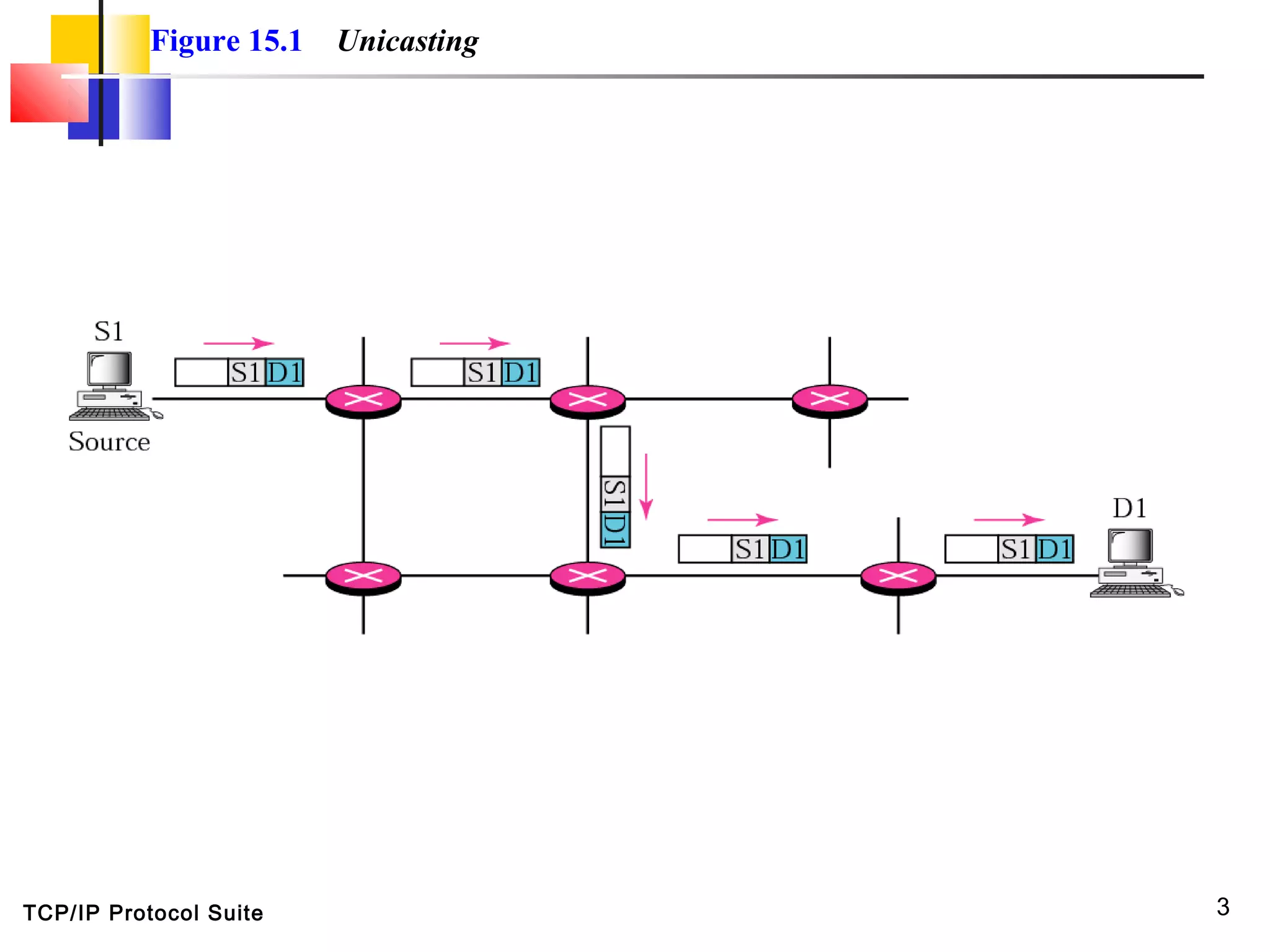
Figure 15.1 Unicasting
TCP/IP Protocol Suite 4
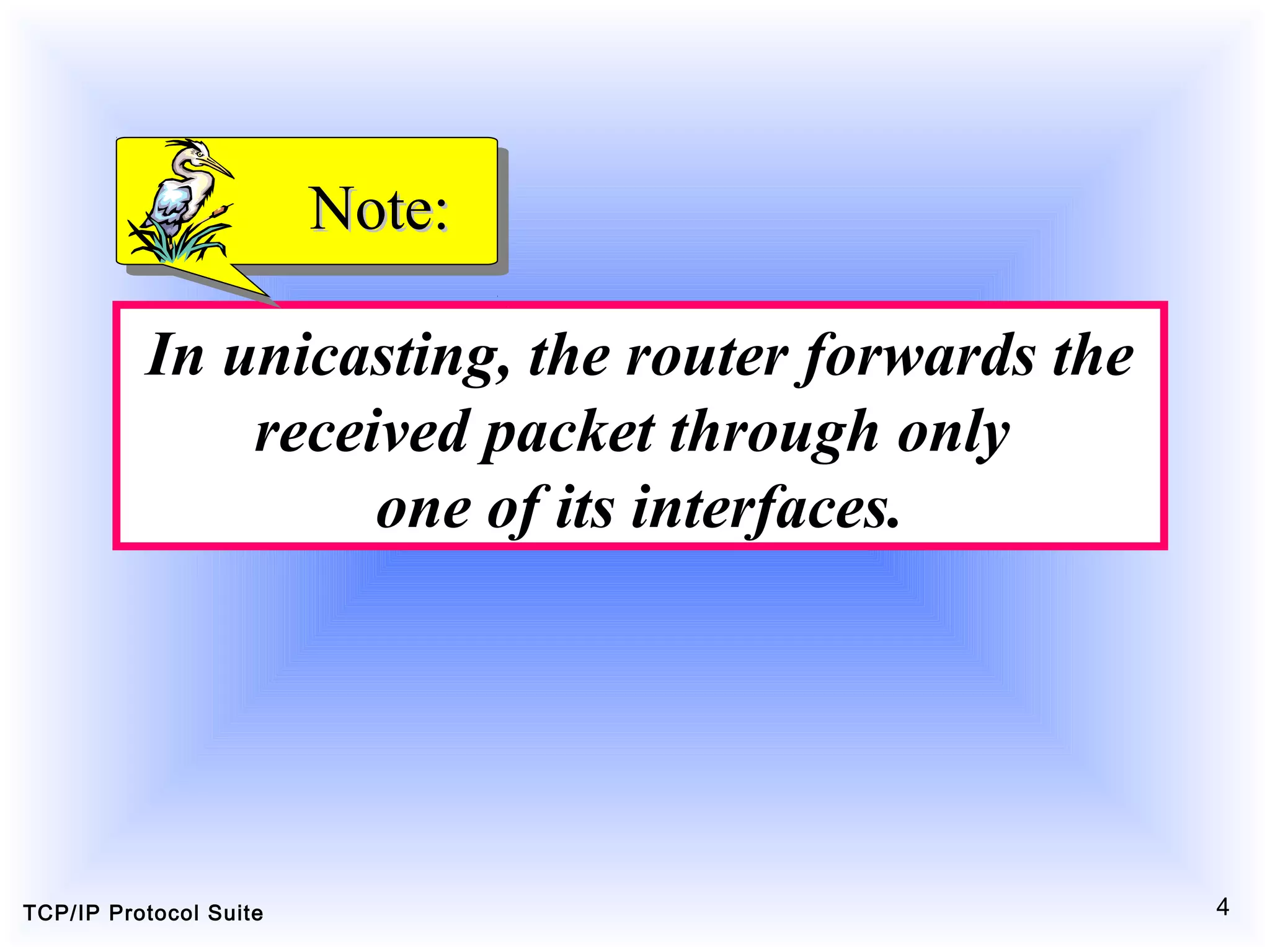
In unicasting, the router forwards the
received packet through only
one of its interfaces.
Note:Note:
TCP/IP Protocol Suite 5
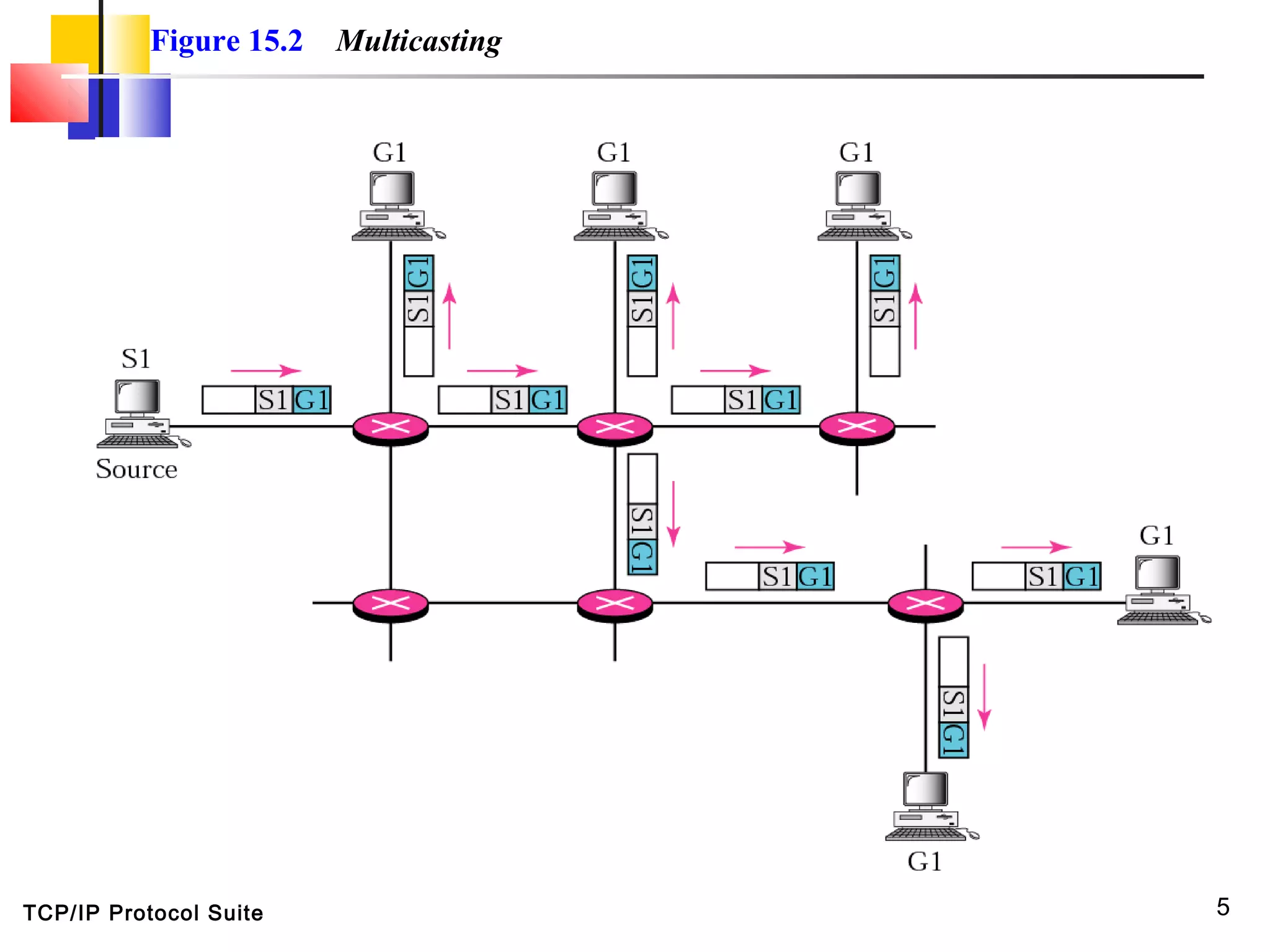
Figure 15.2 Multicasting
TCP/IP Protocol Suite 6
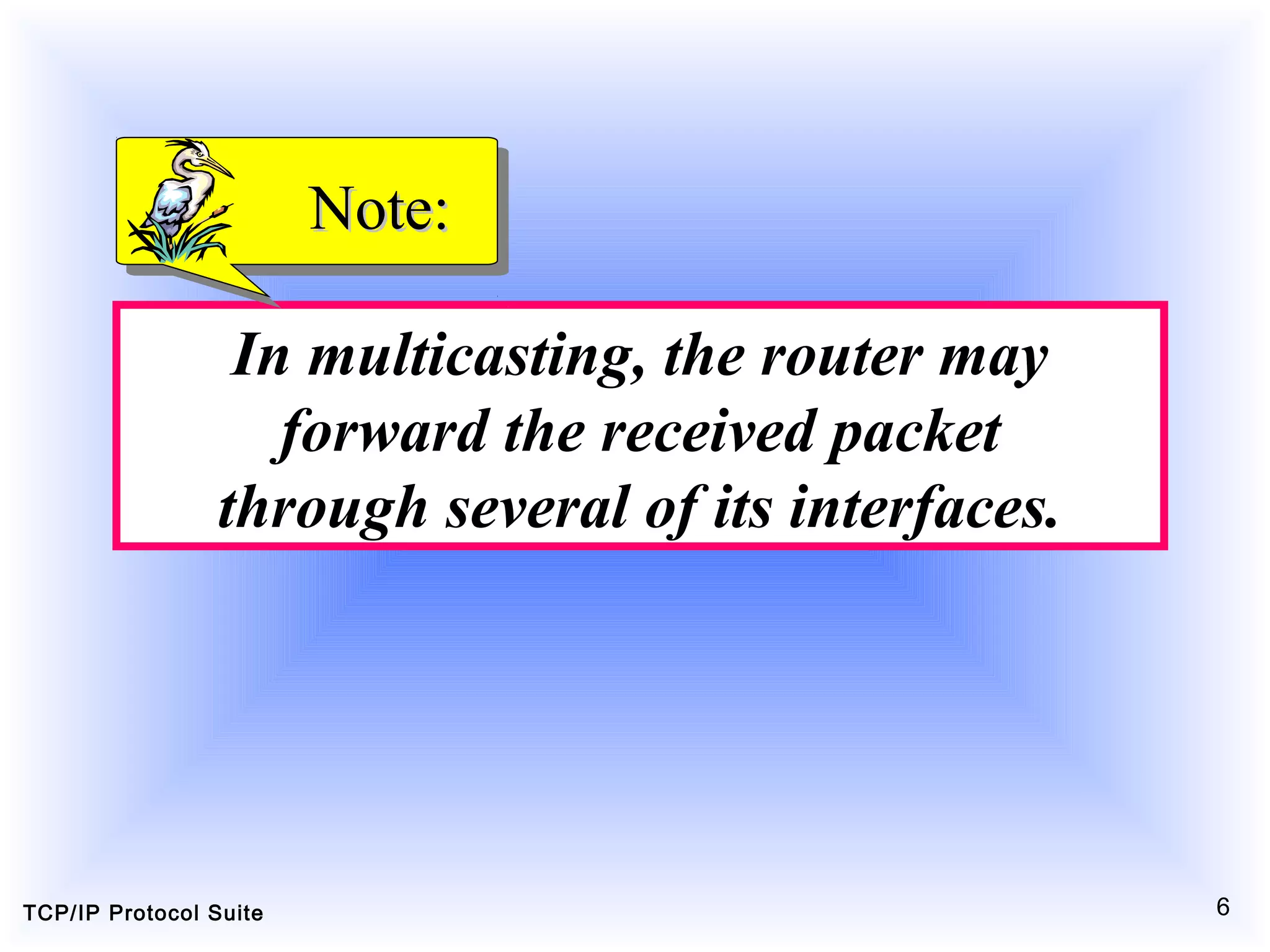
In multicasting, the router may
forward the received packet
through several of its interfaces.
Note:Note:
TCP/IP Protocol Suite 7
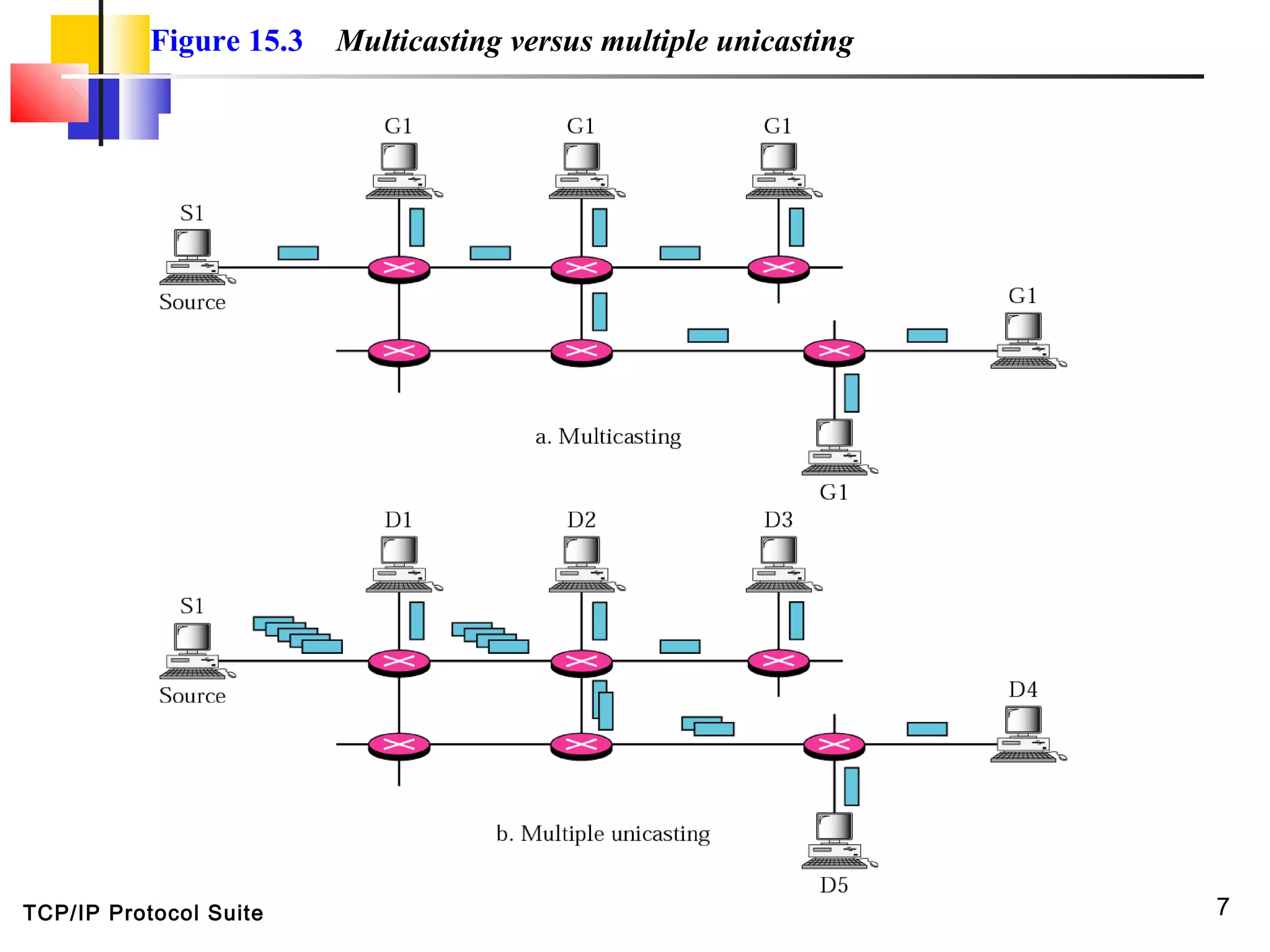
Figure 15.3 Multicasting versus multiple unicasting
TCP/IP Protocol Suite 8
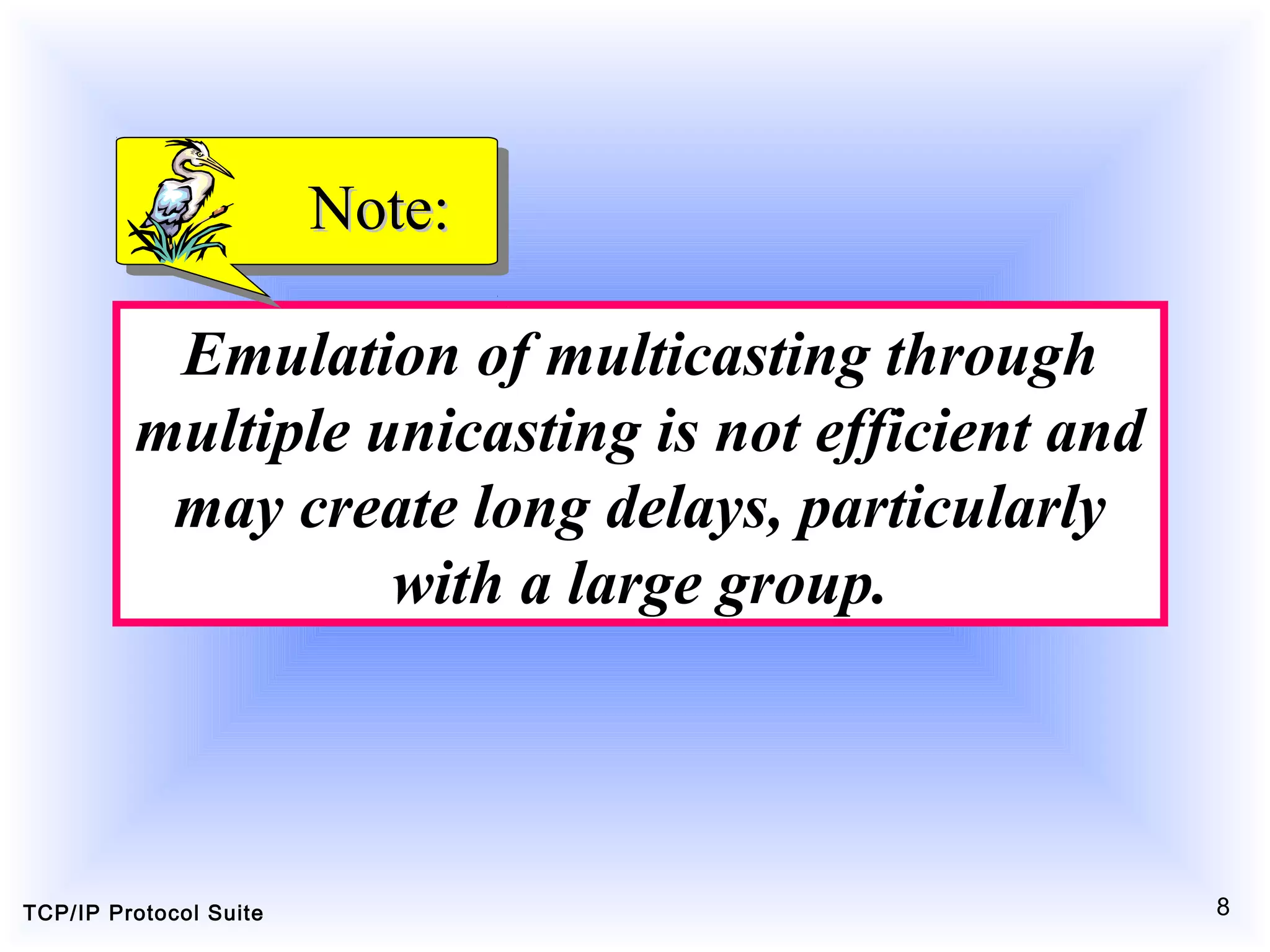
Emulation of multicasting through
multiple unicasting is not efficient and
may create long delays, particularly
with a large group.
Note:Note:
TCP/IP Protocol Suite 9
15.2 MULTICAST APPLICATIONS
Multicasting has many applications today such as access to distributedMulticasting has many applications today such as access to distributed
databases, information dissemination, teleconferencing, and distancedatabases, information dissemination, teleconferencing, and distance
learning.learning.
The topics discussed in this section include:The topics discussed in this section include:
Access to Distributed DatabasesAccess to Distributed Databases
Information DisseminationInformation Dissemination
Dissemination of NewsDissemination of News
TeleconferencingTeleconferencing
Distance LearningDistance Learning
TCP/IP Protocol Suite 10
15.3 MULTICAST ROUTING
In this section, we first discuss the idea of optimal routing, common inIn this section, we first discuss the idea of optimal routing, common in
all multicast protocols. We then give an overview of multicast routingall multicast protocols. We then give an overview of multicast routing
protocols.protocols.
The topics discussed in this section include:The topics discussed in this section include:
Optimal Routing: Shortest Path TreesOptimal Routing: Shortest Path Trees
Routing ProtocolsRouting Protocols
TCP/IP Protocol Suite 11
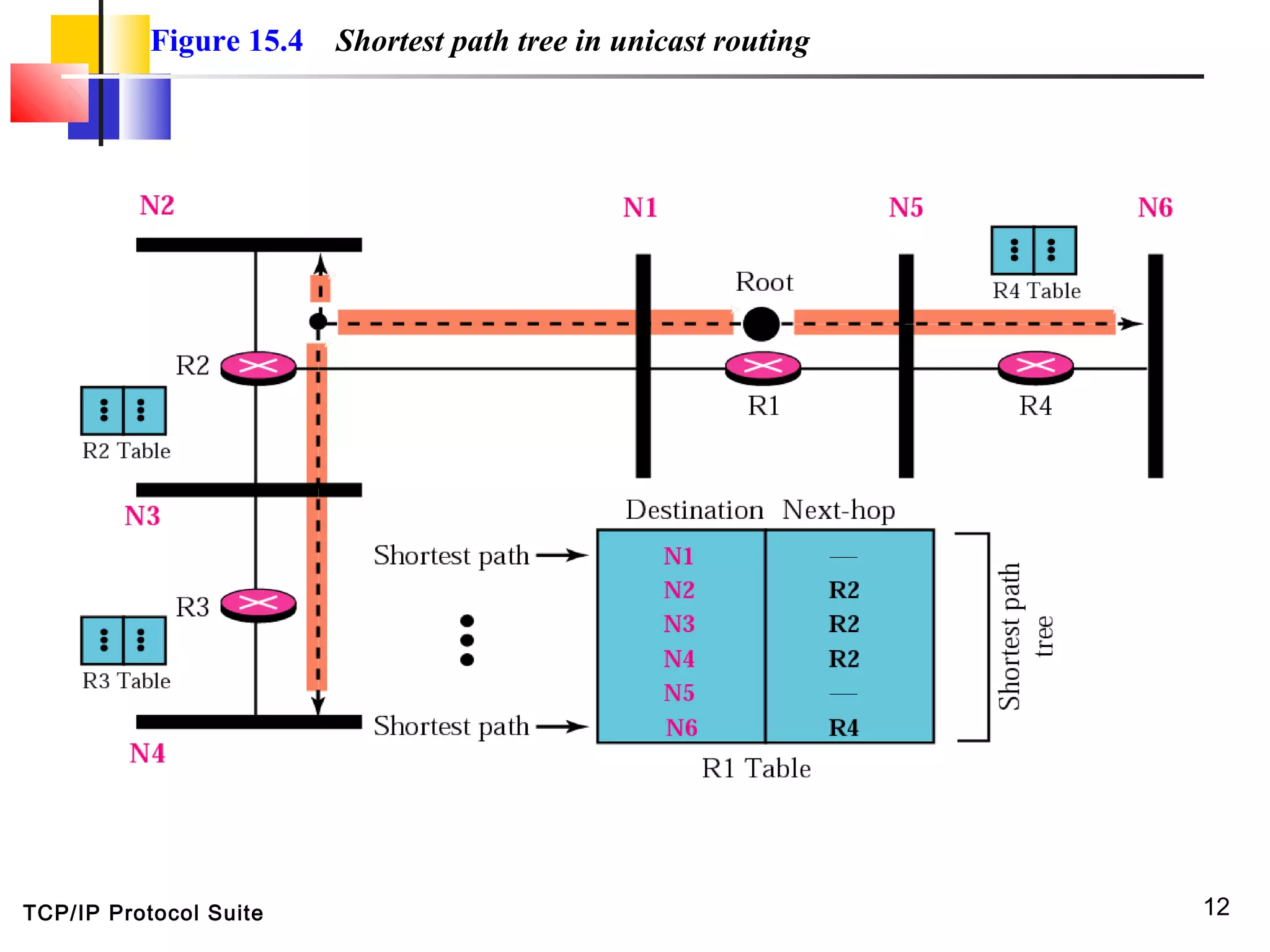
In unicast routing, each router in the
domain has a table that defines a
shortest path tree to possible
destinations.
Note:Note:
TCP/IP Protocol Suite 12
Figure 15.4 Shortest path tree in unicast routing
TCP/IP Protocol Suite 13
In multicast routing, each involved
router needs to construct a shortest
path tree for each group.
Note:Note:
TCP/IP Protocol Suite 14
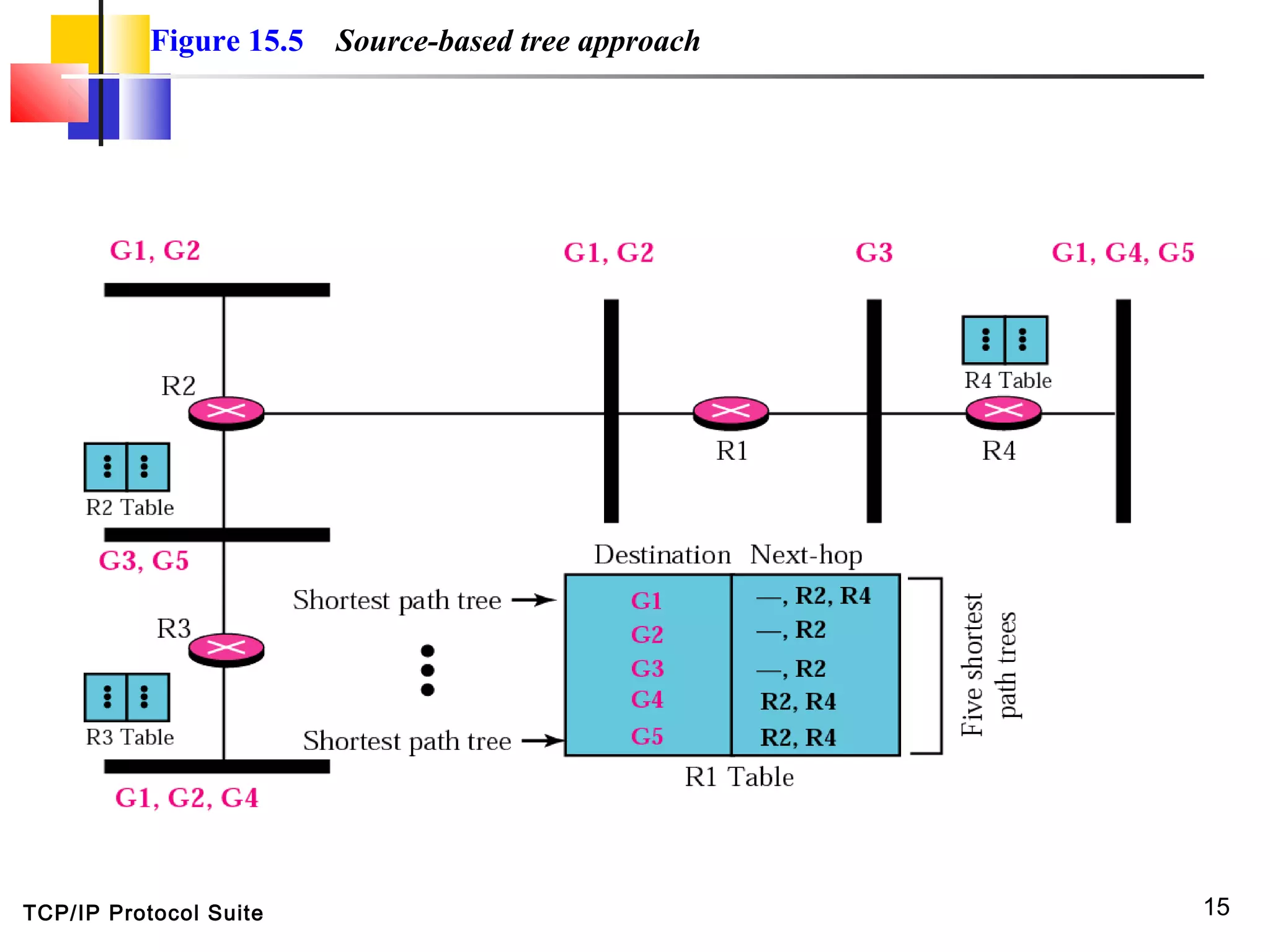
In the source-based tree approach,
each router needs to have one shortest
path tree for each group.
Note:Note:
TCP/IP Protocol Suite 15
Figure 15.5 Source-based tree approach
TCP/IP Protocol Suite 16
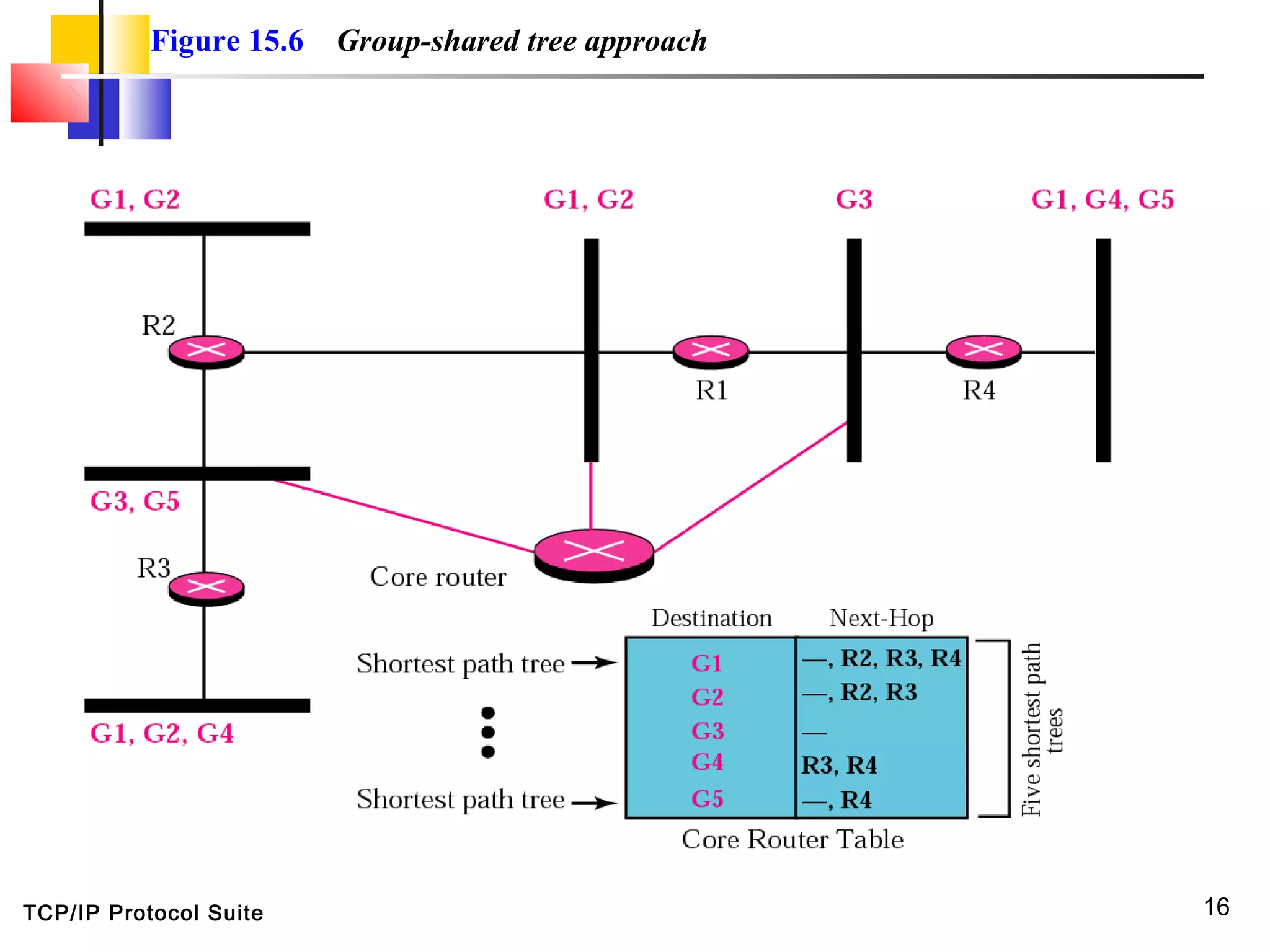
Figure 15.6 Group-shared tree approach
TCP/IP Protocol Suite 17
In the group-shared tree approach,
only the core router, which has a
shortest path tree for each group, is
involved in multicasting.
Note:Note:
TCP/IP Protocol Suite 18
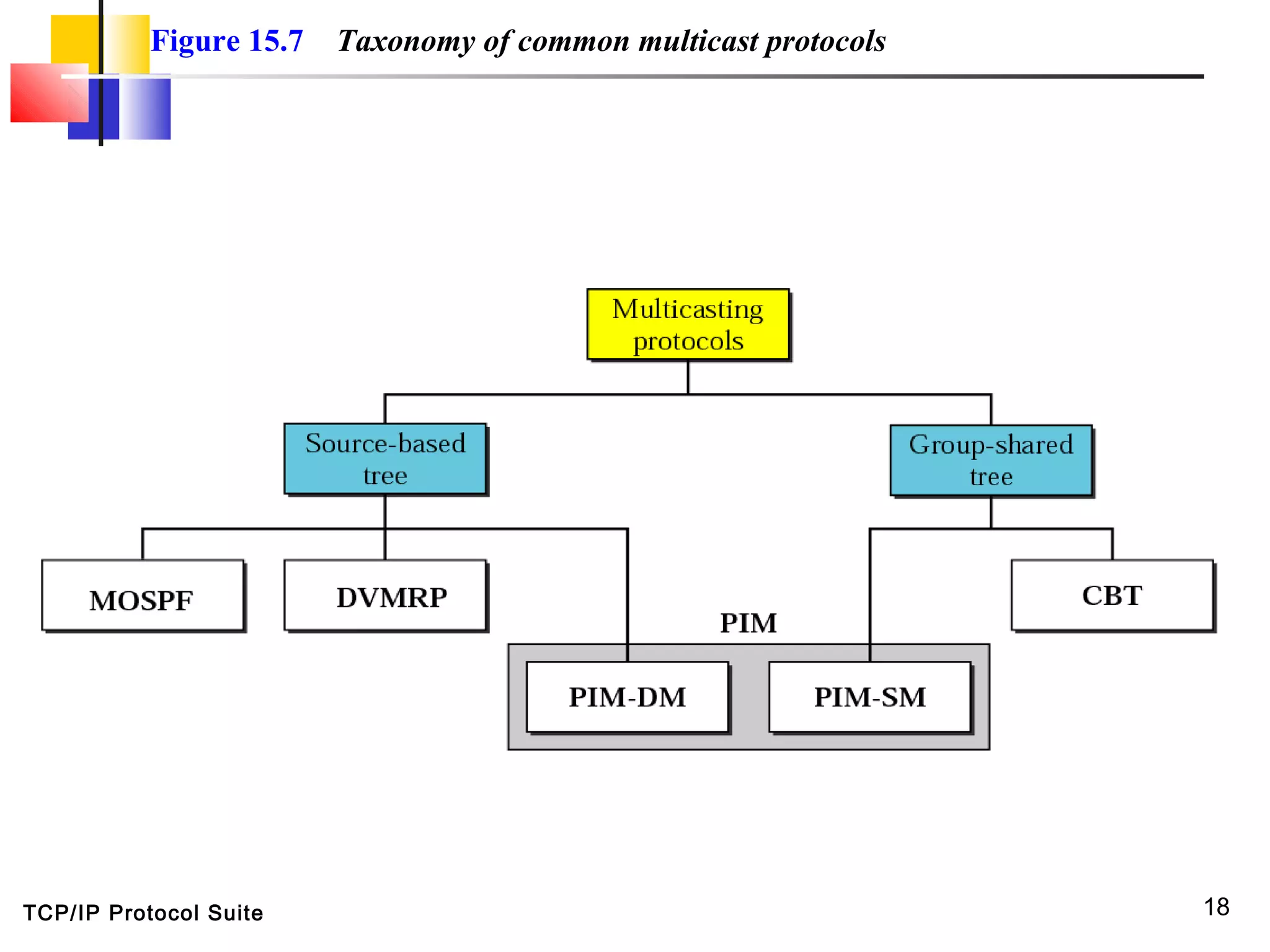
Figure 15.7 Taxonomy of common multicast protocols
TCP/IP Protocol Suite 19
15.4 MULTICAST LINK STATE
ROUTING: MOSPF
In this section, we briefly discuss multicast link state routing and itsIn this section, we briefly discuss multicast link state routing and its
implementation in the Internet, MOSPF.implementation in the Internet, MOSPF.
The topics discussed in this section include:The topics discussed in this section include:
Multicast Link State RoutingMulticast Link State Routing
MOSPFMOSPF
TCP/IP Protocol Suite 20
Multicast link state routing uses the
source-based tree approach.
Note:Note:
TCP/IP Protocol Suite 21
15.5 MULTICAST DISTANCE
VECTOR: DVMRP
In this section, we briefly discuss multicast distance vector routing andIn this section, we briefly discuss multicast distance vector routing and
its implementation in the Internet, DVMRP.its implementation in the Internet, DVMRP.
The topics discussed in this section include:The topics discussed in this section include:
Multicast Distance Vector RoutingMulticast Distance Vector Routing
DVMRPDVMRP
TCP/IP Protocol Suite 22
Flooding broadcasts packets, but
creates loops in the systems.
Note:Note:
TCP/IP Protocol Suite 23
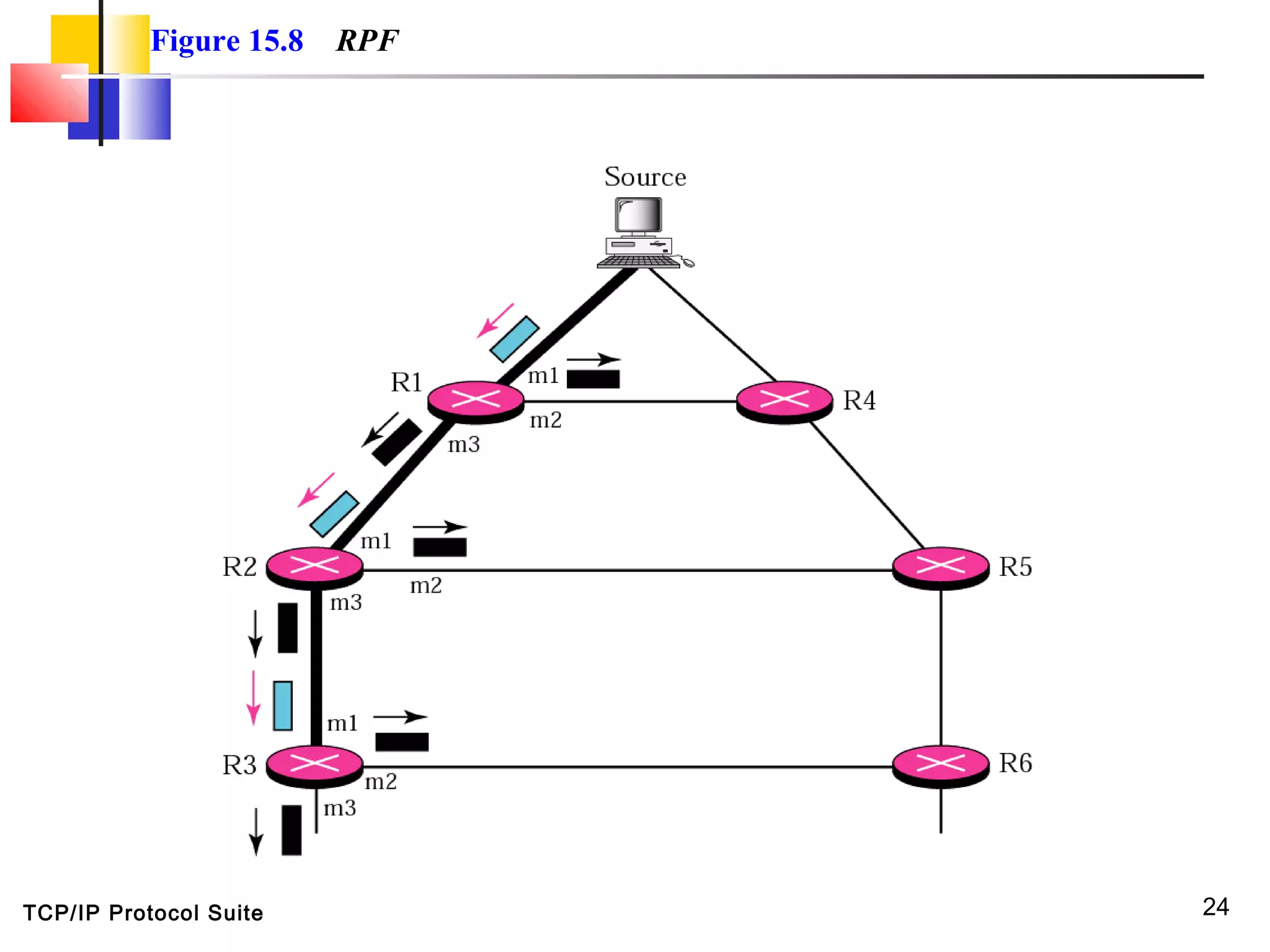
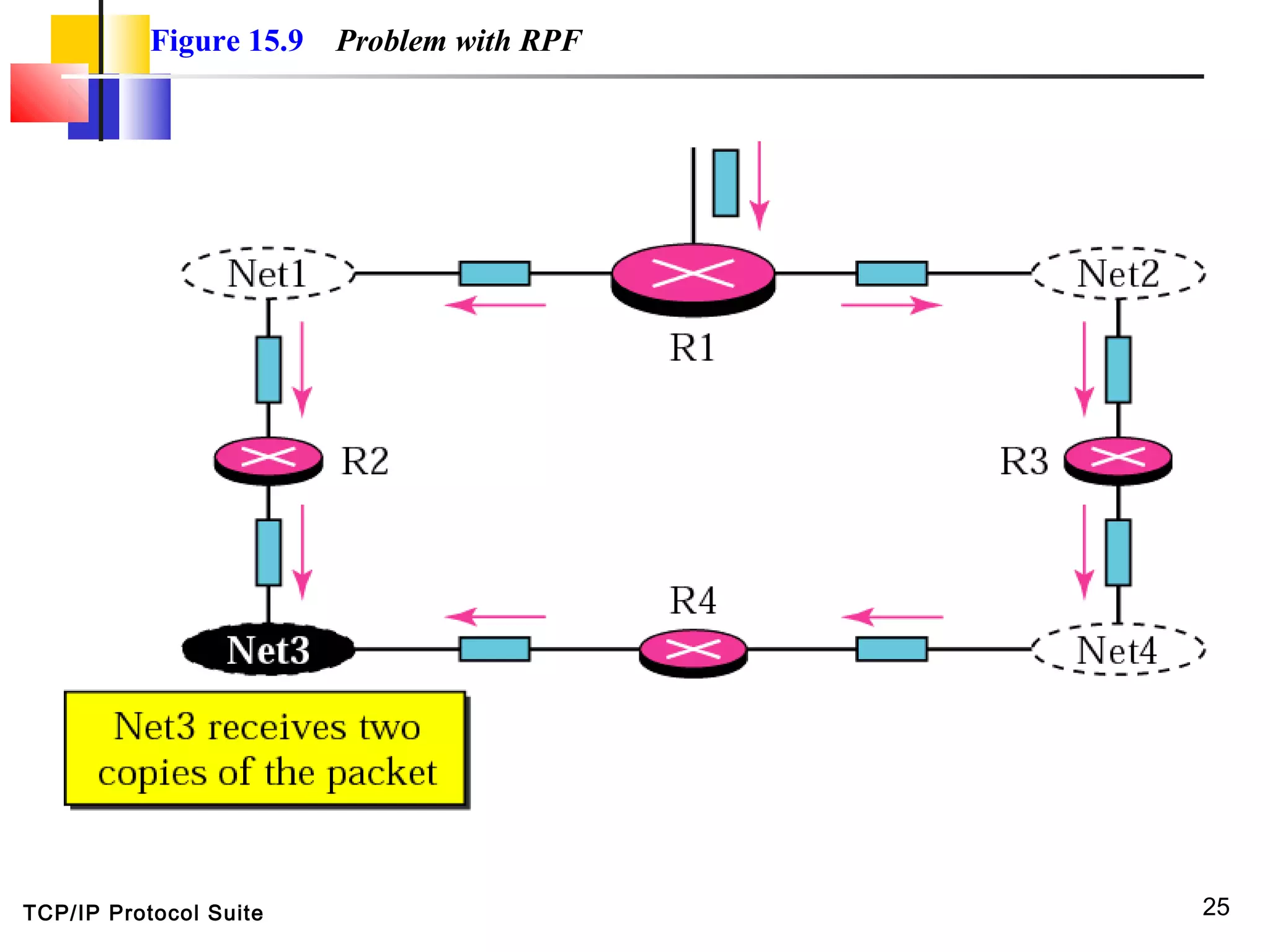
RPF eliminates the loop in the
flooding process.
Note:Note:
TCP/IP Protocol Suite 24
Figure 15.8 RPF
TCP/IP Protocol Suite 25
Figure 15.9 Problem with RPF
TCP/IP Protocol Suite 26
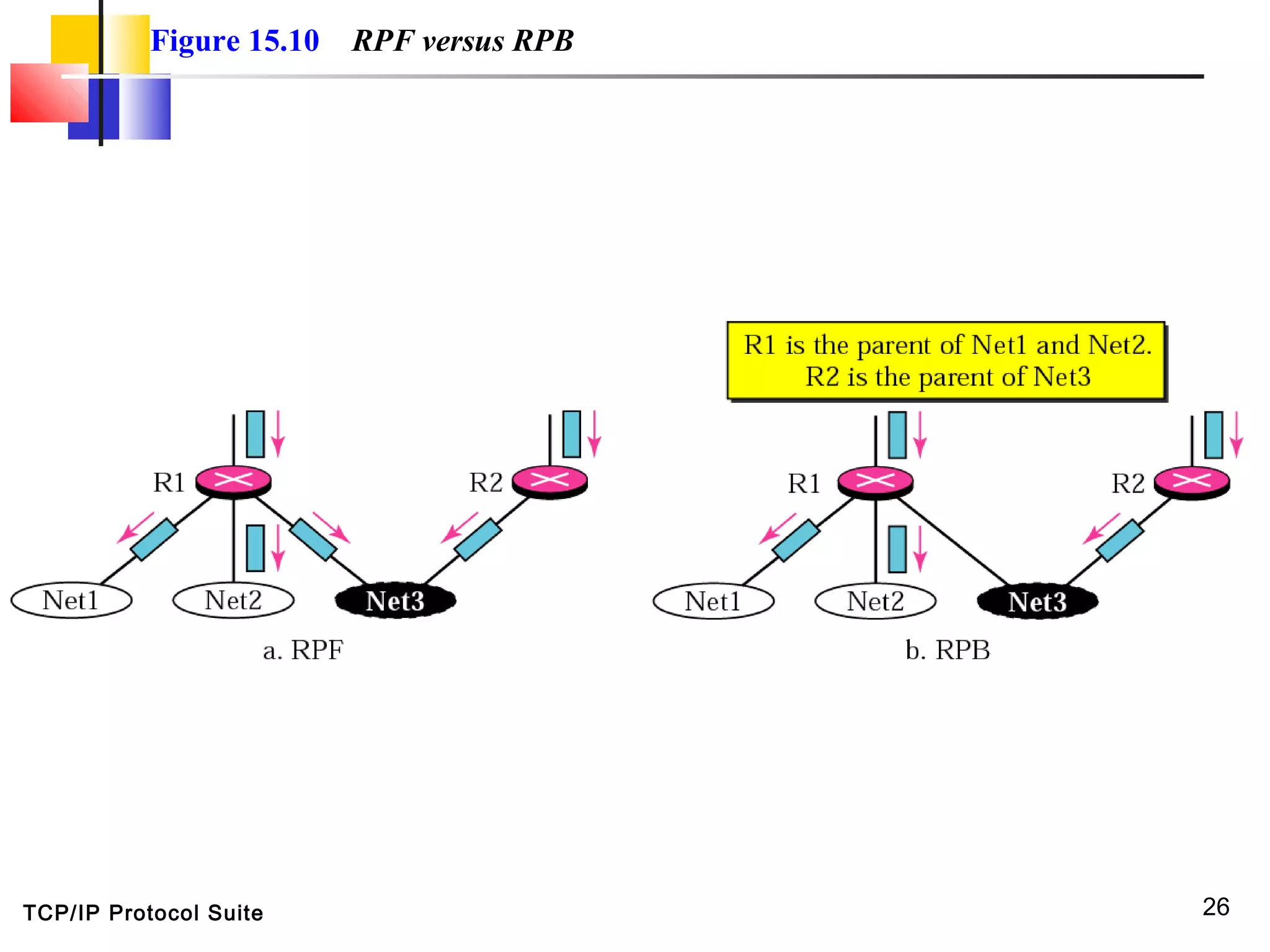
Figure 15.10 RPF versus RPB
TCP/IP Protocol Suite 27
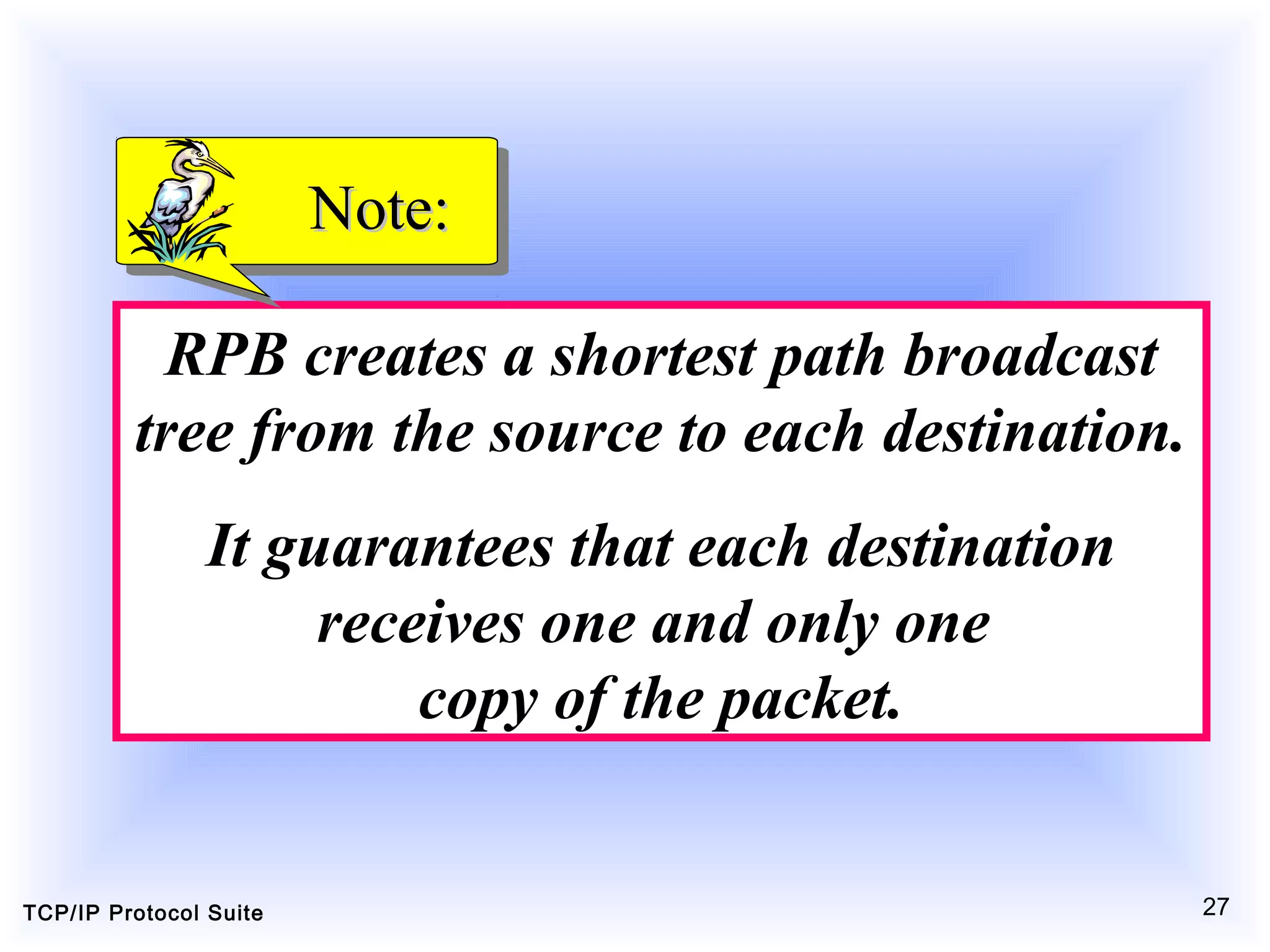
RPB creates a shortest path broadcast
tree from the source to each destination.
It guarantees that each destination
receives one and only one
copy of the packet.
Note:Note:
TCP/IP Protocol Suite 28
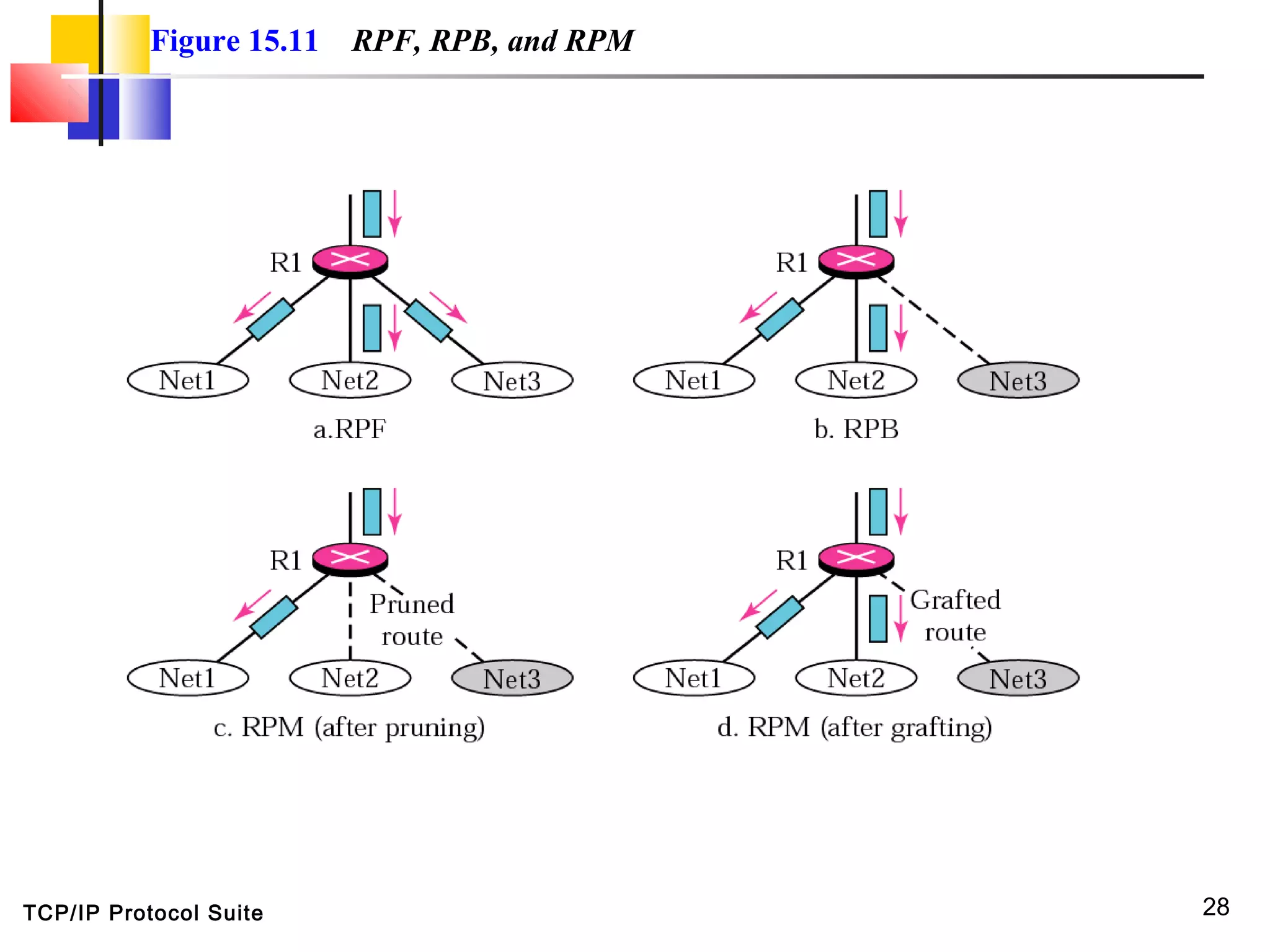
Figure 15.11 RPF, RPB, and RPM
TCP/IP Protocol Suite 29
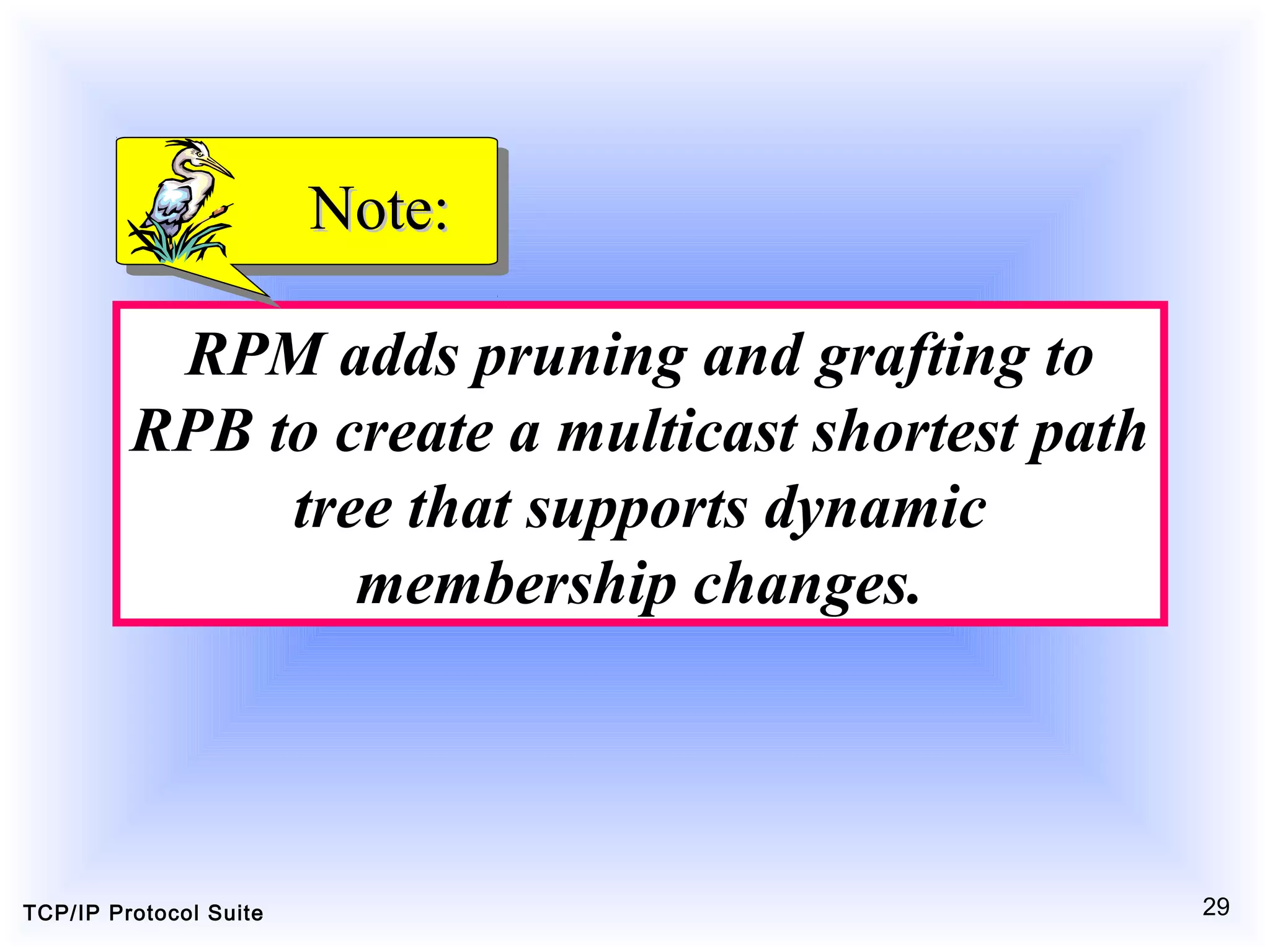
RPM adds pruning and grafting to
RPB to create a multicast shortest path
tree that supports dynamic
membership changes.
Note:Note:
TCP/IP Protocol Suite 30
15.6 CBT
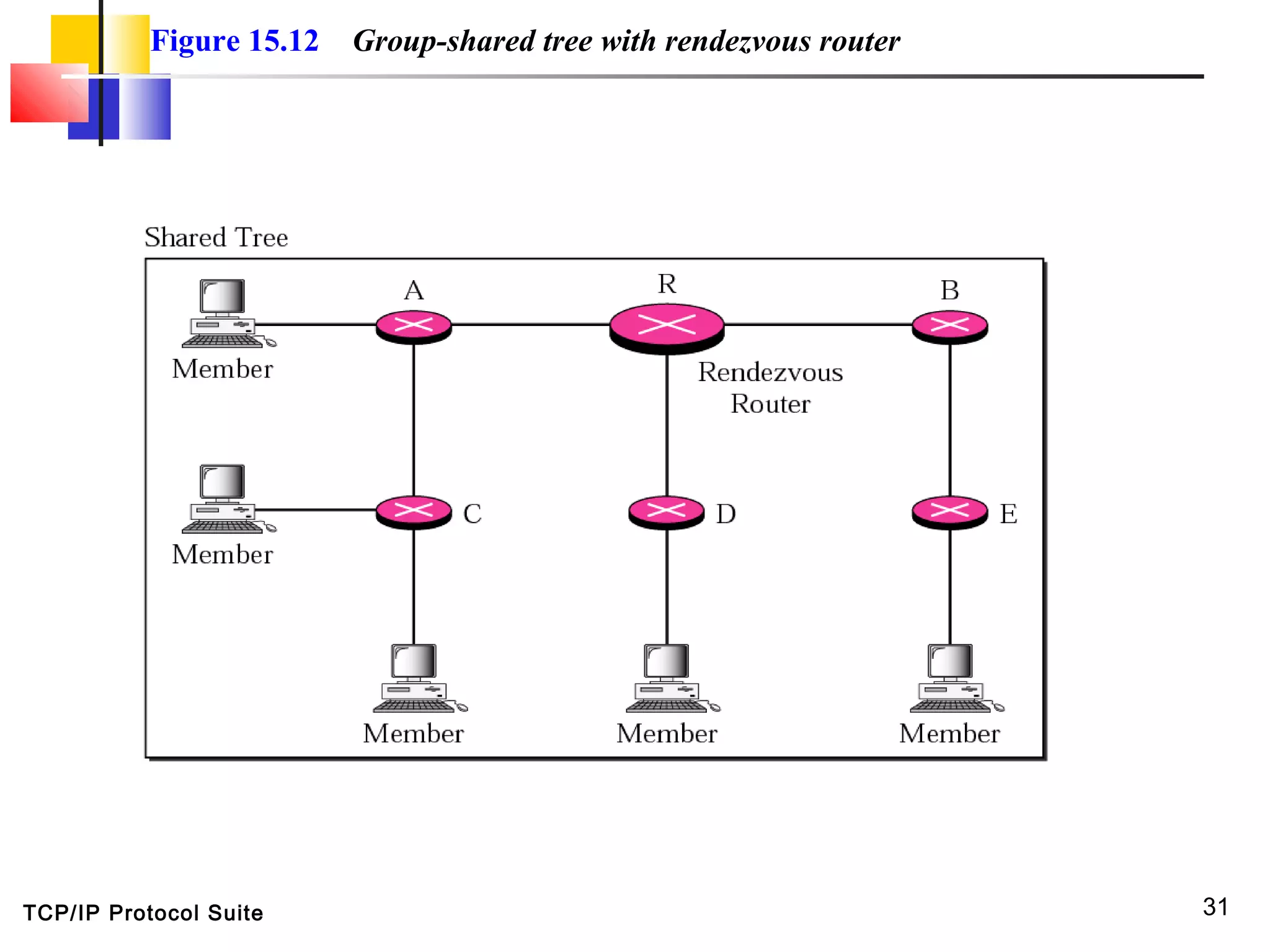
The Core-Based Tree (CBT) protocol is a group-shared protocol thatThe Core-Based Tree (CBT) protocol is a group-shared protocol that
uses a core as the root of the tree. The autonomous system is divided intouses a core as the root of the tree. The autonomous system is divided into
regions and a core (center router or rendezvous router) is chosen forregions and a core (center router or rendezvous router) is chosen for
each region.each region.
The topics discussed in this section include:The topics discussed in this section include:
Formation of the TreeFormation of the Tree
Sending Multicast PacketsSending Multicast Packets
Selecting the Rendezvous RouterSelecting the Rendezvous Router
TCP/IP Protocol Suite 31
Figure 15.12 Group-shared tree with rendezvous router
TCP/IP Protocol Suite 32
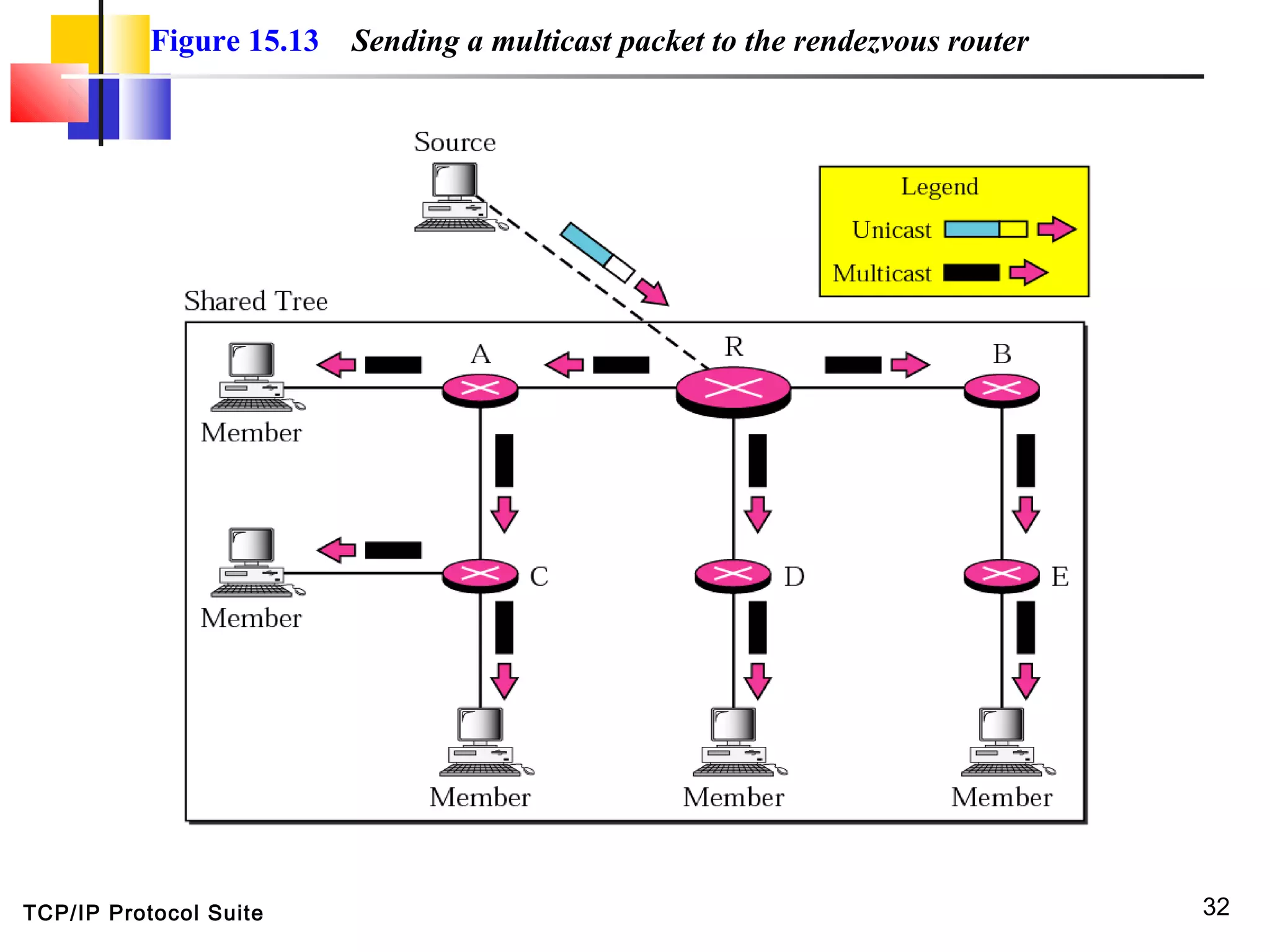
Figure 15.13 Sending a multicast packet to the rendezvous router
TCP/IP Protocol Suite 33
In CBT, the source sends the multicast
packet (encapsulated in a unicast packet)
to the core router.
The core router decapsulates the packet
and forwards it to all interested
interfaces.
Note:Note:
TCP/IP Protocol Suite 34
15.7 PIM
Protocol Independent Multicast (PIM) is the name given to twoProtocol Independent Multicast (PIM) is the name given to two
independent multicast routing protocols: Protocol Independentindependent multicast routing protocols: Protocol Independent
Multicast, Dense Mode (PIM-DM) and Protocol Independent Multicast,Multicast, Dense Mode (PIM-DM) and Protocol Independent Multicast,
Sparse Mode (PIM-SM).Sparse Mode (PIM-SM).
The topics discussed in this section include:The topics discussed in this section include:
PIM-DMPIM-DM
PIM-SMPIM-SM
TCP/IP Protocol Suite 35
PIM-DM is used in a dense multicast
environment, such as a LAN.
Note:Note:
TCP/IP Protocol Suite 36
PIM-DM uses RPF and
pruning/grafting strategies to handle
multicasting.
However, it is independent from the
underlying unicast protocol.
Note:Note:
TCP/IP Protocol Suite 37
PIM-SM is used in a sparse multicast
environment such as a WAN.
Note:Note:
TCP/IP Protocol Suite 38
PIM-SM is similar to CBT but uses a
simpler procedure.
Note:Note:
TCP/IP Protocol Suite 39
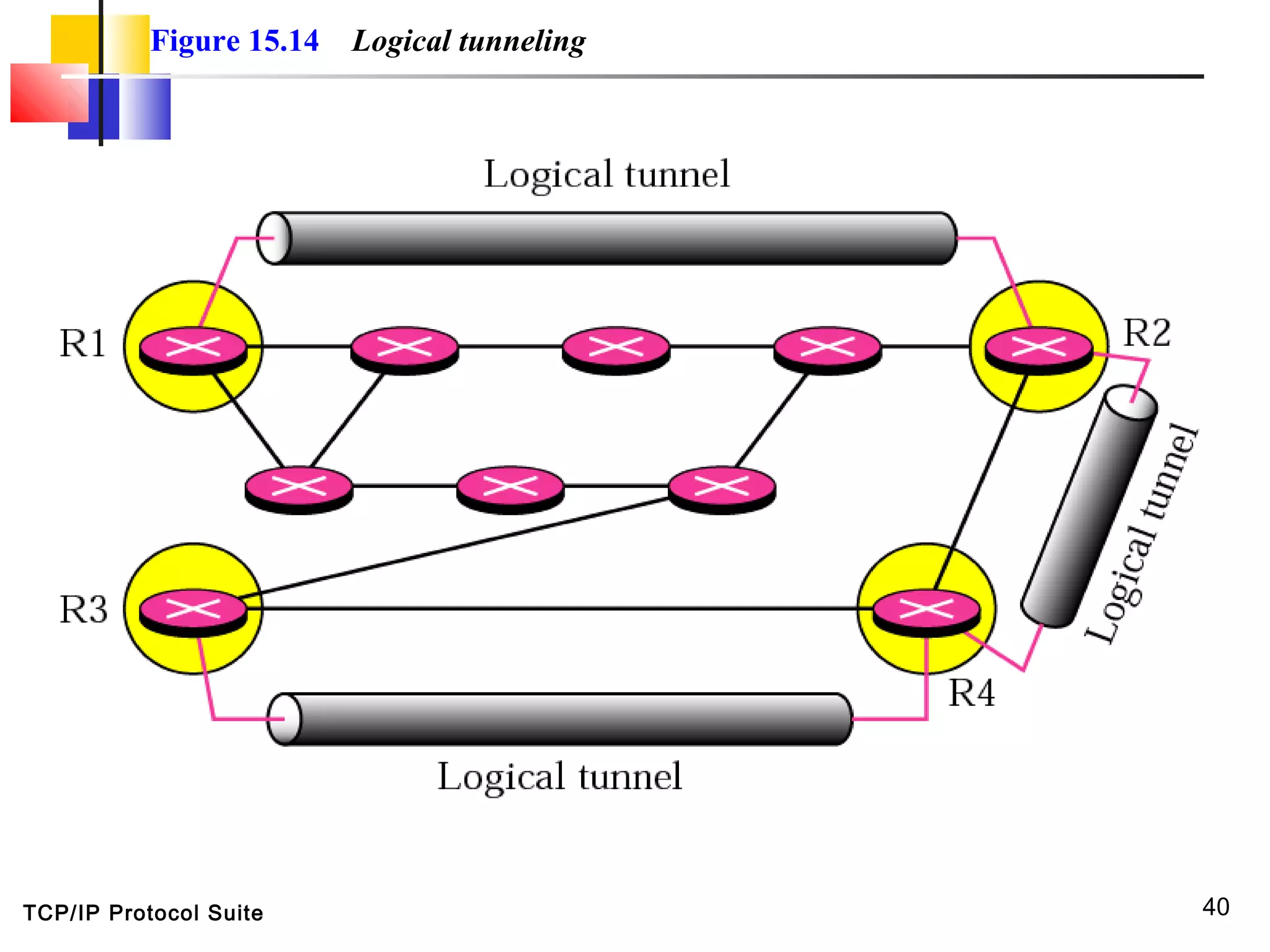
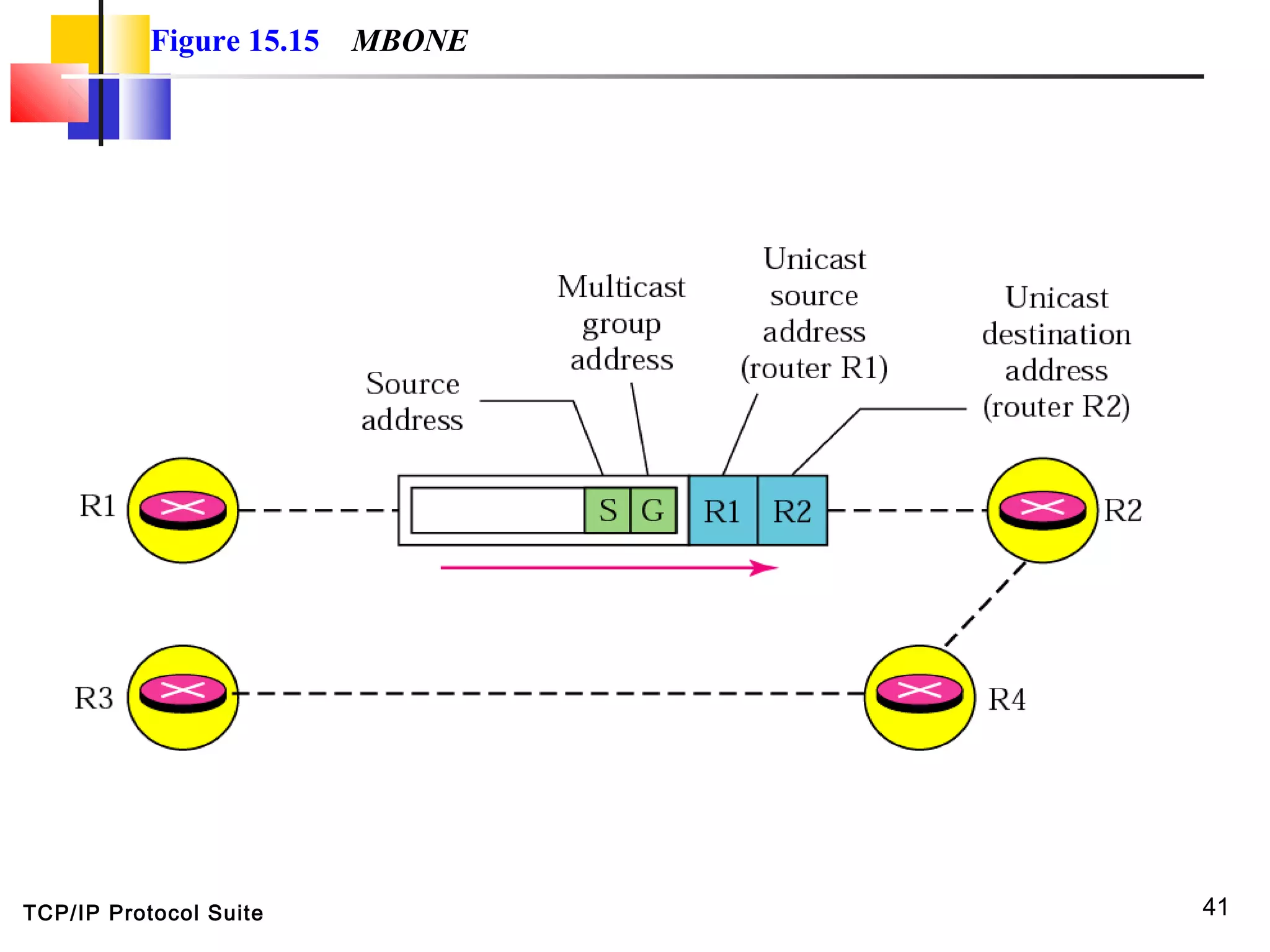
15.8 MBONE
A multicast router may not find another multicast router in theA multicast router may not find another multicast router in the
neighborhood to forward the multicast packet. A solution for thisneighborhood to forward the multicast packet. A solution for this
problem is tunneling. We make a multicast backbone (MBONE) out ofproblem is tunneling. We make a multicast backbone (MBONE) out of
these isolated routers using the concept of tunneling.these isolated routers using the concept of tunneling.
TCP/IP Protocol Suite 40
Figure 15.14 Logical tunneling
TCP/IP Protocol Suite 41
Figure 15.15 MBONE

Multicasting and multicast routing protocols

  • 1.
    TCP/IP Protocol Suite1 Multicasting andMulticasting and Multicast Routing ProtocolsMulticast Routing Protocols • Differentiate between a unicast, multicast, and broadcast message • Know the many applications of multicasting • Understand multicast link state routing and MOSPF • Understand multicast link state routing and DVMRP • Understand the Core-Based Tree Protocol • Understand the Protocol Independent Multicast Protocols • Understand the MBONE concept
  • 2.
    TCP/IP Protocol Suite2 15.1 UNICAST, MULTICAST, AND BROADCAST A message can be unicast, multicast, or broadcast. Let us clarify theseA message can be unicast, multicast, or broadcast. Let us clarify these terms as they relate to the Internet.terms as they relate to the Internet. The topics discussed in this section include:The topics discussed in this section include: UnicastingUnicasting MulticastingMulticasting BroadcastingBroadcasting Multicasting versus Multiple UnicastingMulticasting versus Multiple Unicasting
  • 3.
    TCP/IP Protocol Suite3 Figure 15.1 Unicasting
  • 4.
    TCP/IP Protocol Suite4 In unicasting, the router forwards the received packet through only one of its interfaces. Note:Note:
  • 5.
    TCP/IP Protocol Suite5 Figure 15.2 Multicasting
  • 6.
    TCP/IP Protocol Suite6 In multicasting, the router may forward the received packet through several of its interfaces. Note:Note:
  • 7.
    TCP/IP Protocol Suite7 Figure 15.3 Multicasting versus multiple unicasting
  • 8.
    TCP/IP Protocol Suite8 Emulation of multicasting through multiple unicasting is not efficient and may create long delays, particularly with a large group. Note:Note:
  • 9.
    TCP/IP Protocol Suite9 15.2 MULTICAST APPLICATIONS Multicasting has many applications today such as access to distributedMulticasting has many applications today such as access to distributed databases, information dissemination, teleconferencing, and distancedatabases, information dissemination, teleconferencing, and distance learning.learning. The topics discussed in this section include:The topics discussed in this section include: Access to Distributed DatabasesAccess to Distributed Databases Information DisseminationInformation Dissemination Dissemination of NewsDissemination of News TeleconferencingTeleconferencing Distance LearningDistance Learning
  • 10.
    TCP/IP Protocol Suite10 15.3 MULTICAST ROUTING In this section, we first discuss the idea of optimal routing, common inIn this section, we first discuss the idea of optimal routing, common in all multicast protocols. We then give an overview of multicast routingall multicast protocols. We then give an overview of multicast routing protocols.protocols. The topics discussed in this section include:The topics discussed in this section include: Optimal Routing: Shortest Path TreesOptimal Routing: Shortest Path Trees Routing ProtocolsRouting Protocols
  • 11.
    TCP/IP Protocol Suite11 In unicast routing, each router in the domain has a table that defines a shortest path tree to possible destinations. Note:Note:
  • 12.
    TCP/IP Protocol Suite12 Figure 15.4 Shortest path tree in unicast routing
  • 13.
    TCP/IP Protocol Suite13 In multicast routing, each involved router needs to construct a shortest path tree for each group. Note:Note:
  • 14.
    TCP/IP Protocol Suite14 In the source-based tree approach, each router needs to have one shortest path tree for each group. Note:Note:
  • 15.
    TCP/IP Protocol Suite15 Figure 15.5 Source-based tree approach
  • 16.
    TCP/IP Protocol Suite16 Figure 15.6 Group-shared tree approach
  • 17.
    TCP/IP Protocol Suite17 In the group-shared tree approach, only the core router, which has a shortest path tree for each group, is involved in multicasting. Note:Note:
  • 18.
    TCP/IP Protocol Suite18 Figure 15.7 Taxonomy of common multicast protocols
  • 19.
    TCP/IP Protocol Suite19 15.4 MULTICAST LINK STATE ROUTING: MOSPF In this section, we briefly discuss multicast link state routing and itsIn this section, we briefly discuss multicast link state routing and its implementation in the Internet, MOSPF.implementation in the Internet, MOSPF. The topics discussed in this section include:The topics discussed in this section include: Multicast Link State RoutingMulticast Link State Routing MOSPFMOSPF
  • 20.
    TCP/IP Protocol Suite20 Multicast link state routing uses the source-based tree approach. Note:Note:
  • 21.
    TCP/IP Protocol Suite21 15.5 MULTICAST DISTANCE VECTOR: DVMRP In this section, we briefly discuss multicast distance vector routing andIn this section, we briefly discuss multicast distance vector routing and its implementation in the Internet, DVMRP.its implementation in the Internet, DVMRP. The topics discussed in this section include:The topics discussed in this section include: Multicast Distance Vector RoutingMulticast Distance Vector Routing DVMRPDVMRP
  • 22.
    TCP/IP Protocol Suite22 Flooding broadcasts packets, but creates loops in the systems. Note:Note:
  • 23.
    TCP/IP Protocol Suite23 RPF eliminates the loop in the flooding process. Note:Note:
  • 24.
    TCP/IP Protocol Suite24 Figure 15.8 RPF
  • 25.
    TCP/IP Protocol Suite25 Figure 15.9 Problem with RPF
  • 26.
    TCP/IP Protocol Suite26 Figure 15.10 RPF versus RPB
  • 27.
    TCP/IP Protocol Suite27 RPB creates a shortest path broadcast tree from the source to each destination. It guarantees that each destination receives one and only one copy of the packet. Note:Note:
  • 28.
    TCP/IP Protocol Suite28 Figure 15.11 RPF, RPB, and RPM
  • 29.
    TCP/IP Protocol Suite29 RPM adds pruning and grafting to RPB to create a multicast shortest path tree that supports dynamic membership changes. Note:Note:
  • 30.
    TCP/IP Protocol Suite30 15.6 CBT The Core-Based Tree (CBT) protocol is a group-shared protocol thatThe Core-Based Tree (CBT) protocol is a group-shared protocol that uses a core as the root of the tree. The autonomous system is divided intouses a core as the root of the tree. The autonomous system is divided into regions and a core (center router or rendezvous router) is chosen forregions and a core (center router or rendezvous router) is chosen for each region.each region. The topics discussed in this section include:The topics discussed in this section include: Formation of the TreeFormation of the Tree Sending Multicast PacketsSending Multicast Packets Selecting the Rendezvous RouterSelecting the Rendezvous Router
  • 31.
    TCP/IP Protocol Suite31 Figure 15.12 Group-shared tree with rendezvous router
  • 32.
    TCP/IP Protocol Suite32 Figure 15.13 Sending a multicast packet to the rendezvous router
  • 33.
    TCP/IP Protocol Suite33 In CBT, the source sends the multicast packet (encapsulated in a unicast packet) to the core router. The core router decapsulates the packet and forwards it to all interested interfaces. Note:Note:
  • 34.
    TCP/IP Protocol Suite34 15.7 PIM Protocol Independent Multicast (PIM) is the name given to twoProtocol Independent Multicast (PIM) is the name given to two independent multicast routing protocols: Protocol Independentindependent multicast routing protocols: Protocol Independent Multicast, Dense Mode (PIM-DM) and Protocol Independent Multicast,Multicast, Dense Mode (PIM-DM) and Protocol Independent Multicast, Sparse Mode (PIM-SM).Sparse Mode (PIM-SM). The topics discussed in this section include:The topics discussed in this section include: PIM-DMPIM-DM PIM-SMPIM-SM
  • 35.
    TCP/IP Protocol Suite35 PIM-DM is used in a dense multicast environment, such as a LAN. Note:Note:
  • 36.
    TCP/IP Protocol Suite36 PIM-DM uses RPF and pruning/grafting strategies to handle multicasting. However, it is independent from the underlying unicast protocol. Note:Note:
  • 37.
    TCP/IP Protocol Suite37 PIM-SM is used in a sparse multicast environment such as a WAN. Note:Note:
  • 38.
    TCP/IP Protocol Suite38 PIM-SM is similar to CBT but uses a simpler procedure. Note:Note:
  • 39.
    TCP/IP Protocol Suite39 15.8 MBONE A multicast router may not find another multicast router in theA multicast router may not find another multicast router in the neighborhood to forward the multicast packet. A solution for thisneighborhood to forward the multicast packet. A solution for this problem is tunneling. We make a multicast backbone (MBONE) out ofproblem is tunneling. We make a multicast backbone (MBONE) out of these isolated routers using the concept of tunneling.these isolated routers using the concept of tunneling.
  • 40.
    TCP/IP Protocol Suite40 Figure 15.14 Logical tunneling
  • 41.
    TCP/IP Protocol Suite41 Figure 15.15 MBONE