TCP/IP
PROTOCOL
SUITE
Prince Kumar
BSc.IT
Gaya College , Gaya
Contents…
 OSI model & TCP/IP Suite.
 TCP/IP and layers of OSI
model.
 TCP/IP protocols.
OSI model & TCP/IP Suite.
 OSI model is a network model standardized
by ISO in 1970 to make networks more
flexible, robust and interoperable.
 TCP/IP Suite was developed as prior of OSI
model . It is a stack of protocols required for
communication.
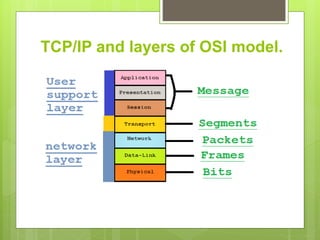
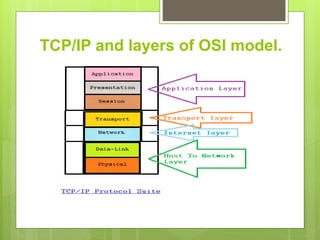
TCP/IP and layers of OSI model.
TCP/IP protocols.
 Each layer in TCP/IP Suite is a set of protocols .
Let us see below_
 Application layer protocols: These are some
protocols come under application layer of TCP/IP
suite.
1. http (hyper text transfer protocol) - It is a protocol to
access data (plain, hypertext, audio, video etc.) on
the WWW.
2. ftp (file transfer protocol) – For copying a file from
one host to another.
TCP/IP protocols.
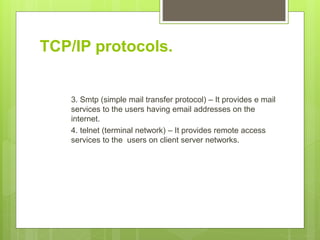
3. Smtp (simple mail transfer protocol) – It provides e mail
services to the users having email addresses on the
internet.
4. telnet (terminal network) – It provides remote access
services to the users on client server networks.
TCP/IP protocols.
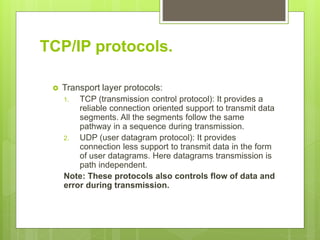
 Transport layer protocols:
1. TCP (transmission control protocol): It provides a
reliable connection oriented support to transmit data
segments. All the segments follow the same
pathway in a sequence during transmission.
2. UDP (user datagram protocol): It provides
connection less support to transmit data in the form
of user datagrams. Here datagrams transmission is
path independent.
Note: These protocols also controls flow of data and
error during transmission.
TCP/IP protocols.
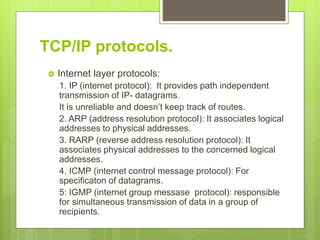
 Internet layer protocols:
1. IP (internet protocol): It provides path independent
transmission of IP- datagrams.
It is unreliable and doesn’t keep track of routes.
2. ARP (address resolution protocol): It associates logical
addresses to physical addresses.
3. RARP (reverse address resolution protocol): It
associates physical addresses to the concerned logical
addresses.
4. ICMP (internet control message protocol): For
specificaton of datagrams.
5: IGMP (internet group messase protocol): responsible
for simultaneous transmission of data in a group of
recipients.
TCP/IP protocols.
 Host to network layers don’t specify any special
protocol.
THE
END !
In the next video:
IEEE PROJECT 802
Send your feedbacks_
824207prince@gmail.com

Tcp ip tutorial

  • 1.
  • 2.
    Contents…  OSI model& TCP/IP Suite.  TCP/IP and layers of OSI model.  TCP/IP protocols.
  • 3.
    OSI model &TCP/IP Suite.  OSI model is a network model standardized by ISO in 1970 to make networks more flexible, robust and interoperable.  TCP/IP Suite was developed as prior of OSI model . It is a stack of protocols required for communication.
  • 4.
    TCP/IP and layersof OSI model.
  • 5.
    TCP/IP and layersof OSI model.
  • 6.
    TCP/IP protocols.  Eachlayer in TCP/IP Suite is a set of protocols . Let us see below_  Application layer protocols: These are some protocols come under application layer of TCP/IP suite. 1. http (hyper text transfer protocol) - It is a protocol to access data (plain, hypertext, audio, video etc.) on the WWW. 2. ftp (file transfer protocol) – For copying a file from one host to another.
  • 7.
    TCP/IP protocols. 3. Smtp(simple mail transfer protocol) – It provides e mail services to the users having email addresses on the internet. 4. telnet (terminal network) – It provides remote access services to the users on client server networks.
  • 8.
    TCP/IP protocols.  Transportlayer protocols: 1. TCP (transmission control protocol): It provides a reliable connection oriented support to transmit data segments. All the segments follow the same pathway in a sequence during transmission. 2. UDP (user datagram protocol): It provides connection less support to transmit data in the form of user datagrams. Here datagrams transmission is path independent. Note: These protocols also controls flow of data and error during transmission.
  • 9.
    TCP/IP protocols.  Internetlayer protocols: 1. IP (internet protocol): It provides path independent transmission of IP- datagrams. It is unreliable and doesn’t keep track of routes. 2. ARP (address resolution protocol): It associates logical addresses to physical addresses. 3. RARP (reverse address resolution protocol): It associates physical addresses to the concerned logical addresses. 4. ICMP (internet control message protocol): For specificaton of datagrams. 5: IGMP (internet group messase protocol): responsible for simultaneous transmission of data in a group of recipients.
  • 10.
    TCP/IP protocols.  Hostto network layers don’t specify any special protocol.
  • 11.
    THE END ! In thenext video: IEEE PROJECT 802 Send your feedbacks_ 824207prince@gmail.com