Prabhat Gangwar

 Mule, the runtime engine of Anypoint Platform, is a
lightweight Java-based enterprise service bus (ESB)
and integration platform that allows developers to
connect applications together quickly and easily,
enabling them to exchange data. It enables easy
integration of existing systems, regardless of the
different technologies that the applications use,
including JMS, Web Services, JDBC, HTTP, and
more.
About Mule ESB

 Service creation and hosting — expose and host reusable
services, using the ESB as a lightweight service container
 Service mediation — shield services from message
formats and protocols, separate business logic from
messaging, and enable location-independent service calls
 Message routing — route, filter, aggregate, and re-
sequence messages based on content and rules
 Data transformation — exchange data across varying
formats and transport protocols
Mule Capabilities

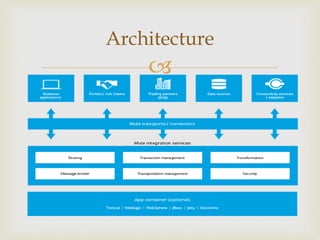
Architecture

 Integration Styles – Batch – File Transfer – Shared
Database – Request/Reply – Messaging 1 -
Synchronous 2- Asynchronous
 ESB Advantages – Supports all styles – Bridges
legacy systems – Modular architecture – Simple and
flexible – Easy to test and maintain – Scalable – Can
be a step towards SOA
Why use an ESB

Mule esb

  • 1.
  • 2.
      Mule, theruntime engine of Anypoint Platform, is a lightweight Java-based enterprise service bus (ESB) and integration platform that allows developers to connect applications together quickly and easily, enabling them to exchange data. It enables easy integration of existing systems, regardless of the different technologies that the applications use, including JMS, Web Services, JDBC, HTTP, and more. About Mule ESB
  • 3.
      Service creationand hosting — expose and host reusable services, using the ESB as a lightweight service container  Service mediation — shield services from message formats and protocols, separate business logic from messaging, and enable location-independent service calls  Message routing — route, filter, aggregate, and re- sequence messages based on content and rules  Data transformation — exchange data across varying formats and transport protocols Mule Capabilities
  • 4.
  • 5.
      Integration Styles– Batch – File Transfer – Shared Database – Request/Reply – Messaging 1 - Synchronous 2- Asynchronous  ESB Advantages – Supports all styles – Bridges legacy systems – Modular architecture – Simple and flexible – Easy to test and maintain – Scalable – Can be a step towards SOA Why use an ESB