 The business model is the manager’s
logic that will allow a venture to:
› Capture the market opportunity;
› Mitigate risks;
› Identify the required resource set; and
› Create value for investors and founders.
 The business model bridges idea and
action.
 It answers the question of why a venture
will be viable and valuable.
 Business models relate to business
strategy as logic relates to the algorithm.
 The business model is not burdened with
the “how” questions.
 These are resolved by the strategic plan.
 Business models are formed through a
process of addressing a series of questions:
› What is the value proposition?
› What are the target markets?
› Who are the critical members of the team?
› Where does competitive advantage exist?
› Why is there a competitive advantage?
› When will development, launch and cash flow
breakeven occur?
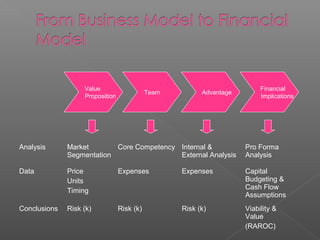
Analysis Market
Segmentation
Core Competency Internal &
External Analysis
Pro Forma
Analysis
Data Price
Units
Timing
Expenses Expenses Capital
Budgeting &
Cash Flow
Assumptions
Conclusions Risk (k) Risk (k) Risk (k) Viability &
Value
(RAROC)
Value
Proposition
Team Advantage
Financial
Implications
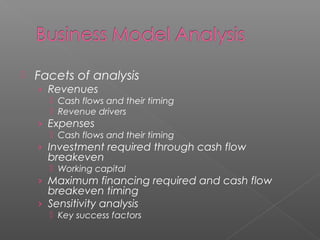
 Facets of analysis
› Revenues
 Cash flows and their timing
 Revenue drivers
› Expenses
 Cash flows and their timing
› Investment required through cash flow
breakeven
 Working capital
› Maximum financing required and cash flow
breakeven timing
› Sensitivity analysis
 Key success factors
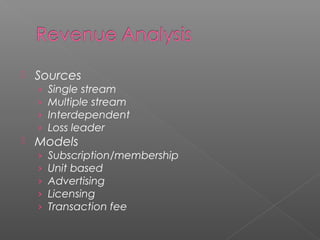
 Sources
› Single stream
› Multiple stream
› Interdependent
› Loss leader
 Models
› Subscription/membership
› Unit based
› Advertising
› Licensing
› Transaction fee
 Cost structures
› Payroll
 Direct
 Indirect
› Inventory
› Location
› Marketing
 Cost drivers
› Fixed, variable or semi-variable
› Scale of fixed cost base
› Anticipated changes to cost drivers
 Maximum financing need
 Timing of cash flow breakeven
 Timing to positive cash flow
 Identify the business factors with the
greatest impact on the cash flows
› An anticipatory business scorecard
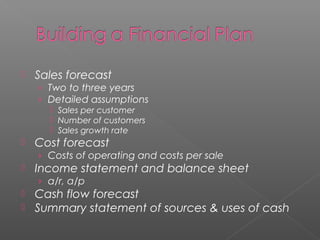
 Sales forecast
› Two to three years
› Detailed assumptions
 Sales per customer
 Number of customers
 Sales growth rate
 Cost forecast
› Costs of operating and costs per sale
 Income statement and balance sheet
› a/r, a/p
 Cash flow forecast
 Summary statement of sources & uses of cash
 Minimum cash balance
 Sales forecast
 Cash receipts forecast
 Cash disbursements forecast
 Ending cash balance
 Three scenario approach (results in three
cash budgets)
› Optimistic
› Realistic
› Pessimistic
 Cash budget must account for delays
between sales and collections (including
write-offs)
 Record disbursements in the month of
payment, not when the obligation is
incurred
 Sales forecast
› Two to three years
› Detailed assumptions
 Sales per customer
 Number of customers
 Sales growth rate
 Cost forecast
› Costs of operating and costs per sale
 Income statement and balance sheet
› a/r, a/p
 Cash flow forecast
 Summary statement of sources & uses of cash
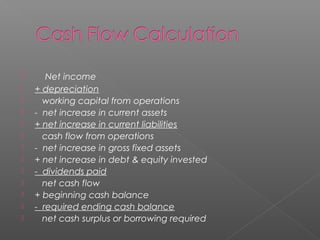
 Net income
 + depreciation
 working capital from operations
 - net increase in current assets
 + net increase in current liabilities
 cash flow from operations
 - net increase in gross fixed assets
 + net increase in debt & equity invested
 - dividends paid
 net cash flow
 + beginning cash balance
 - required ending cash balance
 net cash surplus or borrowing required
 Never do anything that is not fun at least
80% of the time!

Buissness model analysis

  • 2.
     The businessmodel is the manager’s logic that will allow a venture to: › Capture the market opportunity; › Mitigate risks; › Identify the required resource set; and › Create value for investors and founders.
  • 3.
     The businessmodel bridges idea and action.  It answers the question of why a venture will be viable and valuable.  Business models relate to business strategy as logic relates to the algorithm.
  • 4.
     The businessmodel is not burdened with the “how” questions.  These are resolved by the strategic plan.
  • 5.
     Business modelsare formed through a process of addressing a series of questions: › What is the value proposition? › What are the target markets? › Who are the critical members of the team? › Where does competitive advantage exist? › Why is there a competitive advantage? › When will development, launch and cash flow breakeven occur?
  • 6.
    Analysis Market Segmentation Core CompetencyInternal & External Analysis Pro Forma Analysis Data Price Units Timing Expenses Expenses Capital Budgeting & Cash Flow Assumptions Conclusions Risk (k) Risk (k) Risk (k) Viability & Value (RAROC) Value Proposition Team Advantage Financial Implications
  • 7.
     Facets ofanalysis › Revenues  Cash flows and their timing  Revenue drivers › Expenses  Cash flows and their timing › Investment required through cash flow breakeven  Working capital › Maximum financing required and cash flow breakeven timing › Sensitivity analysis  Key success factors
  • 8.
     Sources › Singlestream › Multiple stream › Interdependent › Loss leader  Models › Subscription/membership › Unit based › Advertising › Licensing › Transaction fee
  • 9.
     Cost structures ›Payroll  Direct  Indirect › Inventory › Location › Marketing  Cost drivers › Fixed, variable or semi-variable › Scale of fixed cost base › Anticipated changes to cost drivers
  • 10.
     Maximum financingneed  Timing of cash flow breakeven  Timing to positive cash flow
  • 11.
     Identify thebusiness factors with the greatest impact on the cash flows › An anticipatory business scorecard
  • 12.
     Sales forecast ›Two to three years › Detailed assumptions  Sales per customer  Number of customers  Sales growth rate  Cost forecast › Costs of operating and costs per sale  Income statement and balance sheet › a/r, a/p  Cash flow forecast  Summary statement of sources & uses of cash
  • 13.
     Minimum cashbalance  Sales forecast  Cash receipts forecast  Cash disbursements forecast  Ending cash balance
  • 14.
     Three scenarioapproach (results in three cash budgets) › Optimistic › Realistic › Pessimistic
  • 15.
     Cash budgetmust account for delays between sales and collections (including write-offs)
  • 16.
     Record disbursementsin the month of payment, not when the obligation is incurred
  • 17.
     Sales forecast ›Two to three years › Detailed assumptions  Sales per customer  Number of customers  Sales growth rate  Cost forecast › Costs of operating and costs per sale  Income statement and balance sheet › a/r, a/p  Cash flow forecast  Summary statement of sources & uses of cash
  • 18.
     Net income + depreciation  working capital from operations  - net increase in current assets  + net increase in current liabilities  cash flow from operations  - net increase in gross fixed assets  + net increase in debt & equity invested  - dividends paid  net cash flow  + beginning cash balance  - required ending cash balance  net cash surplus or borrowing required
  • 19.
     Never doanything that is not fun at least 80% of the time!