Mule ESB®
Integration Simplified
Rich Remington
rremington@Rich-Software.com
Kiet Bui
1-SEP-2009All content copyright © 2009, Rich Software Inc; portions copyright © 2009, MuleSource Inc. All rights reserved.2
Topics
 Integration, SOA, and ESB
 What Mule ESB is (and isn’t)
 Mule Architecture & Components
 Configuration & Deployment
 Enterprise Integration Patterns
 Main Demo
 Wrap-up & questions
1-SEP-2009All content copyright © 2009, Rich Software Inc; portions copyright © 2009, MuleSource Inc. All rights reserved.3
Goals
 Educate 1..* people about Mule ESB & how
to simplify integration projects
 Give back to an awesome community
 Have a bit of fun
 Confirm “laziness” is a good thing!
– At least some of the time…
 Convince you it’s safe, easy, and fun, to “get
on the bus”
1-SEP-2009All content copyright © 2009, Rich Software Inc; portions copyright © 2009, MuleSource Inc. All rights reserved.4
Background
 Who am I?
– Mathematician wannabe turned software guy
– A bit lazy
 The bucket of water story
– Moral: don’t work harder than you have to - it’s
okay to be lazy ;-)
1-SEP-2009All content copyright © 2009, Rich Software Inc; portions copyright © 2009, MuleSource Inc. All rights reserved.5
 Reduce
– Code complexity & bloat
 Refactor
– Move code to its proper place
 Transformation, Routing, Service Component
 Reuse
– Plan ahead for service/component reuse
– Use pre-built components & solutions
3 R’s - Plan to be Lazy :-)
1-SEP-2009All content copyright © 2009, Rich Software Inc; portions copyright © 2009, MuleSource Inc. All rights reserved.6
Integration Projects
 Why we integrate
– Users don't care where business functions and
information reside
– We don't always own or control all the pieces
 intranet & external partners
– Cheaper than building new solutions from scratch
– Users want access to information from various
devices - browsers, mobile phone, handhelds, ...
1-SEP-2009All content copyright © 2009, Rich Software Inc; portions copyright © 2009, MuleSource Inc. All rights reserved.7
Integration Projects
 How we integrate
– Set up meetings with business domain experts
– Identify systems and processes
– More meetings…
– Map data flows then model
 Patterns are extremely helpful
– Yet more meetings…
– Define services & message formats
– Start coding away…
 But, then what happens?
1-SEP-2009All content copyright © 2009, Rich Software Inc; portions copyright © 2009, MuleSource Inc. All rights reserved.8
Integration Projects
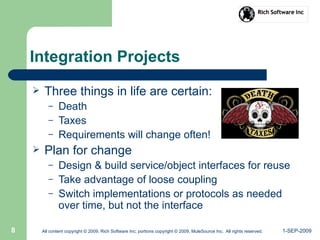
 Three things in life are certain:
– Death
– Taxes
– Requirements will change often!
 Plan for change
– Design & build service/object interfaces for reuse
– Take advantage of loose coupling
– Switch implementations or protocols as needed
over time, but not the interface
1-SEP-2009All content copyright © 2009, Rich Software Inc; portions copyright © 2009, MuleSource Inc. All rights reserved.9
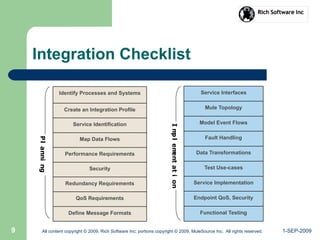
Integration Checklist
Service Interfaces
Mule Topology
Model Event Flows
Fault Handling
Data Transformations
Test Use-cases
Service Implementation
Endpoint QoS, Security
Functional Testing
Implementation
Identify Processes and Systems
Create an Integration Profile
Service Identification
Map Data Flows
Performance Requirements
Security
Redundancy Requirements
QoS Requirements
Define Message Formats
Planning
1-SEP-2009All content copyright © 2009, Rich Software Inc; portions copyright © 2009, MuleSource Inc. All rights reserved.10
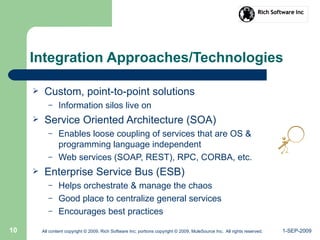
Integration Approaches/Technologies
 Custom, point-to-point solutions
– Information silos live on
 Service Oriented Architecture (SOA)
– Enables loose coupling of services that are OS &
programming language independent
– Web services (SOAP, REST), RPC, CORBA, etc.
 Enterprise Service Bus (ESB)
– Helps orchestrate & manage the chaos
– Good place to centralize general services
– Encourages best practices
1-SEP-2009All content copyright © 2009, Rich Software Inc; portions copyright © 2009, MuleSource Inc. All rights reserved.11
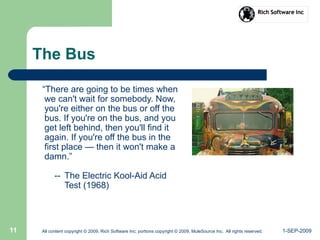
The Bus
“There are going to be times when
we can't wait for somebody. Now,
you're either on the bus or off the
bus. If you're on the bus, and you
get left behind, then you'll find it
again. If you're off the bus in the
first place — then it won't make a
damn.”
-- The Electric Kool-Aid Acid
Test (1968)
1-SEP-2009All content copyright © 2009, Rich Software Inc; portions copyright © 2009, MuleSource Inc. All rights reserved.12
Daily Double
 What are two of the 3 R’s?
 What was the moral of the “bucket of water”
story?
 Name the Integration Approach I’m
suggesting you use
1-SEP-2009All content copyright © 2009, Rich Software Inc; portions copyright © 2009, MuleSource Inc. All rights reserved.13
Audience Poll
 How many of you…
– Need to integrate
– Are using point-to-point integration solutions
– Are doing SOA (SOAP, REST, RPC, …)
– Not doing SOA, but planning to
– Are using an ESB
– Not doing ESB, but planning to
1-SEP-2009All content copyright © 2009, Rich Software Inc; portions copyright © 2009, MuleSource Inc. All rights reserved.14
Why use an ESB
 Integration Styles
– Batch
– File Transfer
– Shared Database
– Request/Reply
– Messaging
 Synchronous
 Asynchronous
 ESB Advantages
– Supports all styles
– Bridges legacy systems
– Modular architecture
– Simple and flexible
– Easy to test and maintain
– Scalable
– Can be a step towards
SOA
1-SEP-2009All content copyright © 2009, Rich Software Inc; portions copyright © 2009, MuleSource Inc. All rights reserved.15
8-APR-2009
All content copyright © 2009, Rich Software Inc; portions copyright © 2009, MuleSource Inc. All rights reserved.
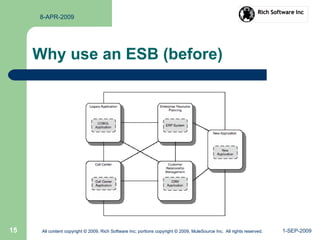
Why use an ESB (before)
1-SEP-2009All content copyright © 2009, Rich Software Inc; portions copyright © 2009, MuleSource Inc. All rights reserved.16
8-APR-2009
All content copyright © 2009, Rich Software Inc; portions copyright © 2009, MuleSource Inc. All rights reserved.
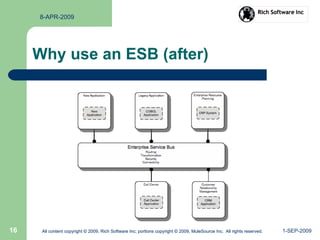
Why use an ESB (after)
1-SEP-2009All content copyright © 2009, Rich Software Inc; portions copyright © 2009, MuleSource Inc. All rights reserved.17
What is Mule ESB?
“Mule is a lightweight integration platform and service
container that allows you to quickly and easily
connect your applications together. Mule provides a
robust, secure and scalable platform to build
enterprise applications offering an array of transports
such as JMS, HTTP, Email, FTP, JDBC and many
more. It also offers a rich set of features for web
services, message routing, mediation, transformation
and transaction management. Designed around the
ESB (Enterprise Service Bus) concept.”
-- www.mulesource.org
1-SEP-2009All content copyright © 2009, Rich Software Inc; portions copyright © 2009, MuleSource Inc. All rights reserved.18
What is Mule ESB?
“Mule is a lightweight integration platform and service
container that allows you to quickly and easily
connect your applications together. Mule provides a
robust, secure and scalable platform to build
enterprise applications offering an array of transports
such as JMS, HTTP, Email, FTP, JDBC and many
more. It also offers a rich set of features for web
services, message routing, mediation, transformation
and transaction management. Designed around the
ESB (Enterprise Service Bus) concept.”
-- www.mulesource.org
1-SEP-2009All content copyright © 2009, Rich Software Inc; portions copyright © 2009, MuleSource Inc. All rights reserved.19 All content copyright © 2009, Rich Software Inc; portions copyright © 2009, MuleSource Inc. All rights reserved.
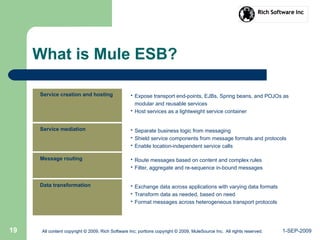
What is Mule ESB?
Service creation and hosting • Expose transport end-points, EJBs, Spring beans, and POJOs as
modular and reusable services
• Host services as a lightweight service container
Service mediation • Separate business logic from messaging
• Shield service components from message formats and protocols
• Enable location-independent service calls
Message routing • Route messages based on content and complex rules
• Filter, aggregate and re-sequence in-bound messages
Data transformation • Exchange data across applications with varying data formats
• Transform data as needed, based on need
• Format messages across heterogeneous transport protocols
1-SEP-2009All content copyright © 2009, Rich Software Inc; portions copyright © 2009, MuleSource Inc. All rights reserved.20 All content copyright © 2009, Rich Software Inc; portions copyright © 2009, MuleSource Inc. All rights reserved.
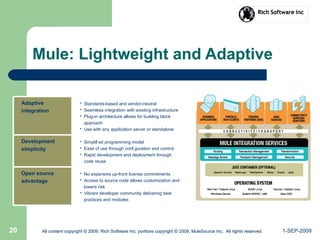
Mule: Lightweight and Adaptive
Adaptive
integration
• Standards-based and vendor-neutral
• Seamless integration with existing infrastructure
• Plug-in architecture allows for building block
approach
• Use with any application server or standalone
Development
simplicity
• Simplifi ed programming model
• Ease of use through confi guration and control
• Rapid development and deployment through
code reuse
Open source
advantage
• No expensive up-front license commitments
• Access to source code allows customization and
lowers risk
• Vibrant developer community delivering best
practices and modules
1-SEP-2009All content copyright © 2009, Rich Software Inc; portions copyright © 2009, MuleSource Inc. All rights reserved.21
What Mule ESB isn’t
 It does not place restrictions on your environment
 It is not message queuing, it uses other (JMS
capable) products
– And, it does not require message queues
 It is not complex
 It does not need to be “the grand master of all
integration endpoints across the enterprise”
– Think big, start small
– It plays nicely with other ESBs
1-SEP-2009All content copyright © 2009, Rich Software Inc; portions copyright © 2009, MuleSource Inc. All rights reserved.22
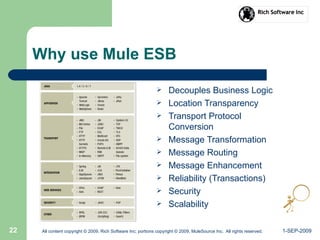
Why use Mule ESB
 Decouples Business Logic
 Location Transparency
 Transport Protocol
Conversion
 Message Transformation
 Message Routing
 Message Enhancement
 Reliability (Transactions)
 Security
 Scalability
1-SEP-2009All content copyright © 2009, Rich Software Inc; portions copyright © 2009, MuleSource Inc. All rights reserved.23
Why choose Mule
 No prescribed message format
– XML, CSV, Binary, Streams, Record, Java Objects
– Mix and match
 Zero code intrusion
– Mule does not impose an API on service objects
– Objects are fully portable
 Existing objects can be managed
– POJOs, IoC Objects, EJB Session Beans, Remote Objects
– REST & Web Services
 Easy to test
– Mule can be run easily from a JUnit test case
– Framework provides a Test compatibility kit
– Scales down as well as up
1-SEP-2009All content copyright © 2009, Rich Software Inc; portions copyright © 2009, MuleSource Inc. All rights reserved.24
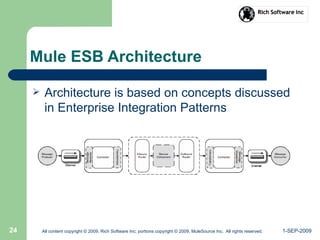
Mule ESB Architecture
 Architecture is based on concepts discussed
in Enterprise Integration Patterns
1-SEP-2009All content copyright © 2009, Rich Software Inc; portions copyright © 2009, MuleSource Inc. All rights reserved.25
Mule Components
 Endpoint
– Channel, MessageReceiver, Connector
 Transformer
– Message transformation / enhancement
 Router
– Message flow control (inbound/outbound)
 Service Component
– Your integration logic lives here
1-SEP-2009All content copyright © 2009, Rich Software Inc; portions copyright © 2009, MuleSource Inc. All rights reserved.26
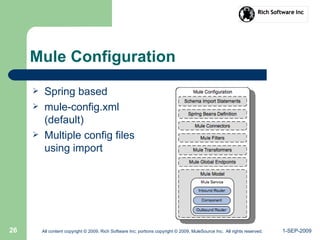
Mule Configuration
 Spring based
 mule-config.xml
(default)
 Multiple config files
using import
1-SEP-2009All content copyright © 2009, Rich Software Inc; portions copyright © 2009, MuleSource Inc. All rights reserved.27
Daily Double
 Name two reasons to use Mule ESB
 Name one thing Mule ESB isn’t
 Name two Mule Components
1-SEP-2009All content copyright © 2009, Rich Software Inc; portions copyright © 2009, MuleSource Inc. All rights reserved.28
Mule Examples (mini-demo)
 Download Mule
– http://www.mulesource.org/display/MULE/Download
 Configure the environment
– MULE_HOME, JAVA_HOME
 echo example
– options 1 & 3, show config
1-SEP-2009All content copyright © 2009, Rich Software Inc; portions copyright © 2009, MuleSource Inc. All rights reserved.29
Mule Deployment
 Standalone
 Embed in servlet container
 JCA 1.5 resource adapter
1-SEP-2009All content copyright © 2009, Rich Software Inc; portions copyright © 2009, MuleSource Inc. All rights reserved.30
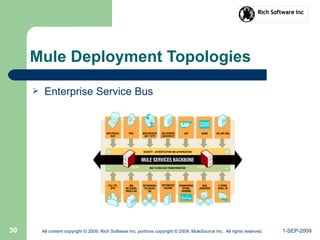
Mule Deployment Topologies
 Enterprise Service Bus
1-SEP-2009All content copyright © 2009, Rich Software Inc; portions copyright © 2009, MuleSource Inc. All rights reserved.31
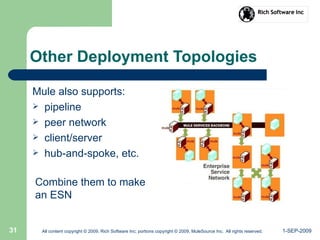
Other Deployment Topologies
Mule also supports:
 pipeline
 peer network
 client/server
 hub-and-spoke, etc.
Combine them to make
an ESN
1-SEP-2009All content copyright © 2009, Rich Software Inc; portions copyright © 2009, MuleSource Inc. All rights reserved.32
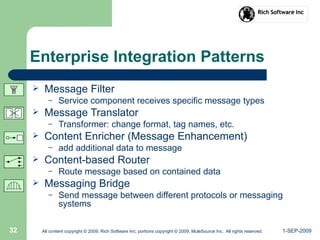
Enterprise Integration Patterns
 Message Filter
– Service component receives specific message types
 Message Translator
– Transformer: change format, tag names, etc.
 Content Enricher (Message Enhancement)
– add additional data to message
 Content-based Router
– Route message based on contained data
 Messaging Bridge
– Send message between different protocols or messaging
systems
1-SEP-2009All content copyright © 2009, Rich Software Inc; portions copyright © 2009, MuleSource Inc. All rights reserved.33
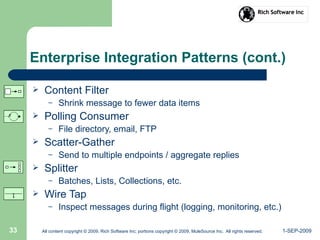
Enterprise Integration Patterns (cont.)
 Content Filter
– Shrink message to fewer data items
 Polling Consumer
– File directory, email, FTP
 Scatter-Gather
– Send to multiple endpoints / aggregate replies
 Splitter
– Batches, Lists, Collections, etc.
 Wire Tap
– Inspect messages during flight (logging, monitoring, etc.)
1-SEP-2009All content copyright © 2009, Rich Software Inc; portions copyright © 2009, MuleSource Inc. All rights reserved.34
Main Demo
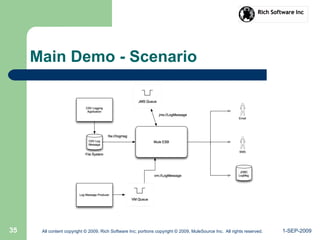
 Set the stage [see diagrams]
– Describe scenario
– Configuration
 Show demo
 Show code
– Transformer(s)
– Service Component(s)
1-SEP-2009All content copyright © 2009, Rich Software Inc; portions copyright © 2009, MuleSource Inc. All rights reserved.35
Main Demo - Scenario
1-SEP-2009All content copyright © 2009, Rich Software Inc; portions copyright © 2009, MuleSource Inc. All rights reserved.36
Other MuleSource Goodies
 MuleForge
– Mule extensions, mostly provided by community
 Mule IDE, modules, tools, transports, etc.
 Mule Galaxy™
– SOA governance platform with an integrated
registry/repository
 Mule ESB Enterprise
– Subscription based support that includes
 Mule HQ™: systems monitoring / management
 Premium connectors (e.g. IBM Websphere MQ)
 Online knowledgebase & support links
1-SEP-2009All content copyright © 2009, Rich Software Inc; portions copyright © 2009, MuleSource Inc. All rights reserved.37
The Bus
“The bus came by and I
got on, that's when it all
began...”
-- "The Other One" by
the Grateful Dead
So, get on the bus!
1-SEP-2009All content copyright © 2009, Rich Software Inc; portions copyright © 2009, MuleSource Inc. All rights reserved.38
Audience Poll
 How many of you…
– learned something about Mule ESB?
– learned something you didn’t know about
integration patterns?
– had a bit of fun?
– will think more about how to be lazy?
1-SEP-2009All content copyright © 2009, Rich Software Inc; portions copyright © 2009, MuleSource Inc. All rights reserved.39
Summary
 Integration Projects
 What Mule ESB is (and isn’t)
 Mule Architecture, Components, Deployment
 Enterprise Integration Patterns
 Easy to implement integration scenarios
 Plan to be lazy :-)
1-SEP-2009All content copyright © 2009, Rich Software Inc; portions copyright © 2009, MuleSource Inc. All rights reserved.40
Double Jeopardy
 Send me a use-case for Mule ESB within your
organization using the contact form on the RSI
website (www.rich-software.com/main/contact)
 Put “Mule ESB use-case” in the subject
 The use-case must be received within 48 hours of
this talk to be eligible for a prize
 I will buy two lucky people a free lunch that includes
up to two hours of free business analysis on your
use-case and/or mentoring on Mule ESB. And, you
will receive one of the Manning books!
1-SEP-2009All content copyright © 2009, Rich Software Inc; portions copyright © 2009, MuleSource Inc. All rights reserved.41
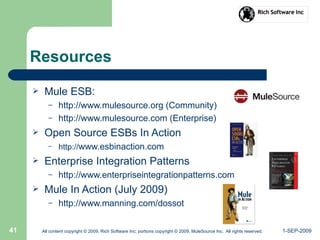
Resources
 Mule ESB:
– http://www.mulesource.org (Community)
– http://www.mulesource.com (Enterprise)
 Open Source ESBs In Action
– http://www.esbinaction.com
 Enterprise Integration Patterns
– http://www.enterpriseintegrationpatterns.com
 Mule In Action (July 2009)
– http://www.manning.com/dossot
1-SEP-2009All content copyright © 2009, Rich Software Inc; portions copyright © 2009, MuleSource Inc. All rights reserved.42
Thank you!
Questions?

Mule Integration Simplified

  • 1.
    Mule ESB® Integration Simplified RichRemington rremington@Rich-Software.com Kiet Bui
  • 2.
    1-SEP-2009All content copyright© 2009, Rich Software Inc; portions copyright © 2009, MuleSource Inc. All rights reserved.2 Topics  Integration, SOA, and ESB  What Mule ESB is (and isn’t)  Mule Architecture & Components  Configuration & Deployment  Enterprise Integration Patterns  Main Demo  Wrap-up & questions
  • 3.
    1-SEP-2009All content copyright© 2009, Rich Software Inc; portions copyright © 2009, MuleSource Inc. All rights reserved.3 Goals  Educate 1..* people about Mule ESB & how to simplify integration projects  Give back to an awesome community  Have a bit of fun  Confirm “laziness” is a good thing! – At least some of the time…  Convince you it’s safe, easy, and fun, to “get on the bus”
  • 4.
    1-SEP-2009All content copyright© 2009, Rich Software Inc; portions copyright © 2009, MuleSource Inc. All rights reserved.4 Background  Who am I? – Mathematician wannabe turned software guy – A bit lazy  The bucket of water story – Moral: don’t work harder than you have to - it’s okay to be lazy ;-)
  • 5.
    1-SEP-2009All content copyright© 2009, Rich Software Inc; portions copyright © 2009, MuleSource Inc. All rights reserved.5  Reduce – Code complexity & bloat  Refactor – Move code to its proper place  Transformation, Routing, Service Component  Reuse – Plan ahead for service/component reuse – Use pre-built components & solutions 3 R’s - Plan to be Lazy :-)
  • 6.
    1-SEP-2009All content copyright© 2009, Rich Software Inc; portions copyright © 2009, MuleSource Inc. All rights reserved.6 Integration Projects  Why we integrate – Users don't care where business functions and information reside – We don't always own or control all the pieces  intranet & external partners – Cheaper than building new solutions from scratch – Users want access to information from various devices - browsers, mobile phone, handhelds, ...
  • 7.
    1-SEP-2009All content copyright© 2009, Rich Software Inc; portions copyright © 2009, MuleSource Inc. All rights reserved.7 Integration Projects  How we integrate – Set up meetings with business domain experts – Identify systems and processes – More meetings… – Map data flows then model  Patterns are extremely helpful – Yet more meetings… – Define services & message formats – Start coding away…  But, then what happens?
  • 8.
    1-SEP-2009All content copyright© 2009, Rich Software Inc; portions copyright © 2009, MuleSource Inc. All rights reserved.8 Integration Projects  Three things in life are certain: – Death – Taxes – Requirements will change often!  Plan for change – Design & build service/object interfaces for reuse – Take advantage of loose coupling – Switch implementations or protocols as needed over time, but not the interface
  • 9.
    1-SEP-2009All content copyright© 2009, Rich Software Inc; portions copyright © 2009, MuleSource Inc. All rights reserved.9 Integration Checklist Service Interfaces Mule Topology Model Event Flows Fault Handling Data Transformations Test Use-cases Service Implementation Endpoint QoS, Security Functional Testing Implementation Identify Processes and Systems Create an Integration Profile Service Identification Map Data Flows Performance Requirements Security Redundancy Requirements QoS Requirements Define Message Formats Planning
  • 10.
    1-SEP-2009All content copyright© 2009, Rich Software Inc; portions copyright © 2009, MuleSource Inc. All rights reserved.10 Integration Approaches/Technologies  Custom, point-to-point solutions – Information silos live on  Service Oriented Architecture (SOA) – Enables loose coupling of services that are OS & programming language independent – Web services (SOAP, REST), RPC, CORBA, etc.  Enterprise Service Bus (ESB) – Helps orchestrate & manage the chaos – Good place to centralize general services – Encourages best practices
  • 11.
    1-SEP-2009All content copyright© 2009, Rich Software Inc; portions copyright © 2009, MuleSource Inc. All rights reserved.11 The Bus “There are going to be times when we can't wait for somebody. Now, you're either on the bus or off the bus. If you're on the bus, and you get left behind, then you'll find it again. If you're off the bus in the first place — then it won't make a damn.” -- The Electric Kool-Aid Acid Test (1968)
  • 12.
    1-SEP-2009All content copyright© 2009, Rich Software Inc; portions copyright © 2009, MuleSource Inc. All rights reserved.12 Daily Double  What are two of the 3 R’s?  What was the moral of the “bucket of water” story?  Name the Integration Approach I’m suggesting you use
  • 13.
    1-SEP-2009All content copyright© 2009, Rich Software Inc; portions copyright © 2009, MuleSource Inc. All rights reserved.13 Audience Poll  How many of you… – Need to integrate – Are using point-to-point integration solutions – Are doing SOA (SOAP, REST, RPC, …) – Not doing SOA, but planning to – Are using an ESB – Not doing ESB, but planning to
  • 14.
    1-SEP-2009All content copyright© 2009, Rich Software Inc; portions copyright © 2009, MuleSource Inc. All rights reserved.14 Why use an ESB  Integration Styles – Batch – File Transfer – Shared Database – Request/Reply – Messaging  Synchronous  Asynchronous  ESB Advantages – Supports all styles – Bridges legacy systems – Modular architecture – Simple and flexible – Easy to test and maintain – Scalable – Can be a step towards SOA
  • 15.
    1-SEP-2009All content copyright© 2009, Rich Software Inc; portions copyright © 2009, MuleSource Inc. All rights reserved.15 8-APR-2009 All content copyright © 2009, Rich Software Inc; portions copyright © 2009, MuleSource Inc. All rights reserved. Why use an ESB (before)
  • 16.
    1-SEP-2009All content copyright© 2009, Rich Software Inc; portions copyright © 2009, MuleSource Inc. All rights reserved.16 8-APR-2009 All content copyright © 2009, Rich Software Inc; portions copyright © 2009, MuleSource Inc. All rights reserved. Why use an ESB (after)
  • 17.
    1-SEP-2009All content copyright© 2009, Rich Software Inc; portions copyright © 2009, MuleSource Inc. All rights reserved.17 What is Mule ESB? “Mule is a lightweight integration platform and service container that allows you to quickly and easily connect your applications together. Mule provides a robust, secure and scalable platform to build enterprise applications offering an array of transports such as JMS, HTTP, Email, FTP, JDBC and many more. It also offers a rich set of features for web services, message routing, mediation, transformation and transaction management. Designed around the ESB (Enterprise Service Bus) concept.” -- www.mulesource.org
  • 18.
    1-SEP-2009All content copyright© 2009, Rich Software Inc; portions copyright © 2009, MuleSource Inc. All rights reserved.18 What is Mule ESB? “Mule is a lightweight integration platform and service container that allows you to quickly and easily connect your applications together. Mule provides a robust, secure and scalable platform to build enterprise applications offering an array of transports such as JMS, HTTP, Email, FTP, JDBC and many more. It also offers a rich set of features for web services, message routing, mediation, transformation and transaction management. Designed around the ESB (Enterprise Service Bus) concept.” -- www.mulesource.org
  • 19.
    1-SEP-2009All content copyright© 2009, Rich Software Inc; portions copyright © 2009, MuleSource Inc. All rights reserved.19 All content copyright © 2009, Rich Software Inc; portions copyright © 2009, MuleSource Inc. All rights reserved. What is Mule ESB? Service creation and hosting • Expose transport end-points, EJBs, Spring beans, and POJOs as modular and reusable services • Host services as a lightweight service container Service mediation • Separate business logic from messaging • Shield service components from message formats and protocols • Enable location-independent service calls Message routing • Route messages based on content and complex rules • Filter, aggregate and re-sequence in-bound messages Data transformation • Exchange data across applications with varying data formats • Transform data as needed, based on need • Format messages across heterogeneous transport protocols
  • 20.
    1-SEP-2009All content copyright© 2009, Rich Software Inc; portions copyright © 2009, MuleSource Inc. All rights reserved.20 All content copyright © 2009, Rich Software Inc; portions copyright © 2009, MuleSource Inc. All rights reserved. Mule: Lightweight and Adaptive Adaptive integration • Standards-based and vendor-neutral • Seamless integration with existing infrastructure • Plug-in architecture allows for building block approach • Use with any application server or standalone Development simplicity • Simplifi ed programming model • Ease of use through confi guration and control • Rapid development and deployment through code reuse Open source advantage • No expensive up-front license commitments • Access to source code allows customization and lowers risk • Vibrant developer community delivering best practices and modules
  • 21.
    1-SEP-2009All content copyright© 2009, Rich Software Inc; portions copyright © 2009, MuleSource Inc. All rights reserved.21 What Mule ESB isn’t  It does not place restrictions on your environment  It is not message queuing, it uses other (JMS capable) products – And, it does not require message queues  It is not complex  It does not need to be “the grand master of all integration endpoints across the enterprise” – Think big, start small – It plays nicely with other ESBs
  • 22.
    1-SEP-2009All content copyright© 2009, Rich Software Inc; portions copyright © 2009, MuleSource Inc. All rights reserved.22 Why use Mule ESB  Decouples Business Logic  Location Transparency  Transport Protocol Conversion  Message Transformation  Message Routing  Message Enhancement  Reliability (Transactions)  Security  Scalability
  • 23.
    1-SEP-2009All content copyright© 2009, Rich Software Inc; portions copyright © 2009, MuleSource Inc. All rights reserved.23 Why choose Mule  No prescribed message format – XML, CSV, Binary, Streams, Record, Java Objects – Mix and match  Zero code intrusion – Mule does not impose an API on service objects – Objects are fully portable  Existing objects can be managed – POJOs, IoC Objects, EJB Session Beans, Remote Objects – REST & Web Services  Easy to test – Mule can be run easily from a JUnit test case – Framework provides a Test compatibility kit – Scales down as well as up
  • 24.
    1-SEP-2009All content copyright© 2009, Rich Software Inc; portions copyright © 2009, MuleSource Inc. All rights reserved.24 Mule ESB Architecture  Architecture is based on concepts discussed in Enterprise Integration Patterns
  • 25.
    1-SEP-2009All content copyright© 2009, Rich Software Inc; portions copyright © 2009, MuleSource Inc. All rights reserved.25 Mule Components  Endpoint – Channel, MessageReceiver, Connector  Transformer – Message transformation / enhancement  Router – Message flow control (inbound/outbound)  Service Component – Your integration logic lives here
  • 26.
    1-SEP-2009All content copyright© 2009, Rich Software Inc; portions copyright © 2009, MuleSource Inc. All rights reserved.26 Mule Configuration  Spring based  mule-config.xml (default)  Multiple config files using import
  • 27.
    1-SEP-2009All content copyright© 2009, Rich Software Inc; portions copyright © 2009, MuleSource Inc. All rights reserved.27 Daily Double  Name two reasons to use Mule ESB  Name one thing Mule ESB isn’t  Name two Mule Components
  • 28.
    1-SEP-2009All content copyright© 2009, Rich Software Inc; portions copyright © 2009, MuleSource Inc. All rights reserved.28 Mule Examples (mini-demo)  Download Mule – http://www.mulesource.org/display/MULE/Download  Configure the environment – MULE_HOME, JAVA_HOME  echo example – options 1 & 3, show config
  • 29.
    1-SEP-2009All content copyright© 2009, Rich Software Inc; portions copyright © 2009, MuleSource Inc. All rights reserved.29 Mule Deployment  Standalone  Embed in servlet container  JCA 1.5 resource adapter
  • 30.
    1-SEP-2009All content copyright© 2009, Rich Software Inc; portions copyright © 2009, MuleSource Inc. All rights reserved.30 Mule Deployment Topologies  Enterprise Service Bus
  • 31.
    1-SEP-2009All content copyright© 2009, Rich Software Inc; portions copyright © 2009, MuleSource Inc. All rights reserved.31 Other Deployment Topologies Mule also supports:  pipeline  peer network  client/server  hub-and-spoke, etc. Combine them to make an ESN
  • 32.
    1-SEP-2009All content copyright© 2009, Rich Software Inc; portions copyright © 2009, MuleSource Inc. All rights reserved.32 Enterprise Integration Patterns  Message Filter – Service component receives specific message types  Message Translator – Transformer: change format, tag names, etc.  Content Enricher (Message Enhancement) – add additional data to message  Content-based Router – Route message based on contained data  Messaging Bridge – Send message between different protocols or messaging systems
  • 33.
    1-SEP-2009All content copyright© 2009, Rich Software Inc; portions copyright © 2009, MuleSource Inc. All rights reserved.33 Enterprise Integration Patterns (cont.)  Content Filter – Shrink message to fewer data items  Polling Consumer – File directory, email, FTP  Scatter-Gather – Send to multiple endpoints / aggregate replies  Splitter – Batches, Lists, Collections, etc.  Wire Tap – Inspect messages during flight (logging, monitoring, etc.)
  • 34.
    1-SEP-2009All content copyright© 2009, Rich Software Inc; portions copyright © 2009, MuleSource Inc. All rights reserved.34 Main Demo  Set the stage [see diagrams] – Describe scenario – Configuration  Show demo  Show code – Transformer(s) – Service Component(s)
  • 35.
    1-SEP-2009All content copyright© 2009, Rich Software Inc; portions copyright © 2009, MuleSource Inc. All rights reserved.35 Main Demo - Scenario
  • 36.
    1-SEP-2009All content copyright© 2009, Rich Software Inc; portions copyright © 2009, MuleSource Inc. All rights reserved.36 Other MuleSource Goodies  MuleForge – Mule extensions, mostly provided by community  Mule IDE, modules, tools, transports, etc.  Mule Galaxy™ – SOA governance platform with an integrated registry/repository  Mule ESB Enterprise – Subscription based support that includes  Mule HQ™: systems monitoring / management  Premium connectors (e.g. IBM Websphere MQ)  Online knowledgebase & support links
  • 37.
    1-SEP-2009All content copyright© 2009, Rich Software Inc; portions copyright © 2009, MuleSource Inc. All rights reserved.37 The Bus “The bus came by and I got on, that's when it all began...” -- "The Other One" by the Grateful Dead So, get on the bus!
  • 38.
    1-SEP-2009All content copyright© 2009, Rich Software Inc; portions copyright © 2009, MuleSource Inc. All rights reserved.38 Audience Poll  How many of you… – learned something about Mule ESB? – learned something you didn’t know about integration patterns? – had a bit of fun? – will think more about how to be lazy?
  • 39.
    1-SEP-2009All content copyright© 2009, Rich Software Inc; portions copyright © 2009, MuleSource Inc. All rights reserved.39 Summary  Integration Projects  What Mule ESB is (and isn’t)  Mule Architecture, Components, Deployment  Enterprise Integration Patterns  Easy to implement integration scenarios  Plan to be lazy :-)
  • 40.
    1-SEP-2009All content copyright© 2009, Rich Software Inc; portions copyright © 2009, MuleSource Inc. All rights reserved.40 Double Jeopardy  Send me a use-case for Mule ESB within your organization using the contact form on the RSI website (www.rich-software.com/main/contact)  Put “Mule ESB use-case” in the subject  The use-case must be received within 48 hours of this talk to be eligible for a prize  I will buy two lucky people a free lunch that includes up to two hours of free business analysis on your use-case and/or mentoring on Mule ESB. And, you will receive one of the Manning books!
  • 41.
    1-SEP-2009All content copyright© 2009, Rich Software Inc; portions copyright © 2009, MuleSource Inc. All rights reserved.41 Resources  Mule ESB: – http://www.mulesource.org (Community) – http://www.mulesource.com (Enterprise)  Open Source ESBs In Action – http://www.esbinaction.com  Enterprise Integration Patterns – http://www.enterpriseintegrationpatterns.com  Mule In Action (July 2009) – http://www.manning.com/dossot
  • 42.
    1-SEP-2009All content copyright© 2009, Rich Software Inc; portions copyright © 2009, MuleSource Inc. All rights reserved.42 Thank you! Questions?