29 February 2020
Meetup# 01
All contents © MuleSoft Inc.
• A group for the community, by the community.
• A environment to learn and share your
integration experiences with peers.
• Discuss a set of important topics related to
MuleSoft Anypoint Platform.
What’s all about?
All contents © MuleSoft Inc.
• Welcome and Introductions
• Session 1: Introduction to Integration and MuleSoft
• Quiz Time
• Tea Break
• Session 2: Deep Dive into Anypoint Platform
• Quiz Time
• Open House Session
• Event Wrap-up
Agenda
All contents © MuleSoft Inc.
Pradhan Yash Sharma
• Active open-source contributor
• Leading MuleSoft Meetup Indore Chapter
• Leading Google Developers Group Indore
• Working in YASH Technologies as Senior Developer
• Java Enthusiast member of Java Community Process at Open-JDK
Introductions
All contents © MuleSoft Inc.
Kirti Gurjar
• Certified MuleSoft Developer
• Speaker in MuleSoft Meetup Indore Chapter
• Working in YASH Technologies as Sr. MuleSoft Developer
Introductions
Introduction to Integration and MuleSoft®
Session 1
Pradhan Yash Sharma
“Connect anything.
Change everything.”
All contents © MuleSoft Inc.
Integration is the act of bringing together different components into a
single system that functions as one.
What is Integration?
All contents © MuleSoft Inc.
Need Of Integration
All contents © MuleSoft Inc.
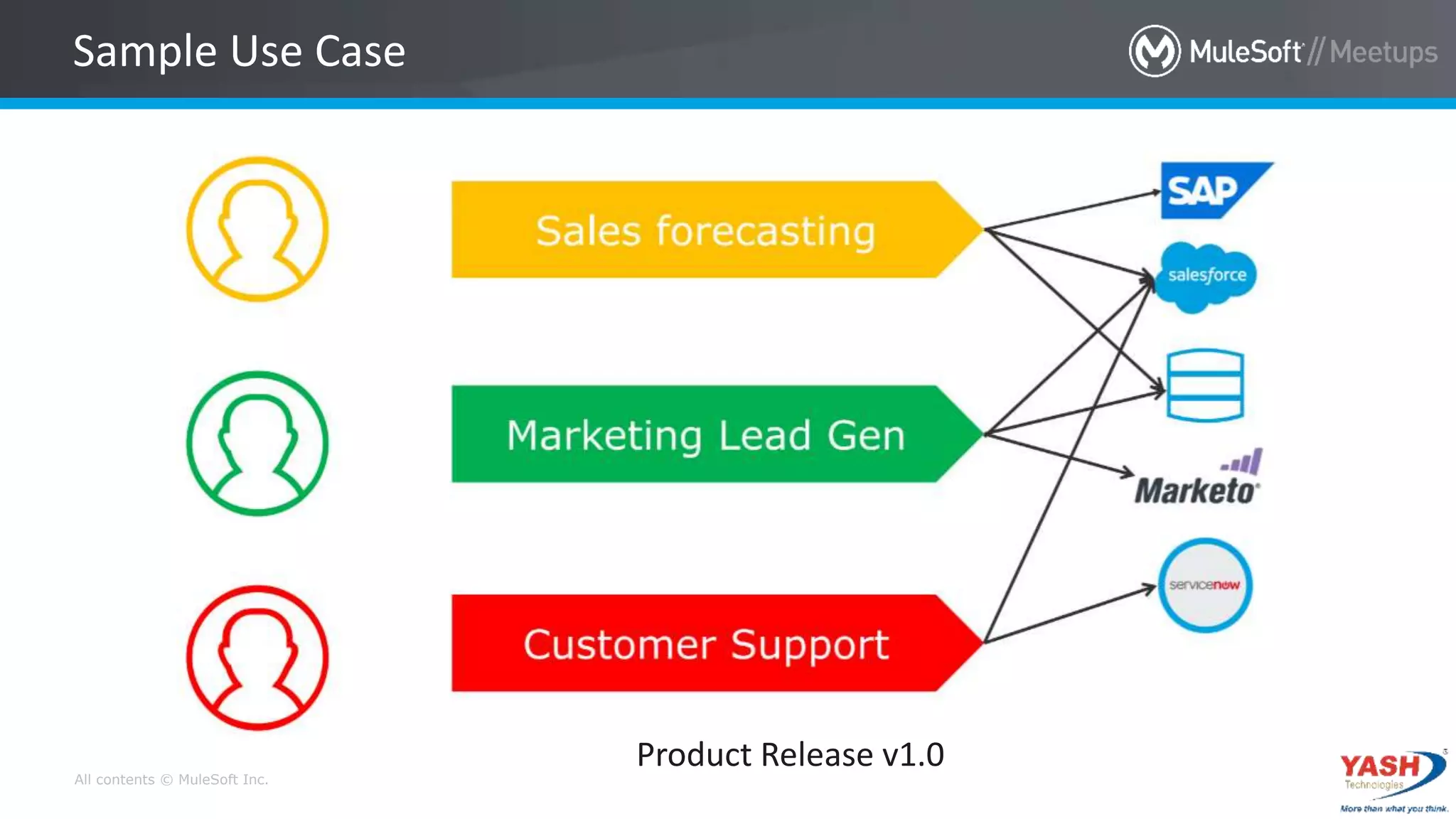
Sample Use Case
Product Release v1.0
All contents © MuleSoft Inc.
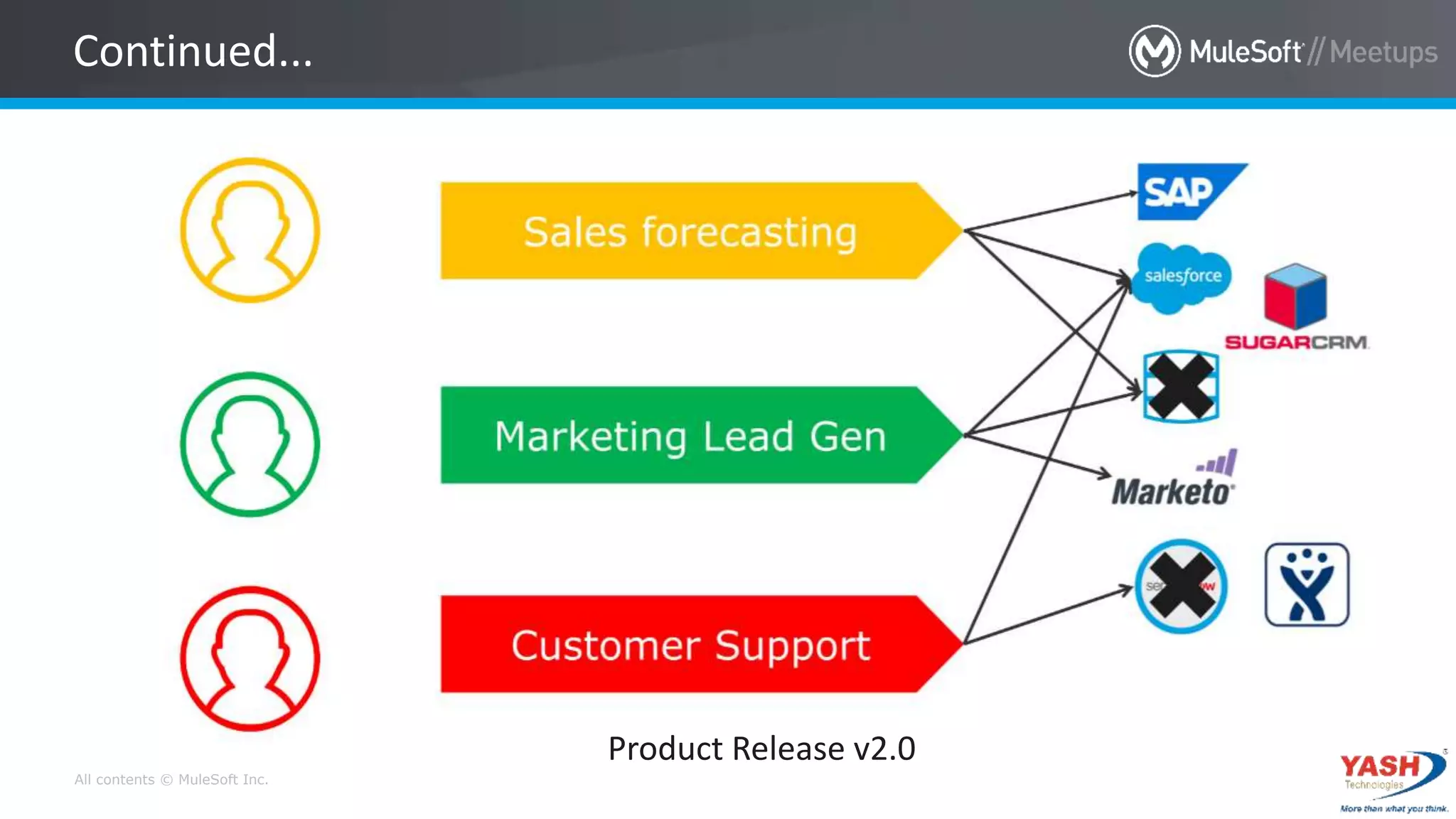
Continued...
Product Release v2.0
All contents © MuleSoft Inc.
Organizations now looks like this
All contents © MuleSoft Inc.
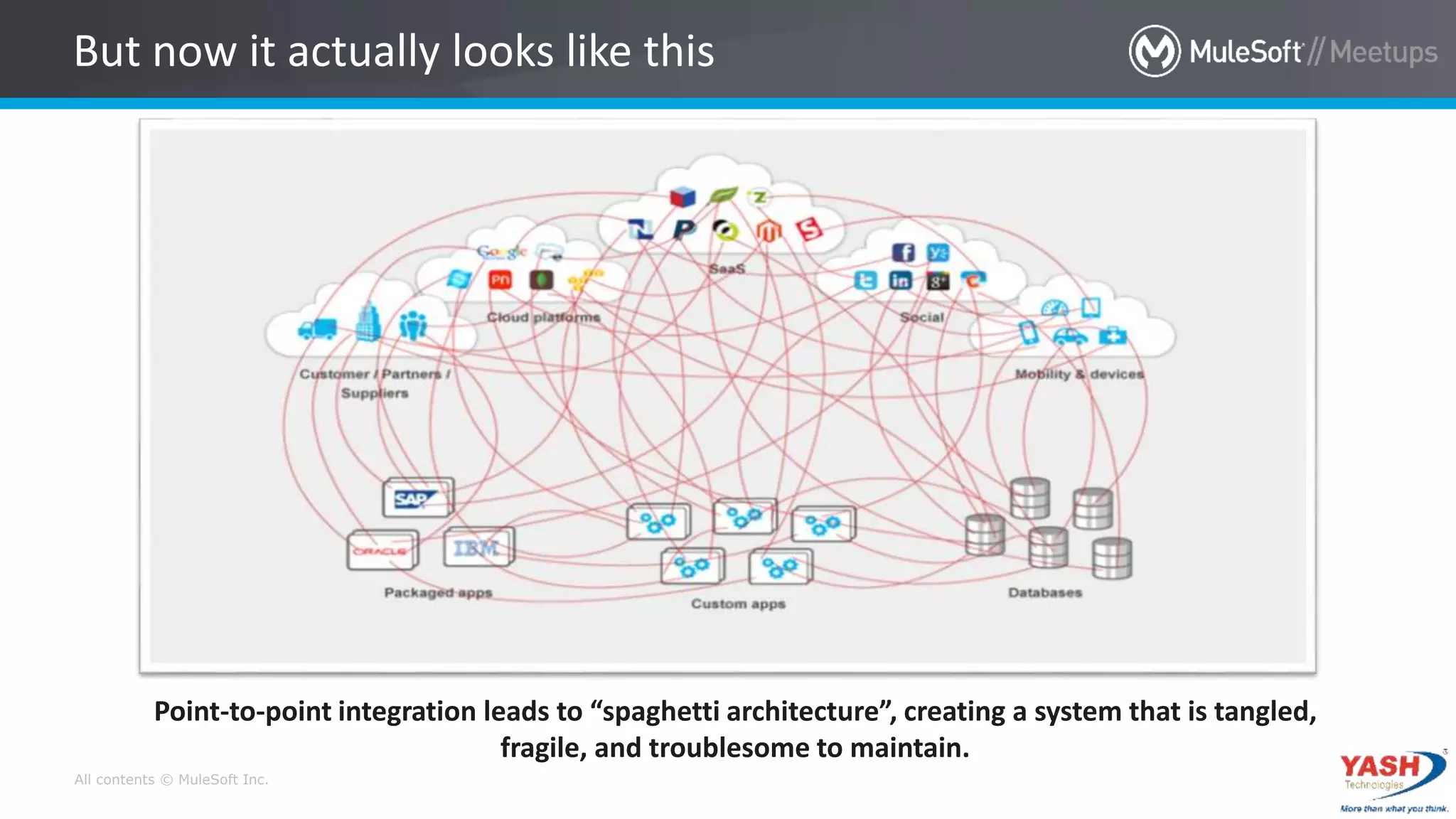
But now it actually looks like this
Point-to-point integration leads to “spaghetti architecture”, creating a system that is tangled,
fragile, and troublesome to maintain.
All contents © MuleSoft Inc.
Pain Points
All contents © MuleSoft Inc.
MuleSoft exists to solve this problem
All contents © MuleSoft Inc.
To connect the world’s applications, data and
devices to transform business
MuleSoft Mission
All contents © MuleSoft Inc.
What is MuleSoft?
Mule, the runtime engine of Anypoint Platform, is a lightweight
Java-based ESB and Integration platform that allows developers to
connect heterogeneous applications together quickly and easily,
enabling them to exchange data.
It enables easy integration of existing systems, regardless of the
different technologies that the applications use, including JMS,
Web Services, JDBC, HTTP, and more.
The ESB can be deployed anywhere, can integrate and
orchestrate events in real time or in batch, and has universal
connectivity.
All contents © MuleSoft Inc.
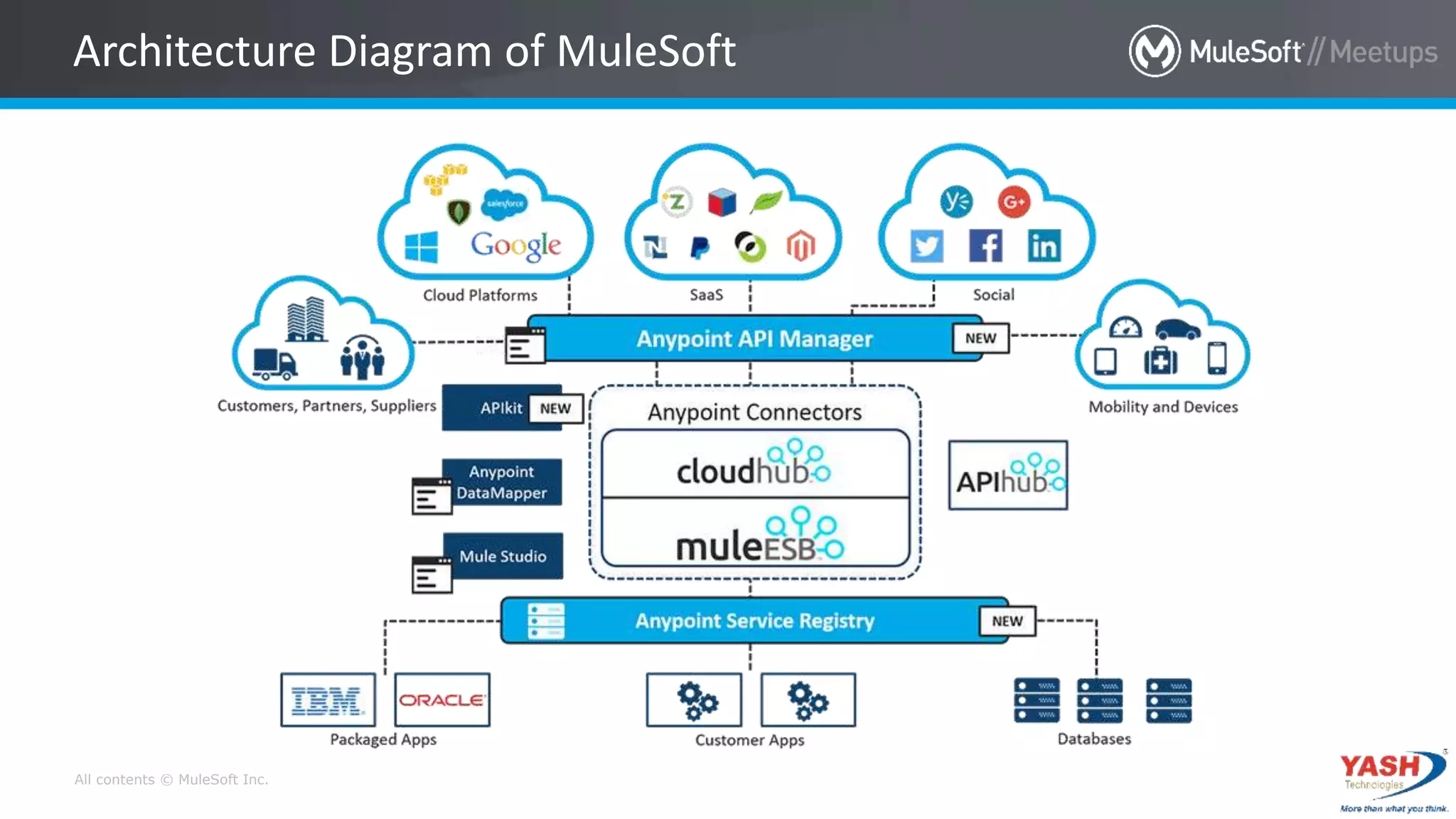
Components of MuleSoft
With Anypoint Connectors and
customizable Integration Apps, the
CloudHub makes it easy for businesses
to offer repeatable integrations quickly
and without complex code both on-
premises or on the cloud.
Studio: Expedite developer productivity by
drawing upon the graphical design
environment of Anypoint Studio for all you
MuleSoft platform needs - build, edit, and
integrate quickly and easily.
DataWeave: Integrate data easily with DataWeave
graphical data mapping and transformation.
Management: Manage ESB resources, including services,
endpoints, and servers, with visibility and flexibility.
Security: Protect the entire enterprise from unwanted
attacks, loss of data integrity, and unwarranted access.
ESB: Mule ESB serves as a middleware
technology to deliver a lightweight, open
source integration solution to connect systems
and services, on-premises and in the cloud.
All contents © MuleSoft Inc.
Architecture Diagram of MuleSoft
All contents © MuleSoft Inc.
Mule exists to solve this problem
All contents © MuleSoft Inc.
Value of API
APIs are the tools that allow businesses to put that data to use.
Businesses are discovering valuable new uses for previously isolated
data sources.
As a growing number of consumers and businesses incorporate web
and mobile apps into their daily routines.
Inspiring innovative developers to create new business opportunities
and improve existing products, systems, and operations.
All contents © MuleSoft Inc.
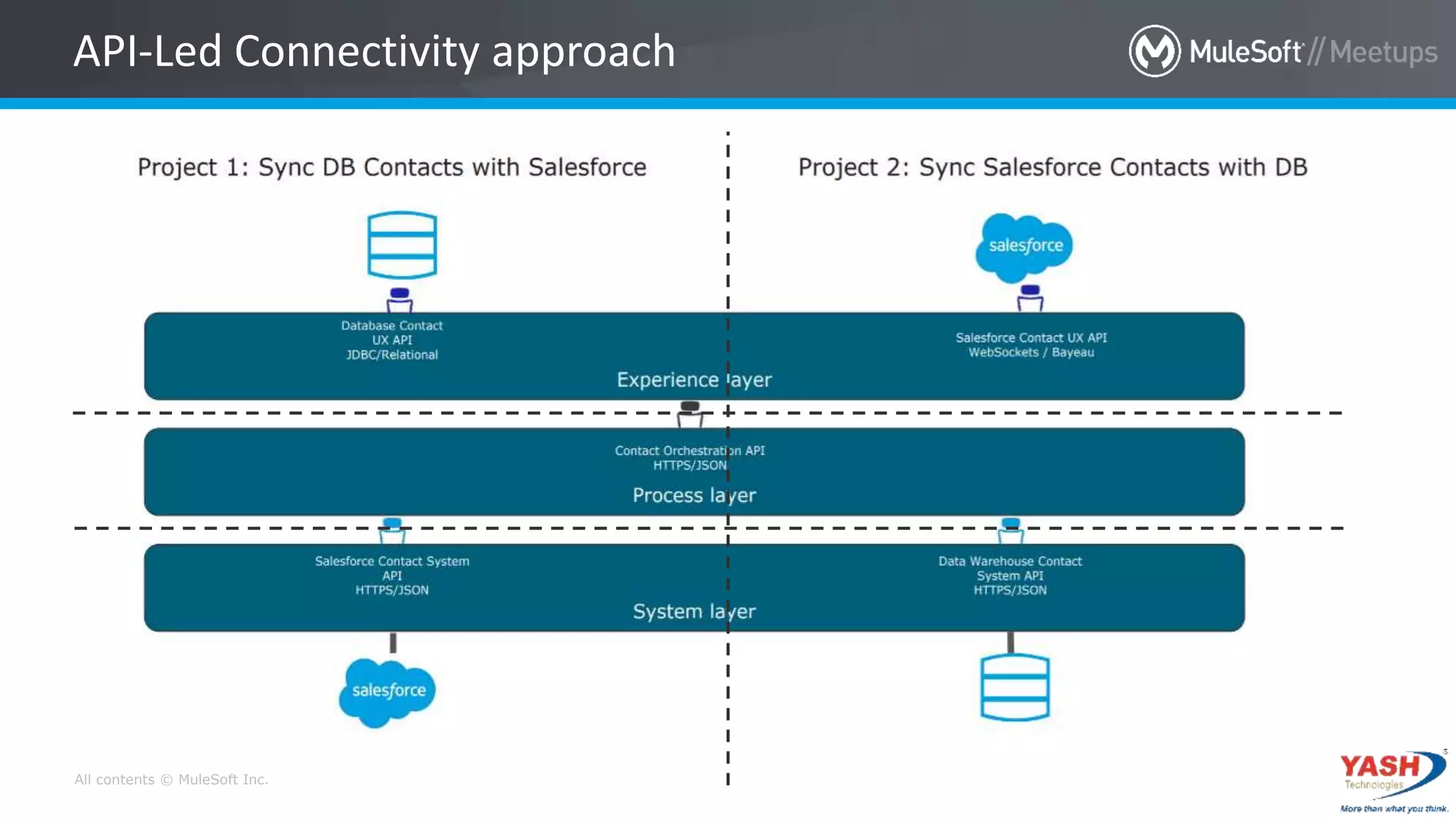
API-Led Connectivity approach
All contents © MuleSoft Inc.
Product Release v1.0
All contents © MuleSoft Inc.
Product Release v2.0
All contents © MuleSoft Inc.
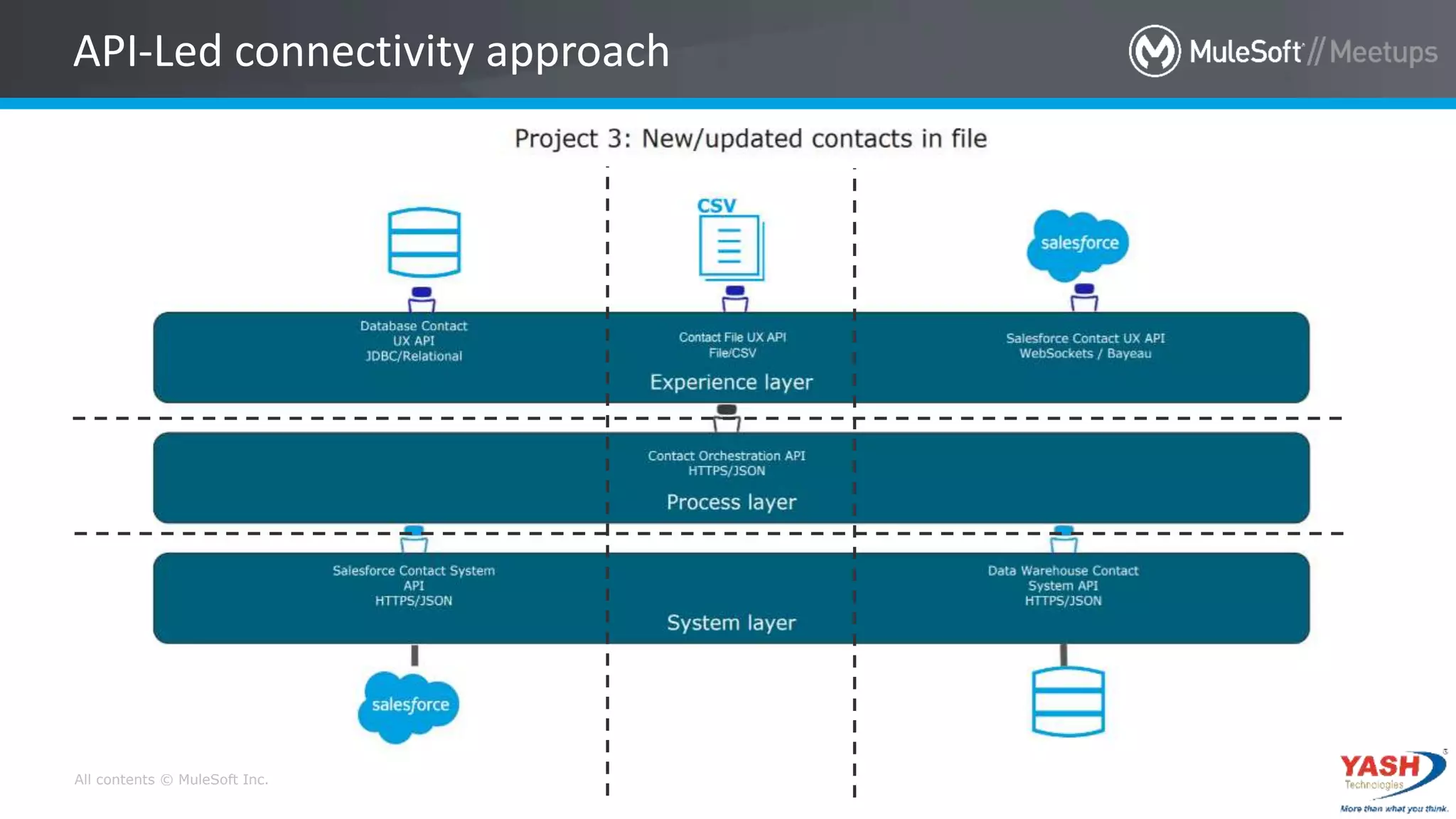
API-Led connectivity approach
All contents © MuleSoft Inc.
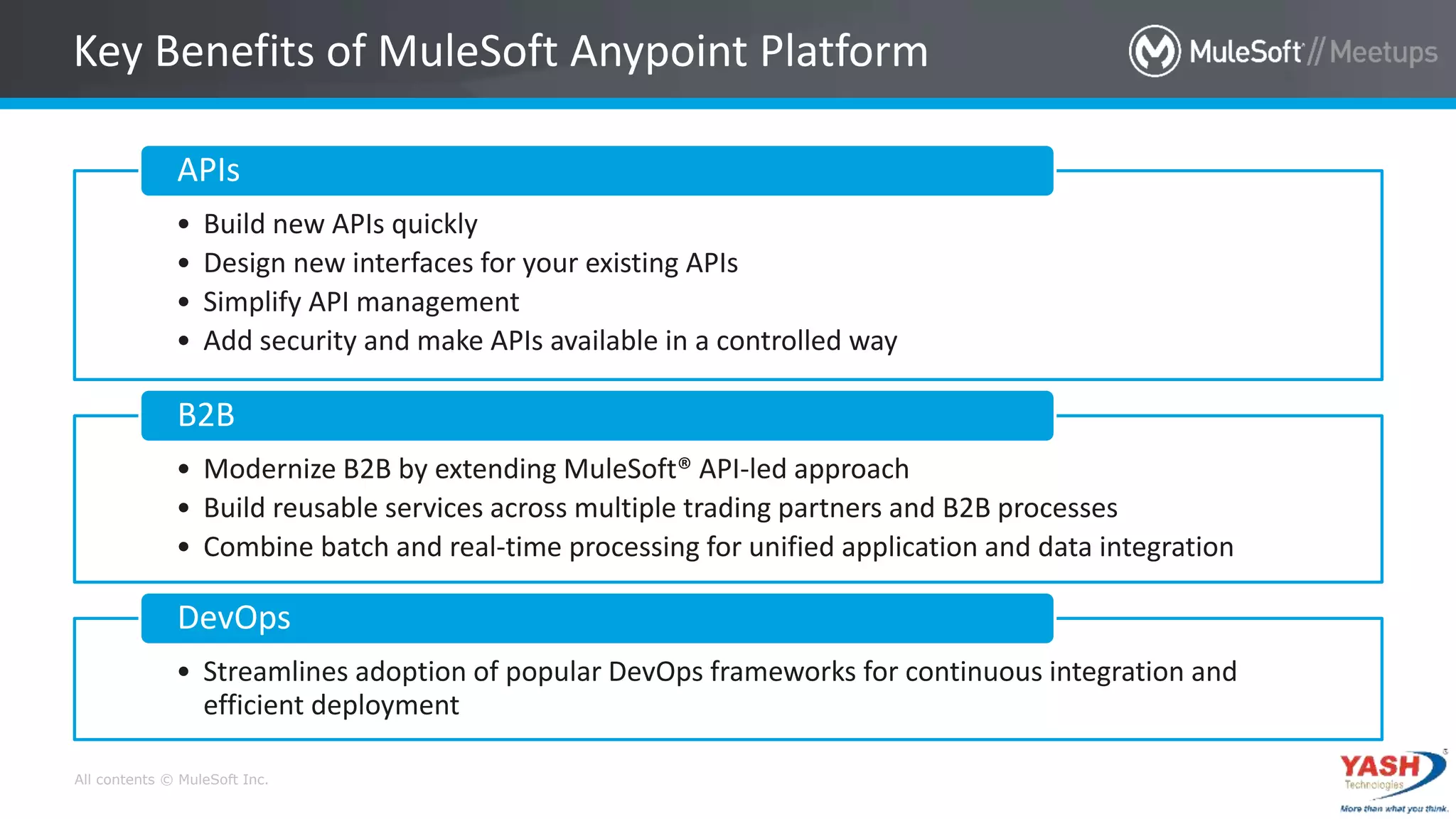
Key Benefits of MuleSoft Anypoint Platform
• Build new APIs quickly
• Design new interfaces for your existing APIs
• Simplify API management
• Add security and make APIs available in a controlled way
APIs
• Modernize B2B by extending MuleSoft® API-led approach
• Build reusable services across multiple trading partners and B2B processes
• Combine batch and real-time processing for unified application and data integration
B2B
• Streamlines adoption of popular DevOps frameworks for continuous integration and
efficient deployment
DevOps
All contents © MuleSoft Inc.
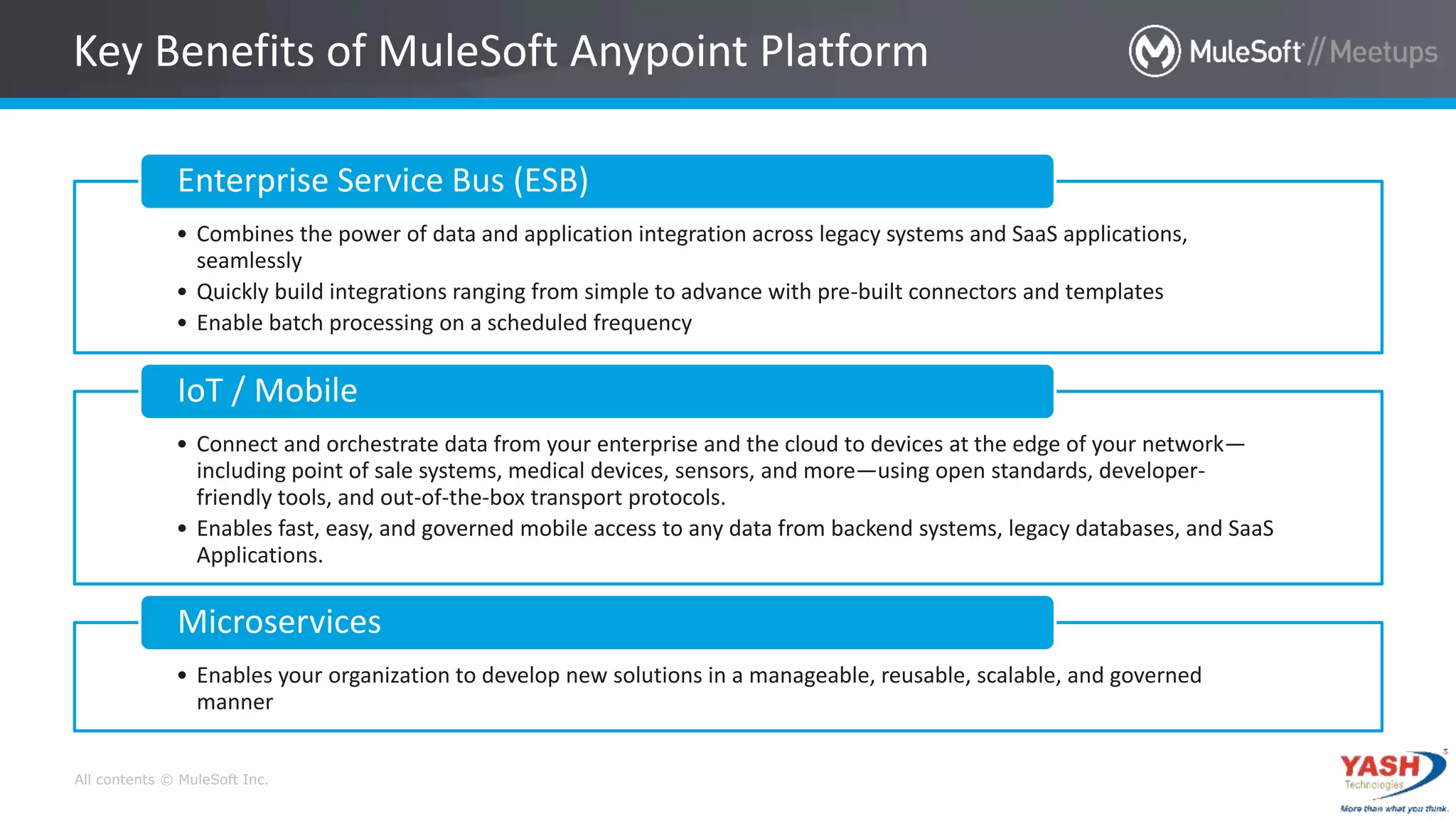
Key Benefits of MuleSoft Anypoint Platform
• Combines the power of data and application integration across legacy systems and SaaS applications,
seamlessly
• Quickly build integrations ranging from simple to advance with pre-built connectors and templates
• Enable batch processing on a scheduled frequency
Enterprise Service Bus (ESB)
• Connect and orchestrate data from your enterprise and the cloud to devices at the edge of your network—
including point of sale systems, medical devices, sensors, and more—using open standards, developer-
friendly tools, and out-of-the-box transport protocols.
• Enables fast, easy, and governed mobile access to any data from backend systems, legacy databases, and SaaS
Applications.
IoT / Mobile
• Enables your organization to develop new solutions in a manageable, reusable, scalable, and governed
manner
Microservices
Quiz Time
Tea Break
Introduce yourself to your neighbors!
Deep dive into MuleSoft® Anypoint Platform
Session 2
Kirti
All contents © MuleSoft Inc.
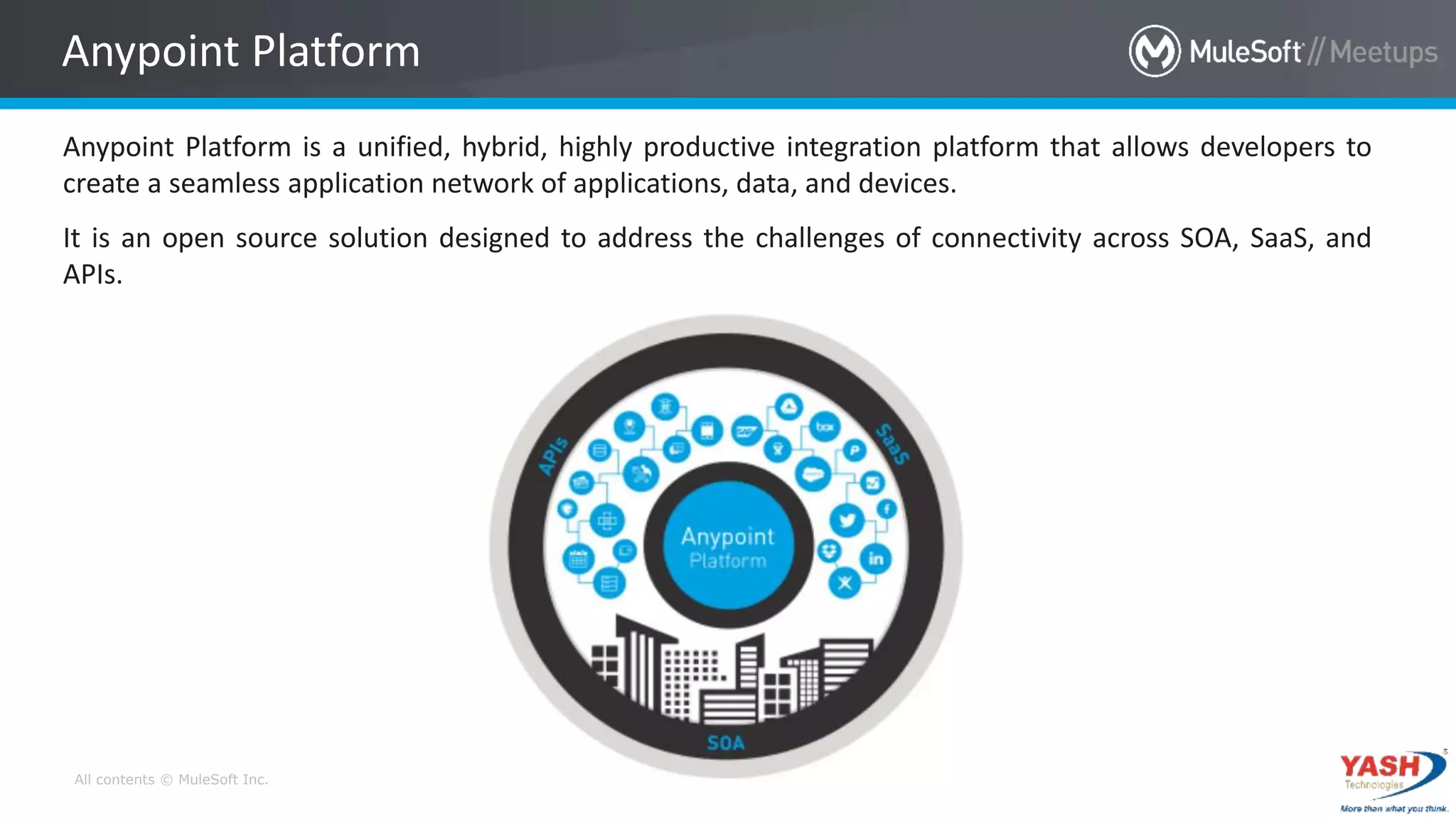
Anypoint Platform is a unified, hybrid, highly productive integration platform that allows developers to
create a seamless application network of applications, data, and devices.
It is an open source solution designed to address the challenges of connectivity across SOA, SaaS, and
APIs.
Anypoint Platform
All contents © MuleSoft Inc.
Continued..
Anypoint Platform provides us the runtime, tool, framework and library (central repository) for our APIs
and applications.
• Runtime to run and deploy our applications on cloud or on-premise.
• Tools and framework for creating an API and building simpler Mule Applications (for complex
applications, Anypoint Studio is recommended).
• Library to store our assets (APIs and applications) where we can view and test them, and it
can be reused by other developers in the organization.
All contents © MuleSoft Inc.
MuleSoft® Component Architecture
All contents © MuleSoft Inc.
Design Center
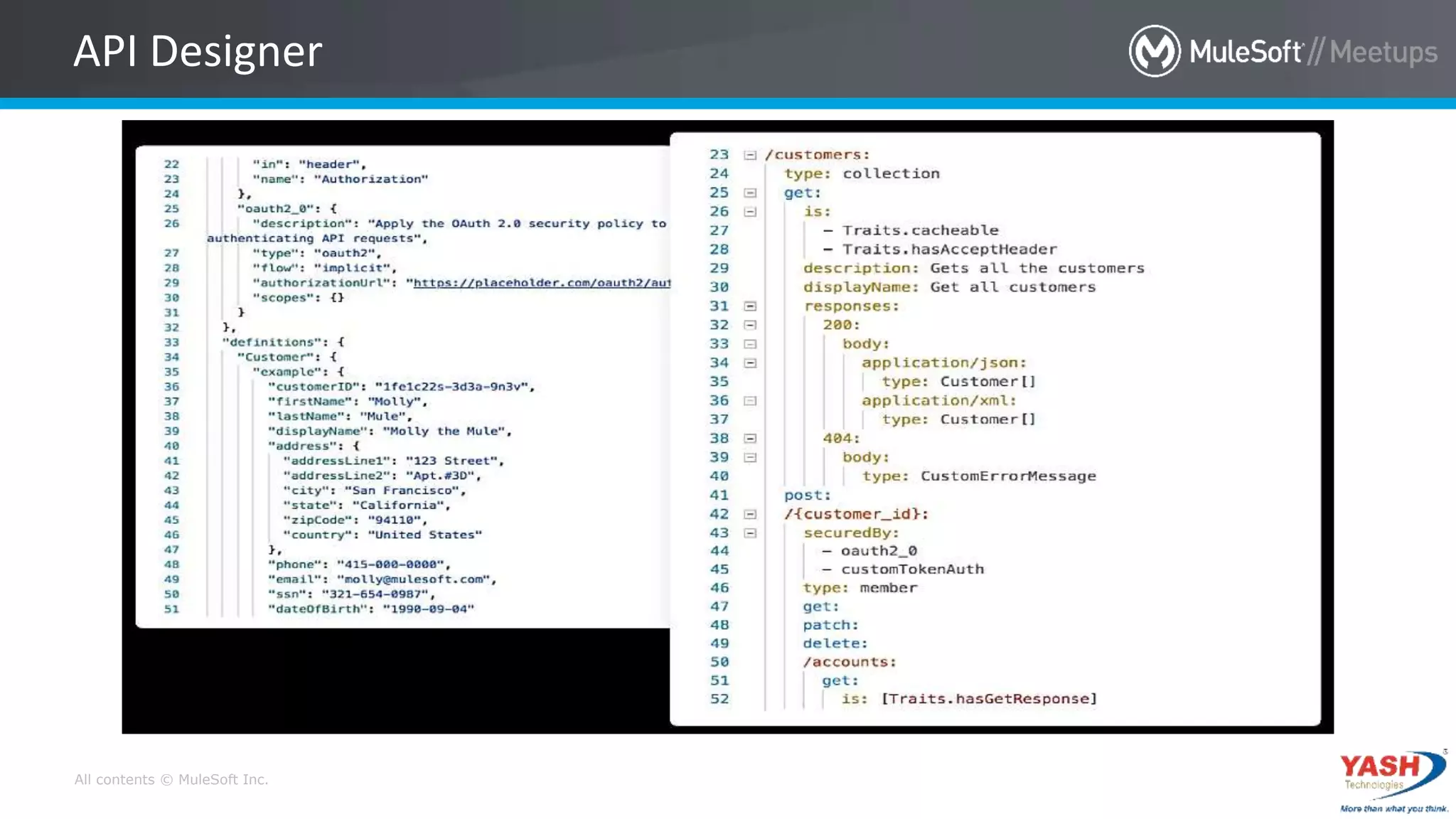
Anypoint Design Center is a development environment that consists of two tools:
• API Designer: In API Designer, you can create API specifications in RESTful API Modeling Language
(RAML) 0.8 or 1.0, or according to OpenAPI specification (OAS) 2.0.
• Flow Designer: In Flow Designer, you create Mule applications to integrate systems into workflows.
All contents © MuleSoft Inc.
API Designer
All contents © MuleSoft Inc.
Flow Designer
All contents © MuleSoft Inc.
Anypoint Exchange
Anypoint Exchange provides us the benefit of being able to share, discover, and incorporate assets and resources into
our Integration or Application. It helps to:
• Create API developer portals
• View and test our APIs
• Simulate data to API, also called as Mocking Service
• Create assets
We can connect to Anypoint Exchange through Anypoint Studio and download and install connector examples or APIs
and use them per our needs.
All contents © MuleSoft Inc.
API Manager
API Manager is a component of Anypoint Platform for designing, building, managing, and publishing APIs. It helps us
to apply different policies like: Rate Limiting, Throttling, Proxy etc. on APIs.
An API Manager can also keep track of an API throughout its lifecycle through the Auto Discovery Scheme. We just
need to configure the Auto Discovery tag of our API with its Mule Application in the studio and deploy it.
The lifecycle of an API involves setup and deployment, management, and engaging users on an API Portal. To perform
these tasks, you might need to obtain permissions and roles from the Anypoint Platform administrator for your
organization.
All contents © MuleSoft Inc.
Runtime Manager
Cloudhub Hybrid
Runtime Manager allows us to run, deploy, and manage our deployed applications from a central location, whether
they are running in CloudHub or on-premise or on the Runtime fabric.
All contents © MuleSoft Inc.
Continued..
Private Cloud Edition
All contents © MuleSoft Inc.
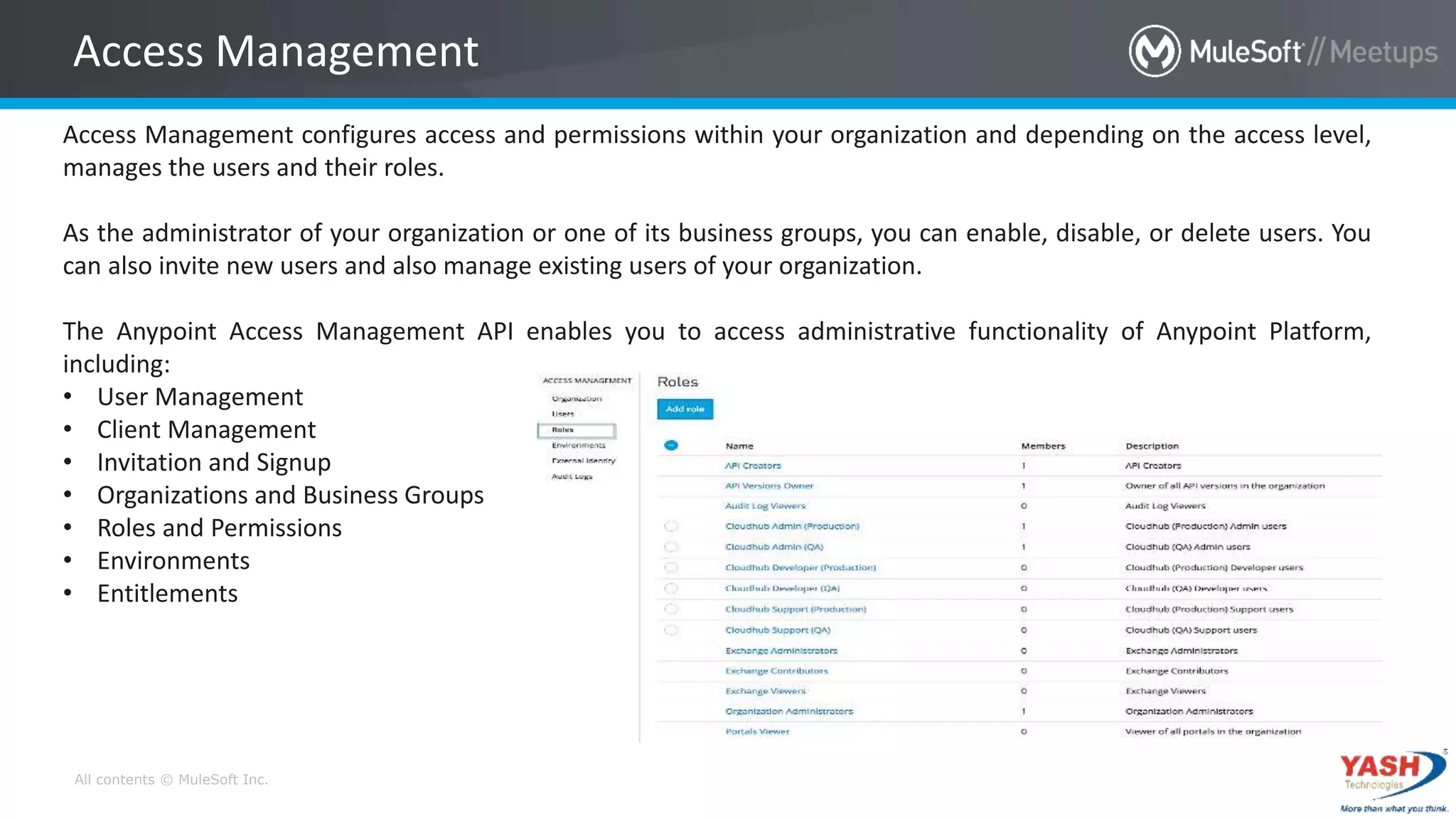
Access Management
Access Management configures access and permissions within your organization and depending on the access level,
manages the users and their roles.
As the administrator of your organization or one of its business groups, you can enable, disable, or delete users. You
can also invite new users and also manage existing users of your organization.
The Anypoint Access Management API enables you to access administrative functionality of Anypoint Platform,
including:
• User Management
• Client Management
• Invitation and Signup
• Organizations and Business Groups
• Roles and Permissions
• Environments
• Entitlements
All contents © MuleSoft Inc.
Anypoint Visualizer
Anypoint Visualizer displays views of different aspects of application network graph. It provides a real-
time graphical representation of the APIs and the Mule applications that are running and discoverable.
It collects the data from the APIs, Mule applications, and proxies deployed to CloudHub or standalone
mule runtime engine to discover all incoming and outgoing connections through an embedded plugin.
All contents © MuleSoft Inc.
Anypoint Monitoring
Understanding the state of your infrastructure is very important for ensuring the reliability and stability of your
services.
Therefore, Anypoint Monitoring provides visibility into integration across your Application Network graph. It provides
feedback from the Mule flows and components in your application network graph.
All contents © MuleSoft Inc.
Secret Manager
Secret Manager uses secure vault technology to store and control access to private keys, passwords, certificates, and
other secrets.
Use Secret Manager to write, read, manage your secret, keys, Transport Layer security Certificate (TLS), and many
other documents.
Lets see how our first “Hello World” application can be built using
Anypoint Studio IDE
Anypoint Studio IDE Demo
Questions?
Quiz Time
Thank You!
See you next time!
Please send your feedback/suggestions at mulesoftindore@gmail.com

Mulesoft Indore meetup #1

  • 1.
  • 2.
    All contents ©MuleSoft Inc. • A group for the community, by the community. • A environment to learn and share your integration experiences with peers. • Discuss a set of important topics related to MuleSoft Anypoint Platform. What’s all about?
  • 3.
    All contents ©MuleSoft Inc. • Welcome and Introductions • Session 1: Introduction to Integration and MuleSoft • Quiz Time • Tea Break • Session 2: Deep Dive into Anypoint Platform • Quiz Time • Open House Session • Event Wrap-up Agenda
  • 4.
    All contents ©MuleSoft Inc. Pradhan Yash Sharma • Active open-source contributor • Leading MuleSoft Meetup Indore Chapter • Leading Google Developers Group Indore • Working in YASH Technologies as Senior Developer • Java Enthusiast member of Java Community Process at Open-JDK Introductions
  • 5.
    All contents ©MuleSoft Inc. Kirti Gurjar • Certified MuleSoft Developer • Speaker in MuleSoft Meetup Indore Chapter • Working in YASH Technologies as Sr. MuleSoft Developer Introductions
  • 6.
    Introduction to Integrationand MuleSoft® Session 1 Pradhan Yash Sharma
  • 7.
  • 8.
    All contents ©MuleSoft Inc. Integration is the act of bringing together different components into a single system that functions as one. What is Integration?
  • 9.
    All contents ©MuleSoft Inc. Need Of Integration
  • 10.
    All contents ©MuleSoft Inc. Sample Use Case Product Release v1.0
  • 11.
    All contents ©MuleSoft Inc. Continued... Product Release v2.0
  • 12.
    All contents ©MuleSoft Inc. Organizations now looks like this
  • 13.
    All contents ©MuleSoft Inc. But now it actually looks like this Point-to-point integration leads to “spaghetti architecture”, creating a system that is tangled, fragile, and troublesome to maintain.
  • 14.
    All contents ©MuleSoft Inc.
  • 15.
    All contents ©MuleSoft Inc. Pain Points
  • 16.
    All contents ©MuleSoft Inc. MuleSoft exists to solve this problem
  • 17.
    All contents ©MuleSoft Inc. To connect the world’s applications, data and devices to transform business MuleSoft Mission
  • 18.
    All contents ©MuleSoft Inc. What is MuleSoft? Mule, the runtime engine of Anypoint Platform, is a lightweight Java-based ESB and Integration platform that allows developers to connect heterogeneous applications together quickly and easily, enabling them to exchange data. It enables easy integration of existing systems, regardless of the different technologies that the applications use, including JMS, Web Services, JDBC, HTTP, and more. The ESB can be deployed anywhere, can integrate and orchestrate events in real time or in batch, and has universal connectivity.
  • 19.
    All contents ©MuleSoft Inc. Components of MuleSoft With Anypoint Connectors and customizable Integration Apps, the CloudHub makes it easy for businesses to offer repeatable integrations quickly and without complex code both on- premises or on the cloud. Studio: Expedite developer productivity by drawing upon the graphical design environment of Anypoint Studio for all you MuleSoft platform needs - build, edit, and integrate quickly and easily. DataWeave: Integrate data easily with DataWeave graphical data mapping and transformation. Management: Manage ESB resources, including services, endpoints, and servers, with visibility and flexibility. Security: Protect the entire enterprise from unwanted attacks, loss of data integrity, and unwarranted access. ESB: Mule ESB serves as a middleware technology to deliver a lightweight, open source integration solution to connect systems and services, on-premises and in the cloud.
  • 20.
    All contents ©MuleSoft Inc. Architecture Diagram of MuleSoft
  • 21.
    All contents ©MuleSoft Inc. Mule exists to solve this problem
  • 22.
    All contents ©MuleSoft Inc. Value of API APIs are the tools that allow businesses to put that data to use. Businesses are discovering valuable new uses for previously isolated data sources. As a growing number of consumers and businesses incorporate web and mobile apps into their daily routines. Inspiring innovative developers to create new business opportunities and improve existing products, systems, and operations.
  • 23.
    All contents ©MuleSoft Inc. API-Led Connectivity approach
  • 24.
    All contents ©MuleSoft Inc. Product Release v1.0
  • 25.
    All contents ©MuleSoft Inc. Product Release v2.0
  • 26.
    All contents ©MuleSoft Inc. API-Led connectivity approach
  • 27.
    All contents ©MuleSoft Inc. Key Benefits of MuleSoft Anypoint Platform • Build new APIs quickly • Design new interfaces for your existing APIs • Simplify API management • Add security and make APIs available in a controlled way APIs • Modernize B2B by extending MuleSoft® API-led approach • Build reusable services across multiple trading partners and B2B processes • Combine batch and real-time processing for unified application and data integration B2B • Streamlines adoption of popular DevOps frameworks for continuous integration and efficient deployment DevOps
  • 28.
    All contents ©MuleSoft Inc. Key Benefits of MuleSoft Anypoint Platform • Combines the power of data and application integration across legacy systems and SaaS applications, seamlessly • Quickly build integrations ranging from simple to advance with pre-built connectors and templates • Enable batch processing on a scheduled frequency Enterprise Service Bus (ESB) • Connect and orchestrate data from your enterprise and the cloud to devices at the edge of your network— including point of sale systems, medical devices, sensors, and more—using open standards, developer- friendly tools, and out-of-the-box transport protocols. • Enables fast, easy, and governed mobile access to any data from backend systems, legacy databases, and SaaS Applications. IoT / Mobile • Enables your organization to develop new solutions in a manageable, reusable, scalable, and governed manner Microservices
  • 29.
  • 30.
    Tea Break Introduce yourselfto your neighbors!
  • 31.
    Deep dive intoMuleSoft® Anypoint Platform Session 2 Kirti
  • 32.
    All contents ©MuleSoft Inc. Anypoint Platform is a unified, hybrid, highly productive integration platform that allows developers to create a seamless application network of applications, data, and devices. It is an open source solution designed to address the challenges of connectivity across SOA, SaaS, and APIs. Anypoint Platform
  • 33.
    All contents ©MuleSoft Inc. Continued.. Anypoint Platform provides us the runtime, tool, framework and library (central repository) for our APIs and applications. • Runtime to run and deploy our applications on cloud or on-premise. • Tools and framework for creating an API and building simpler Mule Applications (for complex applications, Anypoint Studio is recommended). • Library to store our assets (APIs and applications) where we can view and test them, and it can be reused by other developers in the organization.
  • 34.
    All contents ©MuleSoft Inc. MuleSoft® Component Architecture
  • 35.
    All contents ©MuleSoft Inc. Design Center Anypoint Design Center is a development environment that consists of two tools: • API Designer: In API Designer, you can create API specifications in RESTful API Modeling Language (RAML) 0.8 or 1.0, or according to OpenAPI specification (OAS) 2.0. • Flow Designer: In Flow Designer, you create Mule applications to integrate systems into workflows.
  • 36.
    All contents ©MuleSoft Inc. API Designer
  • 37.
    All contents ©MuleSoft Inc. Flow Designer
  • 38.
    All contents ©MuleSoft Inc. Anypoint Exchange Anypoint Exchange provides us the benefit of being able to share, discover, and incorporate assets and resources into our Integration or Application. It helps to: • Create API developer portals • View and test our APIs • Simulate data to API, also called as Mocking Service • Create assets We can connect to Anypoint Exchange through Anypoint Studio and download and install connector examples or APIs and use them per our needs.
  • 39.
    All contents ©MuleSoft Inc. API Manager API Manager is a component of Anypoint Platform for designing, building, managing, and publishing APIs. It helps us to apply different policies like: Rate Limiting, Throttling, Proxy etc. on APIs. An API Manager can also keep track of an API throughout its lifecycle through the Auto Discovery Scheme. We just need to configure the Auto Discovery tag of our API with its Mule Application in the studio and deploy it. The lifecycle of an API involves setup and deployment, management, and engaging users on an API Portal. To perform these tasks, you might need to obtain permissions and roles from the Anypoint Platform administrator for your organization.
  • 40.
    All contents ©MuleSoft Inc. Runtime Manager Cloudhub Hybrid Runtime Manager allows us to run, deploy, and manage our deployed applications from a central location, whether they are running in CloudHub or on-premise or on the Runtime fabric.
  • 41.
    All contents ©MuleSoft Inc. Continued.. Private Cloud Edition
  • 42.
    All contents ©MuleSoft Inc. Access Management Access Management configures access and permissions within your organization and depending on the access level, manages the users and their roles. As the administrator of your organization or one of its business groups, you can enable, disable, or delete users. You can also invite new users and also manage existing users of your organization. The Anypoint Access Management API enables you to access administrative functionality of Anypoint Platform, including: • User Management • Client Management • Invitation and Signup • Organizations and Business Groups • Roles and Permissions • Environments • Entitlements
  • 43.
    All contents ©MuleSoft Inc. Anypoint Visualizer Anypoint Visualizer displays views of different aspects of application network graph. It provides a real- time graphical representation of the APIs and the Mule applications that are running and discoverable. It collects the data from the APIs, Mule applications, and proxies deployed to CloudHub or standalone mule runtime engine to discover all incoming and outgoing connections through an embedded plugin.
  • 44.
    All contents ©MuleSoft Inc. Anypoint Monitoring Understanding the state of your infrastructure is very important for ensuring the reliability and stability of your services. Therefore, Anypoint Monitoring provides visibility into integration across your Application Network graph. It provides feedback from the Mule flows and components in your application network graph.
  • 45.
    All contents ©MuleSoft Inc. Secret Manager Secret Manager uses secure vault technology to store and control access to private keys, passwords, certificates, and other secrets. Use Secret Manager to write, read, manage your secret, keys, Transport Layer security Certificate (TLS), and many other documents.
  • 46.
    Lets see howour first “Hello World” application can be built using Anypoint Studio IDE Anypoint Studio IDE Demo
  • 47.
  • 48.
  • 49.
  • 50.
    See you nexttime! Please send your feedback/suggestions at mulesoftindore@gmail.com

Editor's Notes

  • #25 Our organization plans to integrate with Salesforce for customer relationship management with our application so our current application has our customer data and now salesforce will do that for us but data will be maintained on both the systems. So my developer mind sees 7 functions to push data from our system to salesforce and then reverse function to push from salesforce to our database, the task seems to look simple and for a good developer its a piece of cake to write 14 functions, a couple of classes, with test cases. And we all are happy after 3 days when it's all tested and done.
  • #26 After a few days, business development team want the same data in CSV format again the developer works on it with a two days time frame and completes the task. I can see a lot of boilerplate code and a huge mess here. Let us see all this from a business perspective.