
- S R I K A N T H N
Mule ESB Tutorial Part 1
6/11/2015Srikanth N
What is ESB ?
 An enterprise service bus (ESB) is a software architecture model used for
designing and implementing communication between mutually interacting
software applications in a service-oriented architecture (SOA).
 Key Characteristics of an ESB :
1. Streamlines development
2. Supports multiple binding strategies
3. Performs data transformation
4. Intelligent routing
5. Real time monitoring
6. Exception handling
7. Service security
6/11/2015Srikanth N
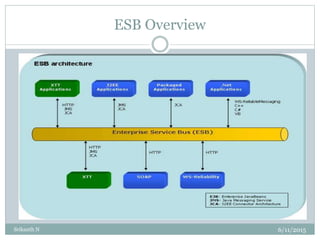
ESB Overview
6/11/2015Srikanth N
What is Mule ESB ?
 Mule ESB is a lightweight Java-based enterprise service bus (ESB) and integration platform
that allows developers to connect applications together quickly and easily, enabling them to
exchange data.
 Mule ESB is an Open Source and best out of all rest of open source ESB’s since It has provided
many key components and not vendor dependency.
 The key advantage are :
1. Service creation and hosting
2. Service mediation
3. Message routing
4. Data transformation
6/11/2015Srikanth N
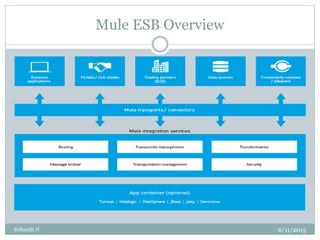
Mule ESB Overview
6/11/2015Srikanth N
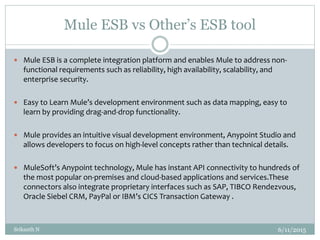
Mule ESB vs Other’s ESB tool
 Mule ESB is a complete integration platform and enables Mule to address non-
functional requirements such as reliability, high availability, scalability, and
enterprise security.
 Easy to Learn Mule’s development environment such as data mapping, easy to
learn by providing drag-and-drop functionality.
 Mule provides an intuitive visual development environment, Anypoint Studio and
allows developers to focus on high-level concepts rather than technical details.
 MuleSoft’s Anypoint technology, Mule has instant API connectivity to hundreds of
the most popular on-premises and cloud-based applications and services.These
connectors also integrate proprietary interfaces such as SAP, TIBCO Rendezvous,
Oracle Siebel CRM, PayPal or IBM’s CICS Transaction Gateway .
6/11/2015Srikanth N
Let’s Start exposure on Mule devlopment
 Mule Concepts:
a. Flows
b. Message Sources
c. Message Processer
6/11/2015Srikanth N
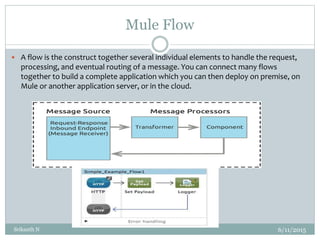
Mule Flow
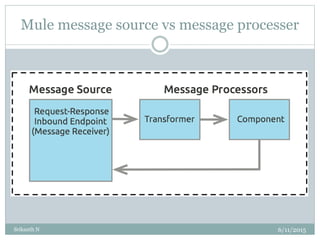
 A flow is the construct together several individual elements to handle the request,
processing, and eventual routing of a message. You can connect many flows
together to build a complete application which you can then deploy on premise, on
Mule or another application server, or in the cloud.
6/11/2015Srikanth N
Mule message source vs message processer
6/11/2015Srikanth N
Chapter 1 End
 Any Questions?
6/11/2015Srikanth N
Mule Flow Control
6/11/2015Srikanth N
Mule Error Handling
6/11/2015Srikanth N

Mule ESB Tutorial Part 1

  • 1.
    - S RI K A N T H N Mule ESB Tutorial Part 1 6/11/2015Srikanth N
  • 2.
    What is ESB?  An enterprise service bus (ESB) is a software architecture model used for designing and implementing communication between mutually interacting software applications in a service-oriented architecture (SOA).  Key Characteristics of an ESB : 1. Streamlines development 2. Supports multiple binding strategies 3. Performs data transformation 4. Intelligent routing 5. Real time monitoring 6. Exception handling 7. Service security 6/11/2015Srikanth N
  • 3.
  • 4.
    What is MuleESB ?  Mule ESB is a lightweight Java-based enterprise service bus (ESB) and integration platform that allows developers to connect applications together quickly and easily, enabling them to exchange data.  Mule ESB is an Open Source and best out of all rest of open source ESB’s since It has provided many key components and not vendor dependency.  The key advantage are : 1. Service creation and hosting 2. Service mediation 3. Message routing 4. Data transformation 6/11/2015Srikanth N
  • 5.
  • 6.
    Mule ESB vsOther’s ESB tool  Mule ESB is a complete integration platform and enables Mule to address non- functional requirements such as reliability, high availability, scalability, and enterprise security.  Easy to Learn Mule’s development environment such as data mapping, easy to learn by providing drag-and-drop functionality.  Mule provides an intuitive visual development environment, Anypoint Studio and allows developers to focus on high-level concepts rather than technical details.  MuleSoft’s Anypoint technology, Mule has instant API connectivity to hundreds of the most popular on-premises and cloud-based applications and services.These connectors also integrate proprietary interfaces such as SAP, TIBCO Rendezvous, Oracle Siebel CRM, PayPal or IBM’s CICS Transaction Gateway . 6/11/2015Srikanth N
  • 7.
    Let’s Start exposureon Mule devlopment  Mule Concepts: a. Flows b. Message Sources c. Message Processer 6/11/2015Srikanth N
  • 8.
    Mule Flow  Aflow is the construct together several individual elements to handle the request, processing, and eventual routing of a message. You can connect many flows together to build a complete application which you can then deploy on premise, on Mule or another application server, or in the cloud. 6/11/2015Srikanth N
  • 9.
    Mule message sourcevs message processer 6/11/2015Srikanth N
  • 10.
    Chapter 1 End Any Questions? 6/11/2015Srikanth N
  • 11.
  • 12.