

By
Arun Yaligar
Contents
• Introduction
• Products
• What is Mule?
• Advantages
• Applications integrate with Mule
• Architecture
• Example on Mule
Introduction
• MuleSoft was founded in 2006 by Ross Mason and Dave
Rosenberg.
• It provides integration software for connecting applications, data
sources and APIs, in the cloud or on-premises.
• Anypoint Platform of integration products are designed to tie
together software as a service (SaaS) and on-premises software
• The company originally provided middleware and messaging, and
later expanded to provide a integration platform as a
service(iPaaS) approach for companies.
Products:
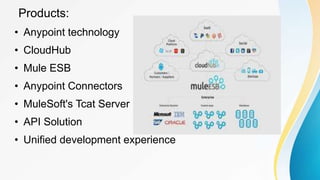
• Anypoint technology
• CloudHub
• Mule ESB
• Anypoint Connectors
• MuleSoft's Tcat Server
• API Solution
• Unified development experience
What is Mule ESB?
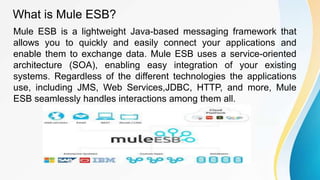
Mule ESB is a lightweight Java-based messaging framework that
allows you to quickly and easily connect your applications and
enable them to exchange data. Mule ESB uses a service-oriented
architecture (SOA), enabling easy integration of your existing
systems. Regardless of the different technologies the applications
use, including JMS, Web Services,JDBC, HTTP, and more, Mule
ESB seamlessly handles interactions among them all.
Advantages of MuleESB
• Mule ESB components can be any type you want. You
can easily integrate anything from a “plain old Java
object” (POJO) to a component from another framework.
• Mule ESB and the ESB model enable significant
component reuse.
• Messages can be in any format from SOAP to binary
image files.
• You can deploy Mule ESB in a variety of topologies, not
just ESB.
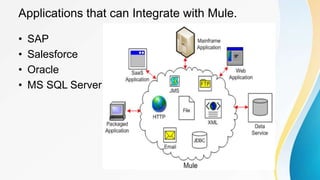
Applications that can Integrate with Mule.
• SAP
• Salesforce
• Oracle
• MS SQL Server
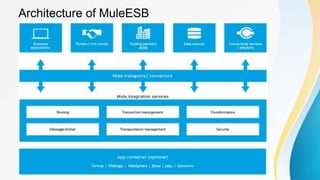
Architecture of MuleESB
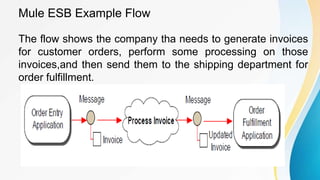
Mule ESB Example Flow
The flow shows the company tha needs to generate invoices
for customer orders, perform some processing on those
invoices,and then send them to the shipping department for
order fulfillment.
Mule soft Basics

Mule soft Basics

  • 1.
  • 2.
    Contents • Introduction • Products •What is Mule? • Advantages • Applications integrate with Mule • Architecture • Example on Mule
  • 3.
    Introduction • MuleSoft wasfounded in 2006 by Ross Mason and Dave Rosenberg. • It provides integration software for connecting applications, data sources and APIs, in the cloud or on-premises. • Anypoint Platform of integration products are designed to tie together software as a service (SaaS) and on-premises software • The company originally provided middleware and messaging, and later expanded to provide a integration platform as a service(iPaaS) approach for companies.
  • 4.
    Products: • Anypoint technology •CloudHub • Mule ESB • Anypoint Connectors • MuleSoft's Tcat Server • API Solution • Unified development experience
  • 5.
    What is MuleESB? Mule ESB is a lightweight Java-based messaging framework that allows you to quickly and easily connect your applications and enable them to exchange data. Mule ESB uses a service-oriented architecture (SOA), enabling easy integration of your existing systems. Regardless of the different technologies the applications use, including JMS, Web Services,JDBC, HTTP, and more, Mule ESB seamlessly handles interactions among them all.
  • 6.
    Advantages of MuleESB •Mule ESB components can be any type you want. You can easily integrate anything from a “plain old Java object” (POJO) to a component from another framework. • Mule ESB and the ESB model enable significant component reuse. • Messages can be in any format from SOAP to binary image files. • You can deploy Mule ESB in a variety of topologies, not just ESB.
  • 7.
    Applications that canIntegrate with Mule. • SAP • Salesforce • Oracle • MS SQL Server
  • 8.
  • 9.
    Mule ESB ExampleFlow The flow shows the company tha needs to generate invoices for customer orders, perform some processing on those invoices,and then send them to the shipping department for order fulfillment.