 Middleware systems are comprised of abstractions
and services to facilitate the design, development,
integration and deployment of distributed
applications in heterogeneous networking environments.
◦ remote communication mechanisms (Web services,
CORBA, Java RMI, DCOM - i.e. request brokers)
◦ event notification and messaging services (COSS
Notifications, Java Messaging Service etc.)
◦ transaction services
◦ naming services (COSS Naming, LDAP)
◦ …
 The following constitute middleware systems or
middleware platforms
◦ CORBA, DCE, RMI, J2EE (?), Web Services, DCOM,
COM+, .Net Remoting, application servers, …
◦ some of these are collections and aggregations of many
different services
◦ some are marketing terms
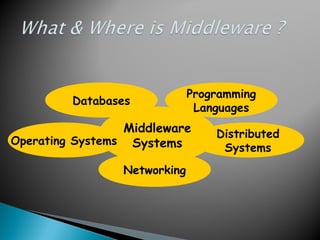
Distributed
Systems
Middleware
Systems
Programming
Languages
Databases
Operating Systems
Networking
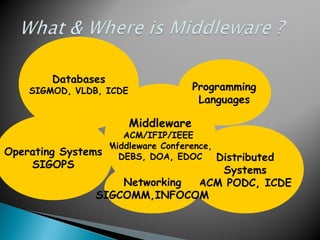
Distributed
Systems
ACM PODC, ICDE
Middleware
ACM/IFIP/IEEE
Middleware Conference,
DEBS, DOA, EDOC
Programming
Languages
Databases
SIGMOD, VLDB, ICDE
Operating Systems
SIGOPS
Networking
SIGCOMM,INFOCOM
 dispersed among different fields
 with different research methodologies
 different standards, points of views, and approaches
 a Middleware research community is starting to crystallize
around conferences such as Middleware, DEBS, DOA, EDOC
et al.
◦ Many other conferences have middleware tracks
 many existing fields/communities are broadening their scope
 “middleware” is still somewhat a trendy or marketing term, but
I think it is crystallizing into a separate field - middleware
systems.
 in the long term we are trying to identify concepts and build a
body of knowledge that identifies middleware systems - much
like OS - PL - DS ...
 In a nutshell:
◦ Middleware is about supporting the
development of distributed applications in
networked environments
 This also includes the integration of systems
 About making this task easier, more efficient, less
error prone
 About enabling the infrastructure software for this
task
 software technologies to help manage complexity and
heterogeneity inherent to the development of distributed
systems, distributed applications, and information
systems
 layer of software above the operating system and the
network substrate, but below the application
 Higher-level programming abstraction for developing the
distributed application
 higher than “lower” level abstractions, such as sockets
provided by the operating system
◦ a socket is a communication end-point from which data can be read
or onto which data can be written
 aims at reducing the burden of developing distributed
application for developer
 informally called “plumbing”, i.e., like pipes that connect
entities for communication
 often called “glue code”, i.e., it glues independent systems
together and makes them work together
 it masks the heterogeneity programmers of distributed
applications have to deal with
◦ network & hardware
◦ operating system & programming language
◦ different middleware platforms
◦ location, access, failure, concurrency, mobility, ...
 often also referred to as transparencies, i.e., network
transparency, location transparency
 an operating system is “the software that makes the
hardware usable”
 similarly, a middleware system makes the distributed
system programmable and manageable
 bare computer without OS could be programmed, so
could the distributed application be developed without
middleware
 programs could be written in assembly, but higher-level
languages are far more productive for this purpose
 however, sometimes the assembly-variant is chosen -
WHY?
 What are the right programming abstractions for
middleware systems?
 What protocols do these abstractions require to work as
promised?
 What, if any, of the underlying systems (networks,
hardware, distribution) should be exposed to the
application developer?
◦ Views range from
 full distribution transparency to
 full control and visibility of underlying system to
 fewer hybrid approaches achieving both
◦ With each having vast implications on the programming
abstractions offered
 Very relevant and wide industry exposure
 Subject to market forces and market trends
 Subject to marketing jargon
 Dominated by standards and de facto standards
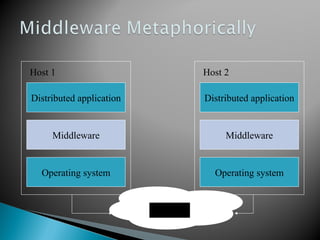
Distributed application
Middleware
Operating system
Network
Host 1
Distributed application
Middleware
Operating system
Host 2
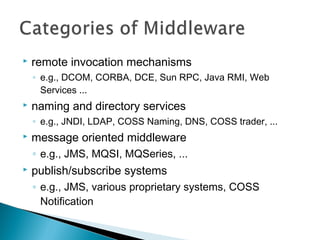
 remote invocation mechanisms
◦ e.g., DCOM, CORBA, DCE, Sun RPC, Java RMI, Web
Services ...
 naming and directory services
◦ e.g., JNDI, LDAP, COSS Naming, DNS, COSS trader, ...
 message oriented middleware
◦ e.g., JMS, MQSI, MQSeries, ...
 publish/subscribe systems
◦ e.g., JMS, various proprietary systems, COSS
Notification
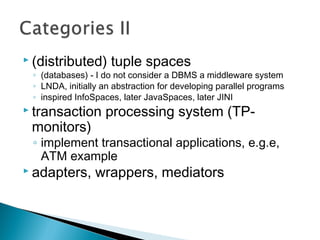
 (distributed) tuple spaces
◦ (databases) - I do not consider a DBMS a middleware system
◦ LNDA, initially an abstraction for developing parallel programs
◦ inspired InfoSpaces, later JavaSpaces, later JINI
 transaction processing system (TP-
monitors)
◦ implement transactional applications, e.g.e,
ATM example
 adapters, wrappers, mediators
 choreography and orchestration
◦ Workflow and business process tools (BPEL et
al.)
◦ a.k.a. Web service composition
 fault tolerance, load balancing, etc.
 real-time, embedded, high-performance,
safety critical

Middleware systems overview and introduction

  • 3.
     Middleware systemsare comprised of abstractions and services to facilitate the design, development, integration and deployment of distributed applications in heterogeneous networking environments. ◦ remote communication mechanisms (Web services, CORBA, Java RMI, DCOM - i.e. request brokers) ◦ event notification and messaging services (COSS Notifications, Java Messaging Service etc.) ◦ transaction services ◦ naming services (COSS Naming, LDAP) ◦ …
  • 4.
     The followingconstitute middleware systems or middleware platforms ◦ CORBA, DCE, RMI, J2EE (?), Web Services, DCOM, COM+, .Net Remoting, application servers, … ◦ some of these are collections and aggregations of many different services ◦ some are marketing terms
  • 5.
  • 6.
    Distributed Systems ACM PODC, ICDE Middleware ACM/IFIP/IEEE MiddlewareConference, DEBS, DOA, EDOC Programming Languages Databases SIGMOD, VLDB, ICDE Operating Systems SIGOPS Networking SIGCOMM,INFOCOM
  • 7.
     dispersed amongdifferent fields  with different research methodologies  different standards, points of views, and approaches  a Middleware research community is starting to crystallize around conferences such as Middleware, DEBS, DOA, EDOC et al. ◦ Many other conferences have middleware tracks  many existing fields/communities are broadening their scope  “middleware” is still somewhat a trendy or marketing term, but I think it is crystallizing into a separate field - middleware systems.  in the long term we are trying to identify concepts and build a body of knowledge that identifies middleware systems - much like OS - PL - DS ...
  • 8.
     In anutshell: ◦ Middleware is about supporting the development of distributed applications in networked environments  This also includes the integration of systems  About making this task easier, more efficient, less error prone  About enabling the infrastructure software for this task
  • 9.
     software technologiesto help manage complexity and heterogeneity inherent to the development of distributed systems, distributed applications, and information systems  layer of software above the operating system and the network substrate, but below the application  Higher-level programming abstraction for developing the distributed application  higher than “lower” level abstractions, such as sockets provided by the operating system ◦ a socket is a communication end-point from which data can be read or onto which data can be written
  • 10.
     aims atreducing the burden of developing distributed application for developer  informally called “plumbing”, i.e., like pipes that connect entities for communication  often called “glue code”, i.e., it glues independent systems together and makes them work together  it masks the heterogeneity programmers of distributed applications have to deal with ◦ network & hardware ◦ operating system & programming language ◦ different middleware platforms ◦ location, access, failure, concurrency, mobility, ...  often also referred to as transparencies, i.e., network transparency, location transparency
  • 11.
     an operatingsystem is “the software that makes the hardware usable”  similarly, a middleware system makes the distributed system programmable and manageable  bare computer without OS could be programmed, so could the distributed application be developed without middleware  programs could be written in assembly, but higher-level languages are far more productive for this purpose  however, sometimes the assembly-variant is chosen - WHY?
  • 12.
     What arethe right programming abstractions for middleware systems?  What protocols do these abstractions require to work as promised?  What, if any, of the underlying systems (networks, hardware, distribution) should be exposed to the application developer? ◦ Views range from  full distribution transparency to  full control and visibility of underlying system to  fewer hybrid approaches achieving both ◦ With each having vast implications on the programming abstractions offered
  • 13.
     Very relevantand wide industry exposure  Subject to market forces and market trends  Subject to marketing jargon  Dominated by standards and de facto standards
  • 14.
    Distributed application Middleware Operating system Network Host1 Distributed application Middleware Operating system Host 2
  • 15.
     remote invocationmechanisms ◦ e.g., DCOM, CORBA, DCE, Sun RPC, Java RMI, Web Services ...  naming and directory services ◦ e.g., JNDI, LDAP, COSS Naming, DNS, COSS trader, ...  message oriented middleware ◦ e.g., JMS, MQSI, MQSeries, ...  publish/subscribe systems ◦ e.g., JMS, various proprietary systems, COSS Notification
  • 16.
     (distributed) tuplespaces ◦ (databases) - I do not consider a DBMS a middleware system ◦ LNDA, initially an abstraction for developing parallel programs ◦ inspired InfoSpaces, later JavaSpaces, later JINI  transaction processing system (TP- monitors) ◦ implement transactional applications, e.g.e, ATM example  adapters, wrappers, mediators
  • 17.
     choreography andorchestration ◦ Workflow and business process tools (BPEL et al.) ◦ a.k.a. Web service composition  fault tolerance, load balancing, etc.  real-time, embedded, high-performance, safety critical