 Management approach focused on
aligning all aspects of an organization
with the wants and needs of clients.
 It could be described as a "process
optimization process„.
 Enables organizations to be more
efficient, effective and capable of change
than a functionally focused, traditional
hierarchical management approach.
 Is "a collection of related, structured activities
that produce a service or product that meet the
needs of a client„,
 Is often used as synonymous of management of
middleware processes; or integrating
application software tasks,
 Foundation is very similar to other Total Quality
Management or Continuous Improvement
Process methodologies or approaches.
Business process management activities can
be grouped into five categories:
 Design
 Modeling
 Execution
 Monitoring
 Optimization
 Process Design encompasses both the
identification of existing processes and the
design of "to-be" processes.
 The aim is to ensure that a correct and efficient
theoretical design is prepared.
 The proposed improvement could be in
human-to-human, human-to-system, and
system-to-system workflows, and might target
regulatory, market, or competitive challenges
faced by the businesses.
 Modeling takes the theoretical design and
introduces combinations of variables (e.g.,
changes in rent or materials costs, which
determine how the process might operate
under different circumstances).
 It also involves running "what-if analysis" on the
processes: "What if I have 75% of resources to
do the same task?" "What if I want to do the same
job for 80% of the current cost?".
 Process Automation is:
 to develop/purchase an application that executes the
required steps of the process,
 to use a combination of software and human
intervention - more complex => difficult
documentation proces.
 Developed software enables the full BP to be defined in
a computer language directly executed by the
computer.The system will use services in connected
applications to perform business operations, or, when a
step is too complex to automate, will ask for human
input.
 A business rule engine can be used to drive process
execution and resolution
 Tracking of individual processes, so, that
information on their state can be easily seen,
and statistics on the performance of one or
more processes can be provided.
 The degree of monitoring depends on what
information the business wants to evaluate and
analyze and how business wants it to be
monitored, in real-time, near real-time or ad-
hoc.
 Process mining is a collection of methods and
tools related to process monitoring.The aim of
this is to analyze event logs extracted through
process monitoring and to compare them with
an a priori process model. It allows to detect
discrepancies between the actual process
execution and the a priori model.
 Process optimization includes retrieving
process performance information from
modeling or monitoring phase;
identifying the potential or actual
bottlenecks and the potential
opportunities for cost savings or other
improvements; and then, applying those
enhancements in the design of the
process.
Is define as:
 „The whole of BMP“, or
 Information moving between enterprise
software packages and immediateli think of
Service Oriented Architecture(SOA).
 Today encompasses the concept of supporting
the managerial approach trhough enabling
technology.
 BMPS should facilitate business process
change throughout the life cycle – this will
assist in the automation of activities,
collaboration, integration with others systems.
 Process engine – platform for modeling and
executing process-based apllications
(including business rules)
 Business Analytics – identification business
issues and reaction accordingly
 Content Management – system for storing and
securing electronic documents
 Collaboration Tools – remove communication
bariers, dynamic workspace
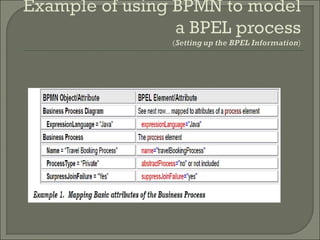
 Graphical representations of BP.
 Is supported with appropriate graphical
object properties that will enable the
generation of executable BPEL (Business
Process Execution Language).
 Creates a standardized bridge for the
gap between the business process
design and process implementation.
1. http://en.wikipedia.org/wiki/Business_
Process_Management
2. http://en.wikipedia.org/wiki/Business_
Process
3. http://en.wikipedia.org/wiki/BPEL
4. http://en.wikipedia.org/wiki/Business_Proc
5. http://www.omg.org/bpmn/Documents
/Mapping_BPMN_to_BPEL_Example.pd
f
Thanks for your attention

Bpm

  • 2.
     Management approachfocused on aligning all aspects of an organization with the wants and needs of clients.  It could be described as a "process optimization process„.  Enables organizations to be more efficient, effective and capable of change than a functionally focused, traditional hierarchical management approach.
  • 3.
     Is "acollection of related, structured activities that produce a service or product that meet the needs of a client„,  Is often used as synonymous of management of middleware processes; or integrating application software tasks,  Foundation is very similar to other Total Quality Management or Continuous Improvement Process methodologies or approaches.
  • 4.
    Business process managementactivities can be grouped into five categories:  Design  Modeling  Execution  Monitoring  Optimization
  • 5.
     Process Designencompasses both the identification of existing processes and the design of "to-be" processes.  The aim is to ensure that a correct and efficient theoretical design is prepared.  The proposed improvement could be in human-to-human, human-to-system, and system-to-system workflows, and might target regulatory, market, or competitive challenges faced by the businesses.
  • 6.
     Modeling takesthe theoretical design and introduces combinations of variables (e.g., changes in rent or materials costs, which determine how the process might operate under different circumstances).  It also involves running "what-if analysis" on the processes: "What if I have 75% of resources to do the same task?" "What if I want to do the same job for 80% of the current cost?".
  • 7.
     Process Automationis:  to develop/purchase an application that executes the required steps of the process,  to use a combination of software and human intervention - more complex => difficult documentation proces.  Developed software enables the full BP to be defined in a computer language directly executed by the computer.The system will use services in connected applications to perform business operations, or, when a step is too complex to automate, will ask for human input.  A business rule engine can be used to drive process execution and resolution
  • 8.
     Tracking ofindividual processes, so, that information on their state can be easily seen, and statistics on the performance of one or more processes can be provided.  The degree of monitoring depends on what information the business wants to evaluate and analyze and how business wants it to be monitored, in real-time, near real-time or ad- hoc.  Process mining is a collection of methods and tools related to process monitoring.The aim of this is to analyze event logs extracted through process monitoring and to compare them with an a priori process model. It allows to detect discrepancies between the actual process execution and the a priori model.
  • 9.
     Process optimizationincludes retrieving process performance information from modeling or monitoring phase; identifying the potential or actual bottlenecks and the potential opportunities for cost savings or other improvements; and then, applying those enhancements in the design of the process.
  • 11.
    Is define as: „The whole of BMP“, or  Information moving between enterprise software packages and immediateli think of Service Oriented Architecture(SOA).  Today encompasses the concept of supporting the managerial approach trhough enabling technology.  BMPS should facilitate business process change throughout the life cycle – this will assist in the automation of activities, collaboration, integration with others systems.
  • 12.
     Process engine– platform for modeling and executing process-based apllications (including business rules)  Business Analytics – identification business issues and reaction accordingly  Content Management – system for storing and securing electronic documents  Collaboration Tools – remove communication bariers, dynamic workspace
  • 13.
     Graphical representationsof BP.  Is supported with appropriate graphical object properties that will enable the generation of executable BPEL (Business Process Execution Language).  Creates a standardized bridge for the gap between the business process design and process implementation.
  • 15.
    1. http://en.wikipedia.org/wiki/Business_ Process_Management 2. http://en.wikipedia.org/wiki/Business_ Process 3.http://en.wikipedia.org/wiki/BPEL 4. http://en.wikipedia.org/wiki/Business_Proc 5. http://www.omg.org/bpmn/Documents /Mapping_BPMN_to_BPEL_Example.pd f
  • 16.
    Thanks for yourattention